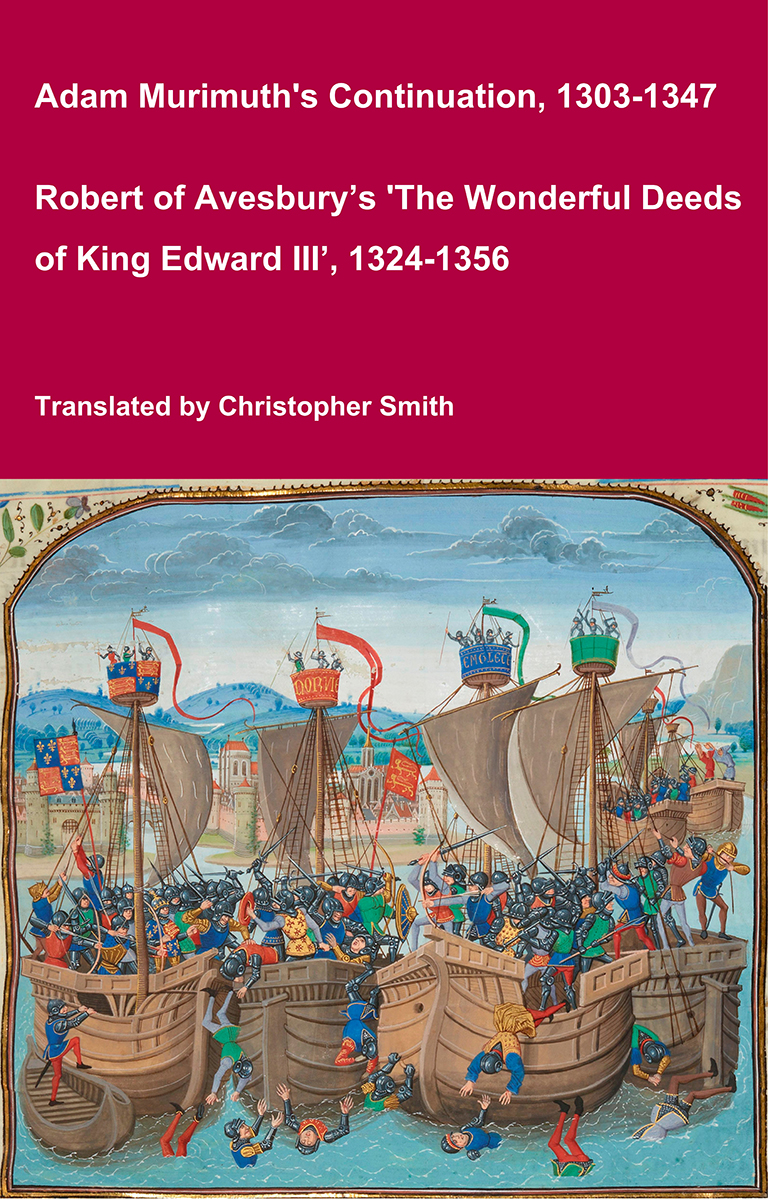
Adam Murimuth's Continuation and Robert of Avesbury’s 'The Wonderful Deeds of King Edward III'

This volume brings together two of the most important contemporary chronicles for the reign of Edward III and the opening phases of the Hundred Years’ War. Written in Latin by English clerical observers, these texts provide a vivid and authoritative window into the political, diplomatic, and military history of fourteenth-century England and its continental ambitions. Adam Murimuth Continuatio's Chronicarum continues an earlier chronicle into the mid-fourteenth century, offering concise but valuable notices on royal policy, foreign relations, and ecclesiastical affairs. Its annalistic structure makes it especially useful for establishing chronology and tracing the development of events year by year. Complementing it, Robert of Avesbury’s De gestis mirabilibus regis Edwardi tertii is a rich documentary chronicle preserving letters, treaties, and official records alongside narrative passages. It is an indispensable source for understanding Edward III’s claim to the French crown, the conduct of war, and the mechanisms of medieval diplomacy. Together, these works offer scholars, students, and enthusiasts a reliable and unembellished account of a transformative period in English and European history. Essential for anyone interested in medieval chronicles, the Hundred Years’ War, or the reign of Edward III.

Available at Amazon in eBook and Paperback format.

St Elvis Farm Burial Chamber, Pembrokeshire, Solva, South West Wales, British Isles [Map]

St Elvis Farm Burial Chamber, Pembrokeshire is in Solva, Pembrokeshire, Prehistoric Wales Neolithic Burials.

Archaeologia Cambrensis 1844 Pages 129-144. The cromlech at St. David's Head [St Elvis Farm Burial Chamber, Pembrokeshire [Map]] (see Arch. Camb., 1872, Plate, p. 141) having lost the supporting stone at one end, thus becomes what some consider a distinct class of cromlech, which they call "demi-cromlechs" or "dolmens". Earthfast is also another name for the same class; but these distinctions are already going out of fashion.

Archaeologia Cambrensis 1872 Pages 81-143. The last representation is the dolmen on St. David's Head [St Elvis Farm Burial Chamber, Pembrokeshire [Map]], close to the strongly fortified camp there. This is a fair example of what some would call a variety of the cromlech or dolmen as previously stated, but is simply a half-ruined chamber. One of the stones of the chamber is lying by its side; and around it is abundant evidence that it had at one time been buried under a carn of stones, and that most of the stones have been removed, although neither the land nor the stones are of any use. So that this single instance by itself is an answer to those who maintain that in certain cases denudation was impossible, because there was no motive for denuding; for what motive could have existed here, on a wild heath, far removed from population,—when thousands of cartloads of stone might be collected from the ruins of the encampment, and where the land is to this day of no value whatsoever?

1890. St Elvis Farm Burial Chamber, Pembrokeshire [Map]. They were blasted by the tenant farmer in 1890 who also removed the stones from the eastern chamber.

The burial chambers at St Elvis Farm consist of two purported capstones, 4.0m by 2.0m and 2.2m by 2.0m, set astride a fieldbank, each rest on the ground at one end and are supported by an errect stone at the other. Other stones may have been structural components. Early accounts refer to a cratered mound and describe the stones as 'a heap'.