Lake Group Barrows is in Stonehenge Barrows, Stonehenge Bronze Age Barrows.
Stonehenge by William Stukeley. Table XXXI. A Prospect of the barrows in Lake field called Eleven barrows & lately the prophets barrows. 2d. Sepr. 1723. A. Stonehenge. Barrow opened by L. Pembroke. SS. by Stukeley.
Colt Hoare 1812. No. 1 [Lake Group Barrow 1 [Map]] is a long barrow, situated at the south-west extremity of the group, and like many others of a similar form has not been opened, as they have in general proved so uniform in their modes of sepulture, and so very unproductive in articles of curiosity.
Wiltshire Archaeological Magazine 1913 V38 Pages 379-414. Wilsford. 41. [Lake Group Barrow 1 [Map]] S.W. of Stonehenge. No. 1 of Hoare's Lake Group. Length 169ft.; S.E. and N.W. No recorded opening. It is now in a plantation, but is otherwise in fair condition. O.M. 63 N W.; A. W. I. 209.
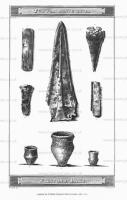
Colt Hoare 1812. The diminutive barrow, No. 2 [Lake Group Barrow 2 [Map]], produced, just under the surface, the very rude and perfect little cup engraved in Tumuli Plate XXX, No. 1, which is perforated at bottom like a cullender, and has holes on the sides for suspension. This article seems to corroborate the idea I started in my Introduction, that these small vases might, without any great impropriety, be called INCENSE CUPS, in which aromatic oils and perfumes, according to ancient usage, were burned and suspended over the funeral pile. This cup accompanied an interment of burned bones.
Colt Hoare 1812. No. 3 [Lake Group Barrow 3 [Map]] and No. 4 [Lake Group Barrow 4 [Map]] had been previously opened by other people.
Colt Hoare 1812. No. 5 [Lake Group Barrow 5 [Map]] was investigated by Mr. Cunnington, in 1805, who found in it an interment of burned bones, with 20 or 30 small black beads, which appear to have been composed of earth or wood, and to have passed the fire.
Colt Hoare 1812. No. 6 [Lake Group Barrow 6 [Map]] is one of the finest barrows in this group, and is 13 feet 9 inches in elevation. On making our section, the workmen had the good fortune to dig close to the side of a large sepulchral urn which stood within one foot of the surface, without injuring it. It was rudely formed and baked, measured 15 inches in height, and 13 in width and was placed with its mouth downwards over a large pile of burned bones, amongst which was a fine ivory bodkin, Plate XXX. No. 2. At a further depth of five feet were the remains of two skeletons; and at the bottom of the barrow, and total depth of 13 feet 9 inches, was an oblong cist, five feet deep, and seven feet long, cut in the chalk, containing the skeleton of a child, apparently not more than two or three years old, accompanied by a drinking cup.
The history of this tumulus, which our learned Doctor would, from its superior size and beautiful form, have styled a KING BARROW, shews what little regard we ought to pay to system; for here, at the vast depth of nearly 14 feet, we find only the deposit of an infant, accompanied by a simple drinking cup. Whilst in No, 21, a mean and insignificant barrow, we discover articles of the greatest beauty and importance. The motto of fronti nulla fides may be justly and strictly applied to barrows; and the antiquary who makes them his study must neither be disappointed in finding only a simple interment in the largest barrow, and the finest urns and most precious trinkets in the smallest. Curiosity, however, is equally kept on the alert; and it matters little whether we gain our information by the operations of the spade on a large or a diminutive tumulus.
Colt Hoare 1812. No. 7 [Lake Group Barrow 7 [Map]] is a large bell-shaped barrow, composed entirely of vegetable earth. It contained, within a cist, a little pile of burned bones, with which had been deposited a very fine brass pin, a large stone bead which had been stained red, a bead of ivory, and a lance-head of brass, Plate XXX. No. 3, 4.
The True Chronicles of Jean le Bel Volume 2 Chapters 61-109 1342-1361
The Chronicle of Jean le Bel, Volume 2 continues one of the most important fourteenth-century accounts of the early Hundred Years’ War. Written by the Liège chronicler Jean le Bel, this vivid narrative follows the fortunes of Edward III, Jean II of France, the Black Prince, the great nobles of France and England, and the soldiers, captains and companies who shaped the conflict. This volume covers some of the most dramatic events of the period, including the battles of Crécy and Poitiers, the siege and capture of Calais, the captivity of King John, the rise of the Jacquerie, the turmoil in Paris under Étienne Marcel and Charles of Navarre, the devastation caused by the free companies, Edward III’s great campaign of 1359–1360, and the negotiations leading to the Treaty of Brétigny. Jean le Bel’s chronicle is especially valuable for its lively detail, its interest in chivalry, warfare, politics and reputation, and its influence on later chroniclers, most famously Froissart. This English translation presents the text in clear, readable British English while preserving the force and character of the original narrative. The translation includes extensive notes to help the reader better understand Jean le Bel's text. Volume 2 also includes translated appendices drawn from royal and administrative records, many from the English Record Office, which illuminate Edward III’s campaigns in Brittany, the siege and occupation of Calais, naval preparations, military finance, appointments, safe conducts and related affairs.
Available at Amazon in eBook and Paperback format.
Colt Hoare 1812. No. 8 [Lake Group Barrow 8 [Map]] is a very wide and flat barrow, elevated about six feet from the ground, and supposed to be the one from which the French Prophets1, about the year 1710, delivered their doctrines, as its summit presents an even surface of 48 feet in diameter. To ensure success in a mound of such magnitude, we were obliged to make a very large section, in which, at the depth of two feet, we came to the top of a pile of marl, which encreased in size as we approached the floor. After considerable labour we found, on the north side of our section, the cist from whence this marl had been thrown out; it was eight feet and a half long, and above two feet wide, and contained a pile of burned human bones, which bad been enclosed within a box of wood. Near the bones lay a fine spear-head, [Plate XXVIII. No. 7.] and a whetstone. From the singular form and extraordinary size of this barrow, we expected to have made more important discoveries; and though most probably we found the primary deposit in the centre or place of honour, it is not at all unlikely that the sides of this large mound might produce other sepulchral deposits.
Note 1. Dr. Stukeley says, that the country people call this group the Prophet's barrows, because the French prophets, 30 years ago (A. D. 1710 set up a standard on the largest barrow, and preached to the enthusiastic multitude." Among the multitude of protestants who fled from France in consequence of the horrible persecutions which followed the revocation OF the Edict of Nantz, were same enthusiasts, who pretended to the gift of prophecy, and other spiritual gifts. These enthusiasts travelled over various parts of the kingdom preaching ta the people, and according to tradition, the summit of one of these barrows was chosen as a fit place for the prophet's oration.
Colt Hoare 1812. No. 9 [Lake Group Barrow 9 [Map]]. A fine bell-shaped barrow, ten feet in elevation, produced only a simple interment of burned bones on the floor.
Colt Hoare 1812. In No. 10 [Lake Group Barrow 10 [Map]] we made two trials, but without success, having found nothing but the skeleton of a dog, and the head of a deer.
Colt Hoare 1812. No. 11 [Lake Group Barrow 11 [Map]] and No. 12 [Lake Group Barrow 12 [Map]] are two fine Druid barrows, which, from the little trouble attending the opening of them, had excited the curiosity of former antiquaries.
Colt Hoare 1812. No. 13 [Lake Group Barrow 13 [Map]] produced a simple interment of burned bones.
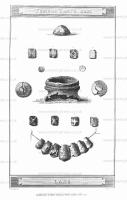
Colt Hoare 1812. No. 14 [In Lake Group Barrow 14 [Map]] and No. 15 [Lake Group Barrow 15 [Map]] we see a kind of double barrow, the smallest end of which had been opened before. The floor of the larger mound was strewed with an immense quantity of wood ashes, and in a small oblong cist we discovered an interment of burned bones, together with four glass pully-beads, one of stone1, two of amber, and a brass pin. This last tumulus is separated from the former group by a bank and ditch, which once formed an old enclosure, for from its situation, and slightness, I cannot consider it as an encampment.
Note 1. The bead of stone, and one of glass, are engraved in Plate XXX. No. 6, 7.
Colt Hoare 1812. No. 14 [In Lake Group Barrow 14 [Map]] and No. 15 [Lake Group Barrow 15 [Map]] we see a kind of double barrow, the smallest end of which had been opened before. The floor of the larger mound was strewed with an immense quantity of wood ashes, and in a small oblong cist we discovered an interment of burned bones, together with four glass pully-beads, one of stone1, two of amber, and a brass pin. This last tumulus is separated from the former group by a bank and ditch, which once formed an old enclosure, for from its situation, and slightness, I cannot consider it as an encampment.
Note 1. The bead of stone, and one of glass, are engraved in Plate XXX. No. 6, 7.
Colt Hoare 1812. A great similarity attended the three first of these tumuli, No. 16 [Lake Group Barrow 16 G47 [Map]], No. 17 [Lake Group Barrow 17 G48 [Map]], No. 18 [Lake Group Barrow 18 G50a [Map]], as they each contained an interment of burned bones, and each produced a small lance-head of brass;
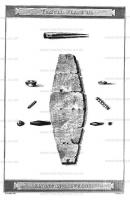
Colt Hoare 1812. but though No. 20 [Lake Group Barrow 19 G50 [Map]] [Note. This appears to be a mistake for 19?] had also a lance-head, the uniformity was most pleasantly broken by the discovery of four carious little articles of bone, which were intermixed with the ashes and burned bones. They are a perfect novelty, and had their meaning and use in British times; though in the more modern and enlightened period of the present day, we are at a loss to conjecture what that meaning and what that usage were. The obverse and reverse of each is faithfully delineated in Tumuli Plate XXXI by which you will perceive that the superficies is flat on one side, and convex on the other; they are made of bone, which appears to have been stained and polished by attrition; and each side is marked with a different pattern and device, except in one instance, where both sides are left blank. We might be led to suppose by this circumstance that the custom of casting lots existed amongst the Britons; and that these articles were appropriated to that purpose; or, perhaps, they might have been used like the ancient talus or tessera, for some kind of game. But in whatever light we view them, they must be considered as the greatest curiosities we have ever yet discovered; and as forming a slight progressive step towards language and civilization.1
Note 1. The custom of casting lots prevailed in the earliest times amongst the nations antiquity, and a late ingenious traveller, Mr. Barrow, informs us that it is still continued in China.
Colt Hoare 1812. No. 20 [Lake Group Barrow 20 G49 [Map]] [Note. This appears to continue the previous mistake and number 20 as 21?] is a wide and low tumulus, over which the plough has performed its agricultural rites for many years. The mode of interment was here varied, and the very rich and numerous trinkets discovered in this barrow, seem to announce the skeleton to have been that of some very distinguished British female. The most remarkable of these, and unique in size, though not in pattern, was an ornament of amber, similar to that before engraved in Tumuli Plate III. but far exceeding it in all its proportions, being ten inches in height and above three in breadth; it is formed of eight instead of six distinct tablets, and by being strung together, formed one ornament, as may be distinctly seen by the perforations at top and bottom. Besides the above were numerous beads of amber of much larger proportions than usual, and varying in their patterns, four articles of gold perforated, perhaps for ear-rings, and two small earthen cups, the one about seven or eight inches deep, the other little above an inch. The largest of the beads, the gold ornaments, and the fragment of the smallest cup are engraved of their full size in Tumuli Plate XXXI.

Colt Hoare 1812. No. 21 [Lake Group Barrow 21 G50c [Map]] had been opened before; but. amongst the earth and scattered bones, we found some fragments of a fine drinking cup, some chipped flints, and one perfect arrow-head of flint.2
Note 2. Engraved in Plate XXX, No. 5.
Colt Hoare 1812. No. 22 [Lake Group Barrow 22 G51 [Map]] had also been partially opened, for amongst the unburned bones which had been moved, we found the remains of two neatly ornamented drinking cups; and an digging towards the south-east, we discovered the skeleton of a child, and over it a drinking cup.3
Note 3. Engraved in Plate XXVIII, No. 8.
Colt Hoare 1812. No. 23 [Lake Group Barrow 23 G53 [Map]] contained a simple internent of burned bones within a cist made in the form of a cone;
Annals of the six Kings of England by Nicholas Trivet
Translation of the Annals of the Six Kings of England by that traces the rise and rule of the Angevin aka Plantagenet dynasty from the mid-12th to early 14th century. Written by the Dominican scholar Nicholas Trivet, the work offers a vivid account of English history from the reign of King Stephen through to the death of King Edward I, blending political narrative with moral reflection. Covering the reigns of six monarchs—from Stephen to Edward I—the chronicle explores royal authority, rebellion, war, and the shifting balance between crown, church, and nobility. Trivet provides detailed insight into defining moments such as baronial conflicts, Anglo-French rivalry, and the consolidation of royal power under Edward I, whose reign he describes with particular immediacy. The Annals combines careful year-by-year reporting with thoughtful interpretation, presenting history not merely as a sequence of events but as a moral and political lesson. Ideal for readers interested in medieval history, kingship, and the origins of the English state, this chronicle remains a valuable and accessible window into the turbulent world of the Plantagenet kings.
Available at Amazon in eBook and Paperback format.
Colt Hoare 1812. and No. 24 [Lake Group Barrow 24 G52 [Map]] produced a similar interment immediately under the turf with fragments of a drinking cup, Two feet lower down, we discovered another deposit of burned bones immediately over the head of a skeleton; and beneath this we found a second skeleton lying with its head towards the north-west, and several large pieces of stag's horns by its side.