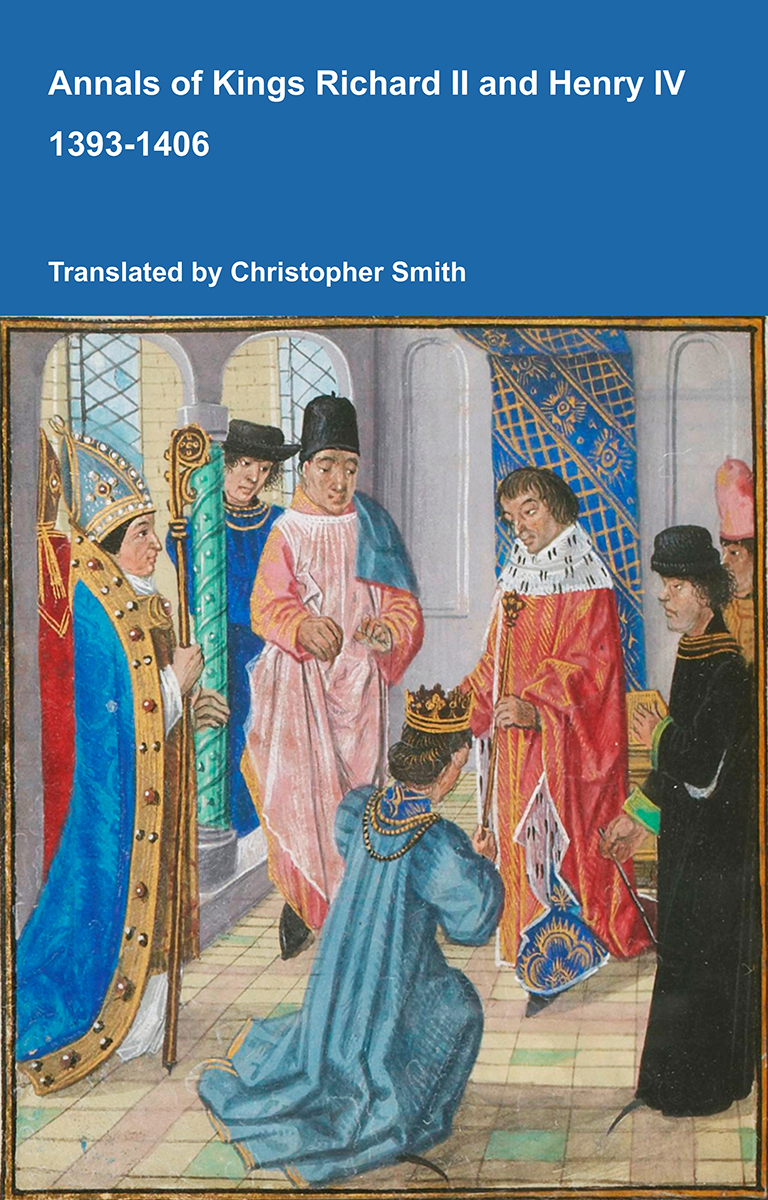
Annals of Kings Richard II and Henry IV 1393-1406

The Annals of Kings Richard II and Henry IV offers a vivid contemporary account of one of the most turbulent periods in late medieval England. Covering the reigns of Richard II and Henry IV, the chronicle records royal ceremonies, political conflict, rebellion, war, taxation, religious controversy, executions, popular unrest and remarkable portents. Its pages include a detailed description of Richard II’s coronation, the fall and deposition of the king, Henry IV’s seizure of the throne, the Percy rebellion, the execution of Archbishop Richard Scrope, the campaigns of Owain Glyndŵr, and England’s relations with Scotland, France, Portugal and Scandinavia. Alongside affairs of state, the annalist preserves reports of miracles, eclipses, prophecies, supernatural events and the experiences of ordinary townspeople, clergy, soldiers and travellers. Written from a monastic perspective, the work combines political observation with moral judgement, presenting victories and disasters as evidence of divine favour or punishment. At once a historical record and a reflection of medieval belief, the Annals provides an invaluable window into the challenges, ceremonies and conflicts of England at the turn of the fifteenth century.

Available at Amazon in eBook and Paperback format.

St Peter and St Paul Church, Belton Church of St Mary Magdalen, Castle Ashby Kensal Green Cemetery

Baron Pietro Carlo Marochetti 1805-1867

See Sculptors.

On 14th January 1805 Baron Pietro Carlo Marochetti was born.

After 15th September 1853. Monument to Richard Brownlow 2nd Baronet in St Peter and St Paul Church, Belton [Map] sculpted by Baron Pietro Carlo Marochetti [aged 48].

Richard Brownlow 2nd Baronet: Before 1643 he was born to William Brownlow 1st Baronet and Elizabeth Duncombe. Before 26th June 1659 he and Elizabeth Freke Lady Brownlow were married. In 1666 William Brownlow 1st Baronet died. His son Richard succeeded 2nd Baronet Brownlow of Humby in Lincolnshire. Elizabeth Freke Lady Brownlow by marriage Lady Brownlow of Humby in Lincolnshire.

Life of Isambard Kingdom Brunel Chapter 17. The funeral was on September 20 [1859], at the Kensal Green Cemetery [Map].

Along the road leading to the chapel many hundreds of his private and professional friends, his neighbours among the tradespeople of Westminster, the Council of the Institution of Civil Engineers, and the servants of the Great Western Railway Company, had assembled, and, with his family, followed his body to its place of burial, in the grave of his father and mother1.

Note 1. A few weeks after Mr, Brunel's death, a meeting of his friends was held, when it was determined to raise some memorial to him. A statue was made by the late Baron Marochetti [aged 54], and a site for it promised by the First Commissioner of Works; but it has not yet been erected.

Mr. Brunel's family, by the permission of the Dean of Westminster, have placed a memorial window in the north aisle of the nave of Westminster Abbey. Along the bottom of the window (which consists of two lights, each 23 feet 6 inches high and 4 feet wide, surmounted by a quatrefoil opening, 6 feet 6 inches across) is the Inscription, 'IN MEMORY OF ISAMBARD KINGDOM BRUNEL, CIVIL ENGINEER. BORN APRIL 9, 1806. DEPARTED THIS LIFE, SEPTEMBER 15, 1859.' Over this are four allegorical figures (two in each light): Fortitude, Justice, Faith, and Charity. The upper part of the window consists of six panels, divided by a pattern work of lilies and pomegranates. The panels contain subjects from the history of the Temple. The three subjects in the western light represent scenes from the Old Testament—viz. the Dedication of the Temple by Solomon, the Finding of the Book of the Law by Hilkiah, and the Laying the Foundations of the Second Temple. The subjects in the eastern light are from the New Testament—viz. Simeon Blessing the Infant Saviour, Christ Disputing with the Doctors, and The Disciples pointing out to Christ the Buildings of the Temple. In the heads of each light are angels kneeling, and in the quatrefoil is a representation of Our Lord in Glory, surrounded by angels.

The work was placed in the hands of Mr. R. Norman Shaw, architect, who prepared the general design, arranged the scale of the various figures, and designed the ornamental pattern work. The figure subjects were drawn by Mr. Henry Holiday, and the whole design was executed in glass by Messrs. Heaton, Butler, & Bayne.

Click to read more ...

On 29th December 1867 Baron Pietro Carlo Marochetti [aged 62] died.