Hamlet Act IV Scene 7 Part IV. [Enter Queen.]
How now, sweet queen?
Gertrude. One woe doth tread upon another's heel,
So fast they follow. Your sister's drown'd, Laertes.
Laertes. Drown'd! O, where?
Gertrude. There is a willow grows aslant a brook,
That shows his hoar leaves in the glassy stream.
There with fantastic garlands did she come
Of crowflowers, nettles, daisies, and long purples,
That liberal shepherds give a grosser name,
But our cold maids do dead men's fingers call them.
There on the pendant boughs her coronet weeds
Clamb'ring to hang, an envious sliver broke,
When down her weedy trophies and herself
Fell in the weeping brook. Her clothes spread wide
And, mermaid-like, awhile they bore her up;
Which time she chaunted snatches of old tunes,
As one incapable of her own distress,
Or like a creature native and indued
Unto that element; but long it could not be
Till that her garments, heavy with their drink,
Pull'd the poor wretch from her melodious lay
To muddy death.
Laertes. Alas, then she is drown'd?
Gertrude. Drown'd, drown'd.
Laertes. Too much of water hast thou, poor Ophelia,
And therefore I forbid my tears; but yet
It is our trick; nature her custom holds,
Let shame say what it will. When these are gone,
The woman will be out. Adieu, my lord.
I have a speech of fire, that fain would blaze
But that this folly douts it. Exit.
Claudius. Let's follow, Gertrude.
How much I had to do to calm his rage I
Now fear I this will give it start again;
Therefore let's follow.
Exeunt.
Samuel Pepys' Diary. 13th February 1661. At the office all the morning; dined at home, and poor Mr. Wood with me, who after dinner would have borrowed money of me, but I would lend none. Then to Whitehall by coach with Sir W. Pen [aged 39], where we did very little business, and so back to Mr. Rawlinson's [aged 47], where I took him and gave him a cup of wine, he having formerly known Mr. Rawlinson, and here I met my uncle Wight, and he drank with us, and with him to Sir W. Batten's [aged 60], whither I sent for my wife, and we chose Valentines against to-morrow1, my wife chose me, which did much please me; my Lady Batten Sir W. Pen, &c. Here we sat late, and so home to bed, having got my Lady Batten to give me a spoonful of honey for my cold.
Note 1. The observation of St. Valentine's day is very ancient in this country. Shakespeare makes Ophelia sing "To-morrow is Saint Valentine's day, All in the morning betime, And I a maid at your window To be your Valentine". Hamlet, act iv. sc. 5.-M. B.
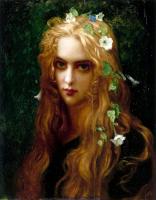
1850. Ernest Hébert [aged 32]. "Ophelia".
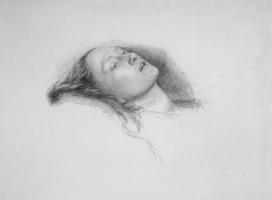
Around 1851. John Everett Millais 1st Baronet [aged 21]. Study for Ophelia. Model Elizabeth Siddal [aged 21].
1851 to 1852. John Everett Millais 1st Baronet [aged 21]. "Ophelia". Hamlet Act IV Scene 7 Part IV in which Queen Gertrude describes Ophelia's death to Laertes. Millais painted the scene near Tolworth, Surrey [Map] using the River Hogsmill. Elizabeth Siddal [aged 21] modelled in a bath-tub at 7 Gower Street, Camden [Map]. The initials PRB bottom right next to his signature. See Ophelia by John Everett MIllais.
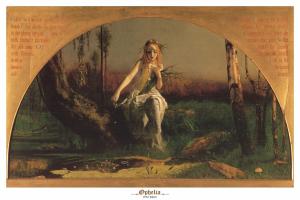
1852. Arthur Hughes [aged 19]. "Ophelia". The quote from Hamlet Act IV Scene 7 Part IV: "There is a willow grows aslant a brook, That shows his hoar leaves in the glassy stream. There with fantastic garlands did she come, Of crowflowers, nettles, daisies, and long purples, That liberal shepherds give a grosser name, But our cold maids do dead men's fingers call them. There on the pendant boughs her coronet weeds, Clamb'ring to hang, an envious sliver broke, When down her weedy trophies and herself, Fell in the weeping brook."
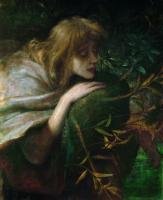
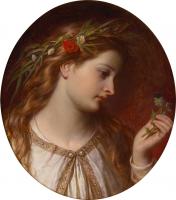
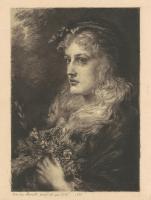
1863. George Frederick Watts [aged 45]. Portrait of Ophelia. Model Ellen Terry [aged 15]. Re-worked in 1877.
The painting itself presents the moment just before Ophelia meets her watery death in Hamlet, Act IV, scene vii, a moment which is reported but not enacted on stage:
There is a willow grows aslant a brook
That shows his hoar leaves in the glassy stream,
Therewith fantastic garlands did she come,
Of crowflowers, nettles, daisies, and long purples…
April 1864. Dante Gabriel Rossetti [aged 35]. "The First Madness of Ophelia".
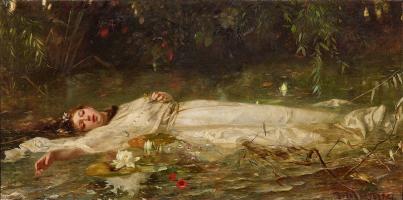
1865. Thomas Francis Dicksee [aged 45]. "Ophelia".
The Deeds of the Dukes of Normandy
The Gesta Normannorum Ducum [The Deeds of the Dukes of Normandy] is a landmark medieval chronicle tracing the rise and fall of the Norman dynasty from its early roots through the pivotal events surrounding the Norman Conquest of England. Originally penned in Latin by the monk William of Jumièges shortly before 1060 and later expanded at the behest of William the Conqueror, the work chronicles the deeds, politics, battles, and leadership of the Norman dukes, especially William’s own claim to the English throne. The narrative combines earlier historical sources with firsthand information and oral testimony to present an authoritative account of Normandy’s transformation from a Viking settlement into one of medieval Europe’s most powerful realms. William’s history emphasizes the legitimacy, military prowess, and governance of the Norman line, framing their expansion, including the conquest of England, as both divinely sanctioned and noble in purpose. Later chroniclers such as Orderic Vitalis and Robert of Torigni continued the history, extending the coverage into the 12th century, providing broader context on ducal rule and its impact. Today this classic work remains a foundational source for understanding Norman identity, medieval statesmanship, and the historical forces that reshaped England and Western Europe between 800AD and 1100AD.
Available at Amazon in eBook and Paperback format.
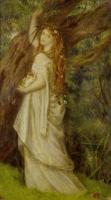
1865. Arthur Hughes [aged 32]. "Ophelia". It illustrates the scene in Shakespeare's 'Hamlet' (Act IV, scene 7) in which Ophelia picks flowers to make garlands shortly before she drowns.
1866. Dante Gabriel Rossetti [aged 37]. Watercolour "Hamlet and Ophelia".
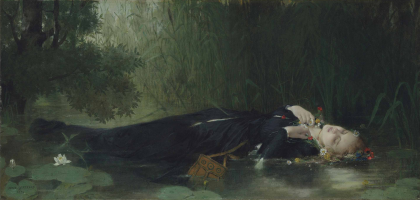
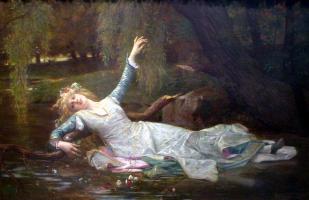
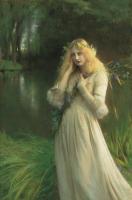
1872. Jean-Baptiste Bertrand [aged 48]. "Death of Ophelia".
1873. Thomas Francis Dicksee [aged 53]. "Ophelia".
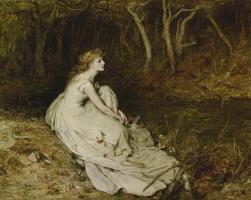
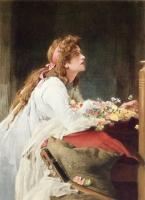
1874. William Quiller Orchardson [aged 41]. "Ophelia".
1876. Jean-Baptiste Bertrand [aged 52]. "Ophelia".
1876. Georges Clairin [aged 32]. Actress in the role of Ophelia.
1880. Anne Lea aka Merritt [aged 35]. "Ophelia".
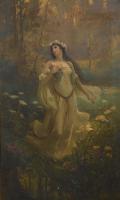
1883. Alexandre Cabanel [aged 59]. "Ophelia".
1888. Marcus Stone [aged 47]. "Ophelia".
Chronicle of a Bourgeois of Valenciennes
Récits d’un bourgeois de Valenciennes aka The Chronicle of a Bourgeois of Valenciennes is a vivid 14th-century vernacular chronicle written by an anonymous urban chronicler from Valenciennes in the County of Hainaut. It survives in a manuscript that describes local and regional history from about 1253 to 1366, blending chronology, narrative episodes, and eyewitness-style accounts of political, military, and social events in medieval France, Flanders, and the Low Countries. The work begins with a chronological framework of events affecting Valenciennes and its region under rulers such as King Philip VI of France and the shifting allegiances of local nobility. It includes accounts of conflicts, sieges, diplomatic manoeuvres, and the impact of broader struggles like the Hundred Years’ War on urban life in Hainaut. Written from the perspective of a burgher (bourgeois) rather than a monastery or royal court, the chronicle offers a rare lay viewpoint on high politics and warfare, reflecting how merchants, townspeople, and civic institutions experienced the turbulence of the 13th and 14th centuries. Its narrative style combines straightforward reporting of events with moral and civic observations, making it a valuable source for readers interested in medieval urban society, regional politics, and the lived experience of war and governance in pre-modern Europe.
Available at Amazon in eBook and Paperback format.
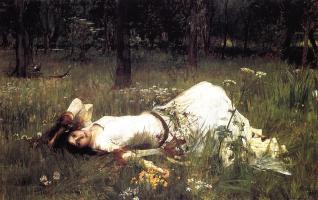
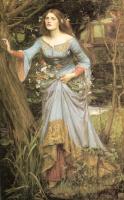
1889. John William Waterhouse [aged 39]. "Ophelia".
1890. Jules Joseph Lefebvre [aged 53]. "Ophelia".
1894. John William Waterhouse [aged 44]. "Ophelia".
1895. Paul Albert Steck [aged 28]. "Ophelia".
1896. Joseph Kirkpatrick [aged 24]. "Ophelia".
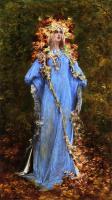
Around 1900. Friedrich Heyser [aged 42]. "Ophelia".
Around 1900. Pascal Dagnan-Bouveret [aged 47]. "Ophelia".
1900. Pascal Dagnan-Bouveret [aged 47]. "Ophelia".
1910. John William Waterhouse [aged 60]. "Ophelia".
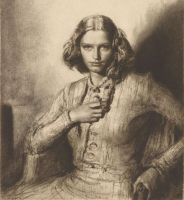
1942. Gerald Leslie Brockhurst [aged 51]. "Ophelia". Portrait of Kathleen Woodward [aged 29].