Cove
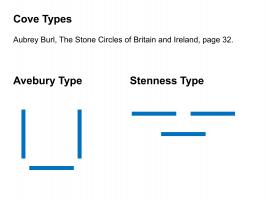
Cove describes a either a three-sided structure, the Avebury Type, formed from upright stones typically at the centre of a Stone Circles or the end of an Avenue, or the Stenness Type: three stones, inline, with the middle offset, as per the following diagram:
Avebury Type Cove
A Avebury Type Cove describes three stones set in a C shape.
Arbor Low Henge and Stone Circle [Map]. Aubrey Burl, in his book "A Guide to the Stone Circles of Britain, Ireland and Brittany", states "The three sided Cove is now prostrate, two huge sides tumbled outwards, a long low stone on edge like a sill or septal slab between them at the east and other little stones nearby. A skeleton of a man about 5ft 5ins tall was buried againbst the eastern corner. Immediately east was a deep pit with a human armbone in it. "It is possible", wtrote the excavator, "That a skeleton or skeltons may have been removed from here".
Stenness Type Cove
A Stenness Type Cove describes three stones, inline, with the centre stone offset, as per the diagram:
3100BC. The Stones of Stenness [Map] is a Henge and Stone Circles erected around 3100BC based on radio-carbon dating; it isn't clear who undertook the dating? Aubrey Burl, in his book "A Guide to the Stone Circles of Britain, Ireland and Brittany", states "The setting [Stenness Type Cove] had consisted of three erect stones, two in line side by side, N-S, separated by a narrow gap behind which the third stood like the backstone of a chamber. It is a form of Cove.