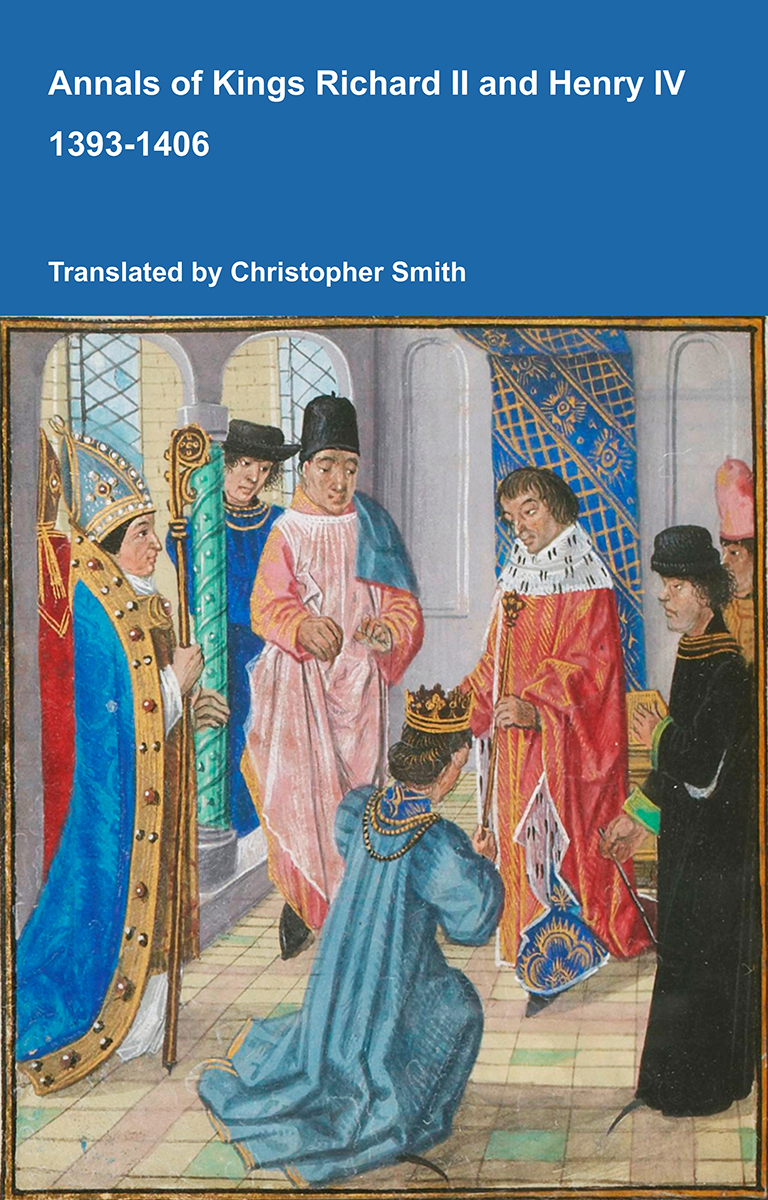
Annals of Kings Richard II and Henry IV 1393-1406

The Annals of Kings Richard II and Henry IV offers a vivid contemporary account of one of the most turbulent periods in late medieval England. Covering the reigns of Richard II and Henry IV, the chronicle records royal ceremonies, political conflict, rebellion, war, taxation, religious controversy, executions, popular unrest and remarkable portents. Its pages include a detailed description of Richard II’s coronation, the fall and deposition of the king, Henry IV’s seizure of the throne, the Percy rebellion, the execution of Archbishop Richard Scrope, the campaigns of Owain Glyndŵr, and England’s relations with Scotland, France, Portugal and Scandinavia. Alongside affairs of state, the annalist preserves reports of miracles, eclipses, prophecies, supernatural events and the experiences of ordinary townspeople, clergy, soldiers and travellers. Written from a monastic perspective, the work combines political observation with moral judgement, presenting victories and disasters as evidence of divine favour or punishment. At once a historical record and a reflection of medieval belief, the Annals provides an invaluable window into the challenges, ceremonies and conflicts of England at the turn of the fifteenth century.

Available at Amazon in eBook and Paperback format.

Carn Goch Long Barrow, Llangatock, Breconshire, Powys, Wales, British Isles [Map]

Long Barrows of the Cotswolds. Carn Goch Long Barrow [Map]

Brecknockshire, 41 N.E. Parish of Llangattock. 6a*.

Latitude 51° 57' 08" Longitude 3° 08' 38". Height above O.D., between 270 & 300 feet.

The following account presumably refers to the site marked "Garn Goch" on the O.S. map:-

Some workmen recently engaged in clearing away a large heap of stones in Llangattock Park, the seat of his Grace the Duke of Beaufort, accidentally met with a cist or cromlech, consisting of four rude stones put up in the ground on their edges, while a fifth covers the top. On its being opened, a quantity of human bones were discovered, some of which soon crumbled to dust; but the bone of the arm and also the upper part of the jaw, part of the skull, and a row of teeth, were quite perfect, all of which were carefully collected and preserved. The size of the interior was 8 feet 6 inches long, 4 feet wide, reduced to 3 feet 10 inches at the other end, and 2 feet 2 inches high."

When I first visited the neighbourhood I heard indirectly that the rnonument in question was supposed not to be an antiquity and did not visit it. On August 17th, 1924 I visited it in company with Dr. Mortimer Wheeler, Director of the National Museum of Wales, and we agreed that the cairn was a long one of the same type as the other Brecknockshire examples. On the south-eastern side are the remnants of a large capstone, but for the rest it is impossible to make out any plan or order. In the wood close by on the east are a number of cairns which may be of natural origin.

Gentleman's Magazine, 1847, Pt. 2, p. 526 (quoted above).

Click to read more ...