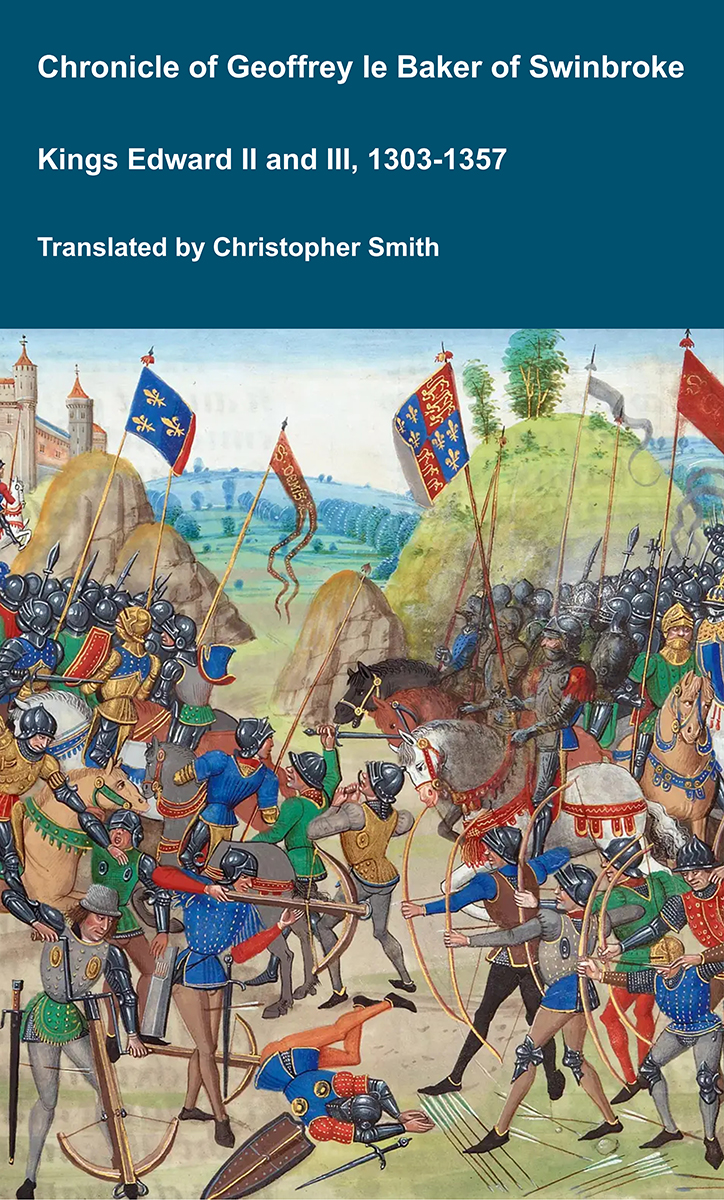
Chronicle of Geoffrey le Baker of Swinbroke
Baker was a secular clerk from Swinbroke, now Swinbrook, an Oxfordshire village two miles east of Burford. His Chronicle describes the events of the period 1303-1356: Gaveston, Bannockburn, Boroughbridge, the murder of King Edward II, the Scottish Wars, Sluys, Crécy, the Black Death, Winchelsea and Poitiers. To quote Herbert Bruce 'it possesses a vigorous and characteristic style, and its value for particular events between 1303 and 1356 has been recognised by its editor and by subsequent writers'. The book provides remarkable detail about the events it describes. Baker's text has been augmented with hundreds of notes, including extracts from other contemporary chronicles, such as the Annales Londonienses, Annales Paulini, Murimuth, Lanercost, Avesbury, Guisborough and Froissart to enrich the reader's understanding. The translation takes as its source the 'Chronicon Galfridi le Baker de Swynebroke' published in 1889, edited by Edward Maunde Thompson.
Available at Amazon in eBook and Paperback format.
Coleman Street is in Coleman Street Ward.
Henry Machyn's Diary. 20th July 1559. The sam day a mayd dwellyng in Colmanstrett dyd cutt her thrott a-pesse, and after she lepyd in-to a welle and drownyd yr seyllff.
Samuel Pepys' Diary. 6th February 1668. He gone, we sat at the office all the morning, and at noon home to dinner, and my wife being gone before, I to the Duke of York's playhouse; where a new play of Etherige's [aged 32], called "She Would if she Could"; and though I was there by two o'clock, there was 1000 people put back that could not have room in the pit: and I at last, because my wife was there, made shift to get into the 18d. box, and there saw; but, Lord! how full was the house, and how silly the play, there being nothing in the world good in it, and few people pleased in it. The King [aged 37] was there; but I sat mightily behind, and could see but little, and hear not all. The play being done, I into the pit to look (for) my wife, and it being dark and raining, I to look my wife out, but could not find her; and so staid going between the two doors and through the pit an hour and half, I think, after the play was done; the people staying there till the rain was over, and to talk with one another. And, among the rest, here was the Duke of Buckingham [aged 40] to-day openly sat in the pit; and there I found him with my Lord Buckhurst [aged 25], and Sidly [aged 28], and Etherige, the poet; the last of whom I did hear mightily find fault with the actors, that they were out of humour, and had not their parts perfect, and that Harris [aged 34] did do nothing, nor could so much as sing a ketch in it; and so was mightily concerned while all the rest did, through the whole pit, blame the play as a silly, dull thing, though there was something very roguish and witty; but the design of the play, and end, mighty insipid. At last I did find my wife staying for me in the entry; and with her was Betty Turner [aged 15], Mercer, and Deb. So I got a coach, and a humour took us, and I carried them to Hercules Pillars, and there did give them a kind of a supper of about 7s., and very merry, and home round the town, not through the ruines; and it was pretty how the coachman by mistake drives us into the ruines from London-wall into Coleman Street: and would persuade me that I lived there. And the truth is, I did think that he and the linkman had contrived some roguery; but it proved only a mistake of the coachman; but it was a cunning place to have done us a mischief in, as any I know, to drive us out of the road into the ruines, and there stop, while nobody could be called to help us. But we come safe home, and there, the girls being gone home, I to the office, where a while busy, my head not being wholly free of my trouble about my prize business, I home to bed. This evening coming home I did put my hand under the coats of Mercer and did touch her thigh, but then she did put by my hand and no hurt done, but talked and sang and was merry.
Samuel Pepys' Diary. 29th Feb 1660. To my office, and drank at Will's with Mr. Moore, who told me how my Lord is chosen General at Sea by the Council, and that it is thought that Monk will be joined with him therein. Home and dined, after dinner my wife and I by water to London, and thence to Herring's, the merchant in Coleman Street, about £50 which he promises I shall have on Saturday next. So to my mother's, and then to Mrs. Turner's, of whom I took leave, and her company, because she was to go out of town to-morrow with Mr. Pepys into Norfolk. Here my cosen Norton gave me a brave cup of metheglin [Note. A liquor made of honey and water, boiled and fermenting. By 12 Charles II, a grant of certain impositions upon beer, ale, and other liquors, a duty of 1d. per gallon was laid upon "all metheglin or mead".] the first I ever drank. To my mother's and supped there.
Life of Edward II of Caernarfon by a Monk of Bridlington. When the king heard of the queen's arrival, accompanied by Englishmen and foreigners, he was greatly disturbed, as were all his household with him. He sent Sir Walter de Stapeldon, Bishop of Exeter, to London, so that he might win over the Londoners and the community of the country to the lord king. The Londoners seized him in the cemetery of Saint Paul's, mistreated him, dragged him out, and beheaded him in the public street, while his followers were put to flight. They did not dare to concern themselves with his funeral rites, and he was buried in a place formerly occupied by the mendicant friars called the Friars of the Sack. Thus those wicked sons, by cutting off the consecrated head of a [....] bishop, most shamefully polluted a consecrated place and the royal city, the most renowned city of the kingdom.
Audiens igitur rex adventum reginæ, Anglicis et alienigenis stipatæ, turbatus est valde, et omnes familiares sui cum co, dominumque Walterum de Stapeltone, episcopum Exoniensem, Londonias misit ut Londonienses et communitatem patriæ domino regi attraheret. Quem Londonienses, in cimiterio Sancti Pauli apprehensum, male tractantes extraxerunt et in strata regia decollaverunt, suis in fugam conversis; qui circa suas exequias intromittere non audebant, sed in loco quondam per mendicantes fratres sacci vocatos inhabitato traditur sepulturæ: sic que filii scelerati, caput [....] consecratum pontificis amputantes, locum dedicatum et civitatem regiam regni famosissimam pessime polluerunt.
Henry Machyn's Diary. 23rd November 1560. The xxiij day of November was bered in s[aint Stephen's] in Colmanstrett ser John Jermy knyght of Suff[olke be]yonde Epwyche [Map] iiij mylles, the wyche was a goo[d man] of the age of iiijxx and ode [odd], the wyche he left iiij sunes [sons] and iij dowthers [daughters], and he had a standard and a pennon of armes, and cott armur, elmett, targett, and sword, and mantyll, and a iij dosen of skochyons and alff a dosen of bokeram; and the chyrche was hangyd with blake, and with armes; and ther was mony morners; and gohyng to the chyrche a mornar beyryng the standard in blake, and anodur a pennon of armes, and then serten mornars; then cam master Somersett the harold bere the elme [helmet] and crest, and after cam master Clarenshux [aged 50] beyryng ys cote armur and the clarke(s) syngyng; and (then) cam the corse with a palle of blake velvett with skochyons on yt, and (then) cam the cheyff morners, and after ys servandes in blake; and master Mollens the archdeacon dyd pryche; and after all done hom to a fleccher('s) howse to dener.
Note. P. 244. Funeral of sir John Jermy. Sir John Jermy was of Metfield and Brightwell in Suffolk, the latter of which is about five miles from Ipswich, and was therefore the residence to which our diarist alludes. He had been one of the knights of the Bath made at the coronation of quene Anne Boleyne.
Henry Machyn's Diary. 7th March 1561. The vij day of Marche was bered in sant Stephens Colmanstrett master Patensun bruar [brewer], and on [one] of the cu[ncil,] and a gentyllman, and with the clothyng of the bruars and of the clarkes, and he had (unfinished)
On 16th November 1575 Richard Blount aka Leigh [aged 25] died. He was buried at St Stephen's Church, Coleman Street on 21st November 1575.
On 17th July 1579 John Ayloffe [aged 46] died. He was buried at St Stephen's Church, Coleman Street.
On 29th December 1940 St Stephen's Church, Coleman Street was destroyed, along with all its fittings, by German bombing in the Blitz on 29 December 1940. The church was not rebuilt; instead its parish was combined with that of St Margaret Lothbury.
Annals Londonienses. In the same year, on the following Tuesday [1st June], Sir Roger Brabazon and Gilbert de Robury sat at the Guildhall in London to receive bills concerning the articles of Trailbaston. In the same year, on the feast of St John the Baptist [24th June], J., son of Andrew Horn1, was born and baptised. He lived for twelve weeks and lies at Colemanchurch beside Aldgate. Ralph Crepin, Manekin le Heanimer, Petrekin his brother, Thomas Attewelle, and several others were imprisoned and arrested upon various charges, and many others were indicted. In the same year, on the seventeenth day before the Kalends of July [15th June], Sir Walter Langton presented a very serious complaint to the lord king of England against Edward, Prince of Wales and son of the aforesaid king, concerning the breaking into his wood. On account of this, the king was angered against his son.
Eodem anno, die Martis proxima, domini Rogerus de Brabazon et Gilbertus de Robury sedebant apud Gildhaldam Londonias ad recipiendas billas super articulis de trailbastone. Eodem anno, die Sancti Johannis Baptistæ, J., filius Andreæ Horn, natus fuit, eb baptizatus, et vixit per xii. septimanas, et jacet apud Coleman-church juxta Alegate. Radulfus Crepyn, Manekynus le Heanimer, Petrekynus frater ejus, Thomas Attewelle et plures alii fuerunt incarcerati et arestati super diversis actionibus; et plures alii fuerunt indictati. Eodem anno, xviio kalendas Julii, dominus Walterus de Langetone querelam gravissimam domino regi Angliæ contra Edwardum principem Walliæ et filium prædicti regis monstravit, super fractione bosci sui; unde rex commotus fuit erga filium suum.
Note 1. Andrew Horn, fishmonger, chamberlain of the city of London, possibly the compiler of this book. He died in October 1328.