Rose-Marie Ormond 1893-1917

In 1891 [her father] Louis Francis Ormond [aged 24] and [her mother] Violet Sargent [aged 20] were married.

On 5th November 1893 Rose-Marie Ormond was born to Louis Francis Ormond [aged 27] and Violet Sargent [aged 23] in Tunis [Map], Tunisia.

1908. [her uncle] John Singer Sargent [aged 51]. "The Black Brook". Portrait of Rose-Marie Ormond [aged 14].

1911. [her uncle] John Singer Sargent [aged 54]. "Nonchaloir", or "Repose". Portrait of Rose-Marie Ormond [aged 17].

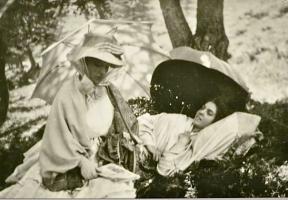
1911. [her uncle] John Singer Sargent [aged 54]. "Simplon Pass: Reading". Portrait of Rose-Marie Ormond [aged 17].

1911. Dorothy Barnard and Rose-Marie [aged 17] (at right) pose for Simplon Pass

1912. [her uncle] John Singer Sargent [aged 55]. Portrait of Rose-Marie Ormond [aged 18].

In August 1913 Robert André-Michel [aged 28] and Rose-Marie Ormond [aged 19] were married. He was killed fifteen months later.

On 13th October 1914 [her husband] Robert André-Michel [aged 30] was killed in action at Soissons, shot in the heart in an intense firefight as he was leading a group of reinforcements over open ground toward the front line.

The True Chronicles of Jean le Bel Volume 1 Chapters 1-60 1307-1342

The True Chronicles of Jean le Bel offer one of the most vivid and immediate accounts of 14th-century Europe, written by a knight who lived through the events he describes, and experienced some of them first hand. Covering the early decades of the Hundred Years’ War, this remarkable chronicle follows the campaigns of Edward III of England, the politics of France and the Low Countries, and the shifting alliances that shaped medieval warfare. Unlike later historians, Jean le Bel writes with a strong sense of eyewitness authenticity, drawing on personal experience and the testimony of fellow soldiers. His narrative captures not only battles and sieges, but also the realities of military life, diplomacy, and the ideals of chivalry that governed noble society. A key source for Jean Froissart, Le Bel’s chronicle stands on its own as a compelling and insightful work, at once historical record and literary achievement. This translation builds on the 1905 edition published in French by Jules Viard, adding extensive translations from other sources Rymer's Fœdera, the Chronicles of Adam Murimuth, William Nangis, Walter of Guisborough, a Bourgeois of Valenciennes, Geoffrey le Baker of Swinbroke and Richard Lescot to enrich the original text and Viard's notes.

Available at Amazon in eBook and Paperback format.

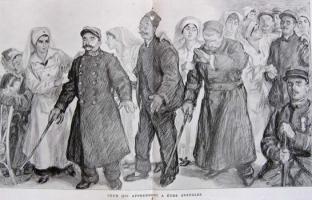
In 1915 Rose-Marie Ormond [aged 21] joined the nursing staff at the newly-established rehabilitation hospital at Reuilly, dedicated to treating soldiers who had been blinded by armaments or mustard gas.

Drawing by Paul Renouard, Those Who Are Learning to be Blind (1915). Rose-Marie is third nurse from left.

On 29th March 1917 a shell from the new "Paris Gun", a gun with a a 30m barrrel, designed specifically to shell Paris, hit "like a tremendous thunderclap high up on the Church of St Gervais, just before the Good Friday concert was about to start. Ninety-one people, mainly women, were killed, and sixty-eight wounded. The US Ambassador reported that "the destruction wrought by this shell was probably not equalled by any single discharge of any hostile gun in the cruelty and horrors of its results". Many of the dead were unrecognisable. Some had to be identified by engravings in their wedding rings. Among them was Rose-Marie Ormond [aged 23]. She was just 24.

Ancestors of Rose-Marie Ormond 1893-1917

Father: Louis Francis Ormond

Rose-Marie Ormond

Great x 4 Grandfather: Epes Sargent

Great x 3 Grandfather: Winthrop Sargent

Great x 2 Grandfather: Fitzwilliam Sargent

Great x 1 Grandfather: Winthrop Sargent

Grandfather: Fitzwilliam Sargent

Mother: Violet Sargent

Grandmother: Mary Newbold Singer