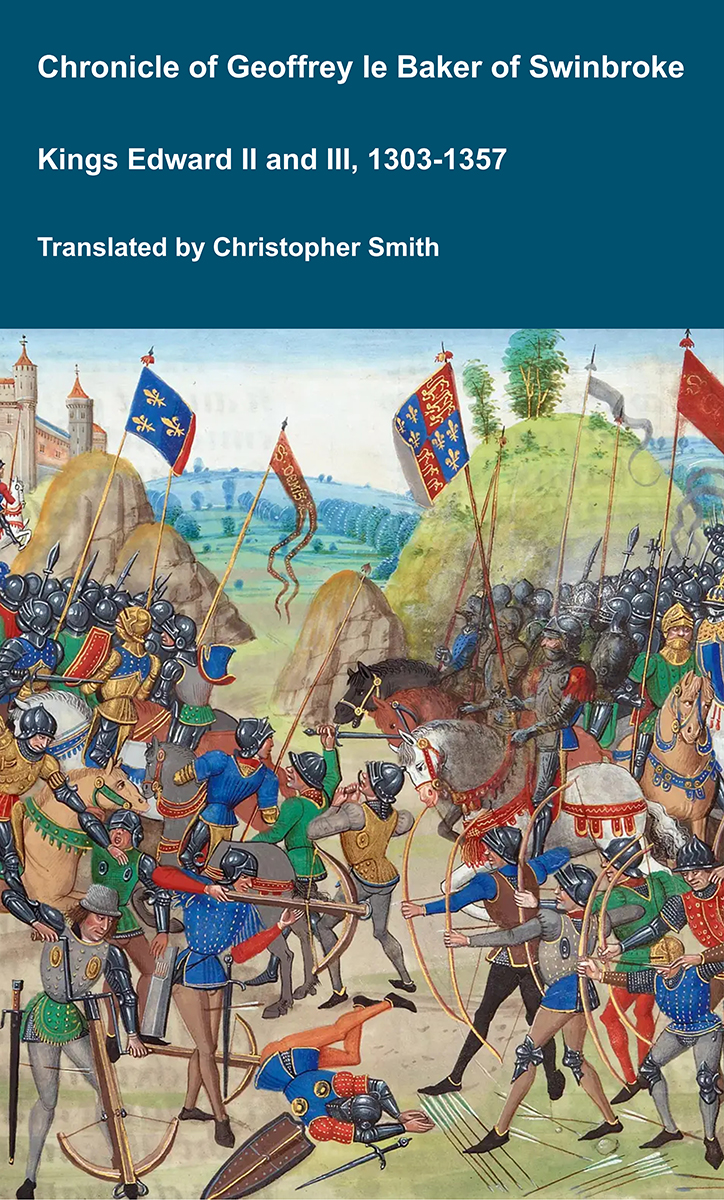
Chronicle of Geoffrey le Baker of Swinbroke
Baker was a secular clerk from Swinbroke, now Swinbrook, an Oxfordshire village two miles east of Burford. His Chronicle describes the events of the period 1303-1356: Gaveston, Bannockburn, Boroughbridge, the murder of King Edward II, the Scottish Wars, Sluys, Crécy, the Black Death, Winchelsea and Poitiers. To quote Herbert Bruce 'it possesses a vigorous and characteristic style, and its value for particular events between 1303 and 1356 has been recognised by its editor and by subsequent writers'. The book provides remarkable detail about the events it describes. Baker's text has been augmented with hundreds of notes, including extracts from other contemporary chronicles, such as the Annales Londonienses, Annales Paulini, Murimuth, Lanercost, Avesbury, Guisborough and Froissart to enrich the reader's understanding. The translation takes as its source the 'Chronicon Galfridi le Baker de Swynebroke' published in 1889, edited by Edward Maunde Thompson.
Available at Amazon in eBook and Paperback format.
Strype Ecclesiastical Memorials is in Georgian Books.
The authors he is beholden to for assisting him with the materials of his history, are four especially: the first is, Patten's Account of the Expedition into Scotland, by the Duke of Somerset, in the first year of the king (which author is transcribed into Hollingshed, whence, I suppose, he had it), and that is the reason he is so large and particular in that affair: but that author assists him no farther than where that expedition ended. His second assistant is HoUingshed's History, which he often transcribes, and sometimes mends the speeches which he meets with there, by his own fancy and additions. His third author is King Edward himself, in his excellent Journal, which, it seems, he had the perusal of by the favour of Sir Robert Cotton; and so he acknowledges: but this Journal containing but short and imperfect notices of things that fell out, our author hath taken too much liberty sometimes, to fill up and add unto them by his own mere conjectures, confidently related as matters of truth, which yet sometimes prove mistakes; and where the Journal is at an end (for it concludes in November, 1552) his history is well near ended too, though there were eight months between that and the king's death. The fourth author he makes use of, is Nicolas Sanders, "De Schism. Anglicano;" a most profligate fellow, a very slave to the Roman see, and a sworn enemy to his own country, caring not what he writ, if it might but throw reproach and dirt enough upon the reforming kings and princes, the reformers and the reformation. From this man he ventures to take some things that he sets down in his book, scurrilous and false: but as for records, registers, manuscript letters, to improve or justify his history, and to present his readers with some new things, and unknown before, he offers nothing else.