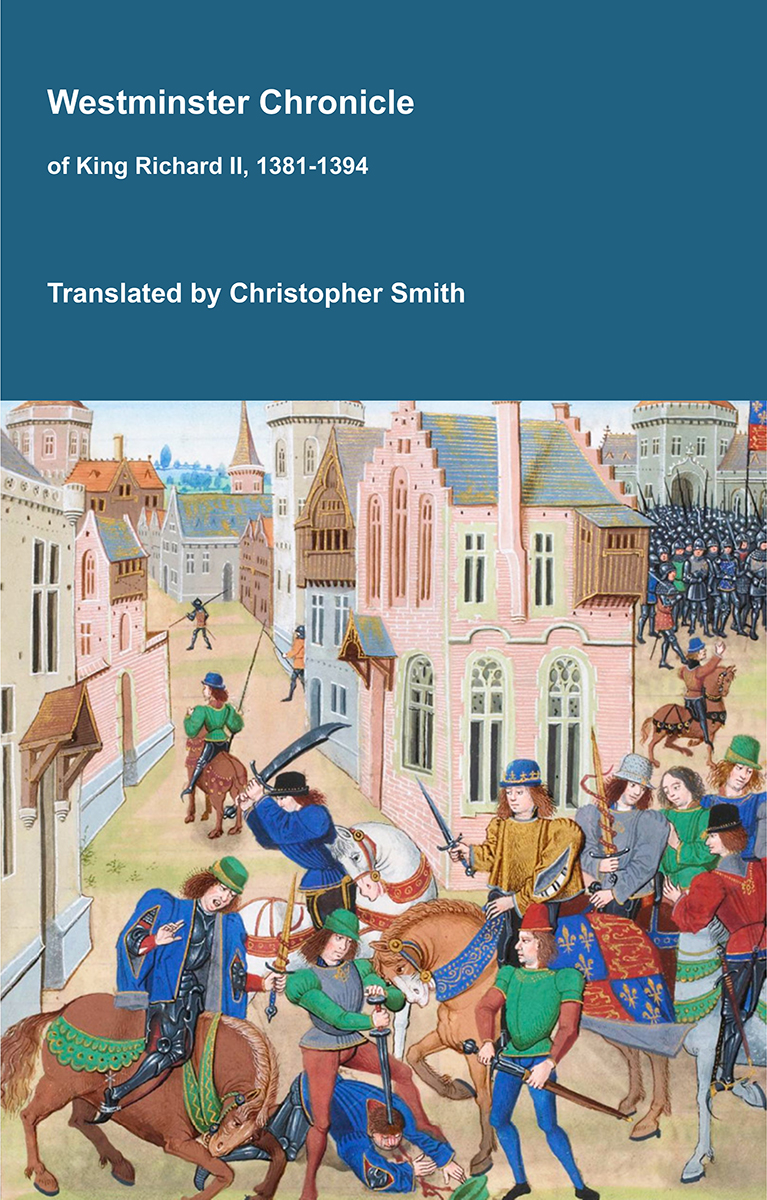
Westminster Chronicle of King Richard II, 1381-1394
The Westminster Chronicle is one of the most vivid and important narrative sources for the reign of Richard II. Written by an anonymous chronicler closely connected with Westminster Abbey, it covers the years 1381 to 1394, from the Peasants’ Revolt to the political tensions, court ceremonies, diplomatic negotiations, royal progresses, and public crises of Richard’s later reign. Rich in detail the chronicle records major events such as the conflicts between the King and Lords Appellant, King and the City of London, negotiations with France and Scotland, the death and funeral of Queen Anne of Bohemia, the illness of Charles VI of France, and the changing fortunes of leading nobles including John of Gaunt, Thomas of Gloucester, Robert de Vere, and the Earl of Arundel. The Chronicle offers readers a remarkable window into late fourteenth-century England, combining political observation, courtly spectacle, urban drama, ecclesiastical affairs, and moral judgement. It is an essential source for anyone interested in medieval monarchy, London, Westminster, and the troubled reign of Richard II.
Available at Amazon in eBook and Paperback format.
Effigy of John de la Pole, Duke of Suffolk, and his Duchess Elizabeth is in Monumental Effigies of Great Britain.
JOHN was the son and heir of that unpopular minister, William de la Pole, Duke of Suffolk, who being banished for his political delinquencies, was put to death on the 2d May, 1450, at sea, off Dover, by the master of a Bristol shipa. His mother was Alice, daughter of Sir Thomas Chaucer, son of the poet of that name, the force of whose extraordinary genius has secured immortality for his works in spite of their obsolete language. He married Elizabeth, second daughter of Richard Duke of York, by whom he had five sons and four daughters; on account of which alliance his brother-in-law King Edward, in 1469, restored to him the dignity forfeited by his father's attainder. He was made Constable of Wallingford Castle, in the first year of the reign of Henry the Seventh, died in 1491, and was interred with his ancestors in the collegiate church at Wingfield [Map], in Suffolk. Elizabeth, his Duchess, was buried at the same place, and both are commemorated by the splendid effigies before us.
Details. Plate. I. Profile view of the head of the Duchess.
Plate II. 1. Portion of the Duke's coronet. 2. One of the metallic loops attaching the cordon of the mantle of the Garter to either shoulder. 3. Skirts of the corslet, hilt and guard of the sword, mountings of the scabbard, &c. 4. Portion of the Garter on the left knee, enlarged. 5. One of the straps attaching the tassets, 6. Hilt of the dagger, or misericorde, with lace attaching it to the hip. 7. The sword-belt. 8. Portion of the Duchess's coronet, enlarged. 9. Part of the metallic loop of the cordon of her mantle. 10. Pattern on the Ranches of her habit.
Plate III. 1. Profile view of the left genouiliiere, with the Garter. 2. Portion of the soles of the solerette, resting on the lion's mane.
Note a. Whatever the Duke's political offences, there is extant an admirable letter of advice from him to his son, John, written just before the Duke's departure on this fatal voyage. See the Paston Letters, vol. 1. p. 32; where also will be found, page 39, another curious letter, giving a circumstantial account of his death.
