Poleyn is in Armour.
Poleyn. Also known as genouillere. The part of plate armour that covers the knee.
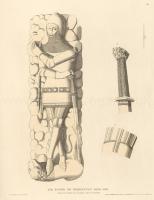
Effigy of Sir Guy Bryan. Although this subject suffers considerably in its appearance, from the mutilations it has undergone, yet, from the richness and peculiarities of the armour, it is a valuable specimen. It is executed in stone, and has been painted, gilt, and silvered, though there is but little of this now remaining. Sir Guy Bryan appears to have been represented in the act of drawing his sword, an action not common on monuments at so late a period: on his head is the basinet, the camail attached to it by a red lace; the surcoat is charged with the arms of Bryan, or, three piles meeting in base azure, the field is diapered with a white raised composition; the piles are painted with ultramarine, and have been beautifully diapered with white, the only remains of which are to be traced under the right arm. The arms are covered by the mail sleeves of the haubergeon, the lower part only from the elbow defended with plate: on the upper, upon the mail, are singular appearances—a number of iron pegs placed in regular order, enclosing a space, in form and extent the same on both arms; for what purpose they were placed there, it is not easy to conjecture. The sword and dagger are broken away, as are also the gauntlets. The mail chausses covering the legs seldom appear after plate-armour had been so long introduced, and they have here singular additions, being strengthened with narrow plates above and below the genouillieres, each plate having, distributed equidistant along its sides, six pegs of wood, the purpose of these, or why they were of an extraneous substance, is as unaccountable as what we find on the arms. The whole of the armour, plate and mail, has been once covered with silver leaf. The mailles of the camail, haubergeon, and chausses, are of different sizes, and formed with a white impressed composition, as on the surcoat. The crest upon the helmet under the head is too much mutilated to determine what it is, but most resembles a griffin's head. We should have expected a bugle-horn for the crest. Sir William Bryan, son of Sir Guy, bearing this on his brass in Seale Church, Kent. The architectural part of the monument is extremely light and elegant, and it has on that account severely suffered; for many of the shafts, which supported this delicate fabric, are lost, and a great number of those that remain are out of their perpendiculars in all directions. As far as there were authorities remaining, a restoration has been made in the etching, which represents the monument nearly in its original state. The arms on the base are in the centre, and on each side. The wife of Sir Guy Bryan, being Elizabeth, daughter of William de Montacute, Earl of Salisbury.
Details.—Plate 2. Fig. 1, 2, 3, mailles of the camail, haubergeon, and chausses, the same size as the originals. 4. Raised diapering on the surcoat. 5. Part of the girdle.


On 30th May 1499 John Cheney 1st Baron Cheyne [aged 57] died. Baron Cheyne extinct. Fluted Period. Alabaster Monument at Salisbury Cathedral [Map].
Fluted armour typified by having no headwear, being clean shaven, a breastplate in two pieces and the neck protected by a Standard. Damaged angel, its head removed, holding the cushion on which his head rests. He wearing a Lancastrian Esses Collar with large Esses. Ringed fingers.


Detail of the heavily graffitied Shoulder Garter.

Detail of the heavily graffitied Leg Garter and Poleyn.

Mutilated Lion at his feet with its head missing. The figure beneath his right foot appears to be a Bedesman. That beneath his left foot may be the remains of the means by which a bedesman was originally fixed to the foot. What appears to be a birds foot lying across the lions body is the tail of the lion.
After 14th April 1587. Elizabethan Period monument to Edward Manners 3rd Earl of Rutland [deceased] and Isabel Holcroft Countess Rutland [aged 37] sculpted by Gerard Johnson The Elder [aged 37] in the Chancel of St Mary the Virgin Church, Bottesford, Leicestershire [Map].
Isabel Holcroft Countess Rutland: In 1550 she was born to Thomas Holcroft. On 6th June 1573 Edward Manners 3rd Earl of Rutland and she were married. She by marriage Countess of Rutland, Baroness Ros Helmsley. He the son of Henry Manners 2nd Earl of Rutland and Margaret Neville Countess Rutland. Around 16th January 1606 she died.


Detail of the sculpture of their only child Elizabeth Manners 15th Baroness Ros of Helmsley [aged 12].

His feet resting on a Bulls Head with a chained coronet around its neck - a change from the Unicorn seen on earlier Manners effigies.


Detail of her Ermine lined mantle and hands clasped in prayer.

Her arms quarterd 1&4 Holcroft 2 Unknown? A squirrel, possibly fox, eating what may be a nut. 3 A black bird and an infant wrapped in swaddling clothes.

Effigy of Sir Edmund de Thorpe and Lady. THESE effigies are in Ashwell Thorp church, Norfolk [Map]. We have in the ancestry of Sir Edmund de Thorpe a striking instance of the mutability of surnames in some families until the thirteenth century. William de Norwich lived about the time of the Conquest, and possessed the manor of Thorpe. From him came Roger, whose son Robert was distinguished by the surname of Fitz-Roger; Fitz-Roger's child Hugh, from some local circumstance, took the surname of de Messingham; and his child John assumed the cognomen of Fitz-Robert, in allusion to his grandfather. In the time of Henry the Third, we hnd the heir of John entitled Robert Fitz-John de Thorpe; and in Edmund, his heir, the surname became hxed and inheritable. Sir Edmund, his son by his wife Joan, daughter of Robert Baynard, is represented by the male effigy- Joan, widow of Lord Scales, his second wife, is the subject of the female figure. In 1417 Sir Edmund de Thorpe was associated with John Nevill and John Kempe, LL.D. (afterwards the Cardinal Archbishop, son of Sir Thomas Kempe, of Wye,) to compose all differences between Henry the Fifth and the Duke of Burgundy. He is considered to be the per- son designated by the Chronicles as Lord Thorpe, who in 1418 was killed at the siege of the Castle of Louviers, in Normandy. He was buried in the church of Ashwell Thorp, in the new aisle erected at his expense. The figures of Sir Edmund de Thorpe and his Lady are of alabaster, and are described by Bloomfield in his time as lying under a canopy of wood. The costume of the figures is elegantly and elaborately detailed. The lady lies at the right side of her lord; her hair is confined by a rich fret; the cordon of her mantle is attached by two clasps, apparently formed as eagles with expanded wings. The same ornament appears near the gusset of the armour on the knight's left shoulder. The front of his basinet is engraved with elegant tracery of foliage; and he wears a splendid wreath, studded, we may suppose, with pearls, and enamelled with leaves of laurel. The surcoat bears, quarterly, the arms of Thorpe and Baynard; the three crescents Argent in the Azure held, in the dexter quarter, being for Thorpe. At the lady's feet are two little dogs with collars and bells; at the knight's a greyhound. The joints of the brassarts, cuisses, genouillieres, and greaves of his armour, are ornamentally engraven. Under his head is a beautiful specimen of the helmet of his time: it is covered with a scallopped mantelet, or lambrequin, surmounted by a rich coronet, and has a panache of peacock's feathers. Details. P!ate 11. Upper part of the lady's coiffure. Profile of her head. Portion of the fret. Profile of the knight's head and shoulders. The figure as originally painted and gilt. The helmet. Portion of the basinet and wreath. Portion of the mailles enlarged. The collar of SS enlarged.


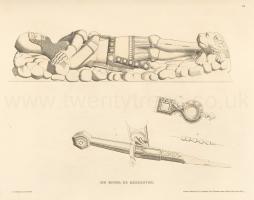
Effigy of John de la Pole, Duke of Suffolk, and his Duchess Elizabeth. JOHN was the son and heir of that unpopular minister, William de la Pole, Duke of Suffolk, who being banished for his political delinquencies, was put to death on the 2d May, 1450, at sea, off Dover, by the master of a Bristol shipa. His mother was Alice, daughter of Sir Thomas Chaucer, son of the poet of that name, the force of whose extraordinary genius has secured immortality for his works in spite of their obsolete language. He married Elizabeth, second daughter of Richard Duke of York, by whom he had five sons and four daughters; on account of which alliance his brother-in-law King Edward, in 1469, restored to him the dignity forfeited by his father's attainder. He was made Constable of Wallingford Castle, in the first year of the reign of Henry the Seventh, died in 1491, and was interred with his ancestors in the collegiate church at Wingfield [Map], in Suffolk. Elizabeth, his Duchess, was buried at the same place, and both are commemorated by the splendid effigies before us.
Details. Plate. I. Profile view of the head of the Duchess.
Plate II. 1. Portion of the Duke's coronet. 2. One of the metallic loops attaching the cordon of the mantle of the Garter to either shoulder. 3. Skirts of the corslet, hilt and guard of the sword, mountings of the scabbard, &c. 4. Portion of the Garter on the left knee, enlarged. 5. One of the straps attaching the tassets, 6. Hilt of the dagger, or misericorde, with lace attaching it to the hip. 7. The sword-belt. 8. Portion of the Duchess's coronet, enlarged. 9. Part of the metallic loop of the cordon of her mantle. 10. Pattern on the Ranches of her habit.
Plate III. 1. Profile view of the left genouiliiere, with the Garter. 2. Portion of the soles of the solerette, resting on the lion's mane.
Note a. Whatever the Duke's political offences, there is extant an admirable letter of advice from him to his son, John, written just before the Duke's departure on this fatal voyage. See the Paston Letters, vol. 1. p. 32; where also will be found, page 39, another curious letter, giving a circumstantial account of his death.


Effigy in Ash Church, Kent. St Nicholas Church, Ash.
ON the authority of Harris, this effigy may he assigned to Sir John Laverick. Weever, speaking of Ash, says, "in this church are many ancient monuments of worthy gentlemen, namely, Sir Goshalls and Sir Levericks, who lie crosse-legged as Knights of Jerusalema." There are many interesting points about the armour of this figure. The basinet and genouillieres are elegantly adorned with studs and leaves. The wrists of the gauntlets are composed of small laminae or splinters of plate.
Details. Plate I. 1. Ornament on the front of the basinet. 2. Buckle of the sword-belt. 3. Ornament on the bottom of the genouilliere. Plate II. Profile. 1. Lace of the camail, passing through scallops of plate, forming the lower part of the basinet. 2. Gauntlets. 3. Part of the solerette and jambe (near the ancle); portion of the spur, with straps. * Fun. Monuments, p.265.
Note a. Fun. Monuments, p.265.


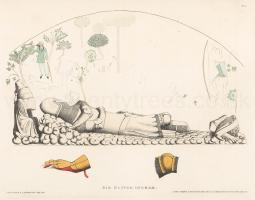
Effigy of Sir Oliver de Ightham. Some points of this description agree very well with the effigy as represented in the plates; while others supply us with particulars which the injuries of time would have otherwise eRaced. The crest on the helmet is broken off; so is the right leg: there is no garter on the left. Weevet mistook the fillet of the genouilliere for a garter. Sir Oliver was not a knight of that order. In the painting which remains on the back ground of the figure, we do not observe the planets as mentioned by Weever. A forest is represented, in which wild animals and beasts of prey are roaming at large; in one corner an archer clothed in
"Cote and hood of green,"
winds his bugle; in the other his companion is seen bending his bow. This would seem to indicate the extensive forests of the duchy of Aquitaine, over which Ingham was Seneschal, or his addiction to the chase. He reposes on the rock, or rather a bed of pebbles, mentioned by Weever, not improbably indicative of his martial hardihooda; an idea that has not escaped Shakspeare:
--- "The tyrant custom
Has made the flinty and steel couch of war
My thrice-driven bed of down."
Details. Plate 1. Helmet with the mantelet. Portion of the mantelet enlarged. Figure as originally painted. The surcoat bears. Party per pale Or and Vert, a cross moline Gules. Belt and clasp. Scabbard, mountings with portions of the belt attached. Plate II. Painting at the back of the tomb; genouillieres or knee-pieces; cuisses with studs; some links of the lower part of the hauberk.
Note a. Another conjecture is that when an effigy is thus placed, it represents the knight as shipwrecked, and thrown upon "the beached verge of the salt flood." We believe that examples of figures of this kind are rare; in this work only one other occurs, that of Sir Roger de Kerdeston. If the purpose of the sculptor had been to represent Ingham as shipwrecked we should have expected a back ground of marine objects. Those painted on the tomb before us are, on the contrary, altogether terrene. The attitudes of Ingham and Kerdeston are very similar, each appears as if roused from his rude bed of slumber, and laying his hand on the hilt of his sword.
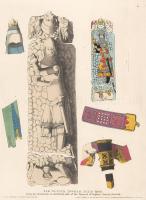
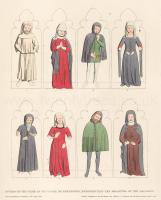
Effigy of Sir Roger de Kerdeston. THIS monument is in the chancel of Reepham church, Norfolk. The family of Kerdeston held a manor of the same name in Reepham parish as early as the reign of Henry the Third. Sir Roger de Kerdeston died in the 11th year of the reign of Edward III 1337. His military habits are represented by the bed of stones on which he reposes. The male and female figures delineated in Plate III. adorn the base of his tomb. They probably represent his children, or relatives, as mourners, and are most interesting specimens of the costume of the fourteenth century.
Details. Plate 1. Hilt of the sword, genouilliere, and part of the cuisses. Plate II. 1. Side view of the sword-hilt, with part of the belt and scabbard. 2. Agrafe or clasp of the belt. 3. Lace attaching the basinet to the camail. Plate III. Mourners on the base of the tomb.