

On 7th February 1741 Henry Fuseli was born at Zurich, Switzerland.

1778. James Northcote [aged 31]. Portrait of Henry Fuseli [aged 36].
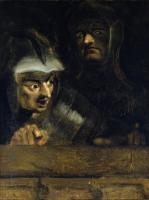
1780 to 1782. Henry Fuseli [aged 38]. "The two murderers of the Duke of Clarence".
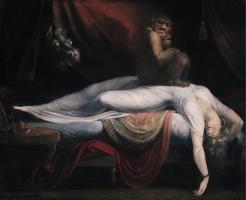
1781. Henry Fuseli [aged 39]. "The Nightmare".
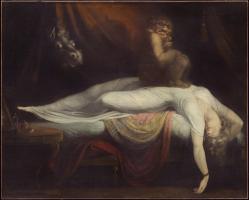
1781. Henry Fuseli [aged 39]. "The Nightmare". The painting was first shown in 1782 at the Royal Academy of London after which it became widely known. Fuseli painted other versions; the original was sold for twenty guineas.
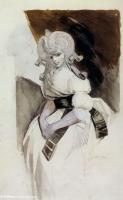
In 1788 Henry Fuseli [aged 46] and Sophia Rawlins were married. She originally one of his models.
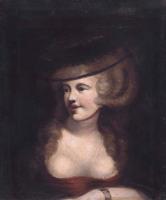
In or after 1788. Henry Fuseli [aged 46]. Portrait of Sophia Rawlins, the artist's wife.
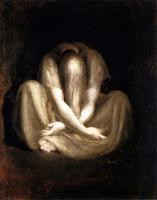
1789. Henry Fuseli [aged 47]. "Silence".
Around 1789 Henry Fuseli [aged 47] and Mary Wollstonecraft [aged 29] planned a trip with him to Paris. His wife Sophia Rawlins stopped any communication between the two.


Annals of the six Kings of England by Nicholas Trivet
Translation of the Annals of the Six Kings of England by that traces the rise and rule of the Angevin aka Plantagenet dynasty from the mid-12th to early 14th century. Written by the Dominican scholar Nicholas Trivet, the work offers a vivid account of English history from the reign of King Stephen through to the death of King Edward I, blending political narrative with moral reflection. Covering the reigns of six monarchs—from Stephen to Edward I—the chronicle explores royal authority, rebellion, war, and the shifting balance between crown, church, and nobility. Trivet provides detailed insight into defining moments such as baronial conflicts, Anglo-French rivalry, and the consolidation of royal power under Edward I, whose reign he describes with particular immediacy. The Annals combines careful year-by-year reporting with thoughtful interpretation, presenting history not merely as a sequence of events but as a moral and political lesson. Ideal for readers interested in medieval history, kingship, and the origins of the English state, this chronicle remains a valuable and accessible window into the turbulent world of the Plantagenet kings.
Available at Amazon in eBook and Paperback format.
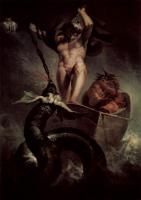
1790. Henry Fuseli [aged 48]. "Thor Battering the Midgard Serpent". Fuseli's diploma work for the Royal Academy
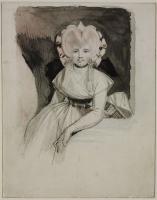
Around 1790. Henry Fuseli [aged 48]. Portrait of the artist's wife Sophia Rawlins.
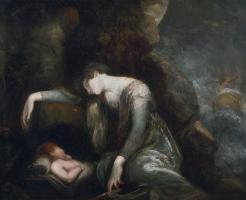
1790. Henry Fuseli [aged 48]. "Danaë and Perseus on Seriphos".

1792. Henry Fuseli [aged 50]. "The Apotheosis of Penelope Boothby".
Penelope Boothby: On 11th April 1785 she was born to Brooke Boothby 6th Baronet in Lichfield, Staffordshire [Map]. On 19th March 1791 Penelope Boothby died at Ashbourne Hall, Derbyshire [Map]. She was buried in St Oswald's Church, Ashbourne [Map].
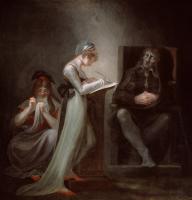
1794. Henry Fuseli [aged 52]. "Milton Dictating to His Daughter".

1794. John Opie [aged 32]. Portrait of Henry Fuseli [aged 52].
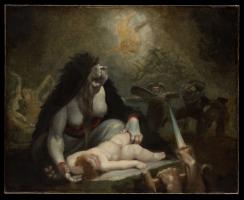
1796. Henry Fuseli [aged 54]. "The Night-Hag Visiting Lapland Witches". Hecate, the Greek goddess who presided over witchcraft and magical rites, was historically known as the "Night-Hag," hence the title that the artist gave this work. It illustrates a passage from Paradise Lost by the English poet John Milton
In 1799 Henry Fuseli [aged 57] was appointed Professor of Painting at the Royal Academy.
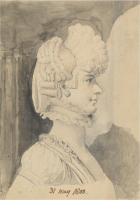
31st May 1800. Henry Fuseli [aged 59]. Sophia Rawlins, the artist's wife, in profile.
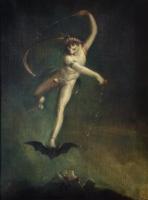
Around 1805. Henry Fuseli [aged 63]. "Ariel".

1817. George Henry Harlow [aged 29]. Portrait of Henry Fuseli [aged 75].
On 17th April 1825 Henry Fuseli [aged 84] died at the house of the Countess of Guildford [aged 55], on Putney Hill