

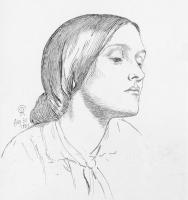
During the 1870s and 1880s, the John Hungerford Pollen and Maria Margaret La Primaudaye rented Newbuildings Place in Shipley, Sussex from Wilfrid Scawen Blunt, a childhood friend of the La Primaudaye family.
On 14th January 1815 [his father] Richard Pollen [aged 28] and [his mother] Anne Cockereill [aged 20] were married.
On 19th November 1820 John Hungerford Pollen was born to Richard Pollen [aged 34] and Anne Cockereill [aged 25]. He was educated at Eton College and Christ Church, Oxford.
On 7th February 1838 [his father] Richard Pollen [aged 51] died.
In 1845 John Hungerford Pollen [aged 24] was ordained as an Anglican priest in 1845, with a parish in Leeds from 1847, writing of his experiences. Pollen converted to Roman Catholicism in 1851. He travelle d to Rome where he met [his future father-in-law] Reverend Charles John La Primaudaye [aged 38] who had also recently converted to Catholicism; he being the father of his future wife Maria Margaret La Primaudaye [aged 6].
In 1855 John Hungerford Pollen [aged 34] and Maria Margaret La Primaudaye [aged 16] were married at the Church of Woodchester Monastery, Stroud, Gloucestershire. They had ten children.
Life of William Morris. In the early part of the Long Vacation of 1857, Rossetti [aged 28] went down to Oxford to see his friend Benjamin Woodward, the architect. Morris, always delighted to take a day at Oxford, went with him. The long battle between the Palladian and Gothic styles for the new University Museum had been at last decided by the Oxford authorities in favour of the latter. Woodward's plans, in a style of mixed Rhenish and Venetian Gothic, had been accepted, and the museum was now in progress. Besides his principal work at the museum, he was engaged in building a debating hall for the Union Society. That hall, now the principal library, was just roofed in. In formi, the hall was a long building with apsidal ends. A narrow gallery fitted with bookshelves ran completely round it, and above the shelves was a broad belt of wall divided into ten bays, pierced by twenty six-foil circular windows, and surmounted by an open timber roof. Rossetti was at once fired with the idea of painting the space thus given. In his notions of the application of painting to architedural surfaces, Woodward, an ardent admirer and a skilled imitator of the Venetian builders, cordially concurred ; and it was at once settled that the ten bays and the whole of the ceiling should be covered with painting in tempera. The Building Committee of the Union, who had a general discretion as regards the work to be done during the Long Vacation, were induced to authorize the work without waiting to refer the matter to a general meeting of the Society. It was arranged that the paintings should forthwith be designed and carried out under Rossetti's superintendence. He himself, and other artists whom he should invite to join him, were to be the executants. The Union was to defray the expense of scaffolding and materials, and the travelling and lodging expenses of the artists, who, beyond this, were to give their services for nothing. No sooner was this settled, than Rossetti went straight back to London and issued his orders: Burne-Jones [aged 23] and Morris [aged 22] were to lay aside all other work and start on the new scheme at once. He had it all planned in his mind. The ten paintings on the walls were to be a series of scenes from the "Morte d' Arthur," and the roof above them was to be covered with a floriated design. For the pidures, ten men had to be found, each of whom should execute one bay, and the work, in the first enthusiasm, was estimated as a matter of six weeks or so. Arthur Hughes [aged 24], Spencer Stanhope [aged 27], Val Prinsep [aged 18], and Hungerford Pollen [aged 36], were drawn into the scheme and agreed to take a picture each; Madox Brown [aged 35] was also asked to execute one, but declined. Rossetti undertook to do two, or if possible three, himself, and Morris and Burne-Jones were each to do one under his eye and with his guidance : eight or nine of the ten bays were thus accounted for, and the remainder of the space was for the moment left to chance.
In 1863 John Hungerford Pollen [aged 42] was appointed assistant keeper of the South Kensington Museum.
On 13th September 1866 [his son] Arthur Pollen was born to John Hungerford Pollen [aged 45] and [his wife] Maria Margaret La Primaudaye [aged 28]. He married 7th September 1898 Maud Beatrice Lawrence and had issue.
Chronicle of a Bourgeois of Valenciennes
Récits d’un bourgeois de Valenciennes aka The Chronicle of a Bourgeois of Valenciennes is a vivid 14th-century vernacular chronicle written by an anonymous urban chronicler from Valenciennes in the County of Hainaut. It survives in a manuscript that describes local and regional history from about 1253 to 1366, blending chronology, narrative episodes, and eyewitness-style accounts of political, military, and social events in medieval France, Flanders, and the Low Countries. The work begins with a chronological framework of events affecting Valenciennes and its region under rulers such as King Philip VI of France and the shifting allegiances of local nobility. It includes accounts of conflicts, sieges, diplomatic manoeuvres, and the impact of broader struggles like the Hundred Years’ War on urban life in Hainaut. Written from the perspective of a burgher (bourgeois) rather than a monastery or royal court, the chronicle offers a rare lay viewpoint on high politics and warfare, reflecting how merchants, townspeople, and civic institutions experienced the turbulence of the 13th and 14th centuries. Its narrative style combines straightforward reporting of events with moral and civic observations, making it a valuable source for readers interested in medieval urban society, regional politics, and the lived experience of war and governance in pre-modern Europe.
Available at Amazon in eBook and Paperback format.

Around 1880 John Hungerford Pollen [aged 59] resigned his position at the South Kensington Museum to become private secretary to George Robinson [aged 52], 1st Marquess of Ripon, whom he then accompanied on a visit to India.
On 7th September 1898 [his son] Arthur Pollen [aged 31] and [his daughter-in-law] Maud Beatrice Lawrence were married.
On 2nd December 1902 John Hungerford Pollen [aged 82] died.
On 18th January 1919 [his former wife] Maria Margaret La Primaudaye [aged 80] died.
Life of William Morris. Before this, however, art was taking a place alongside of literature in Morris's daily life, under the combined influence of his delight in architecture, his natural dexterity of hand, and the companionship of Burne-Jones, whose drawings, then chiefly of a fantastic nature, had already made him a reputation among his schoolfellows at Birmingham. "There was not a boy in the school," one of them writes, "who did not possess at least one of 'Jones's devils.' "Merton Chapel, one of Morris's special haunts, had lately been renovated by Butterfield; and the beautiful painted roof had been executed by Hungerford Pollen, a former fellow of the college. The application of colour to architecture was then a starting novelty, and young architects were making it their business to learn painting. Morris's study of "The Builder" newspaper, which he took in regularly, alternated with the study of mediaeval design and colouring in the painted manuscripts displayed in the Bodleian. One of these, a splendid Apocalypse of the thirteenth century, became his ideal book. Forty years later he went to Oxford to spend a day in studying it, and looked over it with greater knowledge but unimpaired satisfaction. He was constantly drawing windows, arches, and gables in his books; and even in his letters of this time, where the pen had paused, there comes a half unconscious scribble of floriated ornament. Burne-Jones had already found in drawing from nature a relief from the burden of theological perplexities, and spent whole days in Bagley Wood making minute and elaborate studies of flowers and foliage. Morris's rooms were full of rubbings which he had taken from mediaeval brasses. But the great pictorial art of Italy and Flanders was as yet unknown to either. "Of painting," writes Sir Edward Burne-Jones, "we knew nothing. It was before the time when photographs made all the galleries of Europe accessible, and what would have been better a thousand times for us, the wall paintings of Italy. Indeed it would be difficult to make any one understand the dearth of things dear to us in which we lived; and matters that are now well known to cultivated people, and commonplaces in talk, were then impossible for us to know." Giotto, Angelico, Van Eyck, Dürer, names which a little later became of capital importance to Morris, were then wholly unknown to him. The reproductions of the Arundel Society were just beginning to be issued; but at present all that he knew of Pre-Raphaelite Italian art was from one or two pictures in the Taylorian Museum, and the rude woodcuts in Ruskin's Handbook to the Arena Chapel at Padua. Among the most immediately stimulating of the books which he and Burne-Jones fell in with at Oxford was a translation of Fouque's "Sintram," prefixed to which was a woodcut copy of Dürer's engraving of the Knight and Death. Poorly executed as it was, this fired their imagination, and hours were spent in poring over it.
father: Richard Pollen
Great x 1 Grandfather: John Cockerell
Grandfather: Samuel Pepys Cockerell
mother: Anne Cockereill