

See Painters.
In 1818 [his father] Ford Brown [aged 38] and [his mother] Caroline Madox [aged 33] were married.

1840. Ford Madox Brown [aged 18]. "Study for the Dean in the 'Execution of Mary Queen of Scots'". The model is described in some sources as the artist's father Ford Brown [aged 60].
Ford Brown: In 1780 he was born to John Brown. In 1818 he and Caroline Madox were married. In 1842 he died at Paris [Map].

1840. Ford Madox Brown [aged 18]. "Study for 'Execution of Mary Queen of Scots'".

Around 1841. Ford Madox Brown [aged 19]. "The Execution of Mary, Queen of Scots". The moment the Mary tells Bishop Richard Fletcher to stop praying for her in the Protestant faith. His first wife Elizabeth [aged 22] modelled for one of the figures
Elizabeth Bromley: On 10th September 1818 she was born to Samuel Bromley and Mary Madox at Butt Lane, Deptford. She was baptised 2nd October 1818. In April 1841 Ford Madox Brown and she were married. They were half first cousins. On 5th June 1846 Elizabeth Bromley died of tuberculosis in Paris [Map]. She was buried at Kensal Green Cemetery [Map].
In 1841 [his mother] Caroline Madox [aged 56] died.
In April 1841 Ford Madox Brown [aged 19] and Elizabeth Bromley [aged 22] were married. They were half first cousins.

1842. Ford Madox Brown [aged 20]. "Manfred on the Jungfrau". Inspired by Scene II of the poem Manfred by George "Lord Byron" 6th Baron Byron.

On 19th July 1843 [his daughter] Emma Lucy Madox Brown was born to Ford Madox Brown [aged 22] and [his wife] Elizabeth Bromley [aged 24] at Paris [Map]. Coefficient of inbreeding 3.12%. She married 31st March 1874 William Michael Rossetti and had issue.

1844. Ford Madox Brown [aged 22]. "The Bromley Family". His first wife Elizabeth [aged 25] bottom right.
On 5th June 1846 [his wife] Elizabeth Bromley [aged 27] died of tuberculosis in Paris [Map]. She was buried at Kensal Green Cemetery [Map].
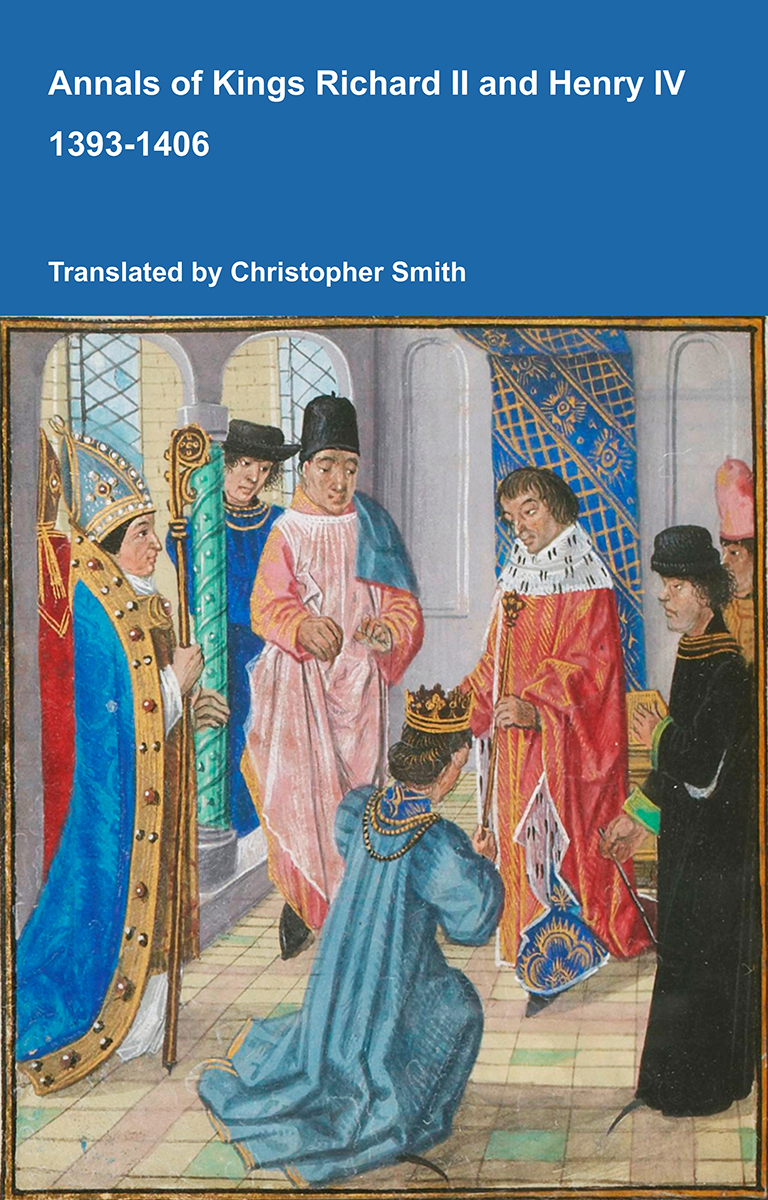
Annals of Kings Richard II and Henry IV 1393-1406
The Annals of Kings Richard II and Henry IV offers a vivid contemporary account of one of the most turbulent periods in late medieval England. Covering the reigns of Richard II and Henry IV, the chronicle records royal ceremonies, political conflict, rebellion, war, taxation, religious controversy, executions, popular unrest and remarkable portents. Its pages include a detailed description of Richard II’s coronation, the fall and deposition of the king, Henry IV’s seizure of the throne, the Percy rebellion, the execution of Archbishop Richard Scrope, the campaigns of Owain Glyndŵr, and England’s relations with Scotland, France, Portugal and Scandinavia. Alongside affairs of state, the annalist preserves reports of miracles, eclipses, prophecies, supernatural events and the experiences of ordinary townspeople, clergy, soldiers and travellers. Written from a monastic perspective, the work combines political observation with moral judgement, presenting victories and disasters as evidence of divine favour or punishment. At once a historical record and a reflection of medieval belief, the Annals provides an invaluable window into the challenges, ceremonies and conflicts of England at the turn of the fifteenth century.
Available at Amazon in eBook and Paperback format.

1849-1854. Ford Madox Brown [aged 27]. "Lear and Cordelia". Model for Cordelia [his future wife] Emma Matilda Hill [aged 19].

1850. Ford Madox Brown [aged 28]. Self-portrait.

On 11th November 1850 [his illegitimate daughter] Catherine Emily Brown was born illegitimately to Ford Madox Brown [aged 29] and [his future wife] Emma Matilda Hill [aged 21].

1851. Unfinished. Ford Madox Brown [aged 29]. "Take Your Son, Sir". Model [his future wife] Emma Matilda Hill [aged 21].

1851. Ford Madox Brown [aged 29]. "Pretty Baa Lambs". Models: the artist's future wife Emma Matilda Hill [aged 21] and their daughter Catherine Emily Brown.
The Diary of George Price Boyce 1851. 13th November 1851. After Clipstone Street spent the evening with Wells [aged 22] at John [aged 24] and Thomas Seddon's [aged 30], 7 Percy Street; G. Rossetti [aged 23], F. M. Brown [aged 30] and G. Truefitt [aged 27] were there.


1852 to 1865. Ford Madox Brown [aged 30]. "Work".

1852 to 1865. Ford Madox Brown [aged 30]. Portrait of his daughter [his illegitimate daughter] Catherine Emily Brown [aged 1].

1853. Ford Madox Brown [aged 31]. Portrait of his daughter [his illegitimate daughter] Catherine Emily Brown [aged 2].

On 5th April 1853 Ford Madox Brown [aged 31] and Emma Matilda Hill [aged 23] were married at St Dunstan's in the West, Fleet Street [Map]. The witnesses were Dante Gabriel Rossetti [aged 24] and Thomas Seddon [aged 31]. Rector Edward Auriol [aged 48] performed the ceremony.
Edward Auriol: On 27th February 1805 he was born to James Peter Auriol. On 28th September 1829 Edward Auriol and Georgina Morris were married. On 7th January 1842 he was appointed Rector of St Dunstan's in the West, Fleet Street [Map]. On 10th July 1880 Edward Auriol died.

1854-1855. Ford Madox Brown [aged 32]. "Carrying Corn".

1854 to 1855. Ford Madox Brown [aged 32]. "Waiting: an English Fireside". Models: the artists wife Emma Matilda Hill [aged 24] and daughter Catherine Emily Brown [aged 3].
In 1855 [his son] Oliver Madox Brown was born to Ford Madox Brown [aged 33] and [his wife] Emma Matilda Hill [aged 25].
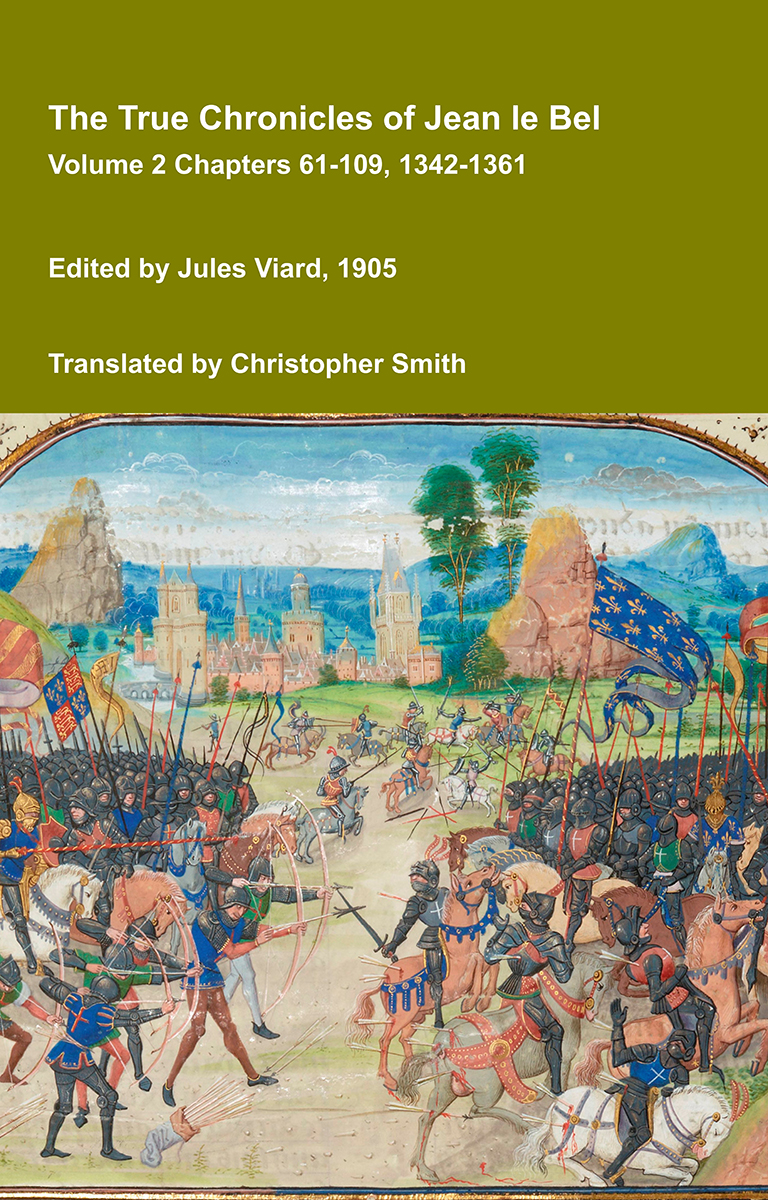
The True Chronicles of Jean le Bel Volume 2 Chapters 61-109 1342-1361
The Chronicle of Jean le Bel, Volume 2 continues one of the most important fourteenth-century accounts of the early Hundred Years’ War. Written by the Liège chronicler Jean le Bel, this vivid narrative follows the fortunes of Edward III, Jean II of France, the Black Prince, the great nobles of France and England, and the soldiers, captains and companies who shaped the conflict. This volume covers some of the most dramatic events of the period, including the battles of Crécy and Poitiers, the siege and capture of Calais, the captivity of King John, the rise of the Jacquerie, the turmoil in Paris under Étienne Marcel and Charles of Navarre, the devastation caused by the free companies, Edward III’s great campaign of 1359–1360, and the negotiations leading to the Treaty of Brétigny. Jean le Bel’s chronicle is especially valuable for its lively detail, its interest in chivalry, warfare, politics and reputation, and its influence on later chroniclers, most famously Froissart. This English translation presents the text in clear, readable British English while preserving the force and character of the original narrative. The translation includes extensive notes to help the reader better understand Jean le Bel's text. Volume 2 also includes translated appendices drawn from royal and administrative records, many from the English Record Office, which illuminate Edward III’s campaigns in Brittany, the siege and occupation of Calais, naval preparations, military finance, appointments, safe conducts and related affairs.
Available at Amazon in eBook and Paperback format.

1855. Ford Madox Brown [aged 33]. "The Last of England". Modelled by himself and his wife Emma Matilda Hill [aged 25]. Inspired by the departure to Australia of his friend Thomas Woolner [aged 29].

1855-1856. Ford Madox Brown [aged 33]. "The Hayfield".

1856 to 1858. Ford Madox Brown [aged 34]. "Chaucer at the Court of Edward III".
Life of William Morris. In the early part of the Long Vacation of 1857, Rossetti [aged 28] went down to Oxford to see his friend Benjamin Woodward, the architect. Morris, always delighted to take a day at Oxford, went with him. The long battle between the Palladian and Gothic styles for the new University Museum had been at last decided by the Oxford authorities in favour of the latter. Woodward's plans, in a style of mixed Rhenish and Venetian Gothic, had been accepted, and the museum was now in progress. Besides his principal work at the museum, he was engaged in building a debating hall for the Union Society. That hall, now the principal library, was just roofed in. In formi, the hall was a long building with apsidal ends. A narrow gallery fitted with bookshelves ran completely round it, and above the shelves was a broad belt of wall divided into ten bays, pierced by twenty six-foil circular windows, and surmounted by an open timber roof. Rossetti was at once fired with the idea of painting the space thus given. In his notions of the application of painting to architedural surfaces, Woodward, an ardent admirer and a skilled imitator of the Venetian builders, cordially concurred ; and it was at once settled that the ten bays and the whole of the ceiling should be covered with painting in tempera. The Building Committee of the Union, who had a general discretion as regards the work to be done during the Long Vacation, were induced to authorize the work without waiting to refer the matter to a general meeting of the Society. It was arranged that the paintings should forthwith be designed and carried out under Rossetti's superintendence. He himself, and other artists whom he should invite to join him, were to be the executants. The Union was to defray the expense of scaffolding and materials, and the travelling and lodging expenses of the artists, who, beyond this, were to give their services for nothing. No sooner was this settled, than Rossetti went straight back to London and issued his orders: Burne-Jones [aged 23] and Morris [aged 22] were to lay aside all other work and start on the new scheme at once. He had it all planned in his mind. The ten paintings on the walls were to be a series of scenes from the "Morte d' Arthur," and the roof above them was to be covered with a floriated design. For the pidures, ten men had to be found, each of whom should execute one bay, and the work, in the first enthusiasm, was estimated as a matter of six weeks or so. Arthur Hughes [aged 24], Spencer Stanhope [aged 27], Val Prinsep [aged 18], and Hungerford Pollen [aged 36], were drawn into the scheme and agreed to take a picture each; Madox Brown [aged 35] was also asked to execute one, but declined. Rossetti undertook to do two, or if possible three, himself, and Morris and Burne-Jones were each to do one under his eye and with his guidance : eight or nine of the ten bays were thus accounted for, and the remainder of the space was for the moment left to chance.

1857. Ford Madox Brown [aged 35]. "Stages of Cruelty". Models: the artists wife Emma Matilda Hill [aged 27] and daughter Catherine Emily Brown [aged 6].
The Diary of George Price Boyce 1855-1857. 6th June 1857. Received from [his future son-in-law] Wm. Rossetti [aged 27] circular of the New York Exhibition of British Art. Works to be in readiness by end of August. Augustus Ruxton projector. F. M. Brown [aged 36] goes with the things.


Memorials of Edward Burne-Jones 1860. After 9th June 1860. In the unsettled week before his marriage Edward [aged 26] had amused himself by painting some figures upon a plain deal sideboard which he possessed, and this in its new state was a delightful surprise to find. "Ladies and animals" he called the subjects illustrated, and there were seven pictures, three on the cupboard doors in front and two at each end, which shewed them in various relations to each other. Three kind and attentive ladies were feeding pigs, parrots and fishes; two cruel ones were tormenting an owl by forcing him to look at himself in a round mirror, and gold fish by draining them dry in a net; while two more were expiating such sins in terror at a hideous newt upon the garden path and the assault of a swarm of angry bees. Mrs. Catherwood gave us a piano, made by Priestly of Berners Street, who had patented a small one of inoffensive shape that we had seen and admired at Madox Brown's [aged 39] house; we had ours made of unpolished American walnut, a perfectly plain wood of pleasing colour, so that Edward could paint upon it. The little instrument when opened shows inside the lid a very early design for the "Chant d' Amour," and on the panel beneath the keyboard there is a gilded and lacquered picture of Death, veiled and crowned, standing outside the gate of a garden where a number of girls, unconscious of his approach, are resting and listening to music. The lacquering of this panel was an exciting process, for its colour had to be bedeepened by heat while still liquid, and Edward used a red-hot poker for the work.
On 11th February 1862 at twenty past seven in the morning Elizabeth Siddal [aged 32] overdosed on laudanum at 14 Chatham Place. Possibly suicide - there may have been a note that said "look after Harry (her invalid brother)" which Ford Madox Brown [aged 40] persuaded Dante Gabriel Rossetti [aged 33] to burn. Shortly after her death Sarah Cox aka Fanny Cornforth [aged 27] moved into the family home to become housekeeper to Dante Gabriel Rossetti.

1867. Dante Gabriel Rossetti [aged 38]. Drawing of Ford Madox Brown [aged 45].

2nd April 1871. Census. 37 Fitzroy Square.
Ford Madox Brown [aged 49]. Head. 49.
[his wife] Emma Matilda Hill [aged 41]. Wife. 36.
[his daughter] Emma Lucy Madox Brown [aged 27]. Daughter. 26.
[his illegitimate daughter] Catherine Emily Brown [aged 20]. Daughter. 20.
[his son] Oliver Madox Brown [aged 16]. Son. 16.
Charloote Kirkby. Servant. 29.
Mary Ann Edwards. Servant. 19.
Oliver Madox Brown: In 1855 he was born to Ford Madox Brown and Emma Matilda Hill. In 1874 he died.
Chronicle of Walter of Guisborough
A canon regular of the Augustinian Guisborough Priory, Yorkshire, formerly known as The Chronicle of Walter of Hemingburgh, describes the period from 1066 to 1346. Before 1274 the Chronicle is based on other works. Thereafter, the Chronicle is original, and a remarkable source for the events of the time. This book provides a translation of the Chronicle from that date. The Latin source for our translation is the 1849 work edited by Hans Claude Hamilton. Hamilton, in his preface, says: 'In the present work we behold perhaps one of the finest samples of our early chronicles, both as regards the value of the events recorded, and the correctness with which they are detailed; Nor will the pleasing style of composition be lightly passed over by those capable of seeing reflected from it the tokens of a vigorous and cultivated mind, and a favourable specimen of the learning and taste of the age in which it was framed.'
Available at Amazon in eBook and Paperback format.

1872. Ford Madox Brown [aged 50]. "The Convalescent". Model [his wife] Emma Matilda Hill [aged 42]. When he made this pastel, the artist wrote, "Now that she is lying in bed thinned with the fever she looks very pictorial and young as ever again."
On 3rd September 1872 [his son-in-law] Francis Heuffer [aged 27] and [his illegitimate daughter] Catherine Emily Brown [aged 21] were married. She the illegitmate daughter of Ford Madox Brown [aged 51] and [his wife] Emma Matilda Hill [aged 43].
In 1874 [his son] Oliver Madox Brown [aged 19] died.
On 31st March 1874 [his son-in-law] William Michael Rossetti [aged 44] and Emma Lucy Madox Brown [aged 30] were married. She the daughter of Ford Madox Brown [aged 52] and Elizabeth Bromley.
On 9th April 1882 Dante Gabriel Rossetti [aged 53] died. He was buried at All Saints Church, Birchington on Sea [Map]. There is a Celtic Cross marking his grave commissioned by his mother Frances Mary Lavinia Polidori [aged 81], designed by Ford Madox Brown [aged 60] and erected in the presence of his brother [his son-in-law] William Michael Rossetti [aged 52] and sister Christina Georgina Rossetti [aged 51] as written on the base of the cross.


On 11th October 1890 [his wife] Emma Matilda Hill [aged 61] died.

5th April 1891. Census. 1 St Edmunds Terrace.
Ford Madox Brown [aged 69]. Head. Widower.
[his illegitimate daughter] Catherine Heuffer [aged 40]. Daughter. Widow.
[his grandson] Ford Madox Ford aka Heuffer [aged 17]. Grandson. 17.
Oliver Madox Heuffer [aged 14]. Grandson. 15.
Juliet Catherine Emma Heuffer [aged 10]. Granddaughter. 10.
Charlotte Kindy. Servant. 31.
Margaret Mullin. Servant. 23.
Ford Madox Ford aka Heuffer: On 17th December 1873 he was born to Francis Heuffer and Catherine Emily Brown On 26th June 1939 he died.
Oliver Madox Heuffer: In 1877 he was born to Francis Heuffer and Catherine Emily Brown On 22nd June 1931 he died.
Juliet Catherine Emma Heuffer: In 1881 she was born to Francis Heuffer and Catherine Emily Brown In 1944 she died.
On 6th October 1893 Ford Madox Brown [aged 72] died. He was buried at St Pancras and Islington Cemetery.
Diary of Ford Madox Brown. The Diary of Ford Madox Brown edited by Virginia Surtees. Published in 1981.
Grandfather: John Brown
Father: Ford Brown
Grandfather: Unknown Brown
Mother: Caroline Madox