James Collinson 1825-1881

In or before 1817 [his father] Robert Collinson [aged 30] and [his mother] Mary Harvey were married.

On 9th May 1825 James Collinson was born to Robert Collinson [aged 39] and Mary Harvey at Mansfield, Nottinghamshire. His father was a bookseller and sub-postmaster. Early in life James received art instruction from a Mrs. Ann Paulson, a local Mansfield artist.

Around 1840 James Collinson [aged 14] entered the Royal Academy Schools where he was a fellow student with Dante Gabriel Rossetti [aged 11] and William Holman Hunt [aged 12].

In June 1845 [his father] Robert Collinson [aged 59] died.

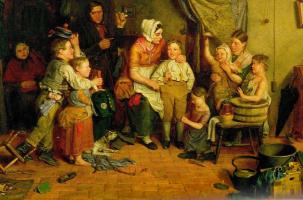
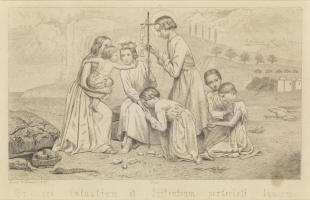
1847. James Collinson [aged 21]. 'The Charity Boy's Debut'. Exhibited at the Royal Academy.

In September 1847 the Pre-Raphaelite Brotherhood was formed at 7 Gower Street, Camden [Map], the home of John Everett Millais 1st Baronet [aged 18]. The seven founder members were Millais, brothers Dante Gabriel Rossetti [aged 19] and William Michael Rossetti [aged 17], William Holman Hunt [aged 20], James Collinson [aged 22], Frederick George Stephens [aged 19] and Thomas Woolner [aged 21].

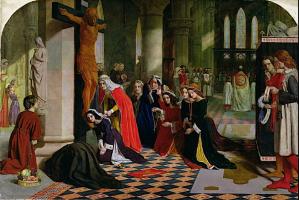
Between 1848 and 1850. James Collinson [aged 22]. "An Incident in the Life of St. Elizabeth of Hungary".

Around 1848 James Collinson [aged 22] and Christina Rossetti [aged 17] were engaged; he had converted to Anglicanism. The engagement ended in 1850 when he reverted to Catholicism.

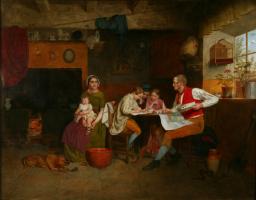
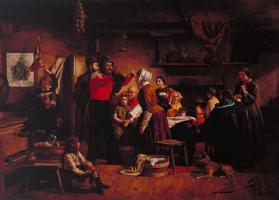
1850. James Collinson [aged 24]. "Answering the Emigrant's Letter". In the collection of Manchester Art Gallery.

Deeds of King Henry V

Henrici Quinti, Angliæ Regis, Gesta, is a first-hand account of the Agincourt Campaign, and subsequent events to his death in 1422. The author of the first part was a Chaplain in King Henry's retinue who was present from King Henry's departure at Southampton in 1415, at the siege of Harfleur, the battle of Agincourt, and the celebrations on King Henry's return to London. The second part, by another writer, relates the events that took place including the negotiations at Troye, Henry's marriage and his death in 1422.

Available at Amazon in eBook and Paperback format.

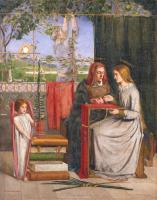
1850. James Collinson [aged 24]. "The Child Jesus".

On 20th May 1850 James Collinson [aged 25] resigned from Pre-Raphaelite Brotherhood being opposed to the Brotherhood bringing the Christian religion into disrepute when Millais' Christ in the House of his Parents was accused of being blasphemous.

The Diary of George Price Boyce 1851. 4th June 1851. Called on Wells [aged 22]. Miss Guyson, the model, was with him, a good looking girl. She gave him a ticket for the Portland Gallery, National Institution, which I made use of. A fine picture [See Painting] there by Collinson [aged 26], P.R.B., from the life of St. Elizabeth of Hungary (price £240).

On 15th January 1853 James Collinson [aged 27] entered Hodder Place near Stonyhurst, the Jesuit College in Lancashire, as a novitiate to train for the priesthood. Collinson discontiued his studies some time between September 1854 and January 1855 without completing his religious training and resumed his painting career.

1856. James Collinson [aged 30]. "A Son of the Soil". Exhibited this painting at the British institution in 1856, no. 375, the first work that he exhibited there. William Michael Rossetti [aged 26] wrote in the Spectator: "Mr. Collinson's Son of the Soil – a lusty labourer seated in a public-house with his pewter pot of beer before him, and behind him an advertisement for men to serve in the Army Works Corps – is an exact study from nature". In the collection of Manchester Art Gallery.

1856. James Collinson [aged 30]. "Home Again".

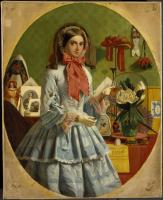
1857. James Collinson [aged 31]. "The Empty Purse". This painting is also known as "For Sale" and "At the Bazzar". Several versions exist. The painting contains many details including a print of 'The Way to Calvary'. The paper besides her tells us this is St. Bride's Church Bazaar for the sale of [use]ful and fancy articles Patroness [the] honourable Lady Dorcas. A reference to he story of Dorcas in Acts 9: 36-42, a woman who followed Christ's teachings and made clothes for widows and the poor. Behind the domed plant is a portrait of a woman, a small chequered ball, and a fan.

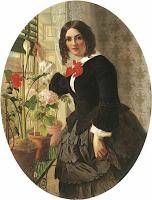
1857. James Collinson [aged 31]. "The Landlady" aka "To Let". The black clothes suggest she is a widow still in mourning and therefore possibly needing to rent a room in her home to supplement her income. The sign she is unveiling say 'To Let'.

On 9th February 1858 James Collinson [aged 32] and Eliza Alvenia Wheeler [aged 40] were married at Brompton Oratory, Kensington.

In or before July 1859 James Collinson [aged 34] and his wife Eliza Alvenia Wheeler [aged 41] were living at Woodcote, New Road, Epsom where their only child Robert Vincent was born.

The Deeds of the Dukes of Normandy

The Gesta Normannorum Ducum [The Deeds of the Dukes of Normandy] is a landmark medieval chronicle tracing the rise and fall of the Norman dynasty from its early roots through the pivotal events surrounding the Norman Conquest of England. Originally penned in Latin by the monk William of Jumièges shortly before 1060 and later expanded at the behest of William the Conqueror, the work chronicles the deeds, politics, battles, and leadership of the Norman dukes, especially William’s own claim to the English throne. The narrative combines earlier historical sources with firsthand information and oral testimony to present an authoritative account of Normandy’s transformation from a Viking settlement into one of medieval Europe’s most powerful realms. William’s history emphasizes the legitimacy, military prowess, and governance of the Norman line, framing their expansion, including the conquest of England, as both divinely sanctioned and noble in purpose. Later chroniclers such as Orderic Vitalis and Robert of Torigni continued the history, extending the coverage into the 12th century, providing broader context on ducal rule and its impact. Today this classic work remains a foundational source for understanding Norman identity, medieval statesmanship, and the historical forces that reshaped England and Western Europe between 800AD and 1100AD.

Available at Amazon in eBook and Paperback format.

From 1861 to 1870 James Collinson [aged 35] was secretary of the Society of British Artists.

In 1863 [his mother] Mary Harvey died.

In or before 1864 James Collinson [aged 38] and his family were living at 15 St John's Park, Upper Holloway.

In or before 1875 James Collinson [aged 49] and his family were living at 370 Cold-Harbour-lane, Brixton.

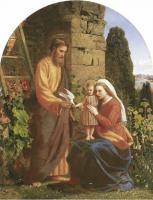
1878. James Collinson [aged 52]. "The Holy Family".

On 24th January 1881 James Collinson [aged 55] died at 16 Paulet Road, Camberwell. He was buried at Camberwell Old Cemetery.

In January 1894 [his former wife] Eliza Alvenia Wheeler [aged 76] died at Camberwell, Surrey [Map].