

Royal Academy is in England.
See: Associate of the Royal Academy, Fellow of the Royal Academy, Landseer Scholarship, President of the Royal Academy, Royal Academy Schools.
On 10th December 1768 the Royal Academy was founded through a personal act of King George III [aged 30] "to establish a school or academy of design for the use of students in the arts" with an annual exhibition.
The founder members included:
Joshua Reynolds [aged 45]; President.
Angelica Kauffmann [aged 27]; one of two female founding members.
Nathaniel Dance-Holland [aged 33]
Francis Cotes [aged 42]
Thomas Gainsborough [aged 41]
William Tyler [aged 40]
William Hoare [aged 61]
Johan Joseph Zoffany [aged 35].
In 1775 John Hoppner [aged 16] entered the Royal Academy.

In 1778 Thomas Stothard [aged 22] became a student at the Royal Academy.
On 8th March 1782 Samuel Woodford [aged 18] became a student at the Royal Academy.
In 1791 Thomas Phillips [aged 20] became a student at the Royal Academy.
In 1806 Joseph Gott [aged 20] won a Royal Academy Silver Medal.
In 1810 Thomas Stothard [aged 54] was appointed Deputy Librarian to the Royal Academy.
In December 1813 Joseph Kendrick [aged 59] was awarded a Gold Medal and a prize of fifty guineas by the Royal Academy for the best historical basso relievo.
From 1818 Richard "The Younger" Westmacott [aged 19] studied at the Royal Academy.
In 1819 Joseph Gott [aged 33] won a Royal Academy Gold Medal for his work "Jacob wrestling with the Angel".
In 1820 John Francis [aged 39] exhibited a bust of Thomas William Coke 1st Earl of Leicester at the Royal Academy.


In 1834 William Calder Marshall [aged 20] enrolled in the Royal Academy where he studied under Francis Leggatt Chantrey [aged 52] and Edward Hodges Baily [aged 45]. In 1835 he was awarded a Silver Medal by the Royal Academy.
Chronicle of Walter of Guisborough
A canon regular of the Augustinian Guisborough Priory, Yorkshire, formerly known as The Chronicle of Walter of Hemingburgh, describes the period from 1066 to 1346. Before 1274 the Chronicle is based on other works. Thereafter, the Chronicle is original, and a remarkable source for the events of the time. This book provides a translation of the Chronicle from that date. The Latin source for our translation is the 1849 work edited by Hans Claude Hamilton. Hamilton, in his preface, says: 'In the present work we behold perhaps one of the finest samples of our early chronicles, both as regards the value of the events recorded, and the correctness with which they are detailed; Nor will the pleasing style of composition be lightly passed over by those capable of seeing reflected from it the tokens of a vigorous and cultivated mind, and a favourable specimen of the learning and taste of the age in which it was framed.'
Available at Amazon in eBook and Paperback format.
The London Gazette 19285. 1st July 1835. St James's Palace [Map]. The King [aged 69] was this day pleased to confer the honour of Knighthood upon Francis Chantrey [aged 54], Esq. Member of the Royal Academy of Arts.
In 1839 Alfred Gatley [aged 22] became a student at the Royal Academy, where he gained silver medals for modelling from the antique, and in 1841 for the first time exhibited a "Bust of a Gentleman".
Around 1840 John Everett Millais 1st Baronet [aged 10] became the youngest student to enter the Royal Academy schools where he met William Holman Hunt [aged 12] and Dante Gabriel Rossetti [aged 11] with whom he later formed the Pre-Raphaelite Brotherhood.


In 1852 William Calder Marshall [aged 38] was appointed Academician of the Royal Academy.
In 1858 Simeon Solomon [aged 17] exhibited at the Royal Academy.


In 1865 Frederick Sandys [aged 35] exhibited "Gentle Spring" at the Royal Academy. To the frame was attached a sonnet by Algernon Charles Swinburne [aged 27] also called "Gentle Spring" as follows:
O Virgin Mother! of gentle days and nights,.
Spring of fresh buds and spring of soft delights,.
Come, with lips kissed of many an amorous hours,.
Come, with hands heavy from the fervent flower,.
The fleet first flower that feels the wind and sighs,.
The tenderer leaf that draws the sun and dies;.
Light butterflies like flowers alive in the air.
Circling and crowning thy delicious hair,.
And many a fruitful flower and floral fruit.
Born of thy breath and fragrant from thy foot.
Thee, Mother, all things born desire, and thee.
Earth and the fruitless hollows of the sea.
Praise, and thy tender winds of ungrown wing.
Fill heaven with murmurs of the sudden spring.
In February 1896 John Everett Millais 1st Baronet [aged 66] was appointed President of the Royal Academy.
In 1907 Gerald Leslie Brockhurst [aged 16] was a pupil at the Royal Academy Schools.


In 1913 Gerald Leslie Brockhurst [aged 22] won the Royal Academy School's gold medal and a travelling scholarship enabling him to visit both France and Italy.
In 1928 Gerald Leslie Brockhurst [aged 37] was appointed Visitor to the Royal Academy Schools. It was at this time that he met the sixteen-year-old artist's life model Kathleen Woodward [aged 15] who he named Dorette.


From 1889 George Spencer Watson [aged 19] studied at the Royal Academy Schools. He exhibited from 1891 winning a Silver Medal in 1889 and 1891, and the Landseer Scholarship in 1892.

In 1830 Martin Archer Shee [aged 60] was elected President of the Royal Academy following the death of Thomas Lawrence [aged 60].
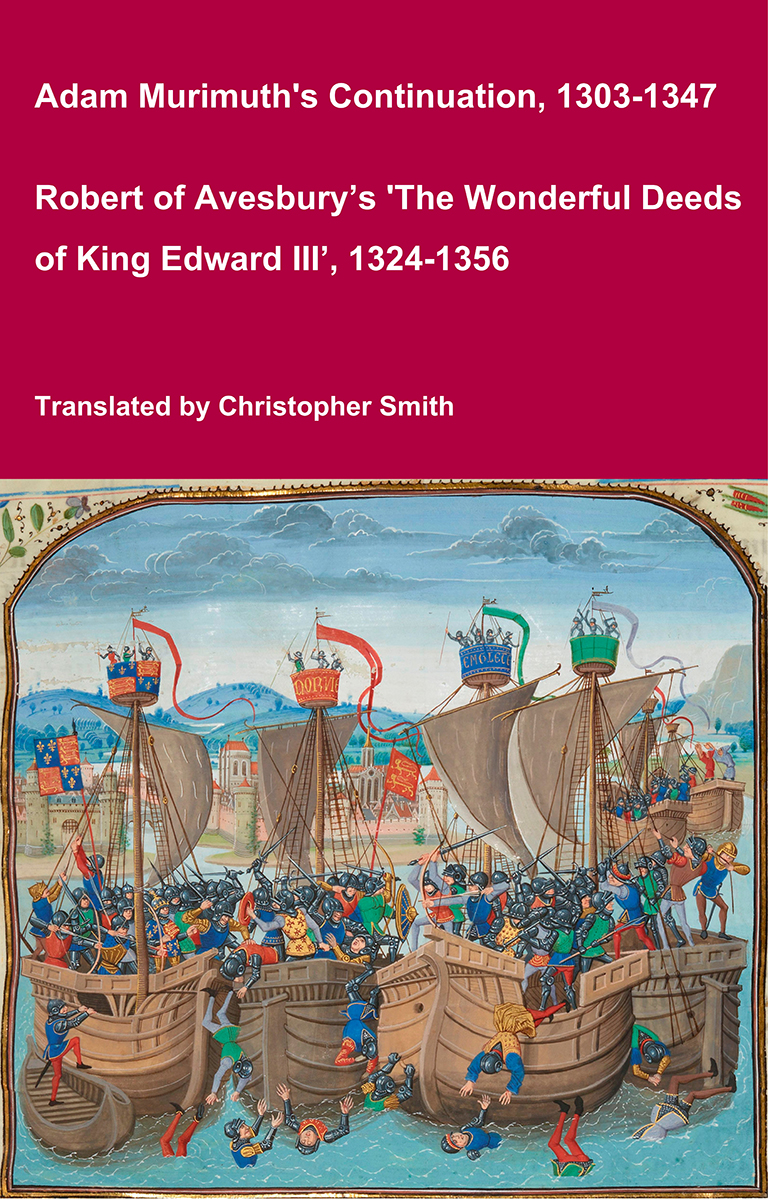
Adam Murimuth's Continuation and Robert of Avesbury’s 'The Wonderful Deeds of King Edward III'
This volume brings together two of the most important contemporary chronicles for the reign of Edward III and the opening phases of the Hundred Years’ War. Written in Latin by English clerical observers, these texts provide a vivid and authoritative window into the political, diplomatic, and military history of fourteenth-century England and its continental ambitions. Adam Murimuth Continuatio's Chronicarum continues an earlier chronicle into the mid-fourteenth century, offering concise but valuable notices on royal policy, foreign relations, and ecclesiastical affairs. Its annalistic structure makes it especially useful for establishing chronology and tracing the development of events year by year. Complementing it, Robert of Avesbury’s De gestis mirabilibus regis Edwardi tertii is a rich documentary chronicle preserving letters, treaties, and official records alongside narrative passages. It is an indispensable source for understanding Edward III’s claim to the French crown, the conduct of war, and the mechanisms of medieval diplomacy. Together, these works offer scholars, students, and enthusiasts a reliable and unembellished account of a transformative period in English and European history. Essential for anyone interested in medieval chronicles, the Hundred Years’ War, or the reign of Edward III.
Available at Amazon in eBook and Paperback format.
In 1924 Frank Bernard Dicksee [aged 70] was appointed President of the Royal Academy.
In 1771 Joseph Kendrick [aged 16] attended the Royal Academy Schools.
In 1788 Peter Rouw [aged 16] was admitted to the Royal Academy Schools and exhibited there until 1838. He a friend of Joseph Nollekens [aged 50].
Around 1820 John Ternouth [aged 23] entered the Royal Academy Schools and studied under Francis Leggatt Chantrey [aged 38].
Around 1840 James Collinson [aged 14] entered the Royal Academy Schools where he was a fellow student with Dante Gabriel Rossetti [aged 11] and William Holman Hunt [aged 12].
In 1840 George Gammon Adams [aged 18] was admitted to Royal Academy Schools and exhibited there from 1841. His address at the time was 1 South Place, Pimlico.
From 1889 George Spencer Watson [aged 19] studied at the Royal Academy Schools. He exhibited from 1891 winning a Silver Medal in 1889 and 1891, and the Landseer Scholarship in 1892.