On 23rd April 1775 Joseph Mallord William Turner was born to William Turner [aged 30] and Mary Marshall at Maiden Lane, Covent Garden. He was baptised on 14th May 1775 at the St Paul's Church, Covent Garden. His father was a barber and wig maker.
Around 1785 Mary Marshall, mother of Joseph Mallord William Turner [aged 9], showed signs of mental disturbance from 1785 and was admitted to St Luke's Hospital for Lunatics in Old Street in 1799. She was moved in 1800 to Bethlem Hospital, a mental asylum, where she died in 1804.
1787. Joseph Mallord William Turner [aged 11]. "View of Nuneham Courtenay from the Thames".
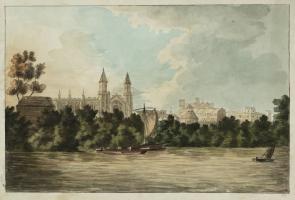
1787. Joseph Mallord William Turner [aged 11]. "Eton College [Map] from the Thames".
1787. Joseph Mallord William Turner [aged 11]. "Folly Bridge, Oxford and Bacon's Tower, Oxford".
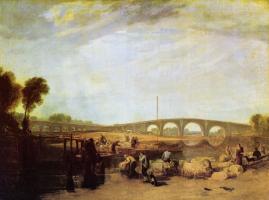
After 1788. Joseph Mallord William Turner [aged 12]. Walton Bridges [Map].
1789. Joseph Mallord William Turner [aged 13]. "Radley Hall, Oxfordshire from the North-West".
In 1789 Joseph Mallord William Turner [aged 13] studied at the Royal Academy of Arts, enrolling when he was 14, and exhibited his first work there at 15.
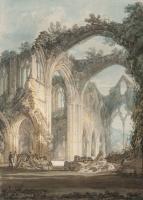
1792. Joseph Mallord William Turner [aged 16]. Tintern Abbey [Map]
1792. Joseph Mallord William Turner [aged 16]. "The Rising Squall, Hot Wells, from St Vincent's Rock, Bristol".
Annals of the six Kings of England by Nicholas Trivet
Translation of the Annals of the Six Kings of England by that traces the rise and rule of the Angevin aka Plantagenet dynasty from the mid-12th to early 14th century. Written by the Dominican scholar Nicholas Trivet, the work offers a vivid account of English history from the reign of King Stephen through to the death of King Edward I, blending political narrative with moral reflection. Covering the reigns of six monarchs—from Stephen to Edward I—the chronicle explores royal authority, rebellion, war, and the shifting balance between crown, church, and nobility. Trivet provides detailed insight into defining moments such as baronial conflicts, Anglo-French rivalry, and the consolidation of royal power under Edward I, whose reign he describes with particular immediacy. The Annals combines careful year-by-year reporting with thoughtful interpretation, presenting history not merely as a sequence of events but as a moral and political lesson. Ideal for readers interested in medieval history, kingship, and the origins of the English state, this chronicle remains a valuable and accessible window into the turbulent world of the Plantagenet kings.
Available at Amazon in eBook and Paperback format.
1793-4. Joseph Mallord William Turner [aged 17]. St Briavels Castle [Map].
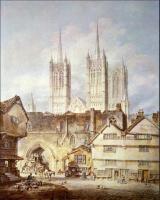
1795. Joseph Mallord William Turner [aged 19]. Lincoln Cathedral [Map]
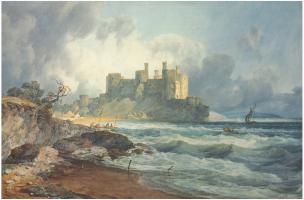
Based on drawings of 1798. Joseph Mallord William Turner [aged 22]. Conwy Castle [Map].
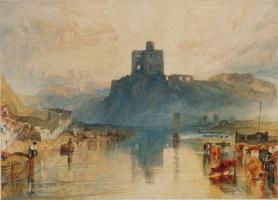
1798. Joseph Mallord William Turner [aged 22]. Norham Castle [Map]: Sunrise.
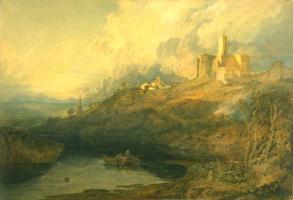
1799. Joseph Mallord William Turner [aged 23]. Warkworth Castle, Northumberland [Map]
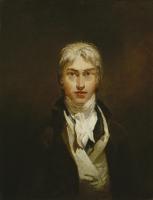
Around 1799. Joseph Mallord William Turner [aged 23]. Self-portrait.
1799. Joseph Mallord William Turner [aged 23]. Notebook sketch of Stonehenge
Around 1800. Joseph Mallord William Turner [aged 24]. Painting of Easby Abbey, Yorkshire [Map].
In 1804 [his mother] Mary Marshall died at Bethlem Hospital. Her son Joseph Mallord William Turner [aged 28] was sent to his maternal uncle, Joseph Mallord William Marshall, a butcher in Brentford, where Turner attended school.
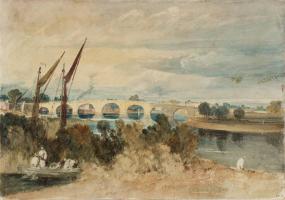
1805. Joseph Mallord William Turner [aged 29]. Kew Bridge [Map] and the River Thames, with Brentford Eyot in the Foreground and Strand-on-Green Seen through the Arches: Low Tide. From the Thames sketchbooks c.1804-14.
The True Chronicles of Jean le Bel Volume 1 Chapters 1-60 1307-1342
The True Chronicles of Jean le Bel offer one of the most vivid and immediate accounts of 14th-century Europe, written by a knight who lived through the events he describes, and experienced some of them first hand. Covering the early decades of the Hundred Years’ War, this remarkable chronicle follows the campaigns of Edward III of England, the politics of France and the Low Countries, and the shifting alliances that shaped medieval warfare. Unlike later historians, Jean le Bel writes with a strong sense of eyewitness authenticity, drawing on personal experience and the testimony of fellow soldiers. His narrative captures not only battles and sieges, but also the realities of military life, diplomacy, and the ideals of chivalry that governed noble society. A key source for Jean Froissart, Le Bel’s chronicle stands on its own as a compelling and insightful work, at once historical record and literary achievement. This translation builds on the 1905 edition published in French by Jules Viard, adding extensive translations from other sources Rymer's Fœdera, the Chronicles of Adam Murimuth, William Nangis, Walter of Guisborough, a Bourgeois of Valenciennes, Geoffrey le Baker of Swinbroke and Richard Lescot to enrich the original text and Viard's notes.
Available at Amazon in eBook and Paperback format.
1810. Joseph Mallord William Turner [aged 34]. "Cockermouth Castle [Map]".
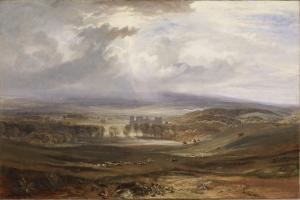
1817. Joseph Mallord William Turner [aged 41]. Raby Castle, County Durham [Map].
Around 1822. Joseph Mallord William Turner [aged 46]. Norham Castle [Map], on the River Tweed.
1828. Joseph Mallord William Turner [aged 52]. Stonehenge
In 1829 [his father] William Turner [aged 84] died.
After 7th January 1830. Joseph Mallord William Turner [aged 54]. "Funeral of Sir Thomas Lawrence [deceased]: A Sketch from Memory". The day after the funeral he wrote to a friend: 'It is something to feel that gifted talent can be acknowledged by the many who yesterday waded up to their knees in snow and muck to see the funeral pomp swelled up by carriages of the great'.
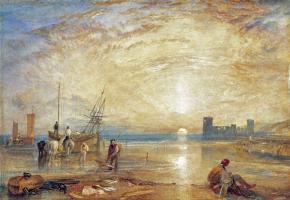
Around 1834. Joseph Mallord William Turner [aged 58]. Flint Castle [Map]
1838. John Linnell [aged 45]. Portrait of Joseph Mallord William Turner [aged 62].
1845. Joseph Mallord William Turner [aged 69]. Norham Castle [Map]: Sunrise.
Around 1850. The house in Maiden Lane, Covent Garden where Joseph Mallord William Turner [aged 74] was born.
William of Worcester's Chronicle of England
William of Worcester, born around 1415, and died around 1482 was secretary to John Fastolf, the renowned soldier of the Hundred Years War, during which time he collected documents, letters, and wrote a record of events. Following their return to England in 1440 William was witness to major events. Twice in his chronicle he uses the first person: 1. when writing about the murder of Thomas, 7th Baron Scales, in 1460, he writes '… and I saw him lying naked in the cemetery near the porch of the church of St. Mary Overie in Southwark …' and 2. describing King Edward IV's entry into London in 1461 he writes '… proclaimed that all the people themselves were to recognize and acknowledge Edward as king. I was present and heard this, and immediately went down with them into the city'. William’s Chronicle is rich in detail. It is the source of much information about the Wars of the Roses, including the term 'Diabolical Marriage' to describe the marriage of Queen Elizabeth Woodville’s brother John’s marriage to Katherine, Dowager Duchess of Norfolk, he aged twenty, she sixty-five or more, and the story about a paper crown being placed in mockery on the severed head of Richard, 3rd Duke of York.
Available at Amazon in eBook and Paperback format.
On 19th December 1851 Joseph Mallord William Turner [aged 76] died of 'natural decay' at the home of Sophia Caroline Booth at his cottage 119 Cheyne Walk, Chelsea aka Davis Place, Cremorne Road. He was buried in St Paul's Cathedral.
The Diary of George Price Boyce 1851. 30th December 1851. Called for John Seddon [aged 24] at 10 0'clock, who accompanied me to St. Paul's Cathedral to witness Turner's [deceased] funeral. We first looked over the Cathedral and criticised the wretched taste of the greater part of the monuments, one by Behnes [aged 56] seemed to be almost the only one that was simple, grand, and characteristic. The mourners, consisting of the Members of the Royal Academy and many personal friends, alighted at the west entrance and advanced slowly to the choir preceded by the choristers, etc. Seddon and I obtained a central place in the choir, close to the coffin. The beautiful and awe-striking service for the dead was then gone through, its influence being much augmented by the sublimity of the scene. The body was then conveyed into the vaults, followed by the mourners. Father, who had brought Joanna [aged 20], bought a ticket which admitted us all three into the vaults. I remained to see the stone rolled over him and to assist in adjusting the same—they first threw a basket full of human bones on and beside the coffin before rolling the stone over it. It was placed between the resting places of James Barry, the painter (next to which was that of Sir Joshua Reynolds), and Constantia, the great grand-daughter of Sir Christopher Wren, next to the tomb of Sir Christopher himself.