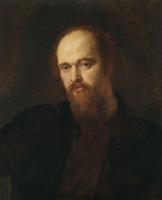
The Diary of George Price Boyce 1851
1st May 1851. The Exhibition procession. Never saw the streets in such a densely crowded state before. Jack in the Greens, acrobats, jugglers, and performances of all descriptions going on.
3rd May 1851. To the Old Water Colour Exhibition. I was delighted with it. Copley Fielding, David Cox [aged 68], W. Hunt and others have some exquisite works.
27th May 1851. To Great Exhibition for first time. The aerial effect of the same enhanced by the rich and brilliant colours of the various fabrics suspended about was more bewitching than I expected accompanied my sisters Ann and Joanna [aged 19] to R. Italian Opera—Beethoven's "Fidelio," the grandest piece of music I had ever heard.
4th June 1851. Called on Wells [aged 22]. Miss Guyson, the model, was with him, a good looking girl. She gave him a ticket for the Portland Gallery, National Institution, which I made use of. A fine picture [See Painting] there by Collinson [aged 26], P.R.B., from the life of St. Elizabeth of Hungary (price £240).
16th June 1851. Went by two "bi" (buses) to Great Exhibition. After going through the India, China, Africa, Persia and Turkey departments, these displaying requisite knowledge and feeling for colour and its right application, and also of greater ingenuity and propriety of design as applied to coloured fabrics and objects than any other in the Exhibition, all the others looked poor, meagre and inharmonious. Took refreshment, sitting opposite the prettiest of all the Hebes, a very pretty fair girl with wavy hair, loving eyes and winning ways.
17th June 1851. Designing Book Plate.
26th June 1851. Went off after breakfast by past 10 bus to Harlesden Green, walked thence through the fields to Willesden Church, of which I took a water-colour sketch, surrounded by small children and other less agreeable nuisances.
8th July 1851. To Mr. Winder's at Tottenham, where I saw the most glorious collection of drawings I ever beheld, mostly firstrate works of Turner's also a fine drawing from about 1800 till within the last few years by an old painter, Girtin.
5th August 1851. (at Bettws-y-Coed [Map]). While sketching, David Cox [aged 68] came and shook hands with me. He has put up here (the "Royal Oak") After dinner I made an evening sketch on grey wrapping-up paper. David Cox saw it and approved.
6th August 1851. Breakfast with Mr. Roberts and Mr. Cox [aged 68]. After dinner strolled out with them, and the former pointed out to me some fine subjects for painting.
10th August 1851. (Sunday). Met Mr. Cox [aged 68] (and Mr. D'Egville M as with him), who took me some way along the road down to the Llegwy to show me a subject. I stopped to listen to some simple and moving singing, in the Welsh Chapel. Mr. Cox uses cobalt for blue sky, French blue and black for shadows of distant ones and black for do. of those at higher angle, cobalt and light red for distance, indigo, gamboge and purple for lake middle distance, brown-pink is merged into foregrounds. He uses Prussian blue in bright greens.
16th August 1851. Mr. Roberts told me some odd tales about Turner and his picture selling; about Cotman, whom he knew, and Crome. He said it was a rule not to have strong colour in foreground or distance, but in middle distance. Mr. Cox [aged 68] uses purple lake and gamboge for foliage in middle distance, and indigo gamboge and burnt sienna for do. in foreground.
26th August 1851. Too wet to go out. Mr. Cox [aged 68] with the greatest kindness gave Mr. Back and myself a lesson in water-colour painting, explaining to us by working two drawings before us, and instructing us in the workings and wherefore his system of gradations. We cast lots for the drawings afterwards on Mr. Cox's proposition. Mr. B. got the prettiest, an idea of Beeston Castle [Map], with a beautiful blue distance and white clouds near horizon. Mine is a mountain subject with flat ground in mid-distance, and a bridge and tree in foreground.
27th August 1851. August 27. Mr. Cox [aged 68] returned from Capel Curig with 4 water colour sketches of rock bits, one on the ½ sheet of imperial which I gave him very fine. He affixed his name in the evening to the sketch he made for me yesterday, in the presence of Messrs. Poole, Bond, Roberts, Hoyle, Back and myself. Completed drawing from Church, which Mr. Cox said looked like a Pre-Raffaelite drawing.
24th September 1851-25. Mr. F. W. Topham [aged 43], who arrived at Bettwys yesterday, made himself very agreeable in the evening, performing several conjuring tricks exceedingly cleverly, to the intense entertainment and astonishment of my boy, Jack, Mary Hughes and her little girl. The mother seemed almost as much frightened as astonished, and to think he had dealings with His Satanic Majesty. I never went into such paroxysms of laughter or at any rate not for a very long time. He swallowed jugs and potatoes .... A very pretty and interesting girl sat for some time in the chimney corner, Elizabeth Pritchard, from Pwlhelly. Mr. Topham also greatly enlivened us by relating Irish adventures and characters met with in Galway, where he had been with Goodall and Fripp, Phillip, etc.
26th September 1851. Went up again, with Messrs. Topham [aged 43] and Fripp, to Transcfon and finished drawing of interior. Had Ellen Pritchard to sit as before in chimney corner, Mr. Topham gave me a few hints on my sketch, using the brush upon it, warming the tone and giving serenity of colour and atmosphere to several parts. He principally used raw sienna, vandyke brown and French blue and yellow ochre. He offered to take me to the Hampstead Conversazione and the Graphic Society?
28th September 1851. September 28. Discussion with Mr. Topham [aged 43] on Ruskin [aged 32], and his opinion seemed to be that he was a very clever writer but no artist, and not having any pretension to constituting himself a judge in art matters.
2nd October 1851. Received notice of my election on Monday last to the Clipstone St. Artists Society rom Mr. Lee, Secretary. Entrance £1 1s., one quarter's subscription, £1 9s. 6d.
23rd October 1851. For the first time attended the Artists' Society in Clipstone Street. Female model (Mrs. May) nude, reclining. Sat next to Mr. Duncan [aged 48], Treasurer. Brought only a small sketch book and made but a hasty pencil sketch. Mr. Topham came in, and introduced me to Mr. Jenkins and Goodall.
27th October 1851. Mr. Trimen called and looked over my sketches. Said he remembered dining with J. M. W. Turner at Mr. -'s. Turner was verry chatty and told Mr. T. that the first money he received for a picture was £3 3s. for a sketch of Walthamstow Church, on which the purchaser found him at work.
At Clipstone Street a large meeting; new model set by Jenkins habited in a Spanish costume and with a guitar. (John Lewis was among those present.)
6th November 1851. At supper tasted some sardines for the first time. Very delicious.
7th November 1851. Commenced etching of Condover Hall.
12th November 1851. Wells [aged 22] came in to see my recent sketches in Wales. Generally they pleased him much, but he found considerable fault with want of masses and realisation in the trees department. We went off to Clipstone Street. Carl Haag sitting next to me. Miss Bine as a French Fisherwoman.
17th November 1851. Finished etching of Condover Hall, and had an impression taken at McQueen's In the evening; it turned out one of the most imperfect I have yet done.
18th November 1851. Wells [aged 22] and I joined in admiring the earnest and persevering study of Millais and Hunt [aged 24], who have been for several months together in a retired part of the country painting minutely from nature the backgrounds to their pictures.
7th December 1851. Mother grieved me much by assuring me that Tom Hake had behaved far more cruelly towards Joanna [aged 20] than I thought or can think possible. She thinks that he has gone so far as to kiss her. Hitherto I have always considered the great attention I have seen him pay to some girls to arrive from natural weakness and thoughtlessness, and I have told him as much. But this fact is without excuse, and most unfeeling. I fear he lets his feelings carry him away so far as to be unable to retreat without wounding the other party. I hope, however, I do not think that Joanna thinks about him and dwells upon his conduct much now.
24th December 1851. Completed etching of bookplate for Warren's brother.

30th December 1851. Called for John Seddon [aged 24] at 10 0'clock, who accompanied me to St. Paul's Cathedral to witness Turner's [deceased] funeral. We first looked over the Cathedral and criticised the wretched taste of the greater part of the monuments, one by Behnes [aged 56] seemed to be almost the only one that was simple, grand, and characteristic. The mourners, consisting of the Members of the Royal Academy and many personal friends, alighted at the west entrance and advanced slowly to the choir preceded by the choristers, etc. Seddon and I obtained a central place in the choir, close to the coffin. The beautiful and awe-striking service for the dead was then gone through, its influence being much augmented by the sublimity of the scene. The body was then conveyed into the vaults, followed by the mourners. Father, who had brought Joanna [aged 20], bought a ticket which admitted us all three into the vaults. I remained to see the stone rolled over him and to assist in adjusting the same—they first threw a basket full of human bones on and beside the coffin before rolling the stone over it. It was placed between the resting places of James Barry, the painter (next to which was that of Sir Joshua Reynolds), and Constantia, the great grand-daughter of Sir Christopher Wren, next to the tomb of Sir Christopher himself.