See Sculptors.
On 10th March 1788 Edward Hodges Baily was born.
In 1806 Edward Hodges Baily [aged 17] and Elizabeth Wardley [aged 18] were married. They had four children.
On 7th February 1827 Bishop George Pelham [aged 60] died at his residence at Connaught Place, Bayswater. He was buried in the Pelham family vault at All Saint's Church, Laughton.
Monument at St Mary's Church, Buckden [Map] to Bishop George Pelham sculpted by Edward Hodges Baily [aged 38].


In 1834 William Calder Marshall [aged 20] enrolled in the Royal Academy where he studied under Francis Leggatt Chantrey [aged 52] and Edward Hodges Baily [aged 45]. In 1835 he was awarded a Silver Medal by the Royal Academy.
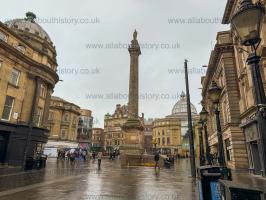
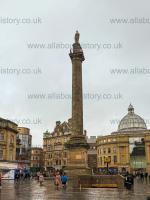
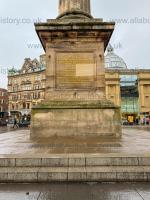
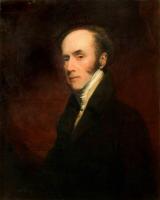
1838. Monument in Grey Square, Newcastle upon Tyne [Map] to Charles Grey 2nd Earl Grey [aged 73] by Edward Hodges Baily [aged 49].

On 17th January 1843 Thomas Botfield [aged 80] died. He was buried at St Michael and All Angels' Church, Hopton Wafers where he and his wife have a fine monument by Edward Hodges Baily [aged 54]. His nephew Beriah Botfield [aged 35] inherited a life interest in Hopton Court, Shropshire.
On 8th March 1858 [his wife] Elizabeth Wardley [aged 70] died.
Cansick's Monumental Inscriptions Volume 2 Highgate Cemetery. Highgate Cemetery. Sacred to the memory of Edward Hodges Baily [aged 69], Esq., R.A., Who died May 22 May, 1867, aged 79 years. Also of Elizabeth [deceased], wife of the said Edward Hodges Baily, Esqre., R.A., Who died March 8th 1858, aged 70 years.
On 22nd May 1867 Edward Hodges Baily [aged 79] died.
St Nicholas Church, Linton [Map]. Britsh Listed Buildings:
Free-standing white marble monument in north-east corner, to the same Charles James Mann, signed by Baily. Young man lying upon Grecian couch. Free-standing marble monument in south-west corner, to Laura, Countess Cornwallis, d.1840, by Baily. Woman, book in hand, turning on couch.