7 Gower Street, Camden St Giles' Church, Wrexham Wallington Hall, Northumberland Cartmel Priory, Lancashire St Mary's Church, Hendon

Thomas Woolner 1825-1892

On 17th December 1825 Thomas Woolner was born to Thomas Woolner and Rebecca Leeks in Hadleigh, Suffolk. He received his first education at Ipswich, but in his boyhood his father removed to London on obtaining an appointment in the post office.

After 1837 William Behnes [aged 42] was tutor to Henry Weekes [aged 29] and Thomas Woolner [aged 11]. So great was Woolner's promise that Behnes agreed to receive him without a premium, on condition that, when sufficiently advanced, he should work for him at something less than the usual rate of pay. He continued with Behnes four years, and in December 1842, at his master's recommendation, entered the schools of the Royal Academy, continuing to be employed by Behnes in his spare time.

In 1843, aged only 17, Thomas Woolner [aged 17] exhibited his first work, a model of Eleanor of Castile sucking the poison from the arm of Prince Edward, the future King Edward I, In 1844 a life-sized group, representing The Death of Boadicea was exhibited in Westminster Hall. In 1845 he gained the Society of Arts' medal for a design representing Affection, a woman with two children. In 1846 a graceful bas-relief of Alastor was exhibited at the academy. The now well-known statuette of Puck, afterwards cast in bronze for Lady Ashburton, was exhibited at the British Institution in 1847, when it attracted the attention of Tennyson.

In September 1847 the Pre-Raphaelite Brotherhood was formed at 7 Gower Street, Camden [Map], the home of John Everett Millais 1st Baronet [aged 18]. The seven founder members were Millais, brothers Dante Gabriel Rossetti [aged 19] and William Michael Rossetti [aged 17], William Holman Hunt [aged 20], James Collinson [aged 22], Frederick George Stephens [aged 19] and Thomas Woolner [aged 21].

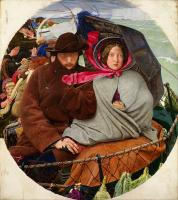
1855. Ford Madox Brown [aged 33]. "The Last of England". Modelled by himself and his wife Emma Matilda Hill [aged 25]. Inspired by the departure to Australia of his friend Thomas Woolner [aged 29].

The Diary of George Price Boyce 1861. May 29. Went down to Epsom by rail and walked to the course. Met Woolner [aged 35] and a brother sculptor, Burnett, John [aged 31] and William [aged 33] Millais, Mr. Abraham Salomon [aged 38] and Mrs. Abraham Salomon and Miss Salomon. Tom Taylor and a lady. When the 18 horses were running for the Derby Stakes and I and Woolner and Burnett were against the ropes on the side the horses took, and we were struck by the thunder and tramping rush of their progress—that was in truth a sublime moment. In the evening adiourned to Cremorne which was densely thronged by men and women in all states of hilarity and inebricty. Met Munro [aged 35] and Ormsby, Poynter, Du Maurier, Millais and Jopling and others.

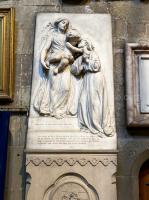
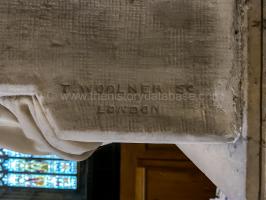
On 9th September 1863 Ellen Mary Palmer died. Monument in St Giles' Church, Wrexham [Map] sculpted by Thomas Woolner [aged 37].

Ellen Mary Palmer: she was born to William Henry Roger Palmer 4th Baronet. On 25th May 1857 Archibald Peel and she were married.

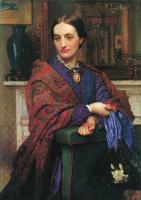
On 6th September 1864 Thomas Woolner [aged 38] and Alice Gertrude Waugh were married. He had previously proposed to her sister Fanny Waugh [aged 31]. They had two sons and four daughters.

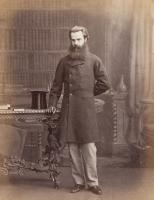
Around 1865 . Unknown Photographer. Photograph of Thomas Woolner [aged 39].

In 1866 [his son] Hugh Woolner was born to Thomas Woolner [aged 40] and [his wife] Alice Gertrude Waugh.

1867 . Thomas Woolner [aged 41]. "Civilization", Wallington Hall, Northumberland [Map].

In November 1875 William Holman Hunt [aged 48] and Marion Edith Waugh [aged 28] were married at Neuchâtel, Switzerland since marrying your late wife's sister was illegal in England - see 1835 Marriage Act. She his [his sister-in-law] first wife's younger sister contrary to English Law; an example of Married to Two Siblings. His brother-in-law Thomas Woolner [aged 49] considered the marriage immoral; they never spoke again.

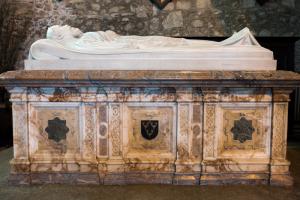
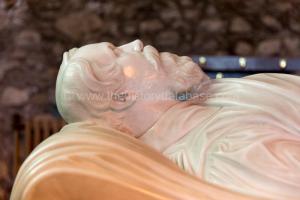
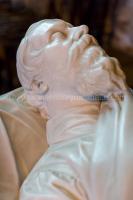
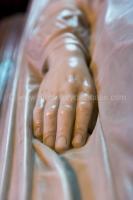
After 6th May 1882. Cartmel Priory, Lancashire [Map]. Monument to Frederick Charles Cavendish [deceased]. Sculpted by Thomas Woolner [aged 56]. Marble effigy on alabaster tomb chest. See Phoenix Park Killings.

The Deeds of the Dukes of Normandy

The Gesta Normannorum Ducum [The Deeds of the Dukes of Normandy] is a landmark medieval chronicle tracing the rise and fall of the Norman dynasty from its early roots through the pivotal events surrounding the Norman Conquest of England. Originally penned in Latin by the monk William of Jumièges shortly before 1060 and later expanded at the behest of William the Conqueror, the work chronicles the deeds, politics, battles, and leadership of the Norman dukes, especially William’s own claim to the English throne. The narrative combines earlier historical sources with firsthand information and oral testimony to present an authoritative account of Normandy’s transformation from a Viking settlement into one of medieval Europe’s most powerful realms. William’s history emphasizes the legitimacy, military prowess, and governance of the Norman line, framing their expansion, including the conquest of England, as both divinely sanctioned and noble in purpose. Later chroniclers such as Orderic Vitalis and Robert of Torigni continued the history, extending the coverage into the 12th century, providing broader context on ducal rule and its impact. Today this classic work remains a foundational source for understanding Norman identity, medieval statesmanship, and the historical forces that reshaped England and Western Europe between 800AD and 1100AD.

Available at Amazon in eBook and Paperback format.

On 7th October 1892 Thomas Woolner [aged 66] died somewhat suddenly, following an internal complaint from which he seemed to be recovering. He was buried in the churchyard at St Mary's Church, Hendon [Map].