Chronicle of Walter of Guisborough

A canon regular of the Augustinian Guisborough Priory, Yorkshire, formerly known as The Chronicle of Walter of Hemingburgh, describes the period from 1066 to 1346. Before 1274 the Chronicle is based on other works. Thereafter, the Chronicle is original, and a remarkable source for the events of the time. This book provides a translation of the Chronicle from that date. The Latin source for our translation is the 1849 work edited by Hans Claude Hamilton. Hamilton, in his preface, says: 'In the present work we behold perhaps one of the finest samples of our early chronicles, both as regards the value of the events recorded, and the correctness with which they are detailed; Nor will the pleasing style of composition be lightly passed over by those capable of seeing reflected from it the tokens of a vigorous and cultivated mind, and a favourable specimen of the learning and taste of the age in which it was framed.'

Available at Amazon in eBook and Paperback format.

Canterbury, Kent Christchurch Priory St Andrew's Church, Great Billing St Andrew's Church, Quatt

Henry Weekes 1807-1877

See Sculptors.

On 14th January 1807 Henry Weekes was born in Canterbury, Kent [Map].

After 1837 William Behnes [aged 42] was tutor to Henry Weekes [aged 29] and Thomas Woolner [aged 11]. So great was Woolner's promise that Behnes agreed to receive him without a premium, on condition that, when sufficiently advanced, he should work for him at something less than the usual rate of pay. He continued with Behnes four years, and in December 1842, at his master's recommendation, entered the schools of the Royal Academy, continuing to be employed by Behnes in his spare time.

Before 1841 Henry Weekes [aged 33] worked for William Behnes [aged 45] and Francis Leggatt Chantrey [aged 59].

In 1841 Henry Weekes [aged 33] took over the studio of Francis Leggatt Chantrey [aged 59].

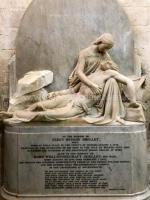
1854. Monument to Percy Bysshe Shelley in Christchurch Priory [Map]. Sculpted by Henry Weekes [aged 46]. The monument possibly contains Shelley's heart, possibly liver, which resisted cremation and was retrieved by Edward Trelawny who was present at the cremation.

The monument verse forty of fifty-five of Shelley's Adonais: An Elegy on the Death of John Keats, Author of Endymion, Hyperion, etc:

He has out-soared the shadow of our night;

Envy and calumny, and hate and pain,

And that unrest which men miscall delight,

Can touch him not and torture not again;

From the contagion of the world's slow stain.

He is secure, and now can never mourn.

A heart grown cold, a head grown gray in vain;

Nor when the spirit's self has ceased to burn,

With sparkless ashes load an unlamented urn.

Click to read more ...

In 1877 Henry Weekes [aged 69] died.

St Andrew's Church, Great Billing [Map]. Monument to Robert Elwes by Henry Weekes..

St Andrew's Church, Ashton-on-Ribble. Marble monument to Captain Thomas Pedder, who died at the Relief of Lucknow, by Henry Weekes.

St Andrew's Church, Quatt [Map]. Monument to William Whitmore by Henry Weekes.