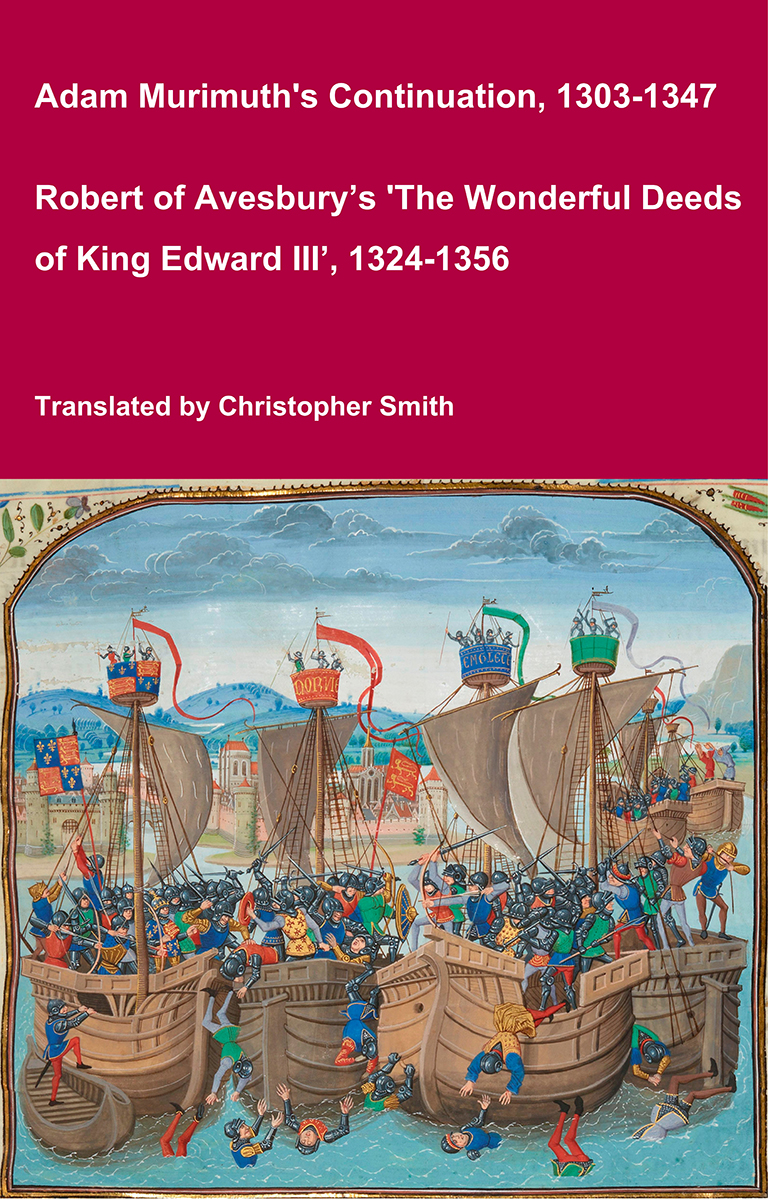
Adam Murimuth's Continuation and Robert of Avesbury’s 'The Wonderful Deeds of King Edward III'

This volume brings together two of the most important contemporary chronicles for the reign of Edward III and the opening phases of the Hundred Years’ War. Written in Latin by English clerical observers, these texts provide a vivid and authoritative window into the political, diplomatic, and military history of fourteenth-century England and its continental ambitions. Adam Murimuth Continuatio's Chronicarum continues an earlier chronicle into the mid-fourteenth century, offering concise but valuable notices on royal policy, foreign relations, and ecclesiastical affairs. Its annalistic structure makes it especially useful for establishing chronology and tracing the development of events year by year. Complementing it, Robert of Avesbury’s De gestis mirabilibus regis Edwardi tertii is a rich documentary chronicle preserving letters, treaties, and official records alongside narrative passages. It is an indispensable source for understanding Edward III’s claim to the French crown, the conduct of war, and the mechanisms of medieval diplomacy. Together, these works offer scholars, students, and enthusiasts a reliable and unembellished account of a transformative period in English and European history. Essential for anyone interested in medieval chronicles, the Hundred Years’ War, or the reign of Edward III.

Available at Amazon in eBook and Paperback format.

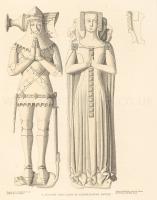
Effigy of a Basset and Lady at Atherington

Effigy of a Basset and Lady at Atherington is in Monumental Effigies of Great Britain.

THIS ancient family, of which two branches were settled in the county of Devon, possessed the manor of Umberleigh, in the parish of Atherington, where they had a mansion. That renowned monarch of the Saxon dynasty, Athelstan, is said to have had a palace at the same place, and to have endowed the churches of Atherington and Bickington adjoining parishes, with land and other privileges.

Note a. Risdon gives the laconic form of the grant, which should put the scribes of modern instruments to the blush, "Ich, Athelstan, King Grome of this home, geve and graunt to the Preste of this Chirch, one yoke of land freely to hold, wood in my holt house to build, bytt (i. e. biting) grass for all his beasts, fuel for his hearth, pannage for his sow and pigs, world without end. Amen."

Polwhele says that these are the effigies of "Sir Arthur Basset and Elinora his wife". It appears from Mr. Stothard's journal of his journey into Devon, in May 1821, in search of subjects for his work, that this was the last monument he ever drew, but four days before the fatal accident which terminated his mortal career. He speaks of the effigy of a knight, in the style of that of William Longespee, as being brought from the ruins of Umberleigh, in the neighbourhood, and placed in Atherington church. He continues: "Besides this figure, there is a tomb on the north side of the church for a Knight and Lady temp. Richard II. The arms on his surcoat, a saltire vaire. By a repetition of the last in another part of the church, I could ascertain that the held was Gules. Prince describes the coat of Basset as barry wavy of six Or and Gules. Crest, an unicorn's head, on the neck two bars indented Gules. The figure of the knight presents the novel appendage of a mantelet, or covering for the camail, adorned with a scallopped border, similarly to the surcoat. On his basinet is a jewelled circlet, or wreath, ornamented with roses. The coiffure of the female is a fret of the square form, the frontlet of which bears a row of 00's, probably as the initial letter of the blessed Virgin's name. Mr. Stothard's original drawing has been very faithfully followed in the etching; but no needle but his own could give an idea of its pure taste and elegant precision.

Details. Side view of part of the head, the fret and coif.