Barry is in Field.
Barry is a number of horizontal stripes.
Around 1577 George Gower [aged 37]. Portrait of Richard Drake [aged 42]. The heraldic escutcheon shows seven quarters as follows:
1:
Drake of Ash Arms. Drake of Ash in the parish of Musbury, Devon.
2: Argent, on a chief gules three cinquefoils of the first; Billet of Ash.
3: Gules, on a fess argent two mullets sable; Hamton of Rockbere and Ash.
4: Ermine, on a chief indented sable three crosslets fitchee or; Orwey of Orwey and Ash.
5: Barry of seven argent and sable.
6: Azure, six lions rampant argent crowned Gules, 3, 2, 1; Forde of Forde.
7: Argent, two chevrons sable (Esse/Ash of Ash); Esse or Ash of Ash.
Lovell Arms. Barry nebuly of six or and gules. Source.
Basset Arms. Barry wavy of six or and gules.
Lusignan Arms. Barry argent and azure. Source.
Brandon Arms. Barry of ten argent and gules, a lion rampant or ducally crowned per pale of the first and second. Source.
Mortimer Arms. Barry or and azure, on a chief of the first two pallets between two base esquires of the second over all an inescutcheon argent. Source.
Chaworth Arms. Barry argent and gules over three martlets.
Oldenburg Arms. Barry or and gules. Source.
The Deeds of the Dukes of Normandy
The Gesta Normannorum Ducum [The Deeds of the Dukes of Normandy] is a landmark medieval chronicle tracing the rise and fall of the Norman dynasty from its early roots through the pivotal events surrounding the Norman Conquest of England. Originally penned in Latin by the monk William of Jumièges shortly before 1060 and later expanded at the behest of William the Conqueror, the work chronicles the deeds, politics, battles, and leadership of the Norman dukes, especially William’s own claim to the English throne. The narrative combines earlier historical sources with firsthand information and oral testimony to present an authoritative account of Normandy’s transformation from a Viking settlement into one of medieval Europe’s most powerful realms. William’s history emphasizes the legitimacy, military prowess, and governance of the Norman line, framing their expansion, including the conquest of England, as both divinely sanctioned and noble in purpose. Later chroniclers such as Orderic Vitalis and Robert of Torigni continued the history, extending the coverage into the 12th century, providing broader context on ducal rule and its impact. Today this classic work remains a foundational source for understanding Norman identity, medieval statesmanship, and the historical forces that reshaped England and Western Europe between 800AD and 1100AD.
Available at Amazon in eBook and Paperback format.
Poynings Arms. Barry of six or and vert a bend gules. Source.
Hungerford Arms. Barry sable and argent in chief three plates. Source.
Poyntz Arms. Barry of eight or and gules.
Hotham Arms. Barry of ten argent and azure, on a canton or a Cornish chough proper. Source.
Boteville Arms. Barry of ten or and sable. Source.
Grey Arms. Barry of six argent and azure, in chief three torteaux. Source.
Blount Arms. Barry nebuly of six or and sable. Source.
Anne Boleyn. Her Life as told by Lancelot de Carle's 1536 Letter.
In 1536, two weeks after the execution of Anne Boleyn, her brother George and four others, Lancelot du Carle, wrote an extraordinary letter that described Anne's life, and her trial and execution, to which he was a witness. This book presents a new translation of that letter, with additional material from other contemporary sources such as Letters, Hall's and Wriothesley's Chronicles, the pamphlets of Wynkyn the Worde, the Memorial of George Constantyne, the Portuguese Letter and the Baga de Secrets, all of which are provided in Appendices.
Available at Amazon in eBook and Paperback format.
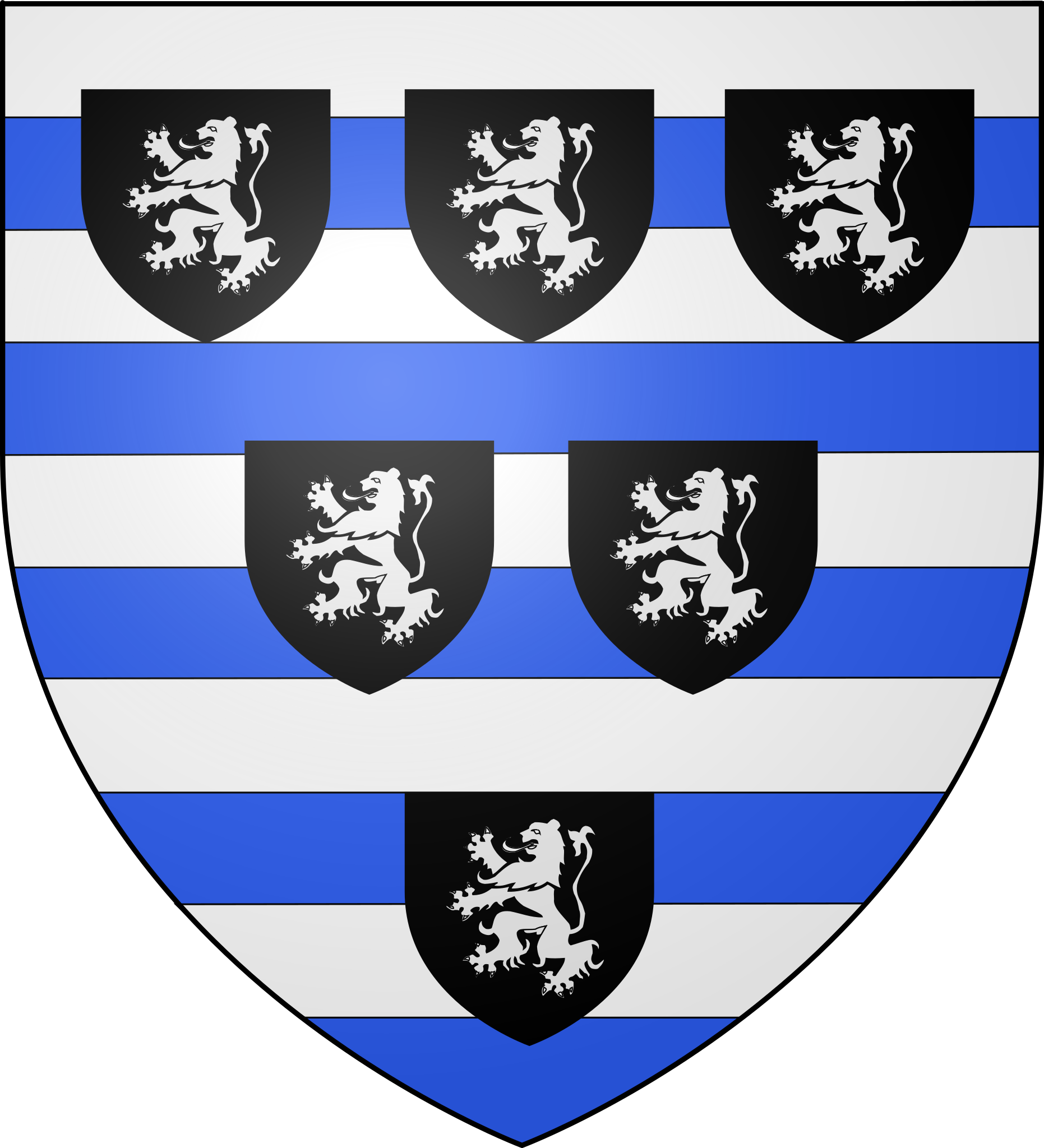
Cecil Arms. Barry of ten argent and azure six escutcheons sable, 3, 2, 1 each charged with a lion rampant argent langued gules. Source.