

Bend is in Ordinaries.
See: Bend Argent, Bend Azure, Bend Cotised, Bend Engrailed, Bend Gules, Bend Lozengy, Bend Or, Bend Sable.
 Chaucer Arms. Per Pale argent and gules, a bend counterchanged. Source.
 Ferneley Arms. Or, on a bend vert three buck's heads caboshed argent.
 Foljambe Arms. Sable a bend between six escallops or.
 Blois Arms. Azure a bend argent cotised. Source.
 Bohun Arms. Azure, a bend argent cotised or between six lions rampant or. Source.
 Freschville Arms. Azure, bend argent between six escallops.
 Hervey Arms. Gules, on a bend argent three trefoils slipped vert, Source.
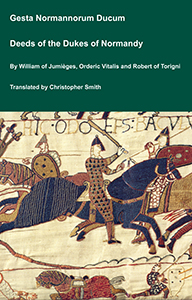
The Deeds of the Dukes of Normandy
The Gesta Normannorum Ducum [The Deeds of the Dukes of Normandy] is a landmark medieval chronicle tracing the rise and fall of the Norman dynasty from its early roots through the pivotal events surrounding the Norman Conquest of England. Originally penned in Latin by the monk William of Jumièges shortly before 1060 and later expanded at the behest of William the Conqueror, the work chronicles the deeds, politics, battles, and leadership of the Norman dukes, especially William’s own claim to the English throne. The narrative combines earlier historical sources with firsthand information and oral testimony to present an authoritative account of Normandy’s transformation from a Viking settlement into one of medieval Europe’s most powerful realms. William’s history emphasizes the legitimacy, military prowess, and governance of the Norman line, framing their expansion, including the conquest of England, as both divinely sanctioned and noble in purpose. Later chroniclers such as Orderic Vitalis and Robert of Torigni continued the history, extending the coverage into the 12th century, providing broader context on ducal rule and its impact. Today this classic work remains a foundational source for understanding Norman identity, medieval statesmanship, and the historical forces that reshaped England and Western Europe between 800AD and 1100AD.
Available at Amazon in eBook and Paperback format.
 Howard Arms. Gules bend argent six crosslets fitchy. Source.
 Howard Augmented Arms. Gules bend argent six crosslets fitchy augmented after the Battle of Flodden with an inescutcheon bearing the lion of Scotland pierced through the mouth with an arrow. Source.
 Lake Arms. Sable, a bend argent six crosslets fitchy.
 Liddell Arms. Gules, on a bend argent, three mullets sable. Source.
 Denison Arms. Ermine, a bend azure cotised sable between a unicorn's head erased in chief and a cross crosslet fitchy in base gules. Source.
 Fitzpayn Arms. Gules, three lions passant guardant argent, overall a bend azure. Source.
 Harding Arms. Or, a bend azure three martlets argent.
 Scott Arms. Or, on a bend azure a mullet of six points between two crescents of the field. Source.
 Leslie Arms. Argent, on a bend azure three buckles or. Source.
 Slanning Arms. Argent, two pales engrailed gules over all on a bend azure three griffin's heads or.
Abbot John Whethamstede’s Chronicle of the Abbey of St Albans
Abbot John Whethamstede's Register aka Chronicle of his second term at the Abbey of St Albans, 1451-1461, is a remarkable text that describes his first-hand experience of the beginning of the Wars of the Roses including the First and Second Battles of St Albans, 1455 and 1461, respectively, their cause, and their consequences, not least on the Abbey itself. His text also includes Loveday, Blore Heath, Northampton, the Act of Accord, Wakefield, and Towton, and ends with the Coronation of King Edward IV. In addition to the events of the Wars of the Roses, Abbot John, or his scribes who wrote the Chronicle, include details in the life of the Abbey such as charters, letters, land exchanges, visits by legates, and disputes, which provide a rich insight into the day-to-day life of the Abbey, and the challenges faced by its Abbot.
Available at Amazon in eBook and Paperback format.
 Stanley Arms. Argent, a bend azure three buck's heads caboshed or. Source.
 Bingham Arms. Azure a bend cotised between six crosses pattee or. Source.
 Dawnay Arms. Argent on a bend cotised sable three annulets of the field. Source.
 Earl Shaftesbury Arms. Quarterly: 1&4
  Ashley Arms; 2&3: gules, a bend engrailed between six lions rampant or (Cooper). Source.
 Culpepper Arms. Argent, a bend engrailed gules. Source.
 Fortescue Arms. Azure a bend engrailed argent cotised or. Source.
 Radclyffe Arms. Argent, a bend engrailed sable. Source.
 Tempest Arms. Argent, a bend engrailed between six martlets sable. Source.
 Davers Arms. Argent, a bend gules three martlets or. Source.
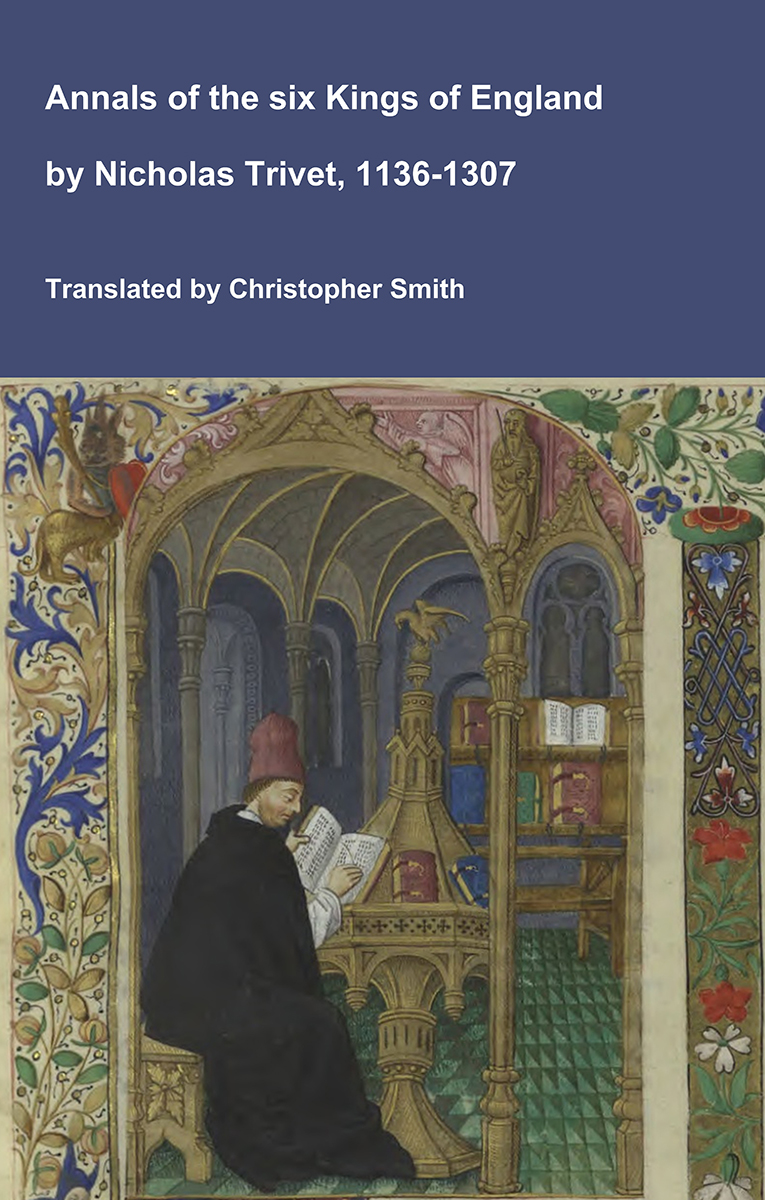
Annals of the six Kings of England by Nicholas Trivet
Translation of the Annals of the Six Kings of England by that traces the rise and rule of the Angevin aka Plantagenet dynasty from the mid-12th to early 14th century. Written by the Dominican scholar Nicholas Trivet, the work offers a vivid account of English history from the reign of King Stephen through to the death of King Edward I, blending political narrative with moral reflection. Covering the reigns of six monarchs—from Stephen to Edward I—the chronicle explores royal authority, rebellion, war, and the shifting balance between crown, church, and nobility. Trivet provides detailed insight into defining moments such as baronial conflicts, Anglo-French rivalry, and the consolidation of royal power under Edward I, whose reign he describes with particular immediacy. The Annals combines careful year-by-year reporting with thoughtful interpretation, presenting history not merely as a sequence of events but as a moral and political lesson. Ideal for readers interested in medieval history, kingship, and the origins of the English state, this chronicle remains a valuable and accessible window into the turbulent world of the Plantagenet kings.
Available at Amazon in eBook and Paperback format.
 Furnival Arms. Argent, a bend gules six martlets gules. Source.
 Halswell Arms. Azure, three bars wavy argent over all a bend gules. Source
 Poynings Arms. Barry of six or and vert a bend gules. Source.
 Wendesley Arms. Ermine, on a bend gules three escallops argent. Source.
 Wingfield Arms. Argent, a bend gules three wings conjoined in lure of the field. Source.
In September 1389 the Scrope vs Grosvenor Case was brought to the Court of Chivalry. Up to that time two families, Scrope and Grosvenor, had been using the armorial  Scrope Arms: Azure, a bend or.
Several hundred witnesses were called including John of Gaunt 1st Duke Lancaster [aged 49], Geoffrey Chaucer [aged 46] and John Savile of Shelley and Golcar [aged 64].
On 3rd September 1386 Owain ap Gruffudd "Glyndŵr" Mathrafal Prince Powys [aged 27] gave evidence at the Church of John the Baptist, Chester [Map].
The Court decided in favour of Scrope.
Neither party was happy with the decision so King Richard II [aged 22] was called upon to give his personal verdict.
On 27th May 1390 he confirmed that Grosvenor could not bear the undifferenced arms.
As a consequence of the case the Grosvenor has for many years used the name Bendor for horses and nicknames.


 Brabazon Arms. Gules on a bend or three martlets sable. Source.
Scrope Arms. Azure, a bend or. Source.
 Stourton Arms. Sable, a bend or between six fountains. Source.
 Browne Arms. Sable a bend sable cotised three lions rampant argent. Source.
 Carey Arms. Argent, a bend sable, three roses of the first. Source.
The Deeds of the Dukes of Normandy
The Gesta Normannorum Ducum [The Deeds of the Dukes of Normandy] is a landmark medieval chronicle tracing the rise and fall of the Norman dynasty from its early roots through the pivotal events surrounding the Norman Conquest of England. Originally penned in Latin by the monk William of Jumièges shortly before 1060 and later expanded at the behest of William the Conqueror, the work chronicles the deeds, politics, battles, and leadership of the Norman dukes, especially William’s own claim to the English throne. The narrative combines earlier historical sources with firsthand information and oral testimony to present an authoritative account of Normandy’s transformation from a Viking settlement into one of medieval Europe’s most powerful realms. William’s history emphasizes the legitimacy, military prowess, and governance of the Norman line, framing their expansion, including the conquest of England, as both divinely sanctioned and noble in purpose. Later chroniclers such as Orderic Vitalis and Robert of Torigni continued the history, extending the coverage into the 12th century, providing broader context on ducal rule and its impact. Today this classic work remains a foundational source for understanding Norman identity, medieval statesmanship, and the historical forces that reshaped England and Western Europe between 800AD and 1100AD.
Available at Amazon in eBook and Paperback format.
 Clavering Arms. Quarterly, or and gules, a bend sable. Source.
 Savile Arms. Argent, a bend sable three owls of the same. Source.
 Spencer Arms. Quarterly 1&4: Argent, 2&3: Gules, a fret or, over all a bend sable.


.svg)


.svg)

.svg)


.svg)





.svg)


.svg)
#/media/File:Blason_Thomas_Le_Despencer.svg)

.svg)