Acheson to Ayscough

Acheson to Ayscough is in Armorials.

Adams Arms

Addington Arms

Addington Arms. Per pale ermine and ermines a chevron charged with five lozenges counterchanged between three fleurs-de-lys or. Source.

Angoulême Arms

NO IMAGE. Lozengy or and gules. Source.

Aragon Arms

Aragon Arms. Or, four pallets gules. Source.

Arden Arms

Arundell Arms

Ashley Arms

Chronicle of Abbot Ralph of Coggeshall

The Chronicle of Abbot Ralph of Coggeshall (Chronicon Anglicanum) is an indispensable medieval history that brings to life centuries of English and European affairs through the eyes of a learned Cistercian monk. Ralph of Coggeshall, abbot of the Abbey of Coggeshall in Essex in the early 13th century, continued and expanded his community’s chronicle, documenting events from the Norman Conquest of 1066 into the tumultuous reign of King Henry III. Blending eyewitness testimony, careful compilation, and the monastic commitment to record-keeping, this chronicle offers a rare narrative of political intrigue, royal power struggles, and social upheaval in England and beyond. Ralph’s work captures the reigns of pivotal figures such as Richard I and King John, providing invaluable insights into their characters, decisions, and the forces that shaped medieval rule. More than a simple annal, Chronicon Anglicanum conveys the texture of medieval life and governance, making it a rich source for scholars and readers fascinated by English history, monastic authorship, and the shaping of the medieval world.

Available at Amazon in eBook and Paperback format.

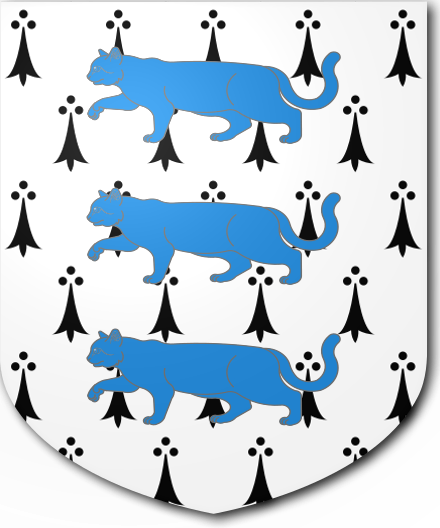
Ashley Arms. Argent three bulls passant sable, armed and unguled or.

Earl Shaftesbury Arms

Earl Shaftesbury Arms. Quarterly: 1&4 Ashley Arms; 2&3: gules, a bend engrailed between six lions rampant or (Cooper). Source.

Atholl Arms

Duke Atholl Arms

Duke Atholl Arms. Earl Atholl Arms overall, an inescutcheon en surtout azure three mullets argent within a double tressure flory or ensigned of a Marquess's coronet. Source.

Earl Atholl Arms

Earl Dunmore Arms

Marquess Atholl Arms

Audley Arms

Audley of Walden Arms

Audley of Walden Arms. Quarterly per pale indented or and azure, in the 2nd and 3rd an eagle displayed of the 1st on a bend of the 2nd a fret between two martlets of the 1st. The fret or knot is a reference to the arms of Audley Arms, which family died out in the male line in 1391. Source.

Avenell Arms

Avenell Arms. Argent, a fess between five annulets gules. Modified from source.

Around 1400. Window in the Chicheley Chapel at St Andrew's Church, Wimpole [Map] from the late 14th early 15th Century depicting alliances of the Ufford family (who are thought to have owned the manor of Wimpole before the Chicheleys) and the Plantagenets through the marriage of Ralph Ufford and Maud Plantagenet Countess Ulster, daughter of Henry Plantagenet 3rd Earl of Leicester 3rd Earl Lancaster .

From top to bottom, left to right:

Tiptoft Arms. The Tiptoft family owned the nearby manor of Harleston.

Bardolf Arms.

Avenell Arms. The Avenell family once held a manor in Wimpole.

Telemache Arms.

Ufford Arms. Believed to be the arms of William Ufford 2nd Earl Suffolk. Note the difference of an annulet argent (white) in the top left corner.

Bohun Arms. Possibly William Bohun 1st Earl of Northampton.

Henry Plantagenet 3rd Earl of Leicester 3rd Earl Lancaster 1281 1345 Arms. Possibly Henry Plantagenet 3rd Earl of Leicester 3rd Earl Lancaster although the label doesn't appear to have the fleur de lys of France.

Bassingbourne Arms.

Engaine Arms. John de Engaine lived in Huntingdonshire.

Lisle Arms. Possibly Robert Lisle 1st Baron Lisle. Robert settled at nearby Rampton.

Robert Ufford 1st Earl Suffolk who married Margaret Norwich Countess Suffolk whose father Walter Norwich owned the manor of Cobbs in Wimpole.

Ufford Arms with a label three points. Believed to be Robert Ufford who predeceased his father Robert Ufford 1st Earl Suffolk.

Bassingbourne Arms.

The figure in the middle is believed to represent William Ufford 2nd Earl Suffolk.

From an original description by James C Powell 1903.

Aylesbury Arms

Chronicle of a Bourgeois of Valenciennes

Récits d’un bourgeois de Valenciennes aka The Chronicle of a Bourgeois of Valenciennes is a vivid 14th-century vernacular chronicle written by an anonymous urban chronicler from Valenciennes in the County of Hainaut. It survives in a manuscript that describes local and regional history from about 1253 to 1366, blending chronology, narrative episodes, and eyewitness-style accounts of political, military, and social events in medieval France, Flanders, and the Low Countries. The work begins with a chronological framework of events affecting Valenciennes and its region under rulers such as King Philip VI of France and the shifting allegiances of local nobility. It includes accounts of conflicts, sieges, diplomatic manoeuvres, and the impact of broader struggles like the Hundred Years’ War on urban life in Hainaut. Written from the perspective of a burgher (bourgeois) rather than a monastery or royal court, the chronicle offers a rare lay viewpoint on high politics and warfare, reflecting how merchants, townspeople, and civic institutions experienced the turbulence of the 13th and 14th centuries. Its narrative style combines straightforward reporting of events with moral and civic observations, making it a valuable source for readers interested in medieval urban society, regional politics, and the lived experience of war and governance in pre-modern Europe.

Available at Amazon in eBook and Paperback format.

Ayscough Arms

Ayscough Arms. Sable, a fess or, between three asses passant argent, maned and unguled of the second. Source.