

Chevron is in Charges.
See: Chevron Argent, Chevron Engrailed, Chevron Ermine, Chevron Gules, Chevron Or, Chevron Sable, Chevrons.
Chevron. A v-shape, pointing upwards unless specified inverted.
 Monck Arms. Gules, a chevron between three lion's heads erased argent. Source.
 Berkeley Arms. Gules a chevron between ten crosses pattee six in chief and four in base argent.
 Mordaunt Arms. Argent, a chevron between three estoiles sable. Source.
 Chicheley Arms. Or, a chevron between three cinquefoils gules. Source.
 Mosley Arms. Sable a chevron between three pickaxes argent. Source.
 Finch Arms. Argent, a chevron between three griffins passant sable. Source.
 Ponsonby Arms. Gules, a chevron between three combs argent. Source.
 Rich Arms. Gules, a chevron between three crosses botonée or. Source.
Chronicle of Walter of Guisborough
A canon regular of the Augustinian Guisborough Priory, Yorkshire, formerly known as The Chronicle of Walter of Hemingburgh, describes the period from 1066 to 1346. Before 1274 the Chronicle is based on other works. Thereafter, the Chronicle is original, and a remarkable source for the events of the time. This book provides a translation of the Chronicle from that date. The Latin source for our translation is the 1849 work edited by Hans Claude Hamilton. Hamilton, in his preface, says: 'In the present work we behold perhaps one of the finest samples of our early chronicles, both as regards the value of the events recorded, and the correctness with which they are detailed; Nor will the pleasing style of composition be lightly passed over by those capable of seeing reflected from it the tokens of a vigorous and cultivated mind, and a favourable specimen of the learning and taste of the age in which it was framed.'
Available at Amazon in eBook and Paperback format.
 Lyttleton Arms. Argent, a chevron between three escallops sable. Source.
 Robinson Arms. Vert, a chevron between three bucks at gaze or. Source.
 Braye Arms. Argent, a chevron between three eagle's legs erased sable. Source.
 Tilney Arms. Azure, a chevron between three griffin's heads erased or. Source.
 Mansel Arms. Argent, a chevron between three maunches. Source.
 Fanshawe Arms. Or a chevron between three fleur de lys sable. Source.
 Littleton Arms. Argent, a chevron between three escallops sable. Source.
 Trefusis Arms. Argent, a chevron between three spindles sable. Source.
 Wyndham Arms. Azure, a chevron between three lion's heads erased or.
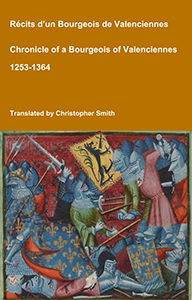
Chronicle of a Bourgeois of Valenciennes
Récits d’un bourgeois de Valenciennes aka The Chronicle of a Bourgeois of Valenciennes is a vivid 14th-century vernacular chronicle written by an anonymous urban chronicler from Valenciennes in the County of Hainaut. It survives in a manuscript that describes local and regional history from about 1253 to 1366, blending chronology, narrative episodes, and eyewitness-style accounts of political, military, and social events in medieval France, Flanders, and the Low Countries. The work begins with a chronological framework of events affecting Valenciennes and its region under rulers such as King Philip VI of France and the shifting allegiances of local nobility. It includes accounts of conflicts, sieges, diplomatic manoeuvres, and the impact of broader struggles like the Hundred Years’ War on urban life in Hainaut. Written from the perspective of a burgher (bourgeois) rather than a monastery or royal court, the chronicle offers a rare lay viewpoint on high politics and warfare, reflecting how merchants, townspeople, and civic institutions experienced the turbulence of the 13th and 14th centuries. Its narrative style combines straightforward reporting of events with moral and civic observations, making it a valuable source for readers interested in medieval urban society, regional politics, and the lived experience of war and governance in pre-modern Europe.
Available at Amazon in eBook and Paperback format.
 Fox Arms. Ermine, on a chevron azure three fox's heads and necks erased or on a canton of the second a fleur de lys of the third. The canton is an augmentation of honour to his paternal arms, granted out of the Royal Arms as a mark of esteem to him and his heirs forever, by King Charles II following the Restoration of the Monarchy. Source.


 Brooke Arms. Gules, on a chevron argent a lion rampant sable crowned or. Source.
 Carr Arms. Gules, on a chevron argent, three mullets, of the field.
 Knollys Arms. Gules, on a chevron argent, three roses gules, barbed and seeded proper. Source.
 Loftus Arms. Sable, a chevron engrailed ermine, between three trefoils slipped argent. Source.
 Child Villiers Arms. Quarterly 1&4
  Villiers Arms and 2&3 Child Arms gules a chevron engrailed ermine between three eaglets argent gorged or. Source.
 Watson Arms. Argent, on a chevron engrailed azure between three martlets sable as many crescents or. Source.
 Baron Annaly Arms. Argent, on a chevron engrailed gules, between three roses of the last, a cross crosslet or. Source.
The History of William Marshal was commissioned by his son shortly after William’s death in 1219 to celebrate the Marshal’s remarkable life; it is an authentic, contemporary voice. The manuscript was discovered in 1861 by French historian Paul Meyer. Meyer published the manuscript in its original Anglo-French in 1891 in two books. This book is a line by line translation of the first of Meyer’s books; lines 1-10152. Book 1 of the History begins in 1139 and ends in 1194. It describes the events of the Anarchy, the role of William’s father John, John’s marriages, William’s childhood, his role as a hostage at the siege of Newbury, his injury and imprisonment in Poitou where he met Eleanor of Aquitaine and his life as a knight errant. It continues with the accusation against him of an improper relationship with Margaret, wife of Henry the Young King, his exile, and return, the death of Henry the Young King, the rebellion of Richard, the future King Richard I, war with France, the death of King Henry II, and the capture of King Richard, and the rebellion of John, the future King John. It ends with the release of King Richard and the death of John Marshal.
Available at Amazon in eBook and Paperback format.
 Beaumont Arms. Chequy or and azure a chevron ermine. Source.
 Blennerhassett Arms. Gules, a chevron ermine, between three dolphins naiant embowed argent. Source.
 Clotworthy Arms. Azure, a chevron ermine between three chaplets or. Source.
 Gresham Arms. Argent, a chevron ermine between three mullets pierced sable.
 Townshend Arms. Azure, a chevron ermine between three escallops argent. Source.
 Turner Baronets Arms. Sable, a chevron ermine between three fers de moline or on a chief argent a lion passant gules. Source.
 Tuchet Arms. Ermine, a chevron gules. Source.
 Brudenell Arms. Argent, a chevron gules between three morion caps azure pointed to the sinister. Source.
 Boleyn Arms. Argent, a chevron gules between three bull's heads afrontée. Source.

Anne Boleyn. Her Life as told by Lancelot de Carle's 1536 Letter.
In 1536, two weeks after the execution of Anne Boleyn, her brother George and four others, Lancelot du Carle, wrote an extraordinary letter that described Anne's life, and her trial and execution, to which he was a witness. This book presents a new translation of that letter, with additional material from other contemporary sources such as Letters, Hall's and Wriothesley's Chronicles, the pamphlets of Wynkyn the Worde, the Memorial of George Constantyne, the Portuguese Letter and the Baga de Secrets, all of which are provided in Appendices.
Available at Amazon in eBook and Paperback format.
 Gorges Arms. Lozengy or and azure, a chevron gules. Source.
 Newport Arms. Argent, a chevron gules between three leopard's faces sable. Source.
 Stafford Arms. Or, a chevron gules.
 Belasyse Arms. Argent a chevron gules between three fleur de lys azure. Source.
 Barkham Arms. Paly argent and gules a chevron or.
 Cobham Arms. Gules a chevron or three lions rampant sable. Source.
 Danvers Arms. Gules a chevron or three estoiles. Source.
 Wentworth Arms. Sable, a chevron or three leopard's faces or. Source.
 Wodehouse Arms. Sable a chevron or between three cinquefoils. Source.
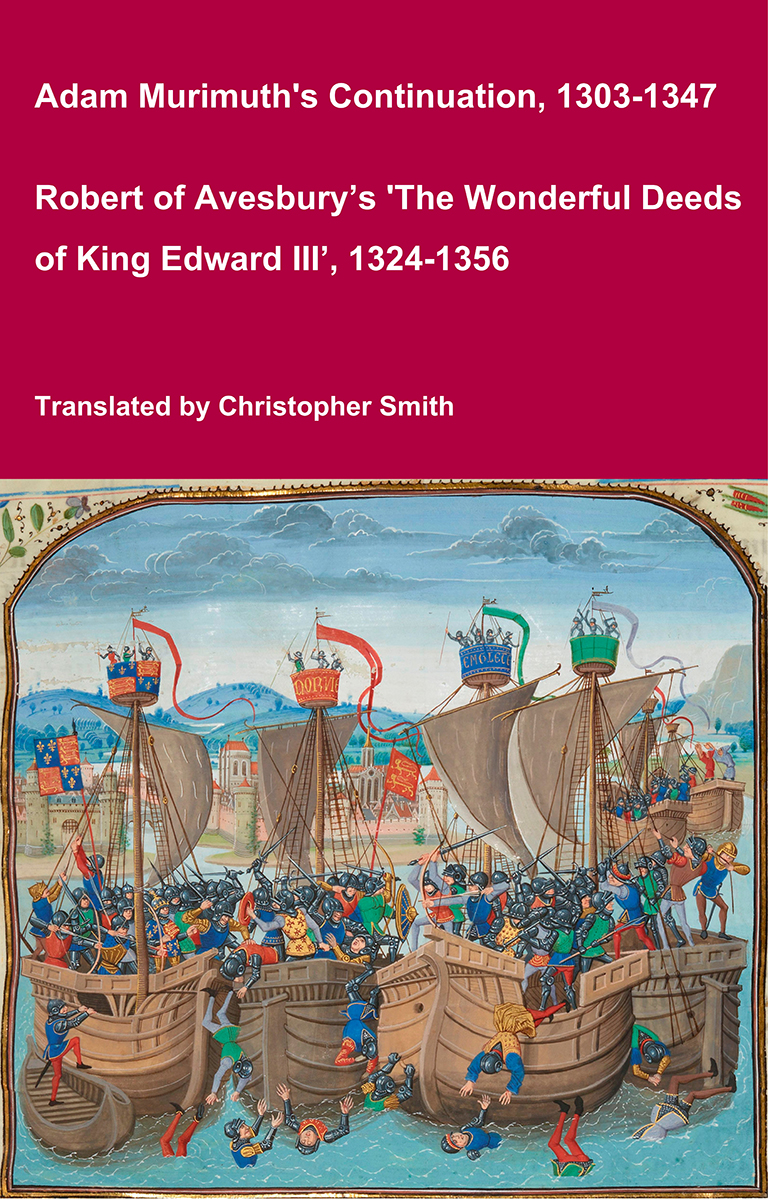
Adam Murimuth's Continuation and Robert of Avesbury’s 'The Wonderful Deeds of King Edward III'
This volume brings together two of the most important contemporary chronicles for the reign of Edward III and the opening phases of the Hundred Years’ War. Written in Latin by English clerical observers, these texts provide a vivid and authoritative window into the political, diplomatic, and military history of fourteenth-century England and its continental ambitions. Adam Murimuth Continuatio's Chronicarum continues an earlier chronicle into the mid-fourteenth century, offering concise but valuable notices on royal policy, foreign relations, and ecclesiastical affairs. Its annalistic structure makes it especially useful for establishing chronology and tracing the development of events year by year. Complementing it, Robert of Avesbury’s De gestis mirabilibus regis Edwardi tertii is a rich documentary chronicle preserving letters, treaties, and official records alongside narrative passages. It is an indispensable source for understanding Edward III’s claim to the French crown, the conduct of war, and the mechanisms of medieval diplomacy. Together, these works offer scholars, students, and enthusiasts a reliable and unembellished account of a transformative period in English and European history. Essential for anyone interested in medieval chronicles, the Hundred Years’ War, or the reign of Edward III.
Available at Amazon in eBook and Paperback format.
 Wodehouse Augmented Arms. Wodehouse Arms augmented with a chevron or guttée de sang. The Wodehouse arms were augmented after the Battle of Agincourt. Source.
 Clare Arms. Or three chevrons gules. Source.
 Fitzhugh Arms. Azure, three chevrons interlaced in base or a chief of the last. Source.

Around 1577 George Gower [aged 37]. Portrait of Richard Drake [aged 42]. The heraldic escutcheon shows seven quarters as follows:
1:  Drake of Ash Arms. Drake of Ash in the parish of Musbury, Devon.
2: Argent, on a chief gules three cinquefoils of the first; Billet of Ash.
3: Gules, on a fess argent two mullets sable; Hamton of Rockbere and Ash.
4: Ermine, on a chief indented sable three crosslets fitchee or; Orwey of Orwey and Ash.
5: Barry of seven argent and sable.
6: Azure, six lions rampant argent crowned Gules, 3, 2, 1; Forde of Forde.
7: Argent, two chevrons sable (Esse/Ash of Ash); Esse or Ash of Ash.
 Daubeney Arms. Or, two chevrons gules three griffin's heads. Source.
 Fitzwalter Arms. Or, a fess gules between two chevrons of the last. Source.
 Lisle Arms. Or a fess between two chevrons sable. Source.
 Walpole Arms. Or a fess between two chevrons sable three cross crosslets of the field. Source.


_Arms.png)


.svg)


.png)


#/media/File:Blason_Louise_d'Abos.svg)


.svg)

.svg)
