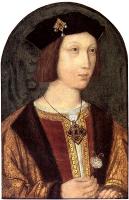
The Receyt of the Ladie Kateryne is in Antiquarian Repertory Volume 2, Tudor Books.
HERE begynneth the note and trewth of the moost goodly behavior in the receyt of the Ladie Kateryne, daughter unto Phardinand, the Kyng of Espayn, yowen in mariage goinct to Prince Arthure, son and heir unto o noble Soferynge of Englond King Henry the VIIthth, in the XVII yere of his reign.
Chapter 1.1. How the Princesse departid from her fathre and mothre, beyng in Hispayne, and what wiendes and jeopardies she suffred in her passage.
Whan that after the prefixed promyses bitwene the noble kinges of the roiall realmes of Englond and of Hispayne, the doughtr and princesse [aged 15] of the said King of Hispayne, for th' entente of matrymonie legallie to be fynesshid and concludid, to her prepaired navye of shippes with the right sufficiaunt gardie and companye of Noblis of that contreth to her assistentes lymyted and assigned theymself shold brefly order and condute. Th' mpacient wiendes of that coostis shold seme to have ben greatly aggreved and not peasably to suffer the before desyred passage of the said Princesse to the coostes of Englond, fatally ordynate and predestinate, the giest and also the dowrie of soo goodlie a ladie and princesse. Wherupon they cruelly with right great hudgenés of storm and tempest oppresed with their oultragious blastes the clothis of the said shippes; enhaunced their mastes owte of their sokettes, disrobbed their taklyng and all their hool remyge. The perilous seas with waves soo fearfully wrought and arrered that unto the rulers and craftie maryners was, moost to th' enfreight persones to be saveguarded, expediently thought to som of their owne lately forsaken havens they shold retourne their course; Where within short seasons it contentid Almyghtie God that more plesant wiends shold goodlie rule the journeis of the cleer eires above, thrugh whoes help and aide, unto th' Englisshe parties they were right shortly conveied, and fortunatly they [Catherine of Aragon] arryved at Plymmouthe [Map] [2nd October 1501], fer in the contreth of the west.
Chapter 1.2. Of her arryvinge in Englond and of the meting of the Kinges Grace and dyvers othre estates of the londe.
Than as sone as this glad entrés of the Ladie was knowen and apperceyved to th' estats and gentiles, borderers of the said contreth off the west, with all goodlie maner and haste sped theymself with right honorable giests to repaire to that noble Princesse [aged 15]; and there they goodly with all requyred poynts and features of curtesie, saluted and welcomed her, so escapid graciously her perilous jeopardies, with their pleasures, presents, and their attendancis, as well in the said furste arryving as in contynuall servyce, waiting, and guyding the sayde Princesse into the further entrans of the realme of Englond toward the honorate and aunciant Citie of London, where at that tyme the Kinges Noble Grace was lodged and abiding.
And furste the Lorde Broke [aged 49], Stuard of the Kinges howse, was by th' assignement of the King's Grace directed and sent to th' entent to purvey and provyde for the Princesse [aged 15] and her retynue in their journey and passage, as well for their viand, horses, and cariage as every other necessité, and right convenyently he did. After that, th' erl off Surrey, with divers other Lords temperall of the lond,, ensuyd unto the metyng and attendaunce of thys whorthy Estate and Princesse; and after them, the Duches of Norff. [aged 24], by a like assent and will of the King, with a goodly companye with her off Countesses, Baroness, & meny other honorable gentylwomen, repaired unto this noble Princesse, and there at her suche metyng had, she kept forth on her contynuall company and waiting.
Notwithstanding, His Highnes and Grace was not soo intentifly satisfied with the chere, servyce, and diligente attendans of his said subjectes gentils, but bountuously let hymself with a semely company of his estats, Dukes, Erls, and Barons with othre dyvers of Knyghtes, Esquyeris, and gentilmen, to be the IIII day of Novembre removed from his maner of Richemount towardes the meting of this goodly Ladie; whois spedefull journey was annoied and suffred impedyment, and of his encrese was sore abreviat by th' enchesion that he and his present lege servantes, the day right fer spent, so late were horsed at their said remove, the silence of th' evenyng full hastily did theym approche, that they were compelled by convenyens at Chartsey, not veray fer from the said manor of Richemount, to purvey and harbage for their reposing that nyght.
Chapter 1.3. Of the meting that the Prince gave the King at Esthampsted1.
The morow clowds were usually and after the course cnaturall expelled; the clere beamys of the sonn full oftetymes the myddell eires with their refleccions had striken: Then the sides of their coursers with their spurres they began to tast, and extend their passage unto the village of Esthampsted. There myght the true and lovyng Englisshe people pleasauntly perceyve the pure and proper Prince Arthure, the heire of their lefull lord, and successour by grace granted of God, full solemply to salute his sage fathre bifore their owne presens, the which was great gladnes to all trusty hertes.
Note 1. Easthampstead. Now part of Bracknell Berkshire, nine miles south-west of Windsor. Formerley part of Windsor Forest.
[4th November 1501]. Loo thus with his sonne the moost noble Henry of Richemount, of Englond the VIIth king of that name, full pleasantly passid ovr the season of that nyght, and in the next morow to the playnes he departid; where met with hym the Prothonotary of Hispayne, and ensured hym that they had receyved by streite injunction and commaundement of their Soveraigne Lord of their lond that they shold in no maner of wise permytt ne suffer their ladie and Princesse [aged 15] of Espayne, whom they had to guyde and in gouvernans, to have eny metyng, ne use eny maner of communycacion neither company, unto th' incepcion of the very daie of the solempnisacion of the mariage. Wherupon after certayn musing of this myend of the Kinge of Hispayne, immediatly there in the feldes the King's Grace of owre realme of Englond let all theym that were of his most honorable Councell to be in that mattier advertised how they thought moost to reason aggreable, either t'enclyne to this declarid purpose, or as he entendid to that lady he shold maynteyn his passage. And sone after the prudent enserche of every persones both spirituall's and temperall's aunswere, it was holy by their sentens concludid that forasmoch as due agrementes in a man' accomplisshed, sithe they were so far entrid into his empire and realme, they shold seme to be in partie dischardgid annempste their Soveraigne, and of all governs of their said Princesse avoided and excluded, and the pleasure and commaundment of her to lie in the power in grace and disposicion of oure noble Kyng of Englond.
[6th November 1501]. Chapter 1.4. Of the demeanure of the King and of the Princesse [aged 15] in their furst metynge.
Thus His Highnes avaunced hymself, levyng the Pryns behynde upon the playne, and in the tyme of II or III of the clok at after none, His Grace entred into the towne of Dogmersfeld, where the Pryncesse was II or III owres before his said comyng right well accompanyed, and right richely beseyn, so as hertofor have be seyn none like her, havyng with her an Archbusshop, a Busshop, and an Erl, with meny other noblis of Hispayne, and meny ladies and gentilwomen of the same contreth to the nombre of thre score; and ladies and gentilwomen of this region right nygh as meny. And assone as the Princesse servauntes were asserteyned of the commyng of the Kyng, as ther archebusshoppe, the Busshoppe, with other of her retynnue & cowncell they shewed hym that the Princesse was in her vest, whom he aunswerd in such forme, that if she were in her bed, he wold se and commone with her, for that was the mynd and th' entent of his comyng; and thus convenyent leisure to her respited, she gave hym an honorable metyng in her third chambre, where were perused the mooste goodly wordes and uttred of the langueges of bothe parties to as great joye and gladnes as in eny persones myght ever covenably have ben had.
After the which welcomes and communycacion endid, the King's Grace deposid his riding garmentes and chaunged hym, and by half season of oon owre the Prince was also knowen to be present, and ensewng the King's Highnes and the Lord Prynce made their second resort toguydre to the chambre of the Pryncesse; and there thrugh th' enterpretation of Busshoppism the speches of bothe contrethes, be the meane of Laten were understonded; and where as tofore they were by deputies contracted, they here now were in their either othre presens spousally ensured; the which semly ensurans, so (as it is promysed), honorably endid, the King sped hym to his souper. And after that he had souped full curteisly, with the Lord Prince visited the Ladie in her owne chambre; and then she and her ladies let call their mynstrelles, and with right goodly behaviour and maner they solaced theymself with the disportes of daunsyng; and afterward the Lorde Prince in like demeanure with the Lady Guldford daunced right plesant and honorably.
Chapter 1.5. Howe the Princesse [aged 15] departid from Dogmersfeld to Londonward, and how the King removed another wey to the same cite.
Upon the morow, the VIIth day of the rehersed moneth of Novembre, the Princesse, on her bihalve toke her journey to Chartsey, and ther lodged all that nyght, and from thens towardes Lamehith; and, orever she cam fully to the said town, beyond a village callid Kyngeston upon Thamyse, the Duke of Bokingham on horsbak full richely beseyn, therle of Kent, the Lord Henry the dukes brothre, and thabbot of Burie with a great company of the Duk's gentilmen and yomen in his lyverey of blak and red to the nombre of III or IIIJ hundreth persones, met this noble ladie, the which, after the Duc had saluted her Grace, declared goodly in Laten a certayn proposicion of her welcomyng into the realme. And at that vyllage they lodgyd all that nyght, and so accompanyed with her as a guyde, in the morne [9th November 1501] right honorably conductid her to her said lodging at Lamehith, where she contynued unto such season as her entring into the Citie of London myght moost convenyently in every manner bihalve be prepared, as well on her partie of the retynue of Hispayn, as in the tother, assistents of the realme of Englond by or Sovereign assigned; partly to th 'encres and magnyfiyng of her honor and estate; secundly, to the mayntenans of olde and famous appetitis that th' Englisshe people have ever used in the welcomynge of their acceptable and welbiloved straungers.
The Kinges Highnes also in his partie removed from the said Princes another wey towardes the cité of London, and the furst nyght he lodged at Esthamsted, whereas His Grace had ben bifore in his furste commyng to the Lady Princesse. And upon the morowe, the VIIIth daie of the rehersid moneth of Novembre, he nyghtid at his castell of Wyndsore.
[9th November 1501]. The IXth daie of the same moneth in his maner of Richemount hymself he reposid, where the Quenys Grace met with hym, whom he asserteyned and made prevy of thactes and demeanure bitwene hymself, the Prince, and the Princesse, and how he likyd hir person and behavour.
[10th November 1501]. And the Xth day ensueng, he rode till he came to Parisgardeyn1 uppon the further side of the ryver from London, and there he toke his barge and was sett upp at his lodgyng callid Baynard's Castell [Map], within the same cytie, set uppon the Tamys side, right pleasauntly sheweng toward the water, with inforth ful well garnysshed and aronde full strongly with wallys encompased without; where to his noble and prudent audiens al maner of matters hade ther recourse that to his owne person were apperteynyng, for his owne honour, and right to all his hoole realme for comfort and justice, and also for the goodly endutynge of this noble Lady and Princes of Hispayne. And at his there settyng upp and landyng, the Quenes Grace by water in her barge with her goodly company of ladyes, was there presently landid and entride in.
Note 1. Paris Garden. It was a large tract of ground in Southwark, famous at that time, and after, for the Bear Gardens there. In the reign of Charles II. the inhabitants of it petitioned the Parliament that it might be made a distinct parish, which was done accordingly, and the parish named, as it continues to be, "Christchurch."
Chapter 1.6. Of th' ordre of the citie of London for the receyte of the Princes.
In the meane season, the stedfast, sure, and.... chambre of Englond, the opulent rehersid cytie of London, was than full excellently accompanyed with the moost great multitude of people; what for the citesens inhabitaunts of the same; what for the estates of every contreth, shyre, and party with ther servantes unto them awaytyng; what for other of honest commons of every town, holde, and border of the realme of Englond; that.... ther might be lodging, ostrie, or roume for the seid great resorte fownde or begotyn within the wallis neithir suberbys of all the seid citie. Every Lord, both spirituall and temporall, was kepyng their opyn householdes with right great ryaltie of fare and vitall; ich gentill his lyvereys, baggs, and conysants1, opynly worne, that every man might apparently perceyve and know every gentilman his servant, the oon of them from the other in that tyme.
Note 1. Badges and cognisants.
The furste Chaptre of the secunde Booke; what solempnyte was used in hir receyte in the Cytie of London1.
NOW it is that we be comyn into the moost joyefull and longest desired and acceptable season, the Fryday the XII day of the moneth of Novembre; uppon whom this great Princes of Hispayne, aftr that she had dyned at her lodgyng of Lambeth, at oure Sovrayn his will pleasure and myend of Englond, she shulde make her entres. Assemblyng first her owne retynue of the contreth of Spayne, and then proceded forth into Seint George's Feld, where were redy present upon horsbak a right semely company, by the Kinge's Grace assigned for the ryall and solempne inducyng of this noble estate, adjoyning nyghly to her seid lodgyng. Furst, there was, for the spiritualls2 of Englond, the Archebushop of York, with other Bushoppes, the Deane of York, with other Prelats of the Churche; For the tempalls, the Duke of York, the Duke of Bokyngham, the Erl of Northumblond, th Erl of Surrey, the Erl of Essex, the Erl of Kent, the Lord Henry of Bokyngham, the Lord Burgevany, the Lord Straunge, the Lord Barners, the Lord Suche, the Lord Willughby, and other Lords, right weel horsed and richely beseen; with many knights and esquyers to a great nombre, lyke wise well horsid and beseen.
Note 1. The titles of this and the succeeding chapter seem to have been accidentally transposed, by the negligence of the transcriber.
Note 2. Spirituals; Bishops, and other dignified clergy.
Jean de Waurin's Chronicle of England Volume 6 Books 3-6: The Wars of the Roses
Jean de Waurin was a French Chronicler, from the Artois region, who was born around 1400, and died around 1474. Waurin’s Chronicle of England, Volume 6, covering the period 1450 to 1471, from which we have selected and translated Chapters relating to the Wars of the Roses, provides a vivid, original, contemporary description of key events some of which he witnessed first-hand, some of which he was told by the key people involved with whom Waurin had a personal relationship.
Available at Amazon in eBook and Paperback format.
The secunde Chaptre; of th' orderyng their raies1 in Seint Georg's Feld.
THUS they made owt their raies, and sett furth ordurly, every person in his roume2 convenient, and passed thorough Southwerk, till they cam to the enteraunce of the great bridge of London, wheruppon was the furst pagent, in maner and forme folowyng; that is to say there was on the myddes of the bridge erecte a tabernacle of two flowres semblaunt unto tweyne rodelofts, in whose lougher floure and peticion there was a sete, and win the sete a faire yong lady with a wheel in hir hand, in liknes of Seint Kathryn, with right many virgynes on every side of her; and on the 2nd and higher floure and story there was another lady, in likenes of Seint Ursula, with her great multitude of virgyns right goodly dressed and arrayed: above the bothe floures there was the pictour of the Trinyté, and upon iche side of these 2nd storyes oon small tabnacle square, with proper vanys; and in every square of the small tabnacle the Gart invyrond with his poysye in Frenche, "Onye soit que malé pens3," and in the myddis of the Garter the rede rose regall; and so in the numbre of bothe sidds were six small, tabernacles, uppon whoes toppes were six aungells, ensensyn4> the Trynyté, Seint Ursula, and Seint Kateryn. The wallis of the saide floures or lofts were peynted, with hangyng courteyns of cloth of tissue, blew and rede; and a prety space before this pagent were two great posts sett, enpeynted with thré estriche fethers, roses red, and portcullys, and on every of them a red lyon rampand, holdyng a vane enpeynted with the armys of Englond; and all the hoole worke cortyn of tymbre, gylte, and peynted with golde, byse, and asur.
Note 1. Arrays, or order of proceeding.
Note 2. That is to say, in the place belonging to his office or station.
Note 3. "Honi soit qui mal y pense" i.e. Shame on him who thinks ill of it. The motto of the Order of the Garter.
Note 4. Incensing; perfuming with incense.
[12th November 1501] AND unto this rehersed pagent at the Standard the Kinge's Highnes had conveyed himself sumwhat prevy and secretly, and stode in a marchaunt's chambre, and with him the Lord Prince, the Erl of Oxinford, the Erl of Darby, the Erl of Shrewesbury, my Lord Chambleyn, with many other Estats; and not very ferre thens, in another chambre, stode the Quene's good Grace, my Lady the King's moder, my Lady Margarete, my Lady her suster, with many other ladies of the londe, not in very opyn sight, lyke as the Kinge's Grace did in his manner and party: There they bothe beholdyng the persones, their raise, ordre, and behavyngs of the hole company bothe of Englond and of Spayne, as well of their apparell and ther horsis as of their discreate and goodly ordre, poynts in featurs of their demeanor. Above, in wyndowes, ledis, guttures, and batilments, stude many of the yemen of the garde, and also benethe in the strete the srvaunts of my Lord Prince, my Lord of Oxinford, my Lord of Darby, my Lord of Shrewesbury, my Lord Chambleyn, with other dyvers to a great and a howge nombre on both the sidds of the strete. And eftsone the begane to approche to the King's sight in the moost goodly wise that ever was seen in Englond, or in any other realme, that of queke and recent memory may be knowen or understond.
And furst in this solempne and ordinat entraunce cam rydyng the Mayre on horsebake, in cremsyn saten, with a riche colour of gold abought his neke, and before him the Sworde berer, after the guyse of the citie; and after him the Recorder, in blake velvet, the two Shrevys, and the twenty-four Aldremen in skarlet, and their servunts right well horsid and beseen. After that they had made their saluts unto the Princes upon the bridge in the entringe of the citie, and made a good space in the strets rum and passage for the Princes and hir greate multitude and retynue, after them cam the Kings of Harods, and Arolds of armys, in their cote armours of velvet and golde of the King's armys of Englond, and also made roome and weye, and devyded the common people right ordrely. Enseyng appered, fresshely appareld, vi goodly galaunts of the Erl of Essex, in yelow cercenet, with many estrich fethers, upon right plesunt cursours of corage, trapped and besett full of silver bellis, avaunsyng their horsis after the moost coriouse manner; and after them rode the gentilmen belonging to the Erl of Northumbland, and then the gentilmen belongyng to the Duke of Bokynghm, and after them the squyers and knights appoynted by the Kyng; and aftr, the seid Lords, the Erlys of Northumbland and Kent; and aftr them the Duke of Bokynhm; and after them such trumpetts, shalmewes, and sakbots, to a great nombre, as cam with the Princes owte of Spayne; and after them straungers of Spayne, as well the estats and gentylmen, every of them rydyng upon the ryght hand of an Englishman, as they were in degre and honour, except the Erle, the Archebushop, and the Bushop, that cam with this Lady, who rode all three toguyders.
Book 3.
[14th November 1501] Chapter 3.1. Of the ordryng of the Church of Powles.
The Cathedrall Chirch of Seint Poulys within the citie of London was ennournyd in all behalvys, bothe autier and quere, and also the body of the Chirche, with the most excellent ornements apperteynyng unto the worship of God, and honour of this joyeful maryage and unyon of the moost revrent Prince and Pnces. First, the auters with their plats, jowalx, and relikks, of wondrefull riche and cyousnes; with copys1 and vestments, in their sortes, honourably to the mynystres abehovabill, of full great valoure: The quere also enhaunged with clothis of Aras; and from the quere doore, the which is of XII or XIII foote enhight from the pavment, extended a weye and passage callid a levy, like unto a brydge of tymbre, byllyd and arrayid upon great and meny posts, roulyd upon bothe the sidds with red say, nailyd and cov'ed upon the seid reylys all the lengeth of the body of the chirch unto the nyghyngys and approximacion of the west doore, the whiche is of VI or VII hundreth foote of lengeth: And nere unto the lougher end of thys levy there was enhaunsed a certayne porcon of V or VI.... like a stage, rownde in compasse, covred with red say, takyd fast with gilte nailys, uppon the which the Prince, Princes, and mynysters of the sacrement of matrimony might conveniently stond; and in object annempst this place, where as the courte and consistory is usyd to be kept, above in the vaute, there was a closet, made pperly woth latés wyndowes, enclosed, within which closett the King's Grace and the Quene's might stond secreatly to se and appceyve the forme and manor of the mynystracon. The wallys also of the body of the Chirch, conteynyng the lengeth of the levy, of a great hight and brede were hangyd with costely and riche clothis of Arras, whoes works and texturys represented the noble and valiaunt acts, storis, and gests, that for the moost ptie poets and oratours writt and remembre in their comments, boks, and scripture; as well the besegyng of noble cities as other batalls, turneis, their horsis, and persons, after the moost goodly pontinge, shapp, and fachyon, with the endevor and practis of the maker his reason and imaginacion.
Note 1. Copes.
Here ensueth certayn matters of the joyefull beholdyng of the Prince and Princes to enter into Powlys.
The prophetes sage, we rede in storys and comment,
Patriarchis, and they that to the temples were
Desirant and longyng, thought their lyves spent
Right well, and their prayours, with wepyng of many a tere,
So that they might abyde without drede or fere
The comyng and the birthe of that noble childe
That with our auncient enemy shuld hold & kepe the ſeld.
And in that bataill mekely though that he were slayn,
And to the ende mortall if he shulde be brought,
The thirde day by his owne powre he shulde aryse ageyn,
Secundly redemyng that first he made of nought;
Who that the true scripture hade enserched & sought
Shuld the holy Symeon especially fyend
Among is hole peticons, desire non other thyng,
Save only that sight or ever that he died;
Oftyn in is orysons, seyeng to Almighti God
Of me.... trowe ye I shall abyde
To se the alman and frute that spryneth of Aron is rode:
The granys of this tre were sowyn all abrode;
Is rote perished the egge and depe places of peyne
The bowes beynge in the erthe, the toppe in heven ageyn.
This vertuouse man at the last did fynally aspyre
Unto his request, and graunted it was to hym,
By the Almighti God, the effecte of his desire; Is age still contynued (though be it is eyn were dyme).
For is clene lief, and purenesse, without synne.
The sone of heven and Marie, as ye be advysed
Was prsent to the Temple to be circumsised.
With mooche joy and gladdnes he resounde this noble songe,
Embrasing this babe betwix his armys two;
Seying here is now comyng us amonge
The light of the gentils, and glory of Isarel also:
"Now, Lord, dimitt thy srvaunt in peas, and lett me go;
"I thanke thyn especiall grace of suffraunce that I might
"Persever in my yeers to see this joyefull sight."
The furst daie of Januar, the leder of the yeer
Thus to be circusised was takyn from his moder;
The XVIII day of Novembre, allege him for his pere,
Of pleasure, joye, and gladnes, above many other:
The Sonday, the xviii yeer of VIIth Henry the Kinge,
Uppon the which Sonday shulde be the goodly weddyng,
And ev'lasting unyon of Englond and of Hispayne,
The most noble regyons undre the hevyn is cope,
Now tornyd and made but oon realme that before was tweyne,
Blessed be the begynners that of the matier spoke,
For this band and unyon I trust shall nev be broke:
In Poulis many Simeons thought they hade well taryed
To see thus Spayne and Englond toguyders to be maried.
Chapter 3.2. Of the company and brynging in to the Chirch of bothe the Prince and Princes.
The ordre due was not.... that first the Temple of God neither that tyme shuld have his duetie and seremonyes of.... after that the office ne the service of the onour tempall, wherupon in this Chirch thus, as it is promised,.... in is solempnités was a great and a right pleasaunt puysauns1 of people, to the entent of reverent awaytyng and diligent attendauns, (hough be hit comonly it is sen great resorte often to be made for wonderyng and pleasure in their owne sights, and in wolgar speche callid gasyngs, of the rud and unlernyd psons;) besids whom there were of the Nobles of the realme electe, chosyn, and assigned, by the King's grace for the onorabyll and goodly company and attendauns to the revrent persons of the Prince and Princes; as the noble Yerle of Oxinford, Great Chamberleyn of Englond, and the Erl of Shrevisbury, with many dyvrs of theres, and other, with them encompaned; the which furst upon the seid Sonday in the morow, abought the oures of IX and X of the clok, set the Lord Prince from his lodgyng, at that tyme callid the King's Wardrope; and, with right semly attendauns and worshyp, brought him to the southe doore of Poulys, were he alyted; and, is devocion there and abediens humblie hade to Almighté God and is Holys, went thorough the Chirche before rehersed unto a privy and a secret chambre with in the Palais of the Busshoppis of London, where he chaungid his vesture, and induyd himself in the ryall and comfortable apparell of weddyng and spousage, and then immediately, in his proper forme, and with his rehersed company, was conduited ageyn to the seid Chirch of Poulys, by the which season the often remembred Pnces, encompanéd with Estats of Englond and of Hispayne, bothe lords, knights, and gentilmen, ladies and other gentilwomen, to a great and a goodly nombre, herself ledde by the two honourabill psons of estate the Duke of York, and the Erl that cam with her owte of Hispayne, the Lady Cecill2 beryng her trayne, made so furthe hir ordynat progression owte of the Paleis, her lodging, toward the entres of the Chirche of Poulys, in at the west doore, tyll she cam to the quire where she shulde be maryed. At the which place the Bushop of Canterbury, with the nombre of XVIII mooe Busshopps and honourabill Abbotts, myghtered full solempny, gave her meatyng, with procession mooste devout and worshipfull; where stode also psent and redy the discrete and well lernyd the King's councell, and there made oppyn and knowen by proposicons of all the aggreaments and accorde betweene the Kings of bothe the realmes, furst, for the giest and porcion that her father shuld devyde with her to her maryage, secundly, were punted unto her certayn writings, and opynly declared ensealid, as well be the King's grace as the Lord Pnce; The seid letters patent, thus contryved and ensealid, implied and conteyned her suertie and endowment. A right goodly multitude of Estatis, the lords and gentilmen in their araye and ordre, by II and II, arme in arme, in apparell of silks, and many in goold, with riche and massie cheynes and colours of goold, aft ' dyvers and goodly werks and fachion, preceded this beautyfull Princes; and her ladies and gentilwomen, in like cours and beseene, folowed also by II and II, as the men did in their former ordre and guyse. All the hool company, lords, ladies, gentilmen, and women, thus conveyed her to this the very stacion before rehersed assigned for the execucon of the Sacrement of matrimony. The garments of the Lord Prince and Princes both were of whight saten; but (for the straunge dyversitie of rayement of the countreth of Hispayne to be discryvyn) she were that tyme and daye of her maryage uppon her hed a coyf of whight silk, with a bordre of goold, perle, and precious stone, beyng of an unche and a half of brede, the which covered the great parte of her visage, and also a large quantité of her body toward her wast and myddill; her gowne very large, bothe the slevys and also the body, with many plights, moch litche unto menys clothyng: And aftr the same forme the remennt of the ladies of Hispayne were arayed; and benethe ther wast certayn rownde hopys, beryng owte ther gownes from ther bodies, aft their countray manner.
Note 1. Puissance - meaning a great number; as the vulgar still say, "a power of people."
Note 2. This must have been the Princess Cecilia, second daughter to Edward IV and sister to the Queen. It was Henry's obvious policy to match the princesses of the house of York beneath their dignity: this lady was accordingly married, first, to John Viscount Welles, and, after his death, to a Mr. Kyme, of Lincolnshire.
The Kinges Hignes and the Quene's, bycause they wold make non opyn shew nor appearaunce that day, whereas they uppon the nyght before had comyn secreatly to the place of the Lord Burgevenyes, nere unto the seid Poulis adjoynyng, so, in like wyse prively, they had conveyed them selffs to the rehersed closett above the consistory, aright annempst the place where the solempnyte of mariage shuld be executed, where they beheld the Archebusshopp of Caunterbury, encompanyed with Bushoppis and Abbotts, as it was lately expressid, after the forme of Cristen religion and lawe couple and conjoyne their noble persons toguyder, as the custom and sacrement in this behalve doeth requyre and aske.
This honourable and high solempnyté perduryd there by the space of thré houres and more, aftr the which paste and doon, the remembrid rayes and ordre of the Archebushoppis, Bushoppis, and Abbotts, Lords, Knightes, and gentilmen, procedid the goodly Prince and Princes; the ladies and gentilwomen foloweng in like course and manner; the mynstrells, also bothe trumpetts, shalmewes, and sakbotts, stroake upp, the which was comfortable and joyefull to here; the Prince and Princes hand in hand, he beyng on her right side, went thus moost solempne and goodly toward the highe Autier upon the levy before rehersed, and, or ever they entryd into the quere dore, they curtesly bothe turnyd them to the southe and to the northe parties, for the entent that the present multitude of people might see and behold their persones; the which people were so brieve and many, that in the rode loffts, vauts, wyndowes, and on the paviment, were to conscidere and behold no thing but visages of this multitude. Were dyvers showghts and noysys made; Sum cryeng King Henry, sum in lyke wise cryeng Prince Arthure.
Chapter 3.3. Of the ascendyng to the Autier, and of the Masse, and their retornyng to the Paleis to their dener.
From thens they ascended to the Aultier unto the moost solempne, devout, and glorious Masse of the Trynyté, celebrate and mynystred by the Archebushop of Canterbury, there doyng the obsequens, the rehersed honourable company of Bushopps, Abbotts, and other Plats of the Chirche, with songe and orgons moost pleasur and excellently: And whan this Masse solempne, with his moost due observans, was ended in the tyme of the ben diccons of the breds, wynnys, and spics, and other things of compfort, and to the refresshyng of the presents, after the curtesy of Englond, shuld be distributed, the Duke of York, with the Erl of Hispayne (after the seid refresshyng) the moost excellent Princes (fully sacrid after the precepts of the Chirche) leed and conveyed, with the rehersed goodly multitude of Nobles and Estats, towards the paleis of the Bushoppis of London, the place riall of this great and noble fest of the mariage. And when they cam without the west dore of Poulys there was the VII pagent, runnyng wwith wynne all the tyme of the mariage and masse, and was a goodly mountagne or mounte, bullid and made in forme and manner foloweng, that is to say the seid mountayne was grene, and many herbis and trees, with many rochis and raggs of stone, geat, amber, and currall, with other marvells of metalls, groweng and apperyng owt of the sidds of the seid mountayne; and uppon the hight of this mountayne grew three great trees, whereof oon uppon the right hand was grene, beryng flours of goold; and sume were red rosys; and in the toppe oon of the rosys stode, as it had been groweng, a whight grehounde; and ageynst the body of the tre stode the King of Fraunce, pictured in clene1 armor, beyng in the mydds of a whight hert, within the body of the seid hert upper to the knees, with a rounde ball of silver in his hand. The secunde tre was also grene with many red rosys; and owt of the topp of this tre, of oon of the rosys sprange a rede dragon dredfull; and anempst the myddell and body of this tre stode the King of Englond, harnessed complet, with a sword in his hand, beying in the mydds of a shypp, and appiered above the seid shypp by the myddill. The third tre was also grene, and is frute was also appals or oranges; and owt of oon of these oranges spronge a red lyon; and annempst the myddill of this tre stode the Kyng of Spayne, in complet harnes, in the mydds of a castell, with a ball of silver in his hand; and evrych. of these Kings hade their skochons and armys above their heds. And in the mydds and depnes of this pagent the conducte was runyng with wynne all the tyme of the mariage, and wout a pale compassid all the hool pagent, and therin a gate for people to entryn at, to fetche and drynke the seid wynne that thus so ubertly rann owt of this conduite.