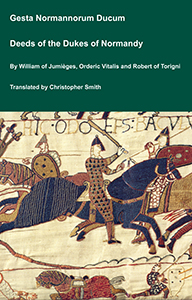
The Deeds of the Dukes of Normandy
The Gesta Normannorum Ducum [The Deeds of the Dukes of Normandy] is a landmark medieval chronicle tracing the rise and fall of the Norman dynasty from its early roots through the pivotal events surrounding the Norman Conquest of England. Originally penned in Latin by the monk William of Jumièges shortly before 1060 and later expanded at the behest of William the Conqueror, the work chronicles the deeds, politics, battles, and leadership of the Norman dukes, especially William’s own claim to the English throne. The narrative combines earlier historical sources with firsthand information and oral testimony to present an authoritative account of Normandy’s transformation from a Viking settlement into one of medieval Europe’s most powerful realms. William’s history emphasizes the legitimacy, military prowess, and governance of the Norman line, framing their expansion, including the conquest of England, as both divinely sanctioned and noble in purpose. Later chroniclers such as Orderic Vitalis and Robert of Torigni continued the history, extending the coverage into the 12th century, providing broader context on ducal rule and its impact. Today this classic work remains a foundational source for understanding Norman identity, medieval statesmanship, and the historical forces that reshaped England and Western Europe between 800AD and 1100AD.
Available at Amazon in eBook and Paperback format.
Wiltshire is in Section 2 Long Barrows.
Giant's Cave Long Barrow [Map]
Wiltshire, 12 NW. Parish of Luckington. 78*.
Latitude 51° 32' 41". Longitude 2° 15' 34'. Height above O.D. about 370 feet.
Mrs. Cunnington (in W.A.M., xxxviii), gives the following account: "Length, 123 feet (present measurement, but no doubt longer originally) E. and W.; chambered. Apparently rifled at some unknown period [but see extracts below] and the cists or chambers left uncovered. This barrow now appears as a mere untidy shapeless heap in a grass field, covered with bushes. There are several large stones placed edgeways, half buried in the ground, that appear to be the ruins of at least three chambers; one of these, oblong in shape, seems to be fairly complete except for any covering stones it may have had."
Aubrey says: — "This barrow. ... is long, and some oakes and other trees and boscage cover it. Here were accidentally discovered since the year 1646 certain small caves about 5 or 6 in number; they were about fower foot in heighth and 7 or 8 foot long; being floared, lined and rooft with great plank-stones which are plentiful hereabout. I saw them 1659." After this Aubrey gives a quotation from J. Childrey's Britannia Baconica (1661), p. 45, explaining that Childrey was "his lordship's chaplain" presumably the Duke of Beaufort's. The caves number about nine "and some of them are (or were formerly) cemented with lime. . The manner of them is two long stones set up on their sides, and broad stones upon the top to cover them. The least of these caves is four foot broad, and some of them are nine or ten foot long ... The curiosity of some ingenious men (as it is reported) within these 40 yeares tempted them to dig into it. . but they found nothing but an old spur and some few other things not worth the mentioning." ...
Britton says "In 1809 another barrow was levelled and found to contain the remains of several human skeletons." Can this refer to the tumulus marked on the O.S. maps on the opposite side of the valley, immediately to the S.E. of the Giant's Cave? There is now no evidence of a mound, and in 1913 Mrs. Cunnington reported that "nothing but a slight natural inequality of surface" could be seen.
This barrow (78) was accidentally omitted from the map and list in the Professional Paper (Sheet 8). Visited January, 1924.
Aubrey, Britannica (MS in Bodleian, never published in full), fol. 6o,
J. Childrey, Britannia Baconica: 1661, p. 45.
Britton's Wilts., Vol. III., 1825, p. 142.
Wilts. Arch. Mag., vii., 323; XXXVIII, 1913-14, p. 394 (quoted above).