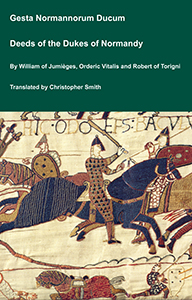
The Deeds of the Dukes of Normandy

The Gesta Normannorum Ducum [The Deeds of the Dukes of Normandy] is a landmark medieval chronicle tracing the rise and fall of the Norman dynasty from its early roots through the pivotal events surrounding the Norman Conquest of England. Originally penned in Latin by the monk William of Jumièges shortly before 1060 and later expanded at the behest of William the Conqueror, the work chronicles the deeds, politics, battles, and leadership of the Norman dukes, especially William’s own claim to the English throne. The narrative combines earlier historical sources with firsthand information and oral testimony to present an authoritative account of Normandy’s transformation from a Viking settlement into one of medieval Europe’s most powerful realms. William’s history emphasizes the legitimacy, military prowess, and governance of the Norman line, framing their expansion, including the conquest of England, as both divinely sanctioned and noble in purpose. Later chroniclers such as Orderic Vitalis and Robert of Torigni continued the history, extending the coverage into the 12th century, providing broader context on ducal rule and its impact. Today this classic work remains a foundational source for understanding Norman identity, medieval statesmanship, and the historical forces that reshaped England and Western Europe between 800AD and 1100AD.

Available at Amazon in eBook and Paperback format.

Historical Inquiries Respecting the Character of Edward Hyde Earl of Clarendon

Historical Inquiries Respecting the Character of Edward Hyde Earl of Clarendon is in Victorian Books.

In 1827 George James Welbore Agar 1st Baron Dover [aged 29] published his Historical Inquiries Respecting the Character of Edward Hyde Earl of Clarendon.

PAGE 34. Note Z. Henry Hyde, Viscount Cornbury [aged 42], only son of Henry Earl of Clarendon and Rochester, was of some talent and great amiability of character. Sir Charles Hanbury Williams, in his poems, calls him "Gentle Cornbury" - Swift says, "he is a young nobleman of learning and morals" - and Pope pays him the high compliment of advising others to "disdain whatever Cornbury disdained." Lord Orford thus draws his character: "He was upright, calm, steady; his virtues were of the gentlest complexion, yet of the firmest texture; vice could not bend him, nor party warp him; even his own talents could not mislead him. Though a master of eloquence, he preferred justice, and the love of his country to all the applause, which the violence of the times in which he lived was so prodigal of bestowing on orators who distinguish themselves in any faction; but the tinsel of popularity and the intrinsic of corruption were equally his contempt. He spoke, nor wrote, nor acted, for fame." He was the author of several pamphlets published without his name - of some tragedies still in manuscript - of a comedy called "The Mistakes, or the Happy Resentment," printed at Strawberry Hill, in 1758 -and of an admirable" Letter to David Mallet, on the intended publication of Lord Bolingbroke's manuscripts." He is believed to have died by suicide at Paris, on the 28th of May, 1753, though the complaisant peerages say that his death was occasioned by a fall from his horse.