

King Pamplona is in Kingdom of Pamplona.
In 870 García King Pamplona [aged 65] died. In 870 His son Fortún [aged 40] succeeded I King Pamplona.
In 905 Sancho I King Pamplona [aged 45] was appointed I King Pamplona.
On 10th December 925 Sancho I King Pamplona [aged 65] died. His son García [aged 6] succeeded I King Pamplona.
Around 970 García I King Pamplona [aged 51] died. Around 970 His son Sancho [aged 32] succeeded II King Pamplona, Count Aragon. Urraca González Queen Consort Leon Queen Consort Pamplona by marriage Queen Consort Pamplona.
In 994 Sancho II King Pamplona [aged 56] died. His son García succeeded II King Pamplona, Count Aragon.
In 1000 García Sánchez "Tremulous" II King Pamplona died. His son Sancho [aged 6] succeeded III King Pamplona, Count Aragon.
On 15th September 1054 García III King Pamplona [aged 42] died in Barcelona [Map]. His son Sancho succeeded IV King Pamplona.
In 1076 Sancho Ramírez I King Aragon V King Pamplona [aged 34] succeeded V King Pamplona.
On 4th June 1094 Sancho Ramírez I King Aragon V King Pamplona [aged 52] died. His son Peter [aged 26] succeeded I King Aragon, I King Pamplona.
In 1104 Peter I King Aragon I King Pamplona [aged 36] died. His half brother Alfonso [aged 31] succeeded I King Aragon, I King Pamplona.
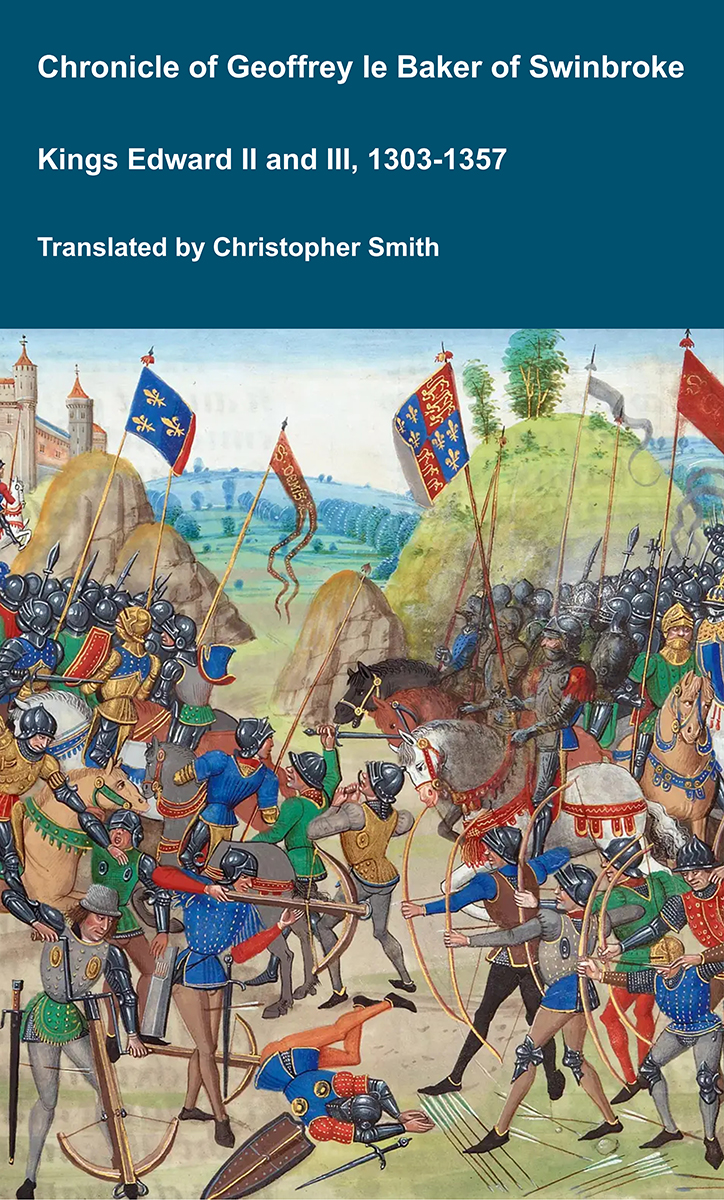
Chronicle of Geoffrey le Baker of Swinbroke
Baker was a secular clerk from Swinbroke, now Swinbrook, an Oxfordshire village two miles east of Burford. His Chronicle describes the events of the period 1303-1356: Gaveston, Bannockburn, Boroughbridge, the murder of King Edward II, the Scottish Wars, Sluys, Crécy, the Black Death, Winchelsea and Poitiers. To quote Herbert Bruce 'it possesses a vigorous and characteristic style, and its value for particular events between 1303 and 1356 has been recognised by its editor and by subsequent writers'. The book provides remarkable detail about the events it describes. Baker's text has been augmented with hundreds of notes, including extracts from other contemporary chronicles, such as the Annales Londonienses, Annales Paulini, Murimuth, Lanercost, Avesbury, Guisborough and Froissart to enrich the reader's understanding. The translation takes as its source the 'Chronicon Galfridi le Baker de Swynebroke' published in 1889, edited by Edward Maunde Thompson.
Available at Amazon in eBook and Paperback format.
García III King Pamplona succeeded III King Pamplona.
García King Pamplona succeeded King Pamplona.