

The Newgate Calendar Volume 2 is in The Newgate Calendar.
A comprehenfive Account of the Life, Trial, and Behaviour of LAURENCE EARL FERRERS, who was hanged for the Murder of Mr. JOHNSON, his Steward; with fome Particulars of his Lordfhip’s Family and Defcent.
FROM the royal-blood of the Plantagenets was the houfe of Ferrers defcended, and had been diftinguifhed for ages. One of the family was flain while fighting on behalf of the crown, at the memorable battle of Shrewfbury, in the beginning of the reign of Henry the Fourth; a circumftance that is mentioned by the immortal Shakcfpeare.
The fecond baronet of this family, Sir Henry Shirley, married one of the daughters of the famous earl of Effex, who was beheaded in the reign of queen Elizabeth; and Sir Robert Shirley, fon of the abovefaid Henry, died in the Tower, where he was confined by Oliver Cromwell, for his attachement to the caufe of king Charles the Firft.
Sir Roberts fecond fon fucceeding to his title and cftate, Charles the Second fummoned him to parliament by the title of lord Ferrers of Chartley, as the defcendant of one of the coheireffes of Robert earl of Effex, the title having been, in abeyance from the death of the faid earl, and the precedency of it as high as the 27th year of Edward the Firft, In the year 1711, quten Anne created Robert lord Ferrers vifcount Tamworth, and earl Ferrers. This nobleman poffeffed a very large eftate; but it was greatly diminifhed by making provifion for his numerous family, which confifted of no lefs than fifteen fons and twelve daughters, by two wives.
The titles were poffeffed by the fecond fon of the firft earl; but as he died without having any fon, they fell to the next furviving brother, who was his father’s ninth fon: but as he did not marry, they fell, on his death, to the tenth fon, who was father to the unfortunate earl whofe crime gives rife to this narrative.
Laurence earl Ferrers was a man of an unhappy difpofition. Though of clear intellects, and acknowledged abilities when fober, yet an early attachment to drinking greatly impaired his faculties; and, when drunk, his behaviour was that of a madman1.
Note 1. On this occafion it may not be improper to obferve on that extravagance which is too frequently the confequence of inebriation. If a man did but confider how he reduces himfelf even below the level of, a brute by drunkennefs, furely he would never be guilty of fuch a low, fuch a pitiful vice!
Lord Ferrers married the youngeft daughter of Sir William Meredith, in the year 1752; but behaved to her with fuch unwarrantable cruelty, that fhe was obliged to apply to parliament for redrefs; the confequence of which was that an act paffed for’ allowing her a feparate maintenance, to be raifed out of his eftates.
At Derby races, in the year 1756, lord Ferrers ran his mare againit captain M—s horfe for £50, and was the winner. When the race was ended, be fpent the evening with fome gentlemen, and in the courfe of converfation the captain (who had heard thar his lordfhip’s mare was with foal) propofed, in a jocofe manner, to run his horfe againft her at the expiration of feven months, Lord Ferrers was fo affronted by this circumftance, which he conceived to have arifen from a preconcerted plan to infult him, that he quitted Derby at three o’clock in the morning, and went immediately to his feat at Stanton-Harold in Letcefterfhire.
He rang his bell as foon as he awaked; and a fervant attending, he afked if he knew how Capt. M— came to be informed that his mare was with foal. The fervant declared that he was ignorant of the matter, but the groom might have told it; and the groom being called, he denied having given any information refpecting the matter.
Previous to the affront prefumed to have been given on the preceding evening, lord Ferrers had invited the captain and the reft of the company to dine with him as on that day; but they all refufed their attendance, though he fent a fervant to remind them that they had promifed to come. Lord Ferrers was fo enraged at this difappointment, that he kicked and horfe-whipped his fervants, and threw at them fuch articles as lay within his reach.
The following will afford a fpecimen of the brutality of lord Ferrers’s behaviour. Some oyfters had been fent from London, which not proving good, his lordfhip directed one of the fervants toswear that the carrier had changed them; but the fervant declining to take fuch an oath, the earl flew on him in a rage, ftabbed him in the breaft with a knife, cut his head with a candleflick, and kicked him on the groin with fuch feverity, that he was incapable of a retention of urine for feveral years afterwards.
Lord Ferrers’s brother and his wife paying a vifit to him and his countefs at Stanton-Harold, fome difpute arofe between the parties; and lady Ferrers being abfent from the room, the earl ran up ftairs with a large clafp-knife in his hand, and afked a fervant whom he met, where his lady was. The man faid, "in her own room;" and, being directed to follow him thither, lord Ferrers ordered him to load a brace of piftols with bullets. This order was complied with; but the fervant, apprehenfive of mifchief, declined priming the piftols, which lord Ferrers difcovering, fwore at him, afked him for powder, and primed them himfelf. He then threatened that if he did not immediately go and fhoot his brother the captain, he would blow his brains out. The fervant hefitating, his lordfhip pulled the trigger of one of the piftols, but it miffed fire. Hereupon the countefs dropped on her Knees, and begged him to appeafe his paffions; but in return he fwore at her, and threatened her deftruction if fhe oppofed him. The fervant now efcaped from the room, and reported what had paffed to his lordfhip’s brother, who immediately called his wife from her bed, and they left the houfe, though it was then two o’clock in the morning.
The unfortunate Mr. Johnfon, who fell a facrifice to the ungovernable paffions of lord Ferrers, had been bred up in the family from his youth, and was diftinguifhed for the regular manner in which he kept his accounts, and his fidelity as a fteward.
When the law had decreed a feparate maintenance for the countefs, Mr. Johnfon was propofed as receiver of the rents for her ufe; but he declined this office, till urged to take it on him by the earl himfelf. It appears that Johnfon now ftood high in His lordfhip’s opinion; but a different fcene foon enfued; for the earl having conceived an opinion that Johnfon had combined with the truftees to difappoint him of a contract for coal-mines, he came to a refolution to deftroy the honeft fteward.
The earl’s difpleafure was firft evinced by his fending notice to Johnfon to quit a beneficial farm which he held under him; but Johnfon producing a leafe granted by the truftees, no farther fteps were taken in the affair.
After this, lord Ferrers behaved in fo affable a manner to Johnfon, that the latter imagined all thoughts of revenge had fubfided; but, on the 13th of January, 1760, his lordfhip called on Johnfon, who lived about half a mile from his feat, and bid him come to Stanton between three and four in the afternoon of the Friday foilowing.
His lordfhip’s family now contifted of a gentle-woman named Clifford, with four of her natural children, three maid-fervants, and five men-fervants, exclufive of an old man and a boy.
After dinner on the Friday, lord Ferrers fent all the men-fervants out of the houfe, and defired Mrs, Clifford to go with the children to the houfe of her father, at the diftance of about two miles.
Johnfon coming to his appointment, one of the maids let him in, and, after waiting fome time, he was admitted to his lordfhip’s room, and, being ordered to kneel down, was fhot with a piftol, the ball from which entered his body juft beneatht his ribs.
Lord Ferrers, alarmed at the crime he had committed, now called for the maid-fervants, and directed them to put Mr. Johnfon to bed. He likewife fent to Mr. Kirkland, a furgeon, who lived at Afhby de la Zouch, two miles from his feat, At the requett of the wounded man, a perfon was alfo fent for his children. Mifs Johnfon, the eldeft daughter, foon came, and was followed by the furgeon, to whom lord Ferrers faid, "I intended to have fhot him dead; but, fince he is ftill alive, you muft do what you can for him."
The furgeon foon found that Johnfon had been mortally wounded; but knowing the earl’s fiery difpofition, and dreading fimilar confequences to himfelf, he diffembled the matter, and told him that there was no danger in the cafe.
Hereupon, the earl drank himfelf into a ftate of intoxication, and then went to bed; after which, Mr. Johnfon was fent to his own houfe in a chair, at two o’clock in the morning, and died at nine.
Mr. Kirkland, being convinced that Johnfon could not live, procured a number of perfons to, fecure the murderer. When they arrived at Stanton Harold, lord Ferrers was juft arifen, and going towards the ftables with his garters in his hand; but obferving the people, he retired to the houfe, and fhifted from place to place, fo that it was à confiderable time before he was taken.
This happened on a Saturday, and he was conveyed to Afhby de la Zouch, and confined at a public-houfe till the Monday following, when the coroner’s jury having fat on the body, and delivered a verdict of "Wilful Murder," his lordfhip was committed to the gaol of Leicefter.
After remaining in the above place about a fortnight, he was conveyed to London in his own landau, He bebaved with the utmoft compofure during the journey, and being taken before the houfe of peers, the verdict of the coroner’s jury was read; on which he was committed to the Tower.
His lordfhip's place of confinement was the round tower [Map], near the draw-bridge. Two wardens conftantly attended in his room, and one waited at the door. At the bottom of the ftairs two foldiers were placed, with their bayonets fixed; and a third was flationcd on the draw-bridge: and the gates of the Tower were fhut an hour before the ufual time, on occafion of this imprifonment.
Mrs. Clifford now brought her four children to London, and taking lodgings in Tower-ftreet, fhe fent meffages to his lordfhip feveral times in the day, and anfwers being fent, the communication became troublefome; fo that their meflages were forbid to pafs more than once in the day.
While in the Tower, lord Ferrers lived in a regular manner. His breakfaft confitted of a muffin, and a bafon of tea, with a fpoonful of brandy in it. After dinner and fupper, he drank a pint of wine mixed with water. His behaviour in general was very decent, but he fometimes exhibited evident proofs of difcompofure of mind. His natural children were permitted to be with him fome times but Mrs. Clifford was denied admitrance, after repeated applications.
Preparations being made for lord Ferrers strial, and lord Henley (the Chancellor) being created high fteward on the occafion, the trial came on before the Houfe of Peers, in Weftminfter-hall, on the 16th of April, 1760. The proof of the fact was fufficiently clear: but lord Ferrers crofs-examined the witneffes in fuch a manner as gave fufficient proof of the fanity of his mind, of which fome doubts had been entertained.
Being found guilty by the Unanimous voice of the peers of Great-Britain, the lord high fteward paffed fentence that he fhould be executed on the 21ft of April; but his fentence was refpited to the 5th of May.
While in the Tower, lord Ferrers left sixty pounds a year to Mrs. Clifford, a thousand pounds to each of his natural daughters, and thirteen hundred pounds to the children of Mr. Johnfon1. This unhappy nobleman petitioned to be beheaded within the Tower: but, as the crime was fo atrocious, the king refufed to mitigate the fentence. A fcaffold was erected under the gallows at Tyburn, and covered with black baize; anda part of this fcaffold, on which he was to ftand, was raifed about eighteen inches above the rett.
Note 1. This legacy, we are affusred, is ftill unpaid.
On the morning [5th May 1760] of execution, he is faid to have written the following lines, and to have been proceeding when the attendance of one of the wardens interrupted him;
In doubt I live, in doubt I die;
Yet, undifmay'd, the vaft abyfs I'll try,
And plunge into eternity.
Through rugged paths—
About nine o’clock thé fheriffs attended at the Tower-gate; and lord Ferrers being told they were come, requefted that he might go in his own landau, inftead of a mourning-coach, which had been prepared for him. No objection being made to this requeft, he entered the landau, attended by the Rev. Mr, Humphries, chaplain of the Tower. His lordfhip was dreffed in a white fuit, richly embroidered with filver, and when he put it on he faid, "This is the fuit in which I was married, and in which I will die."
Mr, Sheriff Vaillant joined them at the Towergate, and, taking his feat in the landau, told his lordfhip how difagreeable it was to wait on him on fo awful an occafion, but that he would endeavour to render his fituation as little irkfome as poflible.
The proceffion now moved slowly, through an immenfe crowd of fpectators. On their way, lord Ferrers afked Mr. Vaillant, if he had ever feen fuch a crowd: the fheriff anfwered in the negative; to which the unhappy peer replied, "I fuppofe it is becaufe they never faw a lord hanged before."
The chaplain, obferving that the public would be naturally inquifitive about his lordfhip’s religious opinions; he replied, "that he did not think himfelf accountable to the world for his fentiments on religion; but that he always believed in one God, the maker of all things; that whatever were his religious notions, he had never propagated them; that all countries had a form of religion, by which the people were governed, and whoever difturbed them in it, he confidered as an enemy to fociety:— that he thought lord Bolingbroke to blame, for permitting his fentiments on religion to be publifhed to the world." And he made other obfervations of a like nature.
Refpecting the death of Mr. Johnfon, he faid, "he was under particular circumftances, and had met with fo many croffes and vexations, that he fcarce knew what he did;" but declared that he had no malice againft the unfortunate man.
immenfe was the crowd, that it was near three hours before the proceflion reached the place of execution; on the way to which lord Ferrers, defired to flop to have a glafs of wine and water; but the fheriff obferving that it would only draw a greater crowd about him, he replied, "that is true, I fay no more; let us by no means ftop." He likewife obferved, that the preliminary apparatus of death produced more terror than death itfelf.
At the place of execution, he expreffed a wifh to take a final leave of Mrs. Clifford; but the fheritf advifed him to decline it, as it would difarm him of the fortitude he poffeffed; to which he anfwercd, "If you, Sir, think I am wrong, I fubmit:" after which he gave the fheriff a pocket-book, containing a bank-note, with a ring, and a purfe of guineas; which were afterwards delivered to the unhappy woman.
The proceffion was attended by a party of horfe-grenadiers and foot-guards, and at the place of execution was met by another party of horfe, which formed a circle round the gallows.
His lordfhip walked up the fteps of the fcaffold with great compofure, and having joined with the chaplain in repeating the Lord’s prayèr, which he called a fine compofition, he spoke the following words with great fervency: "O God, forgive me & all my errors!—pardon all my fins!"
He then prefented his watch to Mr, Vaillant, and gave five guineas to the affiftant of the executioner, by miftake, inftead of giving them to himfelf. The mafter demanding the money, a difpute arofe between the parties, which might have difcompofed the dying man, had not the fheriff exerted his authority to put an end to it.
The executioner now proceeded to do his duty. Lord Ferrers’s neckcloth was taken off, a white cap which he had brought in his pocket was put on his head, his arms fecured with a black fafh, and the halter put round his neck. He then afcended the raifed part of the fcaffold, and the cap being pulled over his face, the fheriff gave a fignal, on which the raifed fcaffold was ftruck, and remained level with the reft.
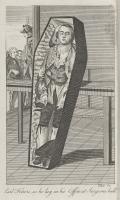
After hanging an hour and five minutes, the body was received in a coffin lined with white fattin, and conveyed to Surgeons’-hall, where an incifion was made from the neck to the bottom of the breaft, and the bowels were taken out; on infpection of which, the furgeons declared that they had never beheld greater figns of long life in any fubject which had come under their notice.
Image. Earl Ferres, as he lay in his Coffin at Surgeons hall.
His lordfhip’s hat and the halter lay near his feet in the coffin, on the lid of which were thefe words, "Laurence Earl Ferrers, fuffered May 5, 1760." After the body had remained fome time at Surgeons-hall, for public infpection, it was deliveréd to his friends for interment: but it would be unjuft to his memory not to mention that, during his imprifonment, he had made pecuniary recompence to feveral perfons whom he had injured, during the extravagance of thofe paffions to which he was unhappily fubject.
This malefactor was executed at Tyburn, on the 5th of May, 1760.
The cafe of lord Ferrers demands our ferious attention. He was born to great hopes and high expectations, and was confeffedly a man of fuperior abilities; but the unhappy indulgence of his paffions led to his ruin. Hence, then, the due government of the paffions ought to be learnt; for what is the man, who permits their unbounded gratification, but fomething lower than a brute?
Lord Ferrers appears to have been uninfluenced by the mild doctrines of Chriftianity. If thefe had held their proper weight on his mind, it would have been impoffible that he could have acted as he did: but when Religion fails to produce its natural, its genuine effects, the man ceafes to appear as fuch, and becomes an object of compaffion, if not of contempt!
On the 15th of May, 1812, four days after the death of Mr Perceval, the trial of the prisoner came on at the Old Bailey. The judges at ten o'clock took their seats on each side of the Lord Mayor; and the recorder, the Duke of Clarence, the Marquis Wellesley and almost all the aldermen of the City of London occupied the bench. The court was crowded to excess, and no distinction of rank was observed, so that Members of the House of Commons were forced to mingle in the throng. There were also present a great number of ladies, all led by the most intense curiosity to behold the assassin, and to hear what he might urge in defence or in palliation of his atrocious act.
At length Bellingham appeared, and advanced to the bar with a firm step, and quite undismayed. He bowed to the Court most respectfully, and even gracefully; and it is impossible to describe the impression which his appearance, accompanied by this unexpected fortitude, produced. He was dressed in a light brown surtout coat and striped yellow waistcoat; his hair plainly dressed, and without powder.
Before the prisoner was called on regularly to plead, Mr Alley, his counsel, made application to have the trial postponed, for the purpose of procuring proofs of his client's insanity, which was alleged in two affidavits he held: he said that he had no doubt, if time were allowed, that the prisoner could be proved to be insane. Mr Alley was here interrupted by the court, who refused to hear him until the prisoner had first pleaded.
The indictment was then read, and the usual question, 'Guilty, or not guilty?' was put to Bellingham, when he addressed the court: 'My lords — Before I can plead to this indictment, I must state, in justice to myself, that by hurrying on my trial I am placed in a most remarkable situation. It so happens that my prosecutors are actually the witnesses against me. All the documents on which alone I could rest my defence have been taken from me and are now in possession of the Crown. It is only two days since I was told to prepare for my defence, and when I asked for my papers, I was told they could not be given up. It is therefore, my lords, rendered utterly impossible for me to go into my justification, and under the circumstances in which I find myself, a trial is absolutely useless. The papers are to be given to me after the trial, but how can that avail me for my defence? I am, therefore, not ready for my trial.'
The Attorney-General was proceeding to explain to the court what had been done with reference to the prisoner's papers, when Chief Justice Mansfield interrupted him, observing, it was necessary the prisoner should first plead.
The prisoner was again interrogated, when he pleaded 'Not guilty' to both counts of the indictment.
The Attorney-General — 'I will now answer what has fallen from the prisoner. He says that he has been denied access to his papers. It is true that Government, for the purposes of justice, has retained them — but it is also true that he has been informed that if he asked for them at the time of his trial they should be ready, and any of them, which he might think useful to his defence, should be given to him: and in the meantime, if he considered it necessary, he might have copies of them. This we are ready to verify on oath.'
The clerk of the arraigns, Mr Shelton, then read the indictment, which charged the prisoner in the usual way with the murder of the Right Hon Spencer Perceval, with which he was also charged on the coroner's inquisition.
Mr Abbott having opened the case, the Attorney-General addressed the jury. He said that a lamentable and painful task devolved upon him to state to the jury the circumstances of this horrid murder — a crime perpetrated on a man whose whole life, he should have thought, would have guarded and protected him against such an attack, who, he was sure, if enough of life had been left him to see by whose hand he had fallen, would have spent his last moment in uttering a prayer for the forgiveness of his murderer. But It was not a time for him to dwell on the public loss, which had been sustained — its brightest ornament had been torn from the country, but the country had done justice to his memory. These were not considerations, however, by which they must be swayed. It was not revenge, nor was it resentment, that ought to have any influence on their consideration of the question. They were to satisfy public justice — to take care, by their verdict, that the public should not be exposed to such horrid crimes. With respect to the prisoner, he knew nothing, nor did he know how his life had been spent, except so far as related to the circumstances of the case. He had been in business and had acted as a merchant, in the course of which he had shown himself a man of sound understanding in every act which he performed; and he had not only conducted his own affairs with understanding, but he had been selected by other persons to manage theirs.
Having stated the main facts of the case as we have already detailed them, he entreated the jury to consider it not as the murder of so eminent a person, but as the murder of a common individual - - to suppose the meanest subject to have suffered as Mr Perceval had suffered, and to return their verdict as they would upon that case. Was he or was he not guilty? To that point they must direct their attention, and he knew of no reason to cause even a doubt. But what remained? This only — the attempt which had been made that day to put off the trial of the prisoner, on the ground of his being fit for this or any other crime, as he was afflicted with insanity. Let them consider this a little. The prisoner was a man conducting himself like others in all the ordinary circumstances of life — who carried on business, none of his family or friends interfering — no pretence being suggested that he was unable to superintend his own affairs. What clearer proofs, then, could be given to show, contrary to the defence set up, that he was not what the law called non compos mentis — that he was an accountable being?
He knew the cases where the plea of insanity would be received — where for instance a murder was committed by a person whose mental infirmity might be considered as very nearly the absence of all mind. Against their defence there was no argument. But he was this day to learn whether the wickedness of the act which the prisoner was called on to answer was to be considered an excuse for its perpetration. Travelling through his whole life, what ground could they adduce for such a plea? His every act appeared rational except one, and that was only irrational, because it was so horrid that the imagination of man could not fancy to itself the existence of so atrocious a deed. But how far must this argument go? It must arrive at this conclusion — that every act of gross and unusual atrocity would carry its defence along with it, that every act of peculiar horror would have within itself a certain defence, for the barbarity of the deed would be considered as a proof that the mind which directed it was not in a state of sufficient security to judge whether the action was right or wrong. If the mind possessed the power of forming that judgement, the prisoner was criminally accountable for the act. A man might be infirm in mind, insufficient to dispose of his property or to judge of the claims of his respective relatives, and if he were in that situation, the management of his affairs might be taken from him and vested in trustees: but such a man was not discharged from criminal acts because he could not transact civil business.
Many cases had occurred within his memory in courts of law, in which it was proved that a person in many respects had evinced symptoms of insanity up to a certain time; but the question then was, whether that insanity was of such a description as precluded or permitted the knowledge of right or wrong? In every one of the cases which recurred to his memory, though a certain degree of madness was proved, still as the parties seemed to have sufficient sense to distinguish right from wrong at the time of the perpetration of the acts charged against them, they were held to be criminally accountable. Here there was no deficiency of understanding whatever. No opinion of others to that effect was adduced: on the contrary, he was entrusted with the management of his own and others' affairs. the question was, whether at the time the murder was perpetrated he possessed sufficient sense to distinguish between right and wrong? What conclusion could they draw in favour of the idea which had been suggested? Let them take from their recollection the frightful nature of the act with the commission of which he was charged, let them take from it its accumulated horrors, and time prisoner stood before them in a state of sanity, and fully accountable for the act, of which, he thought, little doubt could be entertained he had been guilty.
The learned gentleman concluded by expressing his satisfaction at the fact that the prisoner stood alone on that occasion, that he was unconnected with, and unaided and uninfluenced by, any other person or party in the country, and that this deed could not therefore be attributed to any but the personal feelings which he entertained towards His Majesty's Government. On him, and on him only, did the disgrace which he had excited rest, and the character of the country was entirely free from any participation in it.
The first witness called on time part of the Crown was:
Mr William Smith (M.P. for Norwich) who, being sworn, deposed as follows:
He was on his way to attend the House of Commons on the evening of Monday the 11th of May, and was going through the lobby towards the door of the house, when he heard the report of a pistol, which appeared to have been fired close to the entrance door of the lobby. Immediately on the report, he turned towards the place from whence the noise appeared to proceed, and observed a tumult and probably a dozen or more persons about the spot. Almost in the same instant he saw a person rush hastily from among the crowd, and heard several voices cry out, 'Shut the doors — let no one escape.' The person came towards him from the crowd, looking first one way, then another, rather like one seeking for shelter than a person wounded. But taking two or three steps towards the witness, he reeled by him and almost instantaneously fell on the floor with his face downward, Before he fell, witness heard him cry, though not very distinctly, and in what he uttered, he heard the word 'murder!' or something very like it. When he first fell, witness thought that he might have been slightly wounded, and expected to see him make an effort to rise. But gazing on him for a few moments, he observed that he did not stir at all, and he, therefore, immediately stooped down to raise him front the ground, requesting the assistance of a gentleman close by him for the purpose. As soon as they had turned his face upwards, and not till then, he found that it was Mr Perceval. They then took him into their arms, and carried him into the office of the Speaker's secretary, where they seated themselves on the table, with Mr Perceval between them, also sitting on the table, and resting on their arms. His face was now perfectly pale, the blood issuing in small quantities from each corner of his mouth, and probably in two or three minutes from the firing of the pistol all signs of life had ceased. The eyes of the unfortunate gentleman were open, but he did not appear to know witness, nor to take any notice of any person about him, nor did he utter the least articulate sound from the moment he fell. A few convulsive sobs, which lasted perhaps three or four moments, together with a scarcely perceptible pulse, were the only signs of life which appeared then, and those continued but a very short time longer. When witness felt Mr Perceval's pulse for the last time, just before Mr Lynn, the surgeon, arrived, it appeared to him that he was quite dead. Witness remained supporting the body until it was conveyed into the Speaker's house, but he was unable to give any account of what passed in the lobby.
Mr William Lynn, a surgeon in Great George Street, de posed that he was called to the deceased, hut on his arrival he was quite dead. There was blood upon his white waistcoat and shirt, and upon his examining the body, he found that there was an opening in the skin, he probed the wound three inches down wards, and entertained no doubt that the pistol-ball passed into the heart, and was the cause of death.
Mr Henry Burgess, a solicitor who was in the lobby, stated, that after having seen Mr Perceval fall, as had been already described, he heard someone exclaim, 'That's the man!' and saw a hand pointing towards the bench by the fire-place which is on one side of the lobby, he immediately went over to the bench and saw the prisoner at the bar sitting on it in great agitation. There were one or two persons by him. He looked at his hands, and saw his left hand on the bench; and near or under his other hand he saw a pistol, which he took, and asked the prisoner what had induced him to do such a deed? He replied, 'Want of redress of grievances and refusal by government', or words to that effect. Witness then said to the prisoner, 'You have another pistol?' he replied, 'Yes.' Witness asked if it was loaded, to which he answered in the affirmative. Witness then saw some person take the other pistol from his person. The pistol which witness took from the prisoner was warm, and appeared as if it had been recently discharged. The lock was down and the pan open. (Here the pistol was produced, and recognized by the witness.) He then stated, that he put his hand into the right waist coat-pocket of the prisoner, from which he took a small penknife and a pencil, and from his left-hand waistcoat- pocket he took a bunch of keys and some money. The prisoner was detained in custody, and examined shortly afterwards above stairs in the House of Commons before the magistrates. Witness related in the presence of the prisoner, on that occasion, the facts which he had now detailed. When he had concluded, the prisoner made an observation to this effect, as well as he could recollect. 'I wish to correct Mr Burgess' statement in one point; but I believe he is perfectly correct in every other. Instead of my hand being, as Mr Burgess stated, upon or near the pistol, I think he took it from my hand or upon it.'
James Taylor, a tailor, at No 11 North Place, Gray's Inn Lane, deposed that he had been employed by the prisoner to repair some clothes. He was afterwards in Guildford Street, when the prisoner called him, and took him to his lodgings in Millman Street, and there directed him to put a side-pocket into a coat, which he gave him, of a particular length which he pointed out. He completed the job on the same night, and carried the coat home.
Mr John Morris stated that he often attended in the gallery appropriated for strangers, and went down to the House on Monday, the 11th of May, for that purpose. he passed into the lobby about the hour of five in the afternoon. He observed the prisoner at the bar standing in the lobby near the outer door: he was standing beside that part of the door which is generally closed, it was a double door, and one half was usually closed, within which half tile prisoner was standing, and anyone to have entered the lobby must have passed him at unit's length. He observed the prisoner as if watching for somebody coming, and he appeared to look anxiously towards the door. As well as the witness recollected, the prisoner had his right hand within the left breast of his coat. Witness passed on to the staircase of the gallery, and almost immediately after he got into the upper lobby, he heard the report of a pistol, and found soon after that it was connected with the fatal event which occurred on that evening. He had frequently seen the prisoner before in the gallery, where gentlemen who report the parliamentary proceedings resorted, and about the passages of the House of Commons.
John Vickery, a Bow Street officer, said that he went on Monday afternoon to New Millman Street, to the lodgings of the prisoner, which he searched, and found, in the bedroom upstairs, a pair of pistol-bags, and in the same drawer a small powder-flask and some powder in a small paper, a box with some bullets, and some small flints wrapped in paper. There was also a pistol-key to unscrew the pistol for the purpose of loading, and some sand-paper and a pistol- mould. The witness on comparing e bullet found in the loaded pistol with the mould, and the screw with the pistols, found them all to correspond.
Mr Vincent George Dowling was next called. He stated that he was in the gallery on the afternoon in question, and ran down into the lobby on hearing the report of a pistol. He saw the prisoner at the bar sitting on a stool, and going to him, he seized him and began to search his person. he took from his left-hand small-clothes pocket a small pistol, which he produced and which, on his examining it, he found to be loaded with powder and ball. It was primed as well as loaded. The pistol which had been discharged and that which he took from the prisoner were in his belief a brace: they were of the same size and bore, and were marked with the same maker's name. The witness had seen the prisoner several times before in the gallery and in the avenues of the house, and to the best of his recollection the last the he saw him was six or seven days before the death of Mr Perceval, He was frequently in the gallery during the debates, and upon several occasions entered into conversation with the witness. He had often asked for information as to the names of the gentlemen speaking, and also as to the persons of the members of His Majesty's Government.
Other witnesses from Newgate produced tile coat worn by the prisoner at the tine of his apprehension, amid it was identified by Taylor as the same one which he had put the side-pocket.
Lord Chief Justice Mansfield then addressed the prisoner, and told him, that the case on the part of the Crown being now gone through, the period was come for him to make any defence he might wish to offer.
The prisoner asked whether his counsel had nothing to urge in his defence?
Mr Alley informed him that his counsel were not entitled to speak.
The prisoner then said that the documents and papers necessary to his defence had been taken out of his pocket, and had not since been restored to him.
Mr Garrow said that it was the intention of the counsel for the Crown to restore him his papers, having first proved them to be the same which were taken from him, and that they had not suffered any subtraction: his solicitor already had copies of them.
General Gascoigne and Mr Hume (M.P. for Weymouth) proved that the papers were those which had been taken from the person of the prisoner, and that they had been in their custody ever since, and had suffered no subtraction.
The papers were then handed to the prisoner, who proceeded to arrange and examine them.
The prisoner, who had been hitherto sitting, now rose and, bowing respectfully to the court and jury, went into his defence, in a firm tone of voice, and without any appearance of embarrassment. He spoke nearly to the following effect:
'I feel great personal obligation to the Attorney-General for the objection which he has made to the plea of insanity. I think it is far more fortunate that such a plea as that should have been unfounded, than that it should have existed in fact. I am obliged to my counsel, however, for having thus endeavoured to consult my interest, as I am convinced the attempt has arisen from the kindest motives. That I am or have been insane is a circumstance of which I am not apprised, except in the single instance of my having been confined in Russia: how far that may be considered as affecting my present situation, it is not for me to determine. This is the first time that I have ever spoken in public in this way. I feel my own incompetency, but I trust you will attend to the substance, rather than to the manner, of my investigating the truth of an affair which has occasioned my presence at this bar.
'I beg to assure you that the crime which I have committed has arisen from compulsion rather than from any hostility to the man whom it has been my fate to destroy. Considering the amiable character and universally admitted virtues of Mr Perceval, I feel, if I could murder him in a cool and unjustifiable manner, I should not deserve to live another moment in this world. Conscious, however, that I shall be able to justify everything which I have done, I feel some degree of confidence in meeting the storm which assails me, and shall now proceed to unfold a catalogue of circumstances which, while they harrow up my own soul, will, I am sure, tend to the extenuation of my conduct in this honourable court. This, as has already been candidly stated by the Attorney-General, is the first instance in which the slightest imputation has been cast upon my moral character. Until this fatal catastrophe, which no one can more heartily regret than I do, not excepting even the family of Mr Perceval himself, I have stood alike pure in the minds of those who have known me, and in the judgement of my own heart. I hope I see this affair in the true light.
'For eight years, gentlemen of the jury, have I been exposed to all the miseries which it is possible for human nature to endure. Driven almost to despair, I sought for redress in vain. For this affair I had the carte blanche of government, as I will prove by the most incontestible evidence, namely, the writing of the Secretary of State himself. I come before you under peculiar disadvantages. Many of my most material papers are now at Liver pool, for which I have written; but I have been called upon my trial before it was possible to obtain an answer to my letter. Without witnesses, therefore, and in the absence of many papers necessary to my justification, I am sure you will admit I have just grounds for claiming some indulgence. I must state that after my voyage to Archangel, I transmitted a petition to his royal highness the Prince Regent, through Mr Windle, my solicitor, and in consequence of there being no reply I came to London to see the result. Surprised at the delay, and conceiving that the interests of my country were at stake, I considered this step as essential, as well for the assertion of my own right as for the vindication of the national honour. I waited upon Colonel MacMahon, who stated that my petition had been received, but, owing to some accident, had been mislaid. Under these circumstances, I drew out another account of the particulars of the Russian affair, and this may be considered the commencement of that train of events which led to the afflicting and unhappy fate of Mr Perceval.'
The prisoner then read various documents containing the statement of the whole of his affairs in Russia. In the course of narrating these hardships, he took occasion to explain several points, adverting with great feeling to the unhappy situation in which he was placed, from the circumstance of his having been lately married to his wife, then about twenty years of age, with an infant at her breast, and who had been waiting for him at St Petersburgh, in order that she might accompany him to England, a prey to all those anxieties which the unexpected and cruel incarceration of her husband, without any just grounds, was calculated to excite. (He was here much affected.) He also de scribed his feelings at a subsequent period, when his wife, from an anxiety to reach her native country (England) when in a state of pregnancy, and looking to the improbability of his liberation, was obliged to quit Petersburgh unprotected, and under take the voyage at the peril of her life, while Lord L. Gower and Sir S. Sharp suffered him to remain in a situation worse than death. 'My God! my God!' he exclaimed, 'what heart could bear such excruciating tortures, without bursting with indignation at conduct so diametrically opposite to justice and to humanity. I appeal to you, gentlemen of the jury, as men — I appeal to you as brothers — I appeal to you as Christians —whether, under such circumstances of persecution, it was possible to regard the actions of the ambassador and consul of my own country with any other feelings but those of detestation and horror! In using language thus strong, I feel that I commit an error; yet does my heart tell me, that towards men who lent themselves thus to bolster up the basest acts of persecution, there are no observations, however strong, which the strict justice of the case would not excuse my using. Had I been so fortunate as to have met Lord Leveson Gower instead of that truly amiable and highly lamented individual, Mr Perceval, he is the man who should have received the ball!'
Bellingham then went on to recount at great length the history of his various attempts to obtain satisfaction from the Government, which have already been described, ending with his letter to the Bow Street magistrates quoted above.
'In the course of two days,' he continued, 'I called again at Bow Street for an answer to this letter, when I received a little memorandum, in Mr Reid's writing, in which he states that he cannot interfere in my affairs, and that he had felt it his duty to communicate the contents of my packet to the Secretary of State. Had he done otherwise he would have been extremely reprehensible, as events have turned out so calamitously — events which go to my heart to allude to. (Much affected.) At last, in reply to letter of the 13th of April, 1 received a final and direct answer, which at once convinced me that I had no reason to expect any adjustment whatever of those claims which I had on His Majesty's government, for my criminal detention in Russia.
'After this, on personal application at the office of the Secretary f State, and intimating my intention to take justice in my own hand, I was told, by the mouth of Mr Hill, that I was at liberty to take such measures as I thought proper. Who then is to be reprobated in this case — those who were regardless of every feeling of honour and of justice, or him who, spurred on by injury and neglect, and with a due notice of his intentions, pursued the only course likely to lead to a satisfactory termination of calamities which had weighed him down to the lowest ebb of misery? I will now only mention a few observations by way of defence. You have before you all the particulars of this melancholy transaction. Believe me, gentlemen, the rashness of which I have been guilty has not been dictated by any personal animosity to Mr Perceval, rather than injure whom from private or malicious motives I would suffer my limbs to be cut from my body. (Here the prisoner seemed again much agitated.)
'If, whenever I am called before the tribunal of God, I can appear with as clear a conscience as I now possess in regard to the alleged charge of the wilful murder of the unfortunate gentleman, the investigation of whose death has occupied your attention, it would be happy for me, as essentially securing to me eternal salvation; but that is impossible. That my arm has been the means of his melancholy and lamented exit, I am ready to allow. But to constitute murder, it must clearly and absolutely be proved to have arisen from malice prepense and with a malicious design, as I have no doubt the learned judge will shortly lay down, in explaining the law on the subject. If such is the case, I am guilty: if not, I look forward with confidence to your acquittal.
'That the contrary is the case has been most clearly and irrefutably proved. No doubt can rest upon your minds, as my uniform and undeviating object has been an endeavour to obtain justice, according to law, for a series of the most long-continued and unmerited sufferings that were ever submitted to a court of law, without having been guilty of any other crime than an appeal for redress for a most flagrant injury offered to my sovereign and my country, wherein my liberty and property have fallen a sacrifice for the continued period of eight years, to the total ruin of myself and family (with authenticated documents of the truth of the allegations), merely because it was Mr Perceval's plea sure that justice should not be granted, sheltering himself with the idea of there being no alternative remaining, as my petition to parliament for redress could not be brought (as having a pecuniary tendency) without the sanction of His Majesty's ministers, and that he was determined to oppose my claim, by trampling both on law and right.
'Gentlemen, where a man has so strong and serious a criminal case to bring forward as mine has been, the nature of which was purely national, it is the bounden duty of Government to attend to it; for justice is a matter of right and not of valour. And when a minister is so unprincipled and presumptuous at any time, but especially in a case of such urgent necessity, to set himself above both the sovereign and the laws, as has been the case with Mr Perceval, he must do it at his personal risk; for by the law he cannot be protected.
'Gentlemen, if this is not fact, the mere will of a minister would be law: it would be this thing today and the other thing tomorrow, as either interest or caprice might dictate. What would become of our liberties? Where would be the purity and the impartiality of the justice we so much boast of? The Government's non-attendance to the dictates of justice is solely to be attributed the melancholy catastrophe of the unfortunate gentleman, as any malicious intention to his injury was the most remote from my heart. Justice, and justice only, was my object, which Government uniformly objected to grant. The distress it reduced me to, drove me to despair in consequence, and, purely for the purpose of having this singular affair legally investigated, I gave notice at the public office, Bow Street, requesting the magistrates to acquaint His Majesty's ministers, that if they persisted in refusing justice, or even to permit me to bring my just petition into parliament for redress, I should be under the imperious necessity of executing justice myself, solely for the purpose of ascertaining, through a criminal court, whether His Majesty's ministers have the power to refuse justice to a well-authenticated and irrefutable act of oppression, committed by the consul and ambassador abroad, whereby my sovereign's and country's honour were materially tarnished, by my person endeavouring to be made the stalking- horse of justification, to one of the greatest insults that could be offered to the crown. But in order to avoid so reluctant and abhorrent an alternative, I hoped to be allowed to bring my petition to the House of Commons — or that they would do what was right and proper themselves. On my return from Russia, I brought most serious charges to the privy council, both against Sir Stephen Shairp and Lord Granville Leveson Gower, when the affair was determined to be purely national, and consequently it was the duty of His Majesty's ministers to arrange it by acting on the resolution of the council. Suppose, for instance, the charge I brought could have been proved to be erroneous, should not I have been called to a severe account for my conduct? But, being true, ought not I to have been redressed?
'It is a melancholy fact, that the warping of justice, including all the various ramifications in which it operates, occasions more misery in the world, in a immoral sense, than all the acts of God in a physical one, with which he punishes mankind for their transgressions — a confirmation of which, the single, but strong, instance before you is one remarkable proof.
'If a poor unfortunate man stops another upon the highway, and robs him of but a few shillings, he may be called upon to forfeit his life. But I have been robbed of my liberty for years, ill-treated beyond precedent, torn from my wife and family, bereaved of all my property to make good the consequences of such irregularities, deprived and bereaved of everything that makes life valuable, and then called upon to forfeit it, because Mr Perceval has been pleased to patronize iniquity that ought to have been punished, for the sake of a vote or two in the House of Commons, with, perhaps, a similar good turn elsewhere.
'Is there, gentlemen, any comparison between the enormity of these two offenders? No more than a mite to a mountain. Yet the one is carried to the gallows, while the other stalks in security, fancying himself beyond the reach of law or justice: the most honest man suffers, while the other goes forward in triumph to new and more extended enormities.
'We have had a recent and striking instance of some unfortunate men who have been called upon to pay their lives as the forfeit of their allegiance, in endeavouring to mitigate the rigours of a prison. But, gentlemen, where is the proportion between the crimes for which they suffered, and what the Government has been guilty of, in withholding its protection from me? Even in a Crown case, after the years of sufferings, I have been called upon to sacrifice all my property and the welfare of my family, to bolster up the iniquities of the Crown. And then am prosecuted for my life, because I have taken the only possible alternative to bring the affair to a public investigation, for the purpose of being enabled to return to the bosom of my family with some degree of comfort and honour. Every man within the sound of my voice must feel for my situation; but by you, gentle men of the jury, it must be felt in a peculiar degree, who are husbands and fathers, and can fancy yourselves in my situation. I trust that this serious lesson will operate as a warning to all future ministers, and lead them to do the thing that is right, as an unerring rule of conduct, for, if the superior classes were more correct in their proceedings, the extensive ramifications of evil would, in a great measure, be hemmed up. A notable proof of the fact is, that this court would never have been troubled with the case before it, had their conduct been guided by these principles.
'I have now occupied the attention of the court for a period much longer than I intended, yet I trust they will consider the awfulness of my situation to be a sufficient ground for a trespass which, under other circumstances, would be inexcusable. Sooner than suffer what I have suffered for the last eight years, how ever, I should consider five hundred deaths, if it were possible for human nature to endure them, a fate far more preferable. Lost so long to all the endearments of my family, bereaved of all the blessings of life, and deprived of its greatest sweet, liberty, as the weary traveller, who has long been pelted by the pitiless storm, welcomes the much desired inn, I shall receive death as the relief of all my sorrows. I shall not occupy your attention longer, but, relying on the justice of God, and submitting myself to the dictates of your conscience, I submit to the fiat of my fate, firmly anticipating an acquittal from a charge so abhorrent to every feeling of my soul.' Here the prisoner bowed, and his counsel immediately proceeded to call the witnesses for the defence.
Anne Billet, who appeared under the strongest impressions of grief, being sworn, deposed that she lived in the county of Southampton: she came to London in consequence of having read in the newspapers of the prisoner having been apprehended for the murder of Mr Perceval. She was induced to come to town, from a conviction that she knew more of him than any other friend. She knew him from a child. He resided latterly at Liverpool, from whence he came at Christmas last. She knew him to be a merchant. His father died insane in Titchfield Street, Oxford Road. She firmly believed that for the last three or four years the prisoner was in a state of derangement, respecting the business which he had been pursuing. She had not seen him for twelve months until the present moment. She always thought him deranged when his Russian affairs were the subject of conversation.
When cross-examined by Mr Garrow, she deposed that, when in London with the prisoner about twelve months since, he was going to different government offices to seek redress of his grievances. He was then in a state of derangement, as he had been ever since his return from Russia. There was one instance which occurred at the period to which she was alluding, which strongly confirmed her in the opinion of his insanity. About Christmas he told his wife and witness, that now he was come from Russia he had realized more than 100,000L., with which he intended to buy an estate in the west of England and to have a house in London. He admitted that he had not got the money, but said it was the same as if he had, for he had gained his cause in Russia and our government would make good all the loss he had sustained. He repeatedly said to her and to his wife that this was assuredly the fact. Upon one occasion he took Mrs Bellingham and the witness to the Secretary of State's office, where they saw Mr Smith, who said if he had not ladies with him he would not have come to him at all. The prisoner told Mr Smith, that the reason why he brought them was to convince them that his claims were just, and that he would very shortly receive the money. Mr Smith told him he could say nothing upon this subject: he had already sent him a letter alleging that he had nothing to expect. The prisoner then requested Mr Smith would answer him one question — 'My friends say I am out of my senses. Is it your opinion that I am so?' Mr Smith said it was a very delicate question, and one he did not wish to answer. Having then departed, when they got into the carriage which waited for them, he took hold of his wife's hand and said, 'I hope, now, my dear, you are convinced all will now end as we wish.' Since that period she knew that he had been pursuing his object alone, his wife remaining at Liverpool.
Other witnesses were called, who deposed to like facts and to their belief in the insanity of the prisoner, but Lord Chief Justice Mansfield having summed up the case, the jury, after a consultation of two minutes and a half in the box, expressed a wish to retire, and an officer of the court being sworn, accompanied them to the jury-room. As they passed out, the prisoner regarded them separately with a look of mingled confidence and complacency. They were absent fourteen minutes, and, on their return into court, their countenances, acting as indices to their minds, at once unfolded the determination to which they had come. The prisoner again directed his attention to them in the same manner as before.
The names being called over, and the verdict asked for in the usual form, the foreman in a faltering voice, announced the fatal decision of — Guilty.
The prisoner's countenance here indicated surprise, unmixed, however, with any demonstrations of that concern which the awfulness of his situation was calculated to produce.
The Recorder then passed the awful sentence of death on the prisoner in the most feeling manner, and he was ordered for execution on the following Monday, his body to be anatomized. He received the sentence without any emotion.
From the time of his condemnation the unfortunate convict was fed upon bread and water. All means of suicide were removed, and he was not allowed to be shaved — a prohibition which gave him much concern, as he feared he should not appear as a gentleman. He was visited by the ordinary on Saturday, and some religious gentlemen called on him on Sunday, with whose conversation he seemed greatly pleased. He appeared naturally depressed by his situation; but persisted in a resolute denial of his guilt. He frequently said that he had prepared himself to go to his Father, and that he should be pleased when the hour came.
Being informed by Mr Newman that two gentlemen from Liverpool had called, and left word that his wife and children would be provided for, he seemed but little affected; but, having requested pen, ink and paper, he wrote the following letter to his wife:-
MY BLESSED MARY, — It rejoiced me beyond measure to hear you are likely to be well provided for. I am sure the public at large will participate in, and mitigate, your sorrows; I assure you, my love, my sincerest endeavours have ever been directed to your welfare. As we shall not meet any more in this world, I sincerely hope we shall do so in the world to come. My blessing to the boys, with kind remembrance to Miss Stephens, for whom I have the greatest regard, in consequence of her uniform affection for them. With the purest intentions, it has always been my misfortune to be thwarted, misrepresented and ill-used in life; but however, we feel a happy prospect of compensation in a speedy translation to life eternal. It's not possible to be more calm or placid than I feel, and nine hours more will waft me to those happy shores where bliss is without alloy.
Yours ever affectionate, JOHN BELLINGHAM.
That the unfortunate man was afflicted with a strange malady, which occasionally rendered him incapable of correct conclusions, must be evident from the following note, which he wrote the night preceding his execution: 'I lost my suit solely through the improper conduct of my attorney and counsel, Mr Alley, in not bringing my witnesses forward (of whom there were more an twenty): in consequence, the judge took advantage of the circumstance, and I went on the defence without having brought forward a single friend — otherwise I must inevitably have been acquitted.'
On the Monday morning [18th May 1812], at about six o'clock, he rose and dressed himself with great composure, and read for half-an-hour in the Prayer Book. Dr Ford being then announced, the prisoner shook him most cordially by the hand, and left his cell for the room allotted for the condemned criminals. He repeated the declaration which he had frequently before made, that his mind was perfectly calm and composed and that he was fully prepared to meet his fate with resignation. After a few minutes spent in prayer, the sacrament was administered to him, and during time whole of the ceremony he seemed to be deeply impressed with the truths of the Christian religion, and repeatedly uttered some pious ejaculations. After the religious ceremony was ended, the prisoner was informed that the sheriffs were ready. He answered in a firm tone of voice, 'I am perfectly ready also.'
The executioner then proceeded to fasten his wrists together, and the prisoner turned up the sleeves of his coat, and clasped his hands together, presenting them to the man who held the cord, and said, 'So.' When they were fastened, he desired his attendants to pull down his sleeves so as to cover the cord. The officer then proceeded to secure his arms behind him. When the man had finished, he moved his hand upwards, as if to ascertain whether he could reach his neck, and asked whether they thought his arms were sufficiently fastened, saying that he might struggle, and that he wished to be so secured as to prevent any inconvenience arising from it. He was answered that the cord was quite secure, but he requested that it might be tightened a little, which was accordingly done. During the whole of the awful scene he appeared perfectly composed and collected: his voice never faltered, but just before he left the room to proceed to the place of execution, he stooped down his head and appeared to wipe away a tear. He was then conducted by the Lord Mayor, sheriffs, under-sheriffs and officers (Dr Ford walking with him) from the room, in which he had remained from the time his irons were taken off; through the press-yard and time prison to the fatal spot, before the Debtors' door at Newgate.
He ascended the scaffold with rather a light step, a cheerful countenance, and a confident, a calm, but not an exulting air. He looked about him a little, lightly and rapidly, which seems to have been his usual manner and gesture, but made no remark.
Before the cap was put over his face, Dr Ford asked if he had any last communication to make, or anything particular to say. He was again proceeding to talk about Russia and his family, when Dr Ford stopped him, calling his attention to the eternity into which he was entering, and praying. Bellingham prayed also. The clergyman then asked him how he felt, and he answered calmly and collectedly, that 'he thanked God for having enabled him to meet his fate with so much fortitude and resignation.' When the executioner proceeded to put the cap over his face, Bellingham objected to it, and expressed a strong wish that the business could be done without it; but Dr Ford said that was not to be dispensed with. While the cap was being fastened on, it being tied round the lower part of the face by the prisoner's neckerchief, and just when he was tied up, about a score of persons in the mob set up a loud and reiterated cry of 'God bless you!' 'God save you!' This cry lasted while the cap was fastening, and, though those who raised it were loud and daring, it was joined in by but very few. The ordinary asked Bellingham if he heard what the mob were saying. He said he heard them crying out something, but he did not understand what it was, and inquired what. The cry having by this time ceased, the clergyman did not inform him what it was. The fastening on of the cap being accomplished, the executioner retired and a perfect silence ensued. Dr Ford continued praying for about a minute, while the executioner went below the scaffold, and preparations were made to strike away its supporters. The clock struck eight, and while was striking the seventh time, the clergyman and Bellingham both fervently praying, the supporters of the internal part of scaffold were struck away, and Bellingham dropped out of sight down as far as the knees, his body being in full view. The most perfect and awful silence prevailed; not even the slightest attempt at a huzza or noise of any kind whatever was made.
The body was afterwards carried in a cart, followed by a crowd of the lower class, to St Bartholomew's Hospital, and privately dissected. The greatest precautions were adopted to prevent accidents among the crowd. A large bill was placarded at all the avenues the Old Bailey, and carried about on a pole, to this effect: 'Beware of entering the crowd! Remember thirty poor creatures pressed to death by the crowd when Haggerty and Holloway were executed.' But no accident of any moment occurred. To prevent any disposition to tumult, a military force was stationed near Islington and to the south of Blackfriars Bridge, and all the volunteer corps of the metropolis received instructions to be under arms during the whole of the day.