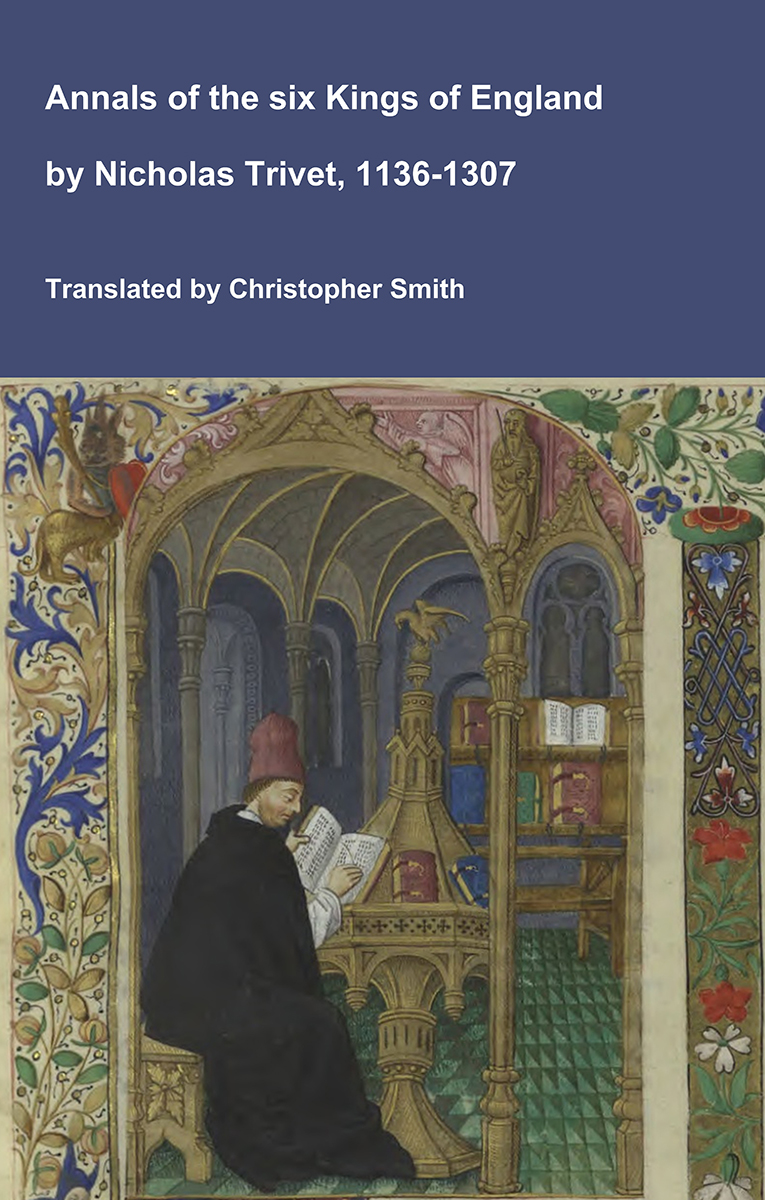
Annals of the six Kings of England by Nicholas Trivet
Translation of the Annals of the Six Kings of England by that traces the rise and rule of the Angevin aka Plantagenet dynasty from the mid-12th to early 14th century. Written by the Dominican scholar Nicholas Trivet, the work offers a vivid account of English history from the reign of King Stephen through to the death of King Edward I, blending political narrative with moral reflection. Covering the reigns of six monarchs—from Stephen to Edward I—the chronicle explores royal authority, rebellion, war, and the shifting balance between crown, church, and nobility. Trivet provides detailed insight into defining moments such as baronial conflicts, Anglo-French rivalry, and the consolidation of royal power under Edward I, whose reign he describes with particular immediacy. The Annals combines careful year-by-year reporting with thoughtful interpretation, presenting history not merely as a sequence of events but as a moral and political lesson. Ideal for readers interested in medieval history, kingship, and the origins of the English state, this chronicle remains a valuable and accessible window into the turbulent world of the Plantagenet kings.
Available at Amazon in eBook and Paperback format.
Carmelite Priory, Doncaster is in Doncaster [Map], Priories in England.
There were several royal visitors to the Carmelite Priory, Doncaster [Map], over the years. The Priory could provide accommodation for the royal personages and their guests would attend service there at the Shrine to St Mary. Henry IV in July 1399 and Edward IV in 1470 were two such visitors and in Tudor times, Henry VII, as a newly-crowned monarch, was another visitor of note. Later on the 13th June 1503, his daughter, Margaret lodged at Whitefriars on her way north to become the wife of King James IV of Scotland.
The original Shrine of Our Lady of Doncaster was part of the Carmelite friary [Map] in the town during the Middle Ages. The Carmelite friary of Doncaster was founded around 1346 by the two founders, and the co-founders by virtue of patronage, Richard II and his uncle, John of Gaunt.
On 30th November 1350 alienation of mortmain was granted by license on the 30th November 1350, by John, son of Henry Nightbrother de Eyam and Richard le Ewere of Doncaster, to the Carmelite Priory of Doncaster [Map]. This provided the Carmelites with a plot of approximately six acres of land on which to build a church and shrine in honour of St Mary, together with living accommodation for the friars, a development described in a document listed in the Victoria County History Vol 3 as "a right goodly house in the middle of the town".
In 1484 Margaret Cobham Countess Westmoreland died. She was buried at Carmelite Priory, Doncaster [Map], in a white marble tomb that was removed to the parish church on the Dissolution.
Collectanea by John Leland [1502-1552]. The XIIIth Day of the said Monneth [13th July 1503], she departed from the fayd Place acompayned as befor: And half a Myll thens cam befor hyr Sir William Conyars, Scheryff of Yorkshire, very well drest, compayned of Sir William Skarguill. also well arayd. His Hors Harnays full of Campanes of Silver, and gylt. And ther was in ther Company many Gentylmen and oders, to the Nombre of 60 Horsys, well horsed, and honestly arayd, Ichon in the Liverays of their sayd Masters.
A Mylle from the sayd Place, the Sheryff of Nothynhamshyre toke hys Leve, and others of hys Felowschyp, and retorned ageyn.
From thens she drew to Doncastre [Map]. And halfe Way came Sir Edward Savage, and with hym Sir Rauf Ryder, well appoynted, and the Folks of ther Liverays, to the Nomber of 60 Horsys, well mounted.
Without the said Doncallre was the Mayor, Aldermen, and Bowrgesses on Foot, the wich resayved the sayd Quene [aged 13]. Thys doon, in fayr Aray she entred within the said Towne, according to the precedent Custome, and was lodged in the Freres Carmes [Map].
The Dissolution of the Carmelite Priory, Doncaster [Map], didn't come about until after the conclusion of the Pilgrimage of Grace. The priory was surrendered to the King's Commissioners by the new prior, Edward Stubbis, and the seven friars on the 13th November 1538. In an inventory compiled at the time, a list of everything was prepared. The list, as shown in the Victoria County History Vol 3, included the following items: the plate, sent to the royal jewel house included 25 oz of gilt plate, 109.5 oz of parcel gilt and 48.5 oz of white plate. Later the sale of the goods realised £21-18-4d.