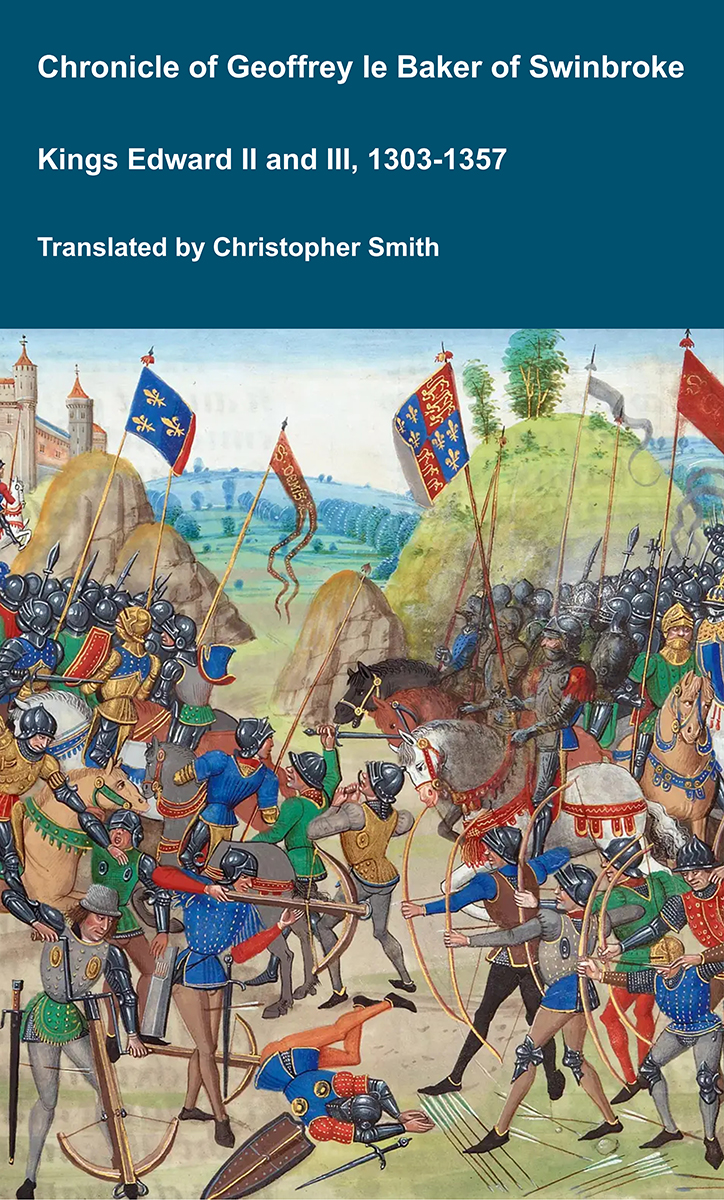
Chronicle of Geoffrey le Baker of Swinbroke

Baker was a secular clerk from Swinbroke, now Swinbrook, an Oxfordshire village two miles east of Burford. His Chronicle describes the events of the period 1303-1356: Gaveston, Bannockburn, Boroughbridge, the murder of King Edward II, the Scottish Wars, Sluys, Crécy, the Black Death, Winchelsea and Poitiers. To quote Herbert Bruce 'it possesses a vigorous and characteristic style, and its value for particular events between 1303 and 1356 has been recognised by its editor and by subsequent writers'. The book provides remarkable detail about the events it describes. Baker's text has been augmented with hundreds of notes, including extracts from other contemporary chronicles, such as the Annales Londonienses, Annales Paulini, Murimuth, Lanercost, Avesbury, Guisborough and Froissart to enrich the reader's understanding. The translation takes as its source the 'Chronicon Galfridi le Baker de Swynebroke' published in 1889, edited by Edward Maunde Thompson.

Available at Amazon in eBook and Paperback format.

Vellocatus

The Histories Book 3. 45. Inspired by these differences between the Roman forces and by the many rumours of civil war that reached them, the Britons plucked up courage under the leader­ship of Venutius, who, in addition to his natural spirit and hatred of the Roman name, was fired by his personal resentment toward Queen Cartimandua [aged 8]. She was ruler over the Brigantes, having the influence that belongs to high birth, and she had later strengthened her power when she was credited with having captured King Caratacus [aged 41] by treachery and so furnished an adornment for the triumph of Claudius Caesar.​20 From this came her wealth and the wanton spirit which success breeds. She grew to despise her husband Venutius, and took as her consort his squire Vellocatus, whom she admitted to share the throne with her. Her house was at once shaken by this scandalous act. Her husband was favoured by the sentiments of all the citizens; the adulterer was supported by the queen's passion for him and by her savage spirit. So Venutius, calling in aid from outside and at the same time assisted by a revolt of the Brigantes themselves, put Cartimandua into an extremely dangerous position. Then she asked the Romans for protection, and in fact some companies of our foot and horse, after meeting with indifferent success in a number of engagements, finally succeeded in rescuing the queen from danger. The throne was left to Venutius; the war to us.

Note 20. Celebrated in 51 A.D. See Tac. Ann. XII. 33‑37; CIL VI.920.

After 51AD Vellocatus and Queen Cartimandua of the Brigantes [aged 8] were married.

Around 69 Queen Cartimandua of the Brigantes [aged 26] died.

Time Team Series 1 Episode 2: On the Edge of an Empire was filmed between 3rd September 1993 and 5th September 1993. It was originally shown on 23rd January 1994.

Location: Ribchester Roman Fort, Lancashire [Map].

Category: Time Team Roman and Iron Age.

Time Team:

Tony Robinson [aged 47], Presenter

Mick Aston [aged 47], Bristol University Landscape Archaeologist

Carenza Lewis [aged 30], Royal Commission on Historic Monuments

Phil Harding [aged 43], Wessex Archaeological Trust Field Archaeologist

Robin Bush [aged 50], Archivist

Victor Ambrus [aged 58], Historical Illustrator

John Gator, Chris Gaffney, Geophysics

Adrian Olivier, Lancaster University Archaeology Unit

Ermine Street Guard

Techniques: Excavation, Resistivity, Magnetometry

Sources: Publius (or Flavius) Vegetius Renatus' "De re militari"

Historical Figures: Brigantes, Queen Cartimandua, King Caractacus of the Silures, King Venutius of the Brigantes, Vellocatus.

Events:

Outcomes: Broken Roman Quern, Decorated Samian Ware, Punic Ditch, plans of Wooden and Stone Forts, location of bathhouse.

Channel 4 Episode