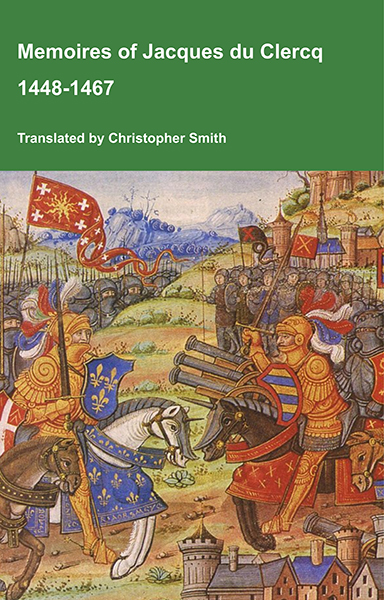
Memoires of Jacques du Clercq

This is a translation of the 'Memoires of Jacques du Clercq', published in 1823 in two volumes, edited by Frederic, Baron de Reissenberg. In his introduction Reissenberg writes: 'Jacques du Clercq tells us that he was born in 1424, and that he was a licentiate in law and a counsellor to Philip the Good, Duke of Burgundy, in the castellany of Douai, Lille, and Orchies. It appears that he established his residence at Arras. In 1446, he married the daughter of Baldwin de la Lacherie, a gentleman who lived in Lille. We read in the fifth book of his Memoirs that his father, also named Jacques du Clercq, had married a lady of the Le Camelin family, from Compiègne. His ancestors, always attached to the counts of Flanders, had constantly served them, whether in their councils or in their armies.' The Memoires cover a period of nineteen years beginning in in 1448, ending in in 1467. It appears that the author had intended to extend the Memoirs beyond that date; no doubt illness or death prevented him from carrying out this plan. As Reissenberg writes the 'merit of this work lies in the simplicity of its narrative, in its tone of good faith, and in a certain air of frankness which naturally wins the reader’s confidence.' Du Clercq ranges from events of national and international importance, including events of the Wars of the Roses in England, to simple, everyday local events such as marriages, robberies, murders, trials and deaths, including that of his own father in Book 5; one of his last entries.

Available at Amazon in eBook and Paperback format.

Llan Druidion Burial Chamber, Ffynnon Druidion, Fishguard, Pembrokeshire, South West Wales, British Isles [Map]

Archaeologia Cambrensis 1872 Pages 81-143. Within a short distance is a place called "Ffynnon Druidion [Map]," and another "Llan Druidion [Map]," whence Fenton draws the conclusion that these names, as well as the numerous megalithic monuments there, prove that this was a favourite residence of the Druids. But has the word "Druidion" anything to do with Druids? The Welsh for a Druid is "Derwydd." "Ceryg y Druidion," in Merioneth, popularly translated stones of the Druids, is said by Welsh scholars to be rather stones of brave or strong men. "Druidion" seems to be the English word Druid with a Welsh plural suffix; and it is difficult to conceive how such a barbarous word can be of such antiquity as might be assigned to names of places in Wales. The assigning of it in these two instances, where megaliths abound, only shews that these stones were thought, in later times, to be Druidical by those who gave the names. But then remains the difficulty, how such a hybrid word as "Druidion" could have come into existence in a district where English is hardly to this day understood. "Drudion" means "heroes" or "brave men."

Near Ffynnon Druidion was once a small dolmen, now so entirely demolished that only one or two of its stones are left to mark where it stood; but it was here that five flint celts were discovered, and which had, no doubt, been buried with the corpse.

A little lower, to the westward, was in Fenton's time a circle of stones, in the centre of which was discovered a stone hammer. One of the flint celts and hammer are figured by Fenton. He does not state the kind of stone of which the hammer is made. The flint weapons are well worked, and must have been brought from a great distance.