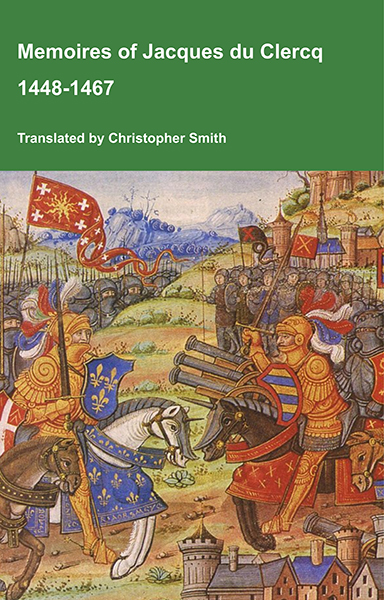
Memoires of Jacques du Clercq

This is a translation of the 'Memoires of Jacques du Clercq', published in 1823 in two volumes, edited by Frederic, Baron de Reissenberg. In his introduction Reissenberg writes: 'Jacques du Clercq tells us that he was born in 1424, and that he was a licentiate in law and a counsellor to Philip the Good, Duke of Burgundy, in the castellany of Douai, Lille, and Orchies. It appears that he established his residence at Arras. In 1446, he married the daughter of Baldwin de la Lacherie, a gentleman who lived in Lille. We read in the fifth book of his Memoirs that his father, also named Jacques du Clercq, had married a lady of the Le Camelin family, from Compiègne. His ancestors, always attached to the counts of Flanders, had constantly served them, whether in their councils or in their armies.' The Memoires cover a period of nineteen years beginning in in 1448, ending in in 1467. It appears that the author had intended to extend the Memoirs beyond that date; no doubt illness or death prevented him from carrying out this plan. As Reissenberg writes the 'merit of this work lies in the simplicity of its narrative, in its tone of good faith, and in a certain air of frankness which naturally wins the reader’s confidence.' Du Clercq ranges from events of national and international importance, including events of the Wars of the Roses in England, to simple, everyday local events such as marriages, robberies, murders, trials and deaths, including that of his own father in Book 5; one of his last entries.

Available at Amazon in eBook and Paperback format.

Marriage of King Edward II and Isabella of France

Marriage of King Edward II and Isabella of France is in 1300-1309 Scottish Succession.

Adam Murimuth Continuation. In the year of our Lord 1307, in the second year of Pope Clement V, reckoning from the feast of Saint Michael, the aforesaid Edward of Caernarfon [aged 22], in the first year of his reign, took Isabella [aged 12], daughter of King Philip of France [aged 38], as his wife at Boulogne-sur-Mer on the 22nd day of January. And at Westminster, on Sunday in Quinquagesima, that is, on the 25th day of February, both he and the queen were crowned by Henry, bishop of Winchester, by commission of Lord Robert, archbishop of Canterbury. And at the said coronation were present Charles, the queen’s brother, who afterwards became king of France; the duke of Brittany; Henry, count of Luxembourg, who afterwards became emperor; and Peter of Gaveston, who appeared in splendid fashion, surpassing all others, and thereby incurred the envy and hatred of everyone. Also Louis, brother of the king of France, was there.

Anno Domini millesimo CCCVII, pape Clementis V anno secundo, inchoando a festo sancti Michaelis, Edwardus prædictus de Carnervan, anno regni sui primo, duxit lsabellam, filiam regis Philippi Franciæ, in uxorem apud Bononiam supra mare XXIJ die Januarii; et apud Westmonasterium, die Dominica in Quinquagesima, scilicet XXV die Februarii, tam ipse quam ipsa regina fuerunt coronati per episcopum Wyntoniensem Henricum, ex commissione domini Roberti archiepiscopi Cantuariensis. Et dicte coronationi interfuerunt Karolus, frater regine, qui postea fuit rex Francie, dux Britanniæ, Henricus comes Luceburgiæ, qui postea fuit imperator, et Petrus de Gavestone, qui nobiliter apparuit omnes transcendens, invidiam et odium omnium incurrebat. Item, Lodowycus, frater regis Francis, fuit ibidem.

Annals Londonienses. In the same year, on the ninth day before the Kalends of February [24th January 1308], King Edward crossed the sea towards France, and on the following day, namely on the feast of the Conversion of St Paul, he married Isabella, daughter of Philip, King of France, with great honour at Boulogne. He landed again in England on the seventh day before the Ides [7th] of February with his wife. At length they came to London, where a great multitude of citizens went out to meet them, and golden tapestries were hung throughout the royal streets. Then London seemed like a new Jerusalem adorned with jewels.

Eodem anno, nono kalendas Februarii, rex Edwardus transfretavit versus Franciam, et in crastino desponsavit Isabellam filiam regis Franciæ Philippi, cum magno honore apud Boloniam; videlicet in festo Conversionis Sancti Pauli; et applicuit versus Angliam septimo ydus Februarii, cum uxore sua; tandem Londoniam venerunt, cui copiosa civium turba obviabant, et per regales vicos tapetos aureos dependebant, et tunc visa est Londonia quasi nova Jerusalem monilibus ormata.

Life of Edward II of Caernarfon by a Monk of Bridlington. Likewise, in the same year, on the twenty-fourth day of January [1308], Edward, King of England, took in marriage at Boulogne-sur-Mer the daughter of Philip, called "the Fair," King of France, in the hope of peace and of recovering the lands in the overseas regions which had been seized by the aforesaid King of France, as had most recently been agreed between him and the King of England. But, once the marriage had been completed, he retained, as before, the lands in Gascony and elsewhere which, as is said, had at first been unjustly occupied.

Item eodem anno, XXIIIIo die Januarii Edwardus rex Angliæ filiam regis Francie Philippi dicti Pulcri apud Bononiam super mare duxit in uxorem, sub spe pacis et recuperationis terrarum in partibus transmarinis, per prædictum regem Francorum occupatarum, prout inter ipsum et regem Angliæ ultimo fuerat prælocutum; sed, completo matrimonio, terras in Gasconia et alibi, ut prædicitur, injuste primitus occupatas, detinuit sicut prius.

Annales Paulini. In this year King Edward kept Christmas with Piers Gaveston at Wye, a manor of the Abbot of Battle. At about this same time, the pope, looking to the peace of both kingdoms, namely France and England, confirmed the marriage which the wise King Edward had long before arranged, namely that the daughter of Philip, King of France, should marry Edward, son of the King of England and now himself king. When everything necessary for the wedding had therefore been prepared, the king entrusted the custody of his realm to Piers Gaveston and crossed the sea towards Boulogne on the twenty-second day of January. The King of France received him with the greatest joy and honour, for he had long desired to see him. Accordingly, the King of England married Isabella, daughter of the King of France, at St Mary's in Boulogne on the twenty-fifth day of January [1308]. Thirty-two dukes and counts from overseas were present at this joyful celebration, apart from the earls who had sailed there with the King of England. The King of France gave the King of England, his son-in-law, the ring of his kingdom, his bed, more beautiful than any other that the eye had seen, choice warhorses, and very many other gifts. The King of England immediately sent all these things to Piers. After some days of wedding festivities had therefore passed, and after he had done homage to the King of France for the lands which he held from him, King Edward of England returned to England with Isabella his wife on the seventh day of February.

Hoc anno rex Edwardus tenuit Nathale suum cum Petro de Gavastone apud Wy, manerium abbatis de Bello. Sub hoc quoque tempore prospiciens papa paci utriusque regni, Franciæ videlicet et Angliæ, matrimonium, quod diu ante præordinaverat Edwardus rex sapiens, confirmavit; de filia scilicet regis Franciæ Philippi nubenda filio regis Angliæ Edwardo et regi. Paratis igitur rebus ad sponsalia necessariis, rex tradidit Petro de Gavastone custodiam regni sui, et vicesimo secundo die Januarii versus Bononiam transfretavit. Quem suscepit rex Franciæ cum maximo gaudio et honore. Erat enim multo tempore cupiens eum videre. Itaque desponsavit rex Angliæ Isabellam filiam regis Franciæ, apud Sanctam Mariam Bononiæ, vicesimo quinto die Januarii. Huic festivæ jocunditati intererant duces et comites de partibus transmarinis triginta et duo, exceptis comitibus qui illac cum rege Angliæ navigarant. Rex Franciæ dedit regi Angliæ genero suo annulum regni sui, cubile suum quam pulcrum oculis non vidit aliud, destrarios electos et alia donaria multa nimis. Quæ omnia rex Angliæ concito Petro misit. Proinde transactis aliquantis diebus nuptialibus, factoque homagio regi Franciæ pro terris suis quas ab eo tenuit, septimo die Februarii, rex Angliæ Edwardus cum Isabella uxore sua in Angliam est reversus.

Click to read more ...

Chronicle of Geoffrey le Baker of Swinbroke. Immediately after acquiring the paternal crown, he [King Edward II] crossed the sea to reconcile himself with Philip the Fair, King of France, whose disposition had previously been much estranged from him. Between them, the fire of the Holy Spirit kindled such a fervor of charity that King Edward took Isabella,1 daughter of the aforementioned King of France, as his wife. With great celebration among the kings and nobles of both kingdoms, their marital union was solemnized in Boulogne on the 28th January 1308.

Qui statim post adepcionem diadematis paterni transfretavit, conciliaturus sibi animum Philippi le Beals regis Francorum, ab ipso perantea multum aversum; inter quos ignis Sancti Spiritus talem fervorem caritatis succendit, quod rex Edwardus Isabellam, filiam predicti regis Francie, cum magna celebritate regum atque procerum utriusque regni apud Boloniam ritu maritali sibi copulavit V kalendas Februarii.

Note 1. Edward in a letter to the king of France, 30th December, 1307, announced his intention of being in Boulogne on the eve of St. Vincent, 21st January 1308; the marriage to take place on the following Wednesday, 24th January 1308. He did not, however, sail from Dover till the morning of the 22nd. He landed at Boulogne on the 24th, and was married on the 28th.

Chronicle of Walter of Guisborough. Our king crossed over the sea with his nobles, and at Paris1 he solemnly took her as his wife in the same year of our Lord 1308, on the fifth day before the Kalends of February [28th January 1308], which was a Sunday.

Transfretavit rex noster cum magnatibus suis, et Parisius duxit eam solemniter in uxorem, eodem scilicet anno Domini MCCCVII quinto kalendas Februarii, quæ Dominica dies erat.

Note 1. The Kings marriage was celebrated at Boulogne, as appears by the following extract from a memorandum on the Fine Rolls, Edward II m. 9:

"Memorandum that on the Wednesday [7th February 1308] next after the feast of the Purification of the Blessed Virgin Mary, in the first year of the reign of King Edward, son of King Edward, the same king, returning from overseas, namely from Boulogne-sur-Mer, where he had taken Lady Isabella, daughter of the King of France, as his wife, landed at Dover in his barge, at about the ninth hour [around 3 p.m.]."

"Memorandum quod die Mercurii proxima post festum Purificationis beatæ Mariæ Virginis anno regni regis Edwardi filii regis Edwardi primo, idem rex rediens de partibus transmarinis, videlicet de Bononia-supra-mare, ubi dominam Isabellam filiam regis Franciæ duxerat in uxorem, applicuit apud Dovor' in bargia sua, circa horam nonam,"

The location is corroborated by Walsingham's Chronicle of England and also by Geoffrey the Baker.

Bourgeois de Valenciennes. After these things had come to pass as we have told you above, it happened that King Philip of France laboured, negotiated, and contrived so earnestly with Edward, King of England, that the marriage and alliance were arranged between Isabel his daughter and Edward, the young King of England his son of whom we have spoken before. The wedding was celebrated at Boulogne-sur-Mer [on 28th January 1308] with great joy and festivity. And there, in the press of the crowd, Hugh, Count of Soissons, was crushed to death in the year 13081. After the solemnities, the dances, jousts, mêlées, tournaments, revels, and all manner of festivities held for the occasion of this marriage, the young King of England took Isabel his wife overseas with him2. Soon afterward, the King of England his father died, and the kingdom of England remained to Edward his son, and he became king.

Après ces choses ainsy advennues comme dessus vous avons dit, advint que le roy Philippe de France exploita, diligenta et pourcacha tant devers Édouart roy d'Engleterre que le mariage et accointage fut fait entre Yzabel sa fille et Édouart le josne roi d'Engleterre son fils, dont nous vous avons chy-dessus parlé. Et en furent les nopces faites à Boullongne-sur-la-mer à moult grant joye et à grant feste. Et là fut en la presse Hue le conte de Soisson estaint en l’an mil IIIe et IX, et puis, après la solempnité, les danses, joustes, behours, tournois, esbanois et touttes manières de joyeuseté faites à l’occasion de ce mariage, emmena le josne roy d'Engleterre Yzabel sa femme oultre mer. Et peu après morut le roy d’Engleterre son père, et demoura à Édouart son fils le royalme d’Engleterre, et en fut roy.

Note 1. The original French text has 1309.

Note 2. King Edward and Queen Isabela returned to England on 7th February 1308, as described in the Fine Rolls, Edward II m. 9: "Memorandum that on the Wednesday [7th February 1308] next after the feast of the Purification of the Blessed Virgin Mary, in the first year of the reign of King Edward, son of King Edward, the same king, returning from overseas, namely from Boulogne-sur-Mer, where he had taken Lady Isabella, daughter of the King of France, as his wife, landed at Dover in his barge, at about the ninth hour [around 3 p.m.]."

Click to read more ...

The Life of Edward II, King of England, by Thomas de la Moore. In the year of Our Lord 1307, Edward of Winchester, King of England, died, and was succeeded by his son, Edward of Caernarfon. He immediately crossed into France in order to win the favour of King Philip the Fair, whose daughter Isabella he married at Boulogne on the fifth day before the Kalends of February [28th January 1308], with extraordinary magnificence. After the king returned to England on the fifth of February, Isabella was crowned at Westminster on the seventh day before the Kalends of March [23rd February 1308]. While the king was in France, Piers Gaveston came to him. He had long been close to Edward, and for that reason had been exiled by the king's father. Edward brought him back to England and granted him the earldom of Cornwall, together with the daughter of his sister Joan of Acre, Countess of Gloucester, as his wife. This Piers was Italian by birth, graceful in body, sharp of intellect, refined in his habits, and sufficiently experienced in warfare. Evidence of this was seen when he commanded the army in Scotland, where he greatly terrified the Scots and restrained them from plundering and other outrages. When he was recalled through the envy of those who looked with displeasure upon his successes, the cunning of the Scots once more gained strength. Those present at the queen's coronation included Charles of Valois, brother of the King of France and father of Philip, the first usurper, the Duke of Brittany, and Henry, Count of Luxembourg, who later became emperor. Yet Piers easily surpassed them all in the splendour of his dress and ornaments, and thereby greatly increased the envy of the magnates against him.

Anno Domini MCCVII, Edwardo de Winchester rege Angliæ mortuo, successit filius Edwardus de Carnarvan. Qui statim in Galliam trajecit, ut sibi conciliaret animom regis Philippi le bel, cujus filiam Isabellam in uxorem duxit Boloniæ, quinto kalendas Februarii, mira cum celebritate. Deinde rege quinto Februarii in Angliam reverso, vii kalendas Martii Isabella coronata est Westmonasterii. Cum rex in Gallia esset, accessit ad eum Petrus de Gaveston, ci antiqua familiaritate notus, et ea gratin a patre suo exul factus; quem is secum in Angliam reduxit, atque ei dedit comitatum Cornubiæ una cum sororis suæ filia, videlicet Johannæ de Acris, comitissa Gloverniæ, in uxorem. Erat hic Petrus Italus natione, corpore elegans, ingenio acer, moribus curiosus, in re militari satis exercitatus. Cujus argumentum, cum is in Scotia militiæ præsideret, Scotos valde terruit et a prædis et aliis vesaniis repressit. Quo per invidiam eorum, qui felices ejus progressus haud libenter viderunt, revocato, invaluit iterum Scotorum versutia. Reginæ coro nationi interfuerunt Carolus de Valois, frater regis Franciæ, et pater Philippi primi intrusoris, et dux Britanniæ, Hen ricus comes Lucenburghe, postea Imperator. Sed cultu facile omnes excelluit et ornamentis Petrus. Quare plurimum auxit in se magnatum invidiam.

Walsingham Chronica Majora. In the year of grace 1308, which is the second year from the Conquest of the reign of King Edward, not yet crowned, the second, the king kept Christmas at Wye, a manor of the Abbot of Battle, with a very large household. A few days after Christmas had passed, he crossed over into France to take as his wife Isabella, daughter of the King of France, who was a little over twelve years old. He entrusted the custody of the kingdom to the aforesaid Piers [Gaveston]; for which cause excessive murmuring arose among the magnates of the realm. The marriage in France at Boulogne-sur-Mer [28th January 1308], at which four kings were present, namely, the King of France [aged 39], the son of the King of France [aged 18], the King of Germany, and the King of Sicily, was solemnly celebrated. Then he returned to the kingdom of England with his wife. The magnates went out to meet their king and his new queen, and all strove to see who could show them greater honour. Among them came Piers himself, whom the king at once admitted into a most special embrace and regarded with the greatest familiarity. The magnates grew envious, but they put off their vengeance for another time.

Note 1. The four kings being King Philip IV of France, his son Louis, King of Navarre, Albert [aged 52], King of Germany and Philip IV's brother Charles [aged 37], King of Sicily.

Anno gratiæ millesimo trecentesimo octavo, qui est annus regni Regis Edwardi, nondum coronati, a Conquæstu Secundi, secundus, tenuit idem rex Natale apud Wy, manerium Abbatis de Bello, cum familia multa nimis. Paucis post Natale diebus transactis, transfretavit in Franciam, ut Regis Francorum filiam in uxorem duceret, nomine Isabellam, qua paulo plus annis duodecim habuit in ætate. Commisit autem regni custodiam Petro præfato; ob quam causam murmur immodicus inter proceres regni succrevit. Nuptiis in Francia apud Boloniam supra Mare, quibus quatuor Reges interfuerunt, videlicet Rex Franciæ, filius Regis Franciæ, Rex Alemanniæ, et Rex Siciliæ, celebratis solemniter, ad regnum Angliæ revertitur cum uxore. Igitur proceres occurrunt regi suo conjugique novæ; et a cunctis elaboratur, quis propensiorem honorem impendere possit illis. Occurrit inter cæteros ipse Petrus, quem mox Rex in amplexus specialius admittebat, et familiarins respiciebat. Invidebant ergo proceres, sed vindictam in tempus aliud differebant.

Click to read more ...