

Walsingham Chronica Majora is in Late Medieval Books.
1308 Marriage of King Edward II and Isabella of France
1308 Coronation of Edward II and Isabella
1326 Return of Queen Isabella and Roger Mortimer
1326 Murder of the Bishop of Exeter
1326 Execution of the Despencers
1377 Coronation of King Richard II
1379 Sinking of John Arundel's Fleet
1396 Marriage of John of Gaunt and Katherine Roet
1396 Marriage of Richard II and Isabella of Valois
1397 Legitimation of the Beauforts
1397 Murder of Thomas of Woodstock
1398 Dukes of Hereford and Norfolk Duel
On the twelfth day before the Kalends of September (i.e., August 21st), the King of England boarded ships, and with the fleet remaining intact and the sea traversed, he landed in Flanders on the sixth day thereafter, being received in a certain town near the port called "Sluys". At that time, the sailors of Portsmouth and Yarmouth, driven by long-standing mutual hatred, emptied the ships of the soldiers' belongings and engaged in a fierce fight among themselves. But with the Yarmouth men being defeated, twenty-five of their ships were burned.
Duodecimo Kalendas Septembris Rex Angliæ naves ingressus, indissoluta classe, sulcato mari, sexto die sequenti applicuit in Flandria, receptus in quadam villa juxta portum qua vocatur "Exclusa." Quo tempore, nauta Portesmuthenses et Gernemuthenses, mutuo flagitante odio, evacuatis navibus ab hiis rebus quæ erant militum, commiserunt ad invicem gravem pugnam; sed succumbentibus Gernemuthensibus, de navibus eorum viginti quinque incendio consumuntur.
The King of England at that time issued a command to the earls and magnates of his realm, that they should assist the Earl of Warenne, the Warden of Scotland, in suppressing the rebellions of the Scots. He set them a deadline of the Octave of Saint Hilary [13th January 1298] by which they were to be ready at York, from which place they would proceed against the enemy.
Mandavit autem Rex Anglia; co tempore Comitibus et magnatibus æ suæ, ut assisterent Comiti de Warenna, Custodi Scotiæ, ad comprimendum rebelliones Scotorum; præfigens eis terminum Octabas Sancti Hillarii, in quo parati f'orcnt Eboraci, contra hostes altering progressuri; ad quem diem et locum mandavit majoribus Scotiæ, ut venirent; alioquin hostes publici haberentur.
Before the Nativity of the Lord, the illustrious knight Robert Clifford, with one hundred armed men who were stationed in the garrison of the city of Carlisle, entered Scotland, where he waged slaughter and committed arson, and having carried off a great booty, he returned to Carlisle.
Ante Natale Domini, Robertus Clifford, miles illustris, cum centum armatis, qui erant in præsidio civitatis Karleoli, Scotiam ingressus, cædes et incendia excrcuit, et, abducta præda magna, Karlcolum est reversus.
This year passed as one unworthy of praise, due to the scarcity of grain; unbearable for the clergy of England, because they were excluded from royal protection, yet plundered by the King nonetheless; Unfortunate for the English in Gascony and Scotland, because in both regions the English people were laid low; troublesome and burdensome for the Kings of England and France; fairly favorable for the Flemings; but troubling for the infidels.
Transit annus iste pro penuria frugum illaudabilis; clero Angliæ importabilis, quia de protcctione regia est exclusus, et per Regcm nihilominus deprædatus; Anglis in Wasconia, sive Scotia, infortunatus, quia in utraque regione populus Angliæ est prostratus; Regibus Angliæ et Franciæ sollicitus et laboriosus; Flandrensibus satis lætus; sed infidclibus inquietus.
In the year of our Lord 1299, which was the 26th year of the reign of King Edward, son of Henry, from the Conquest, the same King was at Christmas in Flanders, at Ghent. On the Feast of the Holy Innocents (28 December), the Master of the Order of Preachers (Dominicans) and the Minister General of the Friars Minor (Franciscans) came to him. In the same manner as they had done before the King of France, they humbly petitioned him, on behalf of the Lord Pope, to send solemn envoys to the Roman Curia—having full power to negotiate, arrange, and conclude all matters pertaining to the restoration of peace; and that the Pope, not as a judge, but as a good mediator of peace, would act without prejudice to either side, to restore the friendship of the Kings to its former state. And because the Pope judged that this could not be done without a truce, he therefore, through these envoys, proclaimed a new truce of two years—which he had already sought through the Cardinals—under penalty of excommunication and interdict of their lands. The King of England, realizing that his position in Flanders was perilous, and that he had been drawn there imprudently by the advice of the Count of Flanders; that his own kingdom was troubled by internal strife; and that his trust in the King of the Romans (who was less favorable to him due to papal influence, and who was disturbing the kingdom of Germany) was in vain—agreed to the proclaimed truce. It was agreed that prisoners, after their ransom was set, would be released on both sides, under the condition that if peace were not made, they would return to captivity or pay the already set ransom. Thus, both Kings sent solemn envoys, with full authority, to the Roman Curia, that through the mediation of the Pope, not as a judge, but as a friendly arbitrator, the matters might be examined and peace and concord between the Kings restored.
Anno Domini millesimo ducentesimo nonagesimo nono, qui est amius regni regis Edwardi, a Conquæstu Primi, vicesimus sextus, fuit idem Rex ad Natale in Flandria, apud Gandavum; ad quem venerunt, in festo Sanctorum Innocentium, Magister Ordinia Prædicatorum et Minister General is Fratrum Minorum; sub eadem forma qua ante Regem Franciæ, ex parte Domini Papæ rogaverunt supplicantes, quatenus nuncios solemnes ad Curiam Romanam, concessa eis plena potcstate tractandi, ordinandi, et perficiendi omnia, quæ pacis reformationem tangerent, destinarent; et ipse Apostolicus, non tanquam judex, sed ut bonus pacis mediator, in nullius præjudicium satageret ad paoem et tranquillitatem regnorum. Regum amicitiam in statnm pristinum reformare. Et quia hoc absque treugis fieri non posse judicavit Dominus Papa, ideo per hos nuncios biennales inducias, quas per Cardinales imploraverat, indixit de novo, sub pœna excommunicationis et interdicti terrarum suarum. Rex Angliæ, perpendens se in Flandria periculosc commorantem, illucquc per informationem Comitis Flandriæ minus prudenter attractum; regnumque proprium intestina seditione turbatum, fiduciamque suam de Rege Romanorum per Papam sibi minus benevolum, regnum Teutoniæ turbantem, frustratam, consensit in trcugas indictas. Convenitque inter eos, ut captivi interim, taxata eorum redemptione, liberarentur hinc inde; ea conditione, ut si pax non fieret, redirent ad suas custodias, vel redemptionem solverent jam taxatam. Transmittunt igitur Reges utrique solemnes nuncios, cum plena potestate, ad Curiam Romanam, ut per mediationem Apostolici, non tanquam judicis, sed amicabilis compositoris, discussis negotiis, pax inter Reges et concordia reformetur.
The king's warhorse, startled by the tumultuous shouting, threw him off just as he was mounting. Kicking out with its hind legs, it struck his side and broke two of his ribs. Nevertheless, the king mounted another horse and, despite his injury, did not fail to accompany the army as it advanced into battle.
Dextrarius vero Regis, tumultuoso actus clamore, Regem jam ascendentem recalcitrando dejecit, laterique ejus calces posteriores allidens, duas ci costas confregit. Qui nihilominus ascendens cum alteram, progredientem ad prœlium comitari excrcitum non omisit.
In the year of grace 1308, which is the second year from the Conquest of the reign of King Edward, not yet crowned, the second, the king kept Christmas at Wye, a manor of the Abbot of Battle, with a very large household. A few days after Christmas had passed, he crossed over into France to take as his wife Isabella, daughter of the King of France, who was a little over twelve years old. He entrusted the custody of the kingdom to the aforesaid Piers [Gaveston]; for which cause excessive murmuring arose among the magnates of the realm. The marriage in France at Boulogne-sur-Mer [28th January 1308], at which four kings were present, namely, the King of France [aged 39], the son of the King of France [aged 18], the King of Germany, and the King of Sicily, was solemnly celebrated. Then he returned to the kingdom of England with his wife. The magnates went out to meet their king and his new queen, and all strove to see who could show them greater honour. Among them came Piers himself, whom the king at once admitted into a most special embrace and regarded with the greatest familiarity. The magnates grew envious, but they put off their vengeance for another time.
Note 1. The four kings being King Philip IV of France, his son Louis, King of Navarre, Albert [aged 52], King of Germany and Philip IV's brother Charles [aged 37], King of Sicily.
Anno gratiæ millesimo trecentesimo octavo, qui est annus regni Regis Edwardi, nondum coronati, a Conquæstu Secundi, secundus, tenuit idem rex Natale apud Wy, manerium Abbatis de Bello, cum familia multa nimis. Paucis post Natale diebus transactis, transfretavit in Franciam, ut Regis Francorum filiam in uxorem duceret, nomine Isabellam, qua paulo plus annis duodecim habuit in ætate. Commisit autem regni custodiam Petro præfato; ob quam causam murmur immodicus inter proceres regni succrevit. Nuptiis in Francia apud Boloniam supra Mare, quibus quatuor Reges interfuerunt, videlicet Rex Franciæ, filius Regis Franciæ, Rex Alemanniæ, et Rex Siciliæ, celebratis solemniter, ad regnum Angliæ revertitur cum uxore. Igitur proceres occurrunt regi suo conjugique novæ; et a cunctis elaboratur, quis propensiorem honorem impendere possit illis. Occurrit inter cæteros ipse Petrus, quem mox Rex in amplexus specialius admittebat, et familiarins respiciebat. Invidebant ergo proceres, sed vindictam in tempus aliud differebant.
In the same year, on the sixth day before the Kalends of March1 [25th February 1308], that is, on the Feast of Saint Matthias the Apostle, the King and Queen were, with the greatest solemnity, magnificently crowned at Westminster by the Bishop of Winchester, acting under the commission of the Archbishop of Canterbury, who was in exile. On the day the King was to be crowned, in the presence of Charles and Louis, counts and uncles of the Queen, of John, Duke of Brabant, and Margaret, Duchess, the Count of Savoy, and many other nobles, the earls and barons of the realm of England discussed the state of the kingdom, and requested of the King the removal of Piers Gaveston from the realm. But the King was unwilling to consent. Therefore, the earls proposed to prevent the royal coronation. When the King became aware of this, he promised in good faith that he would do for them in the next Parliament whatever they might ask, only that the coronation should not be delayed. Meanwhile, the King sent for the regalia of Saint Edward from the monks' church there, intending that after Mass he would return to the palace and sit down to the banquet. By right, the Chancellor of the realm and the Treasurer, if they were priests, ought to carry before the King the chalice of Saint Edward with the paten. But the King, instead of giving them to those to whom they belonged, voluntarily distributed portions of the regalia of Saint Edward, namely the cross, the sceptre, the rod, the spurs, and the swords. But the crown of Saint Edward he entrusted to Piers to carry in his defiled hands, for which reason, and not without cause, both people and clergy were indignant. The crowd was so tightly packed that a certain knight, John de Blakewell, who had long been an enemy of that church, died without the sacrament. Nor did the violence of the people spare either the King to be crowned or the bishops who were to crown him. And so, with great haste and almost without reverence, this solemnity was completed. On that day, the Mass in the church was finished after the ninth hour (mid-afternoon), and the banquet in the palace at night.
Eodem anno, sexto Kalendas Martii, die videlicet Sancti Matthiæ Apostoli, Rex et Regina cum solemnitate maxima apud Westmonasterium ab Episcopo Wyntoniensi, commissione Archiepiscopi Cantuariensis exulantis, magnifice coronatur. In die quo Rex debebat coronari, coram Karolo et Lodewico Comitibus, patruis Reginæ, Johanne Duce Brabantiæ, et Margareta Ducissa, Comite Sabaudiæ, et multis aliis nobilibus, tractaverunt Comites et Barones regni Angliæ de statu regni, petieruntque a Rege amotionem Petri de Gaverstone a regno; sed Rex noluit consentire. Ideirco proposuerunt Comites coronationem regiam impedire. Quod Rex intelligens, promisit bona fide se facturum illis in Parliamento proximo quicquid peterent, tantum ne coronatio differatur. Interim, Rex misit post Regale Sancti Edwardi in ecclesia monachorum ibidem, in quo post Missam est in palatium reversurus, et ad prandium est sessurus. Cancellarius regni et Thesaurarius de jure portare debent calicem Sancti Edwardi cum patena, si presbyteri fuerint, ante Regem: tradidit autem Rex non quibus debebat, sed voluntarie portiunculas Regalis Sancti Edwardi, puta crucem, sceptrum, virgam, calcaria, et gladios; sed coronam Sancti Edwardi tradidit Petro ad portandum manibus inquinatis, ex quo non immerito indignati sunt populus atque clerus. Fuit autem ibi tanta compressio populi, ut quidam miles, Johannes de Blakewelle, qui ab antiquo hostis illius ecclesiæ fuerat, sine viatico expiraret. Sed nec Regi coronando, nec Episcopis, ipsum coronaturis, pepercit violentis populi. Et ideo, cum festinatione nimia, et quasi sine reverentis, fuit ista solemnizatio consummata. Illo die, Missa in ecclesia din post nonam, et prandium in palatio de nocte, sunt finita.
Note 1. The sixth day before the Kalends of March is the 24th of February. However, 1308 was a leap-year. At the time, rather than add an extra day to February, the calendar inserted a second 24th of February, which was known as the "bisextus" or "twice sixth". In a leap year the Church held that St Matthias's Feast Day, usually the 24th of February, was held on the "twice sixth" i.e. the 25th of February in the modern calendar.
12th August 1315. In this year1, Lord Guy de Beauchamp [aged 43], Earl of Warwick, died, who in the last Parliament had been appointed to the King's Council; but, as it is said, the King's private associates, envying him, poisoned him.
Note. The chronology here is incorrect. Guy, Earl of Warwick died on the 12 August 1315.
Hoc anno obiit Dominus Guido de Bello Campo, Comes Warwici, qui in Parliamento ultimo Consilio regio fuerat deputatus; sed privati Regis, invidentes ei, ut dicitur, eum impotionaverunt.
June 1313. In the same year, the King and Queen embarked by sea toward Paris, accompanied by many nobles of the land, and attended the coronation in Paris of Lord Philip [aged 20], the son of the King of France [aged 45], who was made King of Navarre there on Pentecost.
Eodem ammo Rex et Regina miserunt se in mare versus Parisius, cum multis terrax nobilibus, et interfuerunt Parisius coronationi Domini Philippi, filii Regis Francie, in Regem Navariæ ibidem creati, die Pentecostes.
1313. This year passed by, neither very fruitful nor abundant in crops; in England, it was marked by great variability: now cloudy, now clear, now turbulent, now pleasant, now peaceful, now restless; it was suspicious to the King and his flatterers, troubling to the common people and the nobles of the realm; peaceful toward France; indifferent toward the Scots; and, alas, disastrous for the enemies of the Cross of Christ in the Holy Land, who were driven out by Christian warriors.
Transit annus iste nec satis frugifer, nec abundans fructibus; Angliz multipliciter varius; nunc nubilus nunc serenus, nunc turbidus nune ameenus, nunc pacificus nunc inguietus; suspiciosus Regi et suis assentatoribus; sollicitus plebi terra regnique proceribus; Francim pacificus; This year passed by, neither very fruitful nor abundant in crops; in England, it was marked by great variability: now cloudy, now clear, now turbulent, now pleasant, now peaceful, now restless; it was suspicious to the King and his flatterers, troubling to the common people and the nobles of the realm; peaceful toward France; indifferent toward the Scots; and, alas, disastrous for the enemies of the Cross of Christ in the Holy Land, who were driven out by Christian warriors. Scoticis otiosus; inimicis Crucis Christi in Terra Sancta a Christianorum bellig, proh dolor! expeditus.
Novus annus, et Scotorum debacchatio.
A new year, and the rampage of the Scots.
[24th September 1326] Therefore, taking with her her son, the Duke of Aquitaine, about fourteen years of age, Lord Edmund of Woodstock, Earl of Kent, the King of England's brother, Lord Roger de Mortimer, Lord of Wigmore, and many other distinguished men of the kingdom of England who had been exiled, and with Lord John, a valiant man, brother of the Count of Hainaut, at their head, whom many mercenary soldiers from Germany and Hainaut followed, so that their number was two thousand seven hundred and fifty-seven men-at-arms, she embarked with the fleet prepared by the Count of Hainaut. Boldly committing herself to the sea, she sailed safely and happily, and arrived with her whole household at Orwell, and at the port of Harwich entered England, into the land of the Earl Marshal. The Earl Marshal immediately joined her, as did the Earl of Mar and the Earl of Leicester, and other barons and knights of those parts, together with nearly all the prelates, and especially the bishops of Lincoln, Hereford, Dublin, and Ely, who, uniting with the Queen, raised a great army. Others too, and particularly Walter, Archbishop of Canterbury, provided her with money.
Assumptis igitur filio suo, Duce Aquitanniæ, fere quatuordecim annos ætatis habente, Domino Edmundo de Wodestoke Comite Cantiæ, germano Regis Angliæ, Domino Rogero de Mortuo Mari, Domino de Wygomor, et aliis multis viris illustribus de regno Angliæ profligatis, Duce Domino Johanne, viro strenuo fratreque Comitis Hanoniæ, quem sequebantur milites stipendiarii de Alemannia et Hanonia plures valde, ita quod numerus eorundem fuit duo millia septingenti quinquaginta septem hominum armatorum, parata classe per Comitem Hanoniæ, pervenit ad mare, et satis audaciter committens se pelago, feliciter navigavit, pervenitque ad Orwelle cum familia integra, et in portu de Herewych Angliam est ingressa, in terra Comitis Marescalli; cui mox Comes Marescallus et Comes Murimuth, land at Harwich with a great force. Leycestriæ, aliique barones et milites illarum partium, adhæserunt, cum Prælatis fere omnibus, et præcipue Lincolniensi, Herefordensi, Dublinensi, et Eliensi, Episcopis, qui juncti Reginæ magnum exercitum conflaverunt. Alii vero, et præcipue Walterus, Cantuariensis Archiepiscopus, sibi pecuniam ministravit.
Note 1. The narrative here resembles that of Adam Murimuth Continuation, but has been derived from a fuller source.
[15th October 1326] On the same day, continuing their fury, the mob attacked the residence of the Bishop of Exeter, Master Walter de Stapeldon. Setting fire to the doors, they quickly broke in. Not finding the bishop—whom they had come to destroy—they seized his jewels, silver vessels, and household goods. It happened, however, most unfortunately, that the bishop returned from the countryside at that very hour. Though he had been warned in advance of these plots, he feared nothing. Sitting confidently on his horse, he approached the north door of St Paul's, but was immediately seized by the raging crowd. He was struck, torn, thrown down, and at last dragged off to the place of execution. When they had dragged him to Cheapside, they cried out against him, calling him a public traitor, a deceiver of the king, and a destroyer of the liberties of the city. The bishop was wearing a kind of armour, commonly called an aketoun (a padded defensive garment); he was stripped of it, and of all his other clothing as well, and then beheaded. Two members of his household, a squire and a valet, were likewise slain. Having committed this sacrilegious murder, the crowd, as though in triumph, fixed the bishop's head on a tall pole, so that it might stand as a lasting reminder of the crime to all who passed by. His body was thrown without rites into a pit in an old cemetery that had once belonged to the friars commonly called the 'Frères Pies'—but which was now completely abandoned. There, as though excommunicated, he was buried without any funeral. The cause of their hatred was that, when he was Treasurer of the Realm, he had persuaded the King's Council that the itinerant justices should sit in the city of London. As a result, since many of the citizens were found guilty of offenses, they were punished accordingly—through loss of liberties, heavy financial penalties, and bodily punishments, as they had deserved. It was also said that he had raised a large number of fighting men against the queen and her son, the Duke of Aquitaine; and for this reason the Londoners, as they claimed, were eager to preempt his plans before they could be carried out.
Eodem die, continuantes suam rabiem, incurrerunt ad hospitium Exoniensis Episcopi, Magistri Walteri de Stapultone; et supposito igne in januis, concito sunt ingressi. Non invenientes autem Episcopum, ad quern perdendum venerant, jocalia sua, cum vasis argenteis et utensilibus, rapuerunt. Accidit autem, hora infortunata, Episcopum de campo reverti; qui quamvis præmiunitus fuisset de hiis molitionibus, eos tamen nullatenus metuebat; et cum satis audacter equo sedens venisset ad ostium Boreale Sancti Pauli, mox a furenti populo comprebensus est, percussus, laniatus, dejectus, et tandem ad supplicii locum tractus. Cumque traxissent eum ad vicum de Chepe, ubi acclamaverunt eum publicum proditorem, Regis seductorem, et eorum civitatis libertatum destructorem; indutus autem fuit Episcopus quadam armatura, quam "aketone" vulgariter appellamus; qua spoliatus, et etiam aliis omnibus indumentis, decapitatus est; aliis duobus de sua familia, scutifero scilicet et valecto, simili sorte peremptis. Perpetrato sacrilegio, velut pro triumpbo, caput fixerunt Episcopi in longo palo, ut esset aspicientibus diuturna memoria sceleris attentati. Cadaver vero Pontificis in quodam veteri coemeterio, quod fuerat quondam Fratrum quos "Freres Pyes" veteres appellabant, sed tamen penitus derelicto, absque ullis exequiis, velut excommunicatum, in quadam ibidem fovea projecerunt. Causa inimicitiarum fuerat, quia cum esset regni Thesaurarius, apud Regis Consilium procuravit, ut Justiciarii Itinerantes sederent in civitate Londoniarum. Qua occasione, quia in multis cives deliquorant, in amissione libertatum et emunctione pecuniæ ac castigatione corporum multipliciter, prout meruerant, sunt puniti. Dicebatur etiam, quod maximam pugnatorum collegerat multitudinem contra Reginam et filium suum Ducem Aquitanniæ; et ideo Londonienses studuerunt, ut dicebant, molitiones tempestivius prævenire.
[24th November 1326] After this, the said Lord Hugh was sentenced to death at Hereford without being allowed any answer; where he was drawn and hanged on a gallows fifty feet high; and afterwards beheaded and quartered, and the parts sent to the four quarters of the kingdom. His head was set upon London Bridge. He was drawn in a tunic embroidered with his own arms, on which was plainly written in good letters the Psalm, 'Why do you glory in malice?' up to the verse, 'But I am like a green olive tree'. Concerning this someone writes thus:—
The rope with the beams, wretched man, and the sword and the fire,
Hugh, the axe, the horse, have taken away all your honour.
On the same day, Simon of Reading was drawn and hanged on the same gallows where Hugh Despenser was hanged, but ten feet lower. He had been of the king's household and had frequently hurled insults at the queen. Now, by his own example, he showed how dangerous it is to blaspheme the king or queen. These acts were carried out on a Monday, as vengeance for the death of Lord Thomas of Lancaster, who had also suffered on a Monday.
Post hæc, Dominus Hugo prædictus apud Herefordiam fuit morti adjudicatus sine responsione; ubi tractus et suspensus est in furca habente quinquaginta pedes in altitudine; et posteæ decapitatus est et quarterizatus, et partes ad quatuor plagas regni missæ. Caput vero super pontem Londoniarum fixum fuit. Tractus autem fuit in collobio armis 'intexto propriis, in quo legibiliter fuit seriptus bonis litteris Psalmus, "Quid gloriaris in malitia?" usque ad versum, "Ego autem sicut oliva:" de quo quidam sic scribit;—
"Funis cum lignis, à te, miser, ensis et ignis,
Hugo, securis, equus, abstulit omne decus,"
"Funis," quia tractus fuit; "ligna," quiæ suspensus; "ensis, quia decollatus; "ignis," quia exentratus, et viscera concremata; "securis," quia in quartas divisus; "equus" quidern eum traxit.
Eodem die Symon de Redinge tractus fuit et suspensus in cadem furca qua Hugo suspendebatur, sed inferius per decem pedes. Hic de familia Regis fuerat, et plura convitia irrogaverat sæpe Reginæ; unde jam suo docuit exemplo, quam periculosum est regem vel reginam blasphemare. Acta sunt autem hae diebus Lunæ in ultionem necis Domini Thoma Lancastrim, qui passus fuerat die Lunæ.
[28th May 1327] Robert de Baldock, after enduring many humiliations, was released to the custody of the Bishop of Hereford, where he remained until the Feast of the Purification of the Blessed Virgin Mary. Then the Bishop of Hereford had him brought to London... But the Londoners, having gathered together, seized him from the bishop's custody (it was believed with the bishop's consent), and imprisoned him in Newgate, where they treated him with such inhumanity that he later died in torment, around the time of the Feast of the Ascension.
Robertus de Baldok, post multas contumelias, fuit carceri Episcopi Herefordiæ liberatus, ubi mansit usque ad Festum Purificationis Beatæ Mariæ; et tunc Episcopus Herefordensis fecit enm duci Londonias ad eundem.... Londonienses vero conglomerati ipsum de custodia Episcopi, (ut putabatur, consentientis), rapuerunt et apud Newgate incarceraverunt, ef inhumaniter tractaverunt; adeo quod postmodum circa festum Ascensionis Domini obiit in tormentis.

Westminster Chronicle of King Richard II, 1381-1394
The Westminster Chronicle is one of the most vivid and important narrative sources for the reign of Richard II. Written by an anonymous chronicler closely connected with Westminster Abbey, it covers the years 1381 to 1394, from the Peasants’ Revolt to the political tensions, court ceremonies, diplomatic negotiations, royal progresses, and public crises of Richard’s later reign. Rich in detail the chronicle records major events such as the conflicts between the King and Lords Appellant, King and the City of London, negotiations with France and Scotland, the death and funeral of Queen Anne of Bohemia, the illness of Charles VI of France, and the changing fortunes of leading nobles including John of Gaunt, Thomas of Gloucester, Robert de Vere, and the Earl of Arundel. The Chronicle offers readers a remarkable window into late fourteenth-century England, combining political observation, courtly spectacle, urban drama, ecclesiastical affairs, and moral judgement. It is an essential source for anyone interested in medieval monarchy, London, Westminster, and the troubled reign of Richard II.
Available at Amazon in eBook and Paperback format.
Thus, on 26 August, the kings met each other with their armies at Crécy in Ponthieu, where a very fierce battle was fought, and much blood was shed on the French side. For King Philip of France was defeated there, with an innumerable army of mercenaries, and put to flight. Two kings also, who had come to the aid of the King of France, namely the kings of Bohemia and Majorca, were killed there. They say indeed that the King of Bohemia was losing his sight and could not see things placed at a distance. He asked his men how the English were arrayed. They answered him that they were finely arranged in battles, and that they had placed all their baggage behind them. “They,” said the Bohemian, “intend either to die in the field this day, or certainly to be victors.” It was also reported to the King of Bohemia that many birds, namely ravens, crows, jackdaws, and other followers of corpses, were flying above the French army. “This is a prodigy,” said the Bohemian, “and a dreadful sign. It signifies,” he said, “that the army is to be slaughtered. Nevertheless,” he said, “bring me to some nobleman with whom I may be able to fight, if you can.” And at once his knights placed him in a place where he could have the opportunity of fighting with Edward, the eldest son of the King of England. And when he fought steadfastly and warlike, surrounded and overwhelmed by the English, he was killed. There also fell the Duke of Lorraine, with two bishops, eight counts, and many other nobles, whose names it would be long to write one by one. Two thousand knights were overthrown there, and common people, whose number is unknown, were killed in this battle. Those who were able to escape the swords, lances, axes, and arrows of the English fled with their king. But Philip, King of France, while he was urging on his men and trying to encourage them, while he raged against the English like a wolf among lambs, while he struck down and killed many, was wounded both in the throat and in the thigh, and twice was thrown from his horse by the King of England. He would have been captured there, had he not more quickly taken counsel for himself by flight. When he fled, full victory passed to the English.
Rex Franciæ Philippus audiens et cognoscens animositatem et constantiam Regis Edwardi, cum jamdudum comparatis et conducetis exercitibus parat ire obviam Regi Edwardo. Igitur, vicesimo sexto die Augusti Reges sibi obviant cum suis exercitibus apud Oressy in Pontino; ubi commissum est bellum atrox valde, et multum sanguinis effusum ex parte Gallicorum. Nempe Rex Franciæ Philippus ibi devictus est, cam innumerabili exercitu conductitiorum, et fugatus. Duo etiam Reges, qui in auxilium venerant Regis Franciæ, scilicet Boemiæ et Majoricarum, ibi perempti sunt. Ferunt utique Regem Boemiæ cæcutientem fuisse, et res positas a remotis cernere non potuisse; qui quæsivit a suis qualîter Anglici collocati essent. Cui responsum est, quod dispositi erant pulchre per bella, et quod statuissent a tergo omne cariagium eorundem. "Ipsi," inquit Boemius, "vel mori volunt in campo die ista, vel certe victores existere." Relatum cest præterea Regi Boemiæ, quod multi alites, scilicet corvi, cornices, et monedulæ, et aliæ cadaverum sectatrices, supra Francorum exercitum volitarent; "Prodigium," inquit Boemius, "est hoc, et dirum signum; significat," inquit, "exercitum fore mactandum. Attamen," inquit, "applicate me ad aliquem nobilem, cum quo congredi valeam, si potestis." Et mox ejus milites collocaverunt eum in loco ubi copiam habere potuit pugnandi cum Edwardo, Regis Angliæ primogenito. Cumque constanter et bellicose pugnaret, cireumclusus et oppressus ab Anglicis, est peremptus. Cecidit ibi præterea Dux Loteringiæ, cum duobus Episcopis, octo Comitibus, et [pluribus] aliis nobilibus, quorum nomina singillatim scribere longum foret; duoque millia militum ibidem prostrati sunt, et vulgus, cujus numerus ignoratur, in hoc bello necatur. Qui gladios, lanceas, secures, sagittas Anglorum potuerunt evadere, cum Rege sno fugerunt. Philippus vero Rex Franciæ, dum suos hortabatur et animare conatus est, dum in Anglos, ut lupus inter agnos, desævit, dum multos prosternit et perimit, et gutture et femore vulneratur, et bina vice per Regem Angliæ equo suo dejicitur. Captusque fuisset ibidem, nisi citius sibimet fuga consuluisset. Qno fugiente, plena victoria cessit Anglis.
In the year of grace 1347, which was the twenty-first year of the reign of King Edward, the third since the Conquest, when the King of England was besieging Calais very closely, the King of France, according to the promise which he had made to those under siege, gathered an army and approached Calais, to raise the siege if he could by any means. But on the day after his arrival, at daybreak, he secretly fled, leaving behind his tents, which were abundantly filled with provisions, clearly fearing the boldness of the English king, which he had experienced a little before, to his own loss. Those who held the town of Calais against the King of England, seeing that the King of France had fled, and now utterly despairing of relief, especially because they were wasting away from hunger and starvation, surrendered the town to the King of England, saving their lives and limbs. The king, having entered the town, devoted himself entirely to its arrangement and ordering, remaining there for about the space of one month.
Anno gratiæ millesimo trecentesimo quadragesimo septimo, qui est annus regni Regis Edwardi, a Conquæstu Tertii, vicesimus primus, cum Rex Angliæ strictius obsideret Calesiam, Rex Franciæ, juxtæ promissionem quam obsessis promiserat, collecto exercitu, Calesiam appropinquat, ad dissolvendum obsidionem, si quoquomodo valeret. In crastino vero adventus sui, clam aufugit diluculo, relictis tentoriis, cum victualibus abunde refertis, metuens nimirum Anglici Regis audaciam, quam expertus fuerat parum ante, damno suo. Qui in Calesia villam tenebant contra Regem Angliæ, viso quod Rex Franciæ aufugisset, jam omnino desperantes de suceursu, et eo maxime quod fame et inedia tabescebant, villam Regi Angliæ reddiderunt, salvis vita et membris. Rex autem ingressus villam, ejus dispositioni et ordinationi totaliter intendebat, quasi per spatium, unius mensis manens ibidem.
In the same year [1350], with great reverence, the Translation of Saint Thomas, Bishop of Hereford, was carried out in the presence of the King, along with several prelates of the English Church, nobles of the kingdom, and a large multitude of common people.
Eodem anno, cum magna veneratione facta est Translatio Sancti Thom, Herefordensis Episcopi, Rege prasente, cum nonnullis Ecclesim Anglicanm privlatis regnique nobilibus, et aliis plebeiis in multitudine copiosa.
[13th April 1360] And on the morrow, the Octave of Easter, he turned his standards with the army toward Orléans, pillaging, laying waste, and consuming many things with fire. At that time, there arose such a fierce and unheard-of storm that many thousands of men and horses in the King's army, while on the march, perished—suddenly collapsing dead due to the intense harshness of the cold. Yet these things did not in the least terrify the King or his men, so as to prevent them from continuing with their undertakings.
Et in crastino, Octavis Paschæ, convretit signa cum excrcitu versus Aurclianum, prædando, vastando, et igni consumendo plurima. Quo tempore ingruebat tam sæva tempestas et inaudita, ut plura millia hominum et equorum in Regis exercitu itinerando perirent, subito mortua corruendo præ frigoris imminentis aspcritatc. Quæ tantum Regem nec suos terruerunt, quin procederent cum inceptis.
[Before 16th December 1379]. When, as we have previously mentioned, Lord John of Arundel [aged 31], along with his companions, had arrived at [the sea], and the favourable wind had not yet blown for them, he decided, as he desired, to wait for a more favourable wind. Meanwhile, he went to a certain [monastery] of virgin nuns not far from there, and, entering with his companions, he requested from the mother of the monastery that she allow his fellow soldiers, laborers in royal matters, to stay there as guests. However, the holy woman, weighing the dangers that such guests might bring, and because this request was completely contrary to her religious duties, with the reverence and humility due, explained to him that there were many young men who had come with him, and they could easily be led into an unforgivable crime; that this would not only bring disgrace and infamy to that place, but would also lead to the destruction and ruin of him and his companions, who would not only avoid attacking the camp of chastity, but would also struggle to avoid all kinds of sin if they did what they were asking. In response, he began more fervently to persist in his purpose, saying that she was mistaken in her suspicions, and that it was not likely that he was contemplating anything imaginary. To which she, kneeling down, said, 'I know, Lord, that your men are likely unchaste, since they perhaps do not fear God, and it is entirely unsuitable for us, nor for you, that they enter our cloister. Therefore, with joined hands, I beg your generosity, advise and counsel you, that, abandoning this proposal, you seek shelter elsewhere, where it is abundant in the neighboring land.'
Cum igitur, ut praediximus, Dominus Johannes de Arundel cum suis complicibus ad [mare] pervenisset, et necdum aura secunda flaret eisdem, statuit, ut optabat, opperiri tempus gratioris venti. Perrexit interea ad quoddam [monasterium] monialium virginum non procul situm, et, cum suis ingrediens, petiit & matre monasterii, ut ibidem suos commilitones, in negotiis regiis laboratores, permitteret hospitari, Sanctimonialis autem fœmina, mente librans pericula qum per tales hospites possent: emergere, et quia ommino religioni talis petitio contraibat, cum reverentia et humilitate qua decuit, exposuit sibi juvenes [esse] plures qui cum eo venerant, et impelli posse de facili in scelus inexpiabile; quod non solum in opprobrium et infamiam illins loci, sed in perienlum et perniciem sui et suorum redundaret, qui non modo castra pudicitiæ impugnare vitarent, sed etiam omne genus peccati effugere laborarent, si id agerent, obtinerent, quod viros ad bellum profecturos, oporteret. E contra, ille insistere magis fervide ccepit in proposito, dicens illam falli in suis suspicionibus, et non esse verisimile quod mente imaginarie pertractaret. Cui illa, solo prostrata,— "Scio," inquit, "Domine, viros tuos effrienos esse, "utpote qui Deum forsitan non verentur, et omnino non expedire nobis, nee tibi, ut ingrediantur claustra nostra, Quapropter, et junctis manibus, tuam generositatem oro, convenio, consulo, ut, hoc dimisso proposito, alibi tibi tuisque requires hospitia, quæ superabundant in patria convicina.
[Before 16th December 1379]. He, persisting in his purpose, contemptuously ordered them to rise, swearing that he would not be deterred in any way and that he would provide lodging for his men in the same place. Therefore, he immediately commanded his men to enter the houses and occupy both the public and private rooms until the time for sailing arrived. Soon after, as it is believed, they were driven by a demonic spirit and broke into the cloister of the monastery. As is common with such undisciplined crowds, one of them entered this room, another that one, breaking into the chambers where virgins, the daughters of the leading families of the province, were being kept to study letters, and many of them were already prepared to receive the sacred habit of religion, having fixed their minds on the vow of virginity. These women, with the reverence for the place and the fear of God set aside, were violently overwhelmed and defiled. And not only was their lust raging in these women, but they did not even hesitate to violate the widows' chastity and the marital bond, polluting them. For many widows had gathered there for hospitality, as is customary in such abbeys, either due to the poverty of their families or to better and more securely maintain their chastity. They also committed public adultery, but a violent one, with married women who had come there for the aforementioned reasons. And not content with such wickedness, as it is said, they subjected the nuns to their luxury, disregarding the stigma of incest and rape. Initially, those who endured this outrage were patient, but soon all those who lived in the neighborhood, upon hearing of such a great evil, gathered and cursed them with terribly horrible curses, praying to God to bring them any misfortune or adversity they might deserve.
Ille vero, persistens in proposito, contemptibiliter præcepit ut surgeret, jurans se nullo modo flectendum quin in eodem loco suis hospitia provideret. Confestim ergo jubet suis ut domos ingrediantur, et cameras publicas occupent et privatas, donee velificandi tempus insistat. Qui mox, ut creditur, diabolico spiritu agitati, irruunt in claustra monasterii, et, ut assolet in tam indisciplinato vulgo, ille istam, iste illam, irrumpit cameram, in quibus virgines filiæ majornm provinciæ servabantur ad discendas litteras, et plerisque jam paratæ fuerant ad suscipiendum sacra religionis habitum, et in proposito virginitatis mentem fixerant. Quas, spreta loci reverentia et Dei timore postposito, opprimunt et polluunt violenter; et non solum in istis eorum libido furit, sed et vidualem continentiam et conjugale vinculum pollutioni tradere minime verebantur. Nam plures illuc viduæ confluxerant hospitandi gratia, ut moris est in talibus abbathiis, vel pro rei familiaris inopia, vel pro perfectius et securius servanda continentia. In mulieres etiam conjugatas, quae illuc ex causis preemissis convenerant, adulterium commiserunt publicum, sed violentum. Nec tantis contenti nequitiis, ut fertur, ipsas sanctimoniales suæ luxuriæ substraverunt, parvipendentes incesti et stupri notam. Qua de re primo patientes injuriam, mox universi qui in vicinia morabantur, ad quos notitia tanti mali pervenerat, maledictiones congerunt super eorum capita satis horribiles, et eis quicquid infortunii, quicquid adversi, Deus eis suscitare valeat, imprecati sunt.
[Before 16th December 1379]. In all of this, Lord John Arundel [aged 31], paying no heed to the uproar, to the many curses, to the disgrace of such infamy, added sins to sins, and evil to evil. Indeed, he seemed to spoil the country, to oppress the people; while he did not compel those bringing necessary supplies or provisions to pay, he rather supported their violence, and became a participant in their wrongdoing. As a result, the inhabitants of that region declared that they would have preferred the arrival of enemies into that land, along with the burning of houses, rather than the coming of Lord John and his followers.
In hiis omnibus, ipse Dominus Johannes Arundel, nihili pendens tantum clamorem, tot execrationes, talis infamiæ dedecus, adjecit peccata peccatis, addit mala malis. Revera permigit suos quodammodo spoliare patriam, apporiare vulgus; dum victualia vel catera necessaria vi afferentes non compulit ad solvendum, sed potius eorum favebat violentise, et ipse particeps effectus erroris eorum; unde protestati sunt illius regionis incole maluisse adventum [hostium] in terram illam, præter domornm incendia, quam ipsius Domini Johannis, cum sequela sua.
[Before 16th December 1379]. These are few, indeed small, compared to what follows. For on that day, when they were about to board the sea, along with him, they violently seized a newly married woman, who that very same day had been joined to her husband through the hands and prayers of the priest. They took her, coming out of the church after the Mass and the wedding had been celebrated, and forcibly dragged her away from the middle of those who were leading her, and brought her to the ships, intending to commit a foul deed on her after they had boarded the ship. They did not consider or think that such wicked deeds should be swiftly punished. From the abbey, it is said, they also abducted married women, widows, and virgins, and placed them on their ships. Not satisfied with these, some of them even extended their hands to sacrilege. After hearing the Mass, as appeared irreverently, before the priest could remove his chasuble, they rushed in, seized the chalice from the altar, and with great haste, gleefully as if plundering, ran to the ships, the priest pursuing them in his sacred vestments, namely, the alb, stole, and chasuble, and under threat of excommunication, calling them back to restore the chalice. And when they had not heeded, and had received no other threatening words or terrifying threats, he decided not to remain silent. But, calling upon neighboring priests, he went to the shore, with lit candles, bells, books, and other items necessary to proclaim such sentences; and there he demanded that the chalice be restored under penalty of excommunication. Since they still would not satisfy the demand, he thundered a sentence of excommunication upon them terribly and publicly, and threw the wax candle into the sea to extinguish it.
Pauca sunt ista, immo parva sunt ista, respectu eorum quæ sequuntur. Die namque illo quo mare ingressuri erant sui, et ipse cum eis, quandam novam nuptam, et illo eodem die per manus et orationes sacerdotis viro de provincia copulatam, de ecclesia post Missam et sponsalia celebrata revertentem, violenter rapiunt de medio et manibus eam ducentium, et ad naves usque deducunt, operaturi in ea opus nefarium post ingressum eorum in mari; non considerantes nec putantes tanta scelera celeriter punienda. Ex abbathia etiam, ut fertur, prædicta fœminas conjugatas, viduas, et virgines, abduxerunt, et in suis navibus collocarunt. Nec istis saturati, quidam ex ipsis ad sacrilegia manus extendunt. Nempe post auditam Missam, ut apparuit indevote, antequam sacerdos casulam deponere potunisset, accedentes, et calicem de altari rapientes, cum summa festinatione, letabundi quasi de præda, currunt ad naves, sacerdote eos in sacris vestibus, scilicet, alba, stola, et fanone, persequente, et sub interminatione censuræ calicem repetente. Cumque nisi sannas et terribiles minas, nisi retrocederet, accepisset, non sic quidem silere decrevit; sed, accitis convicinis sacerdotibus, ad littus usque processit, cum candelis accensis, campanulis, libris, et hiis quæ sententiis hujusmodi promulgandis requiruntur; ibique petiit, sub pœna [excommunicationis, ablata restitui; cum autem nec sic curarvent satisfacere, in eos] excommunicationis sententiam terribiliter et publice fulminavit, et jactu in mari cereum extinguendo.
[Before 16th December 1379]. Lord Hugo Kalverlee [aged 55] and Lord Thomas Percy, and several others whose earlier actions had been hidden, before they were about to board the ships, had it publicly proclaimed throughout the country that those who had been troubled by their men in any way, whether by inflicted injuries or by any other means or causes, could come before the day of embarkation and would receive proper satisfaction for any grievances they wished to complain about. As a result, it happened that the people, with devout prayers, followed them to the sea, just as, on the other hand, they had pursued Lord John Arundel with dire imprecations.
Dominus Hugo Kalverlee ef Dominus Thomas Percy, et nonnulli alii quos hme priaemissa latebant, antequam naves ascensuri erant, fecerunf proclamari per patriam voce publica, ut venirent ante diem mnavigationis qui molestati fuerant per suos ullo modo, vel per illatas injurias, vel per alias quascunque vias vel causas, habituri condignam satisfactionem de quibuscunque transgressionibus conqueri volnissent: unde contigit, ut ipsos 'devotis precatibus populus prosequeretur ad mare, sicut e contra Dominum Johannem Arundelle diris imprecationibus fuerant insecuti.
[16th December 1379]. After a few hours had passed, the wind had risen a bit stronger. Lord John [aged 31] ordered that all the ships embark, and he commanded the sailors to set the sails and let the ships be driven by the wind. However, the captain of the ship that Lord John had boarded, Robert Rust of Blakeney, foreseeing the coming storm, advised him not to venture out into the sea at that time, saying that a storm would soon come, bringing certain danger and possibly leading to shipwreck. But Lord John, 'drawn by his fate,' would not heed his words and insisted on sailing. The captain, seeing that he could not persuade Lord John to wait, handed the ships over to Neptune and shortly after, they entered the deep sea. And as it is said, 'after they had reached the open sea, the winds, like a formation, struck the sea,' and 'a blue storm cloud stood above their heads, bringing both night and winter, and the waves shuddered in darkness.' Immediately the winds turned the sea, and great waves arose; and the ships were tossed about in the vast whirlpool. The storm clouds covered the day, and soon the damp sky was blotted out: so that they wandered blindly on the waves, and all things before them threatened death. And what was even more terrifying than death, as it is said, a demonic vision or apparition appeared among them, which was visibly threatening the destruction of those who had boarded Lord John Arundel's ship. What a cry, what a lamentation, what groans, how many tears, then there were among the women who, by force or willingly, had boarded the ships. It is hard to describe how, with the wind and waves driving them, the ships rose to the sky and sank to the abyss; when they no longer saw the image of death, but death itself, present before them, and they did not doubt they would be given over to death. What great agitation and trembling of the mind, what great remorse of the body, and anxiety of conscience, overtook the men who, to satisfy their lust, had dragged the women into the dangers of the sea. They, who were well aware, as participants in such evil, when, by God's mercy, they sometimes managed to reach the haven of salvation.
Post hæc evolutis non multis horarum spatiis, eum ventus flavisset paulo turgidius, imperat Dominus Johannes ut omnes naves ingrediantur, et mandat naucleris ut, velis expansis et in altum deductis, committant navigia ventis. Nauta vero in cujus navem ipse Dominus Johannes concesserat, videlicet Robertus Rust de Blakeney, præsagus intemperiei futuræ, dissuadet ei se pro tunc mari committere, dicens tempestatem post modicum tempus affuturam, quæ et indubitatum ferret periculum, et forsitan naufragii causa foret. Ipse autem, quem "sua fata trahebant," aurem accommodare noluit verbis ejus, sed magis urgebat ad velificandum. Igitur nauta, cernens non posse persuaderi dicto Johanni ut remorari deberet, dat Neptuno naves, et in brevi ingreditur alta maris; et ut ita dicam; — "Postquam altum tenuere rates," mox "venti, velut agmine facto," "incubuere mari," '"cæruleusque supra capita eorum imber astitit, noctem hyememque ferens, et inhorruit unda tenebris. Continuoque venti volvunt mare, magnaque surgunt mquora; et dispersi jactantur gurgite vasto. Involvere diem nimbi, et mox humida cœlum abstulit:" itaque cæcis "errant in undis, præsentemque eis intentant omnia mortem." Et, quod ipsa morte terribilius est, ut ferunt, diabolica visio, sive species, apparuit inter eos, quæ visibiliter videbatur eornm perditioni, qui in navem dicti Johannis Arundelle concesserant, imminere. Quis clamor, quantus luctus, quales gemitus, quot lacrymæ, tunc inter mulieres, quæ vi vel sponte in naves ascenderant, [fuerint, est narrare difficile, cum impnlsu ventorum et fluctuum ascenderent] usque ad cœlos, et descenderent usque ad abyssos; cum jam non mortis imaginem, sed ipsam mortem, præsentem cernerent, et continuo morti dari minime dubitarent. Quanta perturbatio mentisque trepidatio, corporisque magnus remorsus, et anxietas conscientiæ viros invasit, qui pro explenda libidine mulieres ad pericula maris traxerant, ipsi optime referre noverint, qui, participes existentes tanti mali, quandoque Domino miserante, salutis portum contingere meruerunt.
Therefore, they were uncertain what to do amidst the winds and storms on one side, and the waves and the cries of women on the other. First, they tried to lighten the ship, throwing out the worthless cargo, and then, piece by piece, the more valuable goods, in the hope that this might somehow raise their chances of survival. But when they realized that this did not lessen their desperation but rather increased their distress, they turned the blame for their misfortune on the women. In a spirit of fury, they threw the women into the sea with the same hands that had once caressed them, and with the same arms that had fondled them lasciviously. These women, reportedly around sixty in number, were cast into the water to be devoured by fish and sea creatures. But the storm did not cease, instead it worsened, taking away any hope of escaping the dangers of death. After several days and nights, not only in danger of death but in the very jaws of death, and after enduring great anxiety, they finally saw a shore and an island in the region of Ireland, the shore being situated amidst the waves of the sea. Overcome with sudden joy, Lord John Arundel immediately ordered the sailors to head for that shore, hoping they might somehow land. But the sailors, reluctant and asserting that in such turbulence it would be safer to stay in the open sea rather than risk the winds driving them onto the sand or rocks of the shore, were violently opposed by Lord John. In a fit of rage, he cruelly killed some of them, as it is reported.
Ideirco, quid inter hæc agerent dubitabant, cum hine ventis et procellis, illinc fluctibus et fœminarum clamoribus, urgerentur. Tentavit ergo primo alleviare vasa, projicientes vilia, dehinc quaque pretiosa, si forte vel sic eis exsurgeret spes salutis. Sed cum ita non minus desperationem, sed potius angeri cernerent, refundunt causas infortunii in ipsas fœminas, ac, in spiritu furoris, eisdem manibus quibus ante illas blande attractaverant, eisdem brachiis quibus eas libidinose demulserant, arreptas in mare projiciunt; ad numerum, ut fertur, sexaginta fœminarum, piscibus et marinis bellnis devorandas. Sed ita quidem non cessavit tempestas, sed execrevit per amplius, ut cunctis omnem spem adimeret mortis pericula evadendi. Cumque diebus aliquot atque mnoctibug, non tantum in mortis periculo quantum in mortis faucibus, non sine trepidatione maxima transegissent, tandem vidit quoddam littus, et quandam insulam, in regione Hiberniæ, ecirea littus illud in fluctibus marinis sitam; unde momentaneo gandio perfusus, Dominus Johannes Arundelle mox jubet ut nautæ se transferant ad littus illud, si forte eis terram contingere donaretur. Nautis autem reluctantibus, et asserentibus in tantis turbinibus magis tutum fore maris alta tenere, quam vi ventorum illidi arenæ vel scopulis appropinquando terra, irruit in eos dictus Johannes furibunde, et quosdam ex eis ecrudeliter, ut fertur, interfecit.
The King followed them, mounted on a great warhorse suited to so exalted a person and richly caparisoned in royal fashion. Lord Simon Burley rode before him, carrying the King’s sword raised in his hands, while Lord Nicholas Bond led the horse by the bridle on foot. Behind the King came knights of his own age, together with members of the royal household. Nor was there any lack of trumpets and clarions among so great a multitude, for each group had its own trumpeters marching before it. The Londoners had also stationed trumpeters above the conduit and upon the tower erected in the same marketplace in honour of the King, so that they might sound their instruments at his approach. When all these trumpeters sounded together, they produced a marvellous noise for those who heard it. That day was therefore a day of joy and gladness, a day, so to speak, of trumpet blasts and fanfares, a day long awaited for the restoration of peace and of the laws of the realm, which had for some time been banished by the indolence of the aged King and the greed of the servants who pandered to him.
Rex autem, insidens magnum dextrarium, tantæ personæ aptum, stratumque regaliter, sequebatur illos. Cujus gladium, manibus elevatum, portabat ante eum Dominus Symon Burlee; Dominus quoque Nicholaus Bonde ejus frænum duxit, incedendo pedes. Regem vero sequebantur milites et coætanei sui, atque domus regiæ familiares. Nec defuit tantæ turbæ magna vis lituorum et tubarum; nam quælibet turba seorsim suos tubicines præcedentes habebat, statutique fuerant per Londonienses super Aquæductum, et super turrim [in eodem foro quæ] in honorem Regis facta fuerat, tubicines qui clangerent in adventu Regis. Qui omnes simul juneti clangentes, sonum mirabilem audientibus reddiderunt. Fuit igitur dies ille jocunditatis et lætitiæ, dies, ut ita dicam, clangoris et buccinæ, dies diu expectatus renovationis pacis et legum patriæ, quæ jam diu exulaverant, desidia Regis senis et avaritia obsecundantium sibi servorum ejus.
To honour the King, the citizens had also arranged for wine to flow abundantly through the pipes of the conduit, and to run continuously throughout the whole procession, that is, for three hours or more. A certain castle with four towers had also been built at the upper end of the market called Cheapside, and from two sides of it wine likewise flowed in abundance. In its four towers were placed four exceptionally beautiful maidens, one in each tower, of the King’s own age and stature, dressed in white garments. While the King was still approaching from a distance, they blew golden leaves towards his face, and, when he came nearer, they scattered golden florins, though counterfeit ones, over him and his warhorse. When he reached the castle, they took golden cups, filled them with wine from its pipes, and offered them to the King and the lords. At the summit of the castle, raised like a tower between the four turrets, stood a golden angel holding a golden crown in its hands. It had been constructed by such ingenious means that, as the King approached, it bowed and offered him the crown. Many other displays were devised throughout the city that day in the King’s honour, which it would take too long to recount individually. In every street and square, people competed to show him the greatest possible reverence. Amid such rejoicing by the people and citizens, and such joy among the lords and nobles, the King was escorted to the royal palace beside Westminster Abbey, where he rested that night.
Ad honorem insuper regium, cives ordinaverant ut per fistulas Aquæduetus efflueret abundans vinum, eb per totum tempus equitationis, id est, per tres et amplius horas, jugiter emanaret. Factum etiam fuerat quoddam castrum habens turres quatuor, in superiori parte Fori venalium, quod "Chepe" nuncupatur; de quo etiam per duas partes vinum defluxit abundanter. In turribus autem ejus quatuor virgines speciosissimmæ ‘collocatæ fuerant, staturæ et ætatis regiæ, vestibus albis indutæ, in qualibet turri una; quæ adventanti Regi procul aurea folia in ejus faciem efflaverunt, et propius accedenti, florenos aureos, sed sophisticos, super eum et ejus dextrarium projecerunt. Cum autem ante castellum venisset, ciphos aureos acceperunt, et implentes eos vino ad fistulas dicti castelli, Regi atque Dominis obtulerunt. In summitate castelli, quæ ad modum tali inter quatuor turres elevata fuerat, positus erat angelus aureus, tenens auream coronam in manibus, qui tali ingenio factus fuerat, ut adventanti Regi coronam porrigeret inclinando. Adinventa sunt illo die in civitate et alia multa in honorem Regis, quæ numerare per singula longum foret. Nam singuli per vicos et plateas decertarunt, quis ei propensiorem reverentiam exhiberct. Igitur cum tanto plebis civiumque tripudio, cum tanto dominorum procerumque gaudio, perductus est ad Palatium regium prope Monasterium Occidentale, ubi illa nocte quievit.
On Thursday, 16 July [1377], the seventeenth day before the Kalends of August and the vigil of Saint Kenelm the King, the Archbishop, the bishops and the nobles of the realm assembled at Westminster early in the morning. A procession of monks in copes was arranged, and the bishops, accompanied by the monks, went to the door of the royal chamber. Finding the King prepared there, they received him from the hands of those standing at his sides and conducted him into the Church of Saint Peter, singing an antiphon in honour of the Apostle, followed by an appropriate prayer and by this prayer: “O God, visitor of the humble, who consoles us through thy mercy, extend thy mercy over thy servant, our King, so that through him we may feel thy presence among us.” As soon as the King reached the altar, he prostrated himself upon the ground before it. The pavement had been covered with rich cloths and carpets. When the prayer had been completed, as described above, the Archbishop and the bishops present prostrated themselves on the pavement around the King. Meanwhile, two bishops devoutly sang the Litany. When it was finished, the King rose and was conducted to his seat, while the choir sang the antiphon, “Let thy hand be strengthened”. The bishop then preached to the people on the subject of the King and the kingdom, explaining how the King ought to conduct himself towards his people, and in what matters the people owed him obedience.
Die Jovis, id est sexto-decimo die Julii, videlicet septimodecimo Kalendas Augusti, Vigilia Sancti Kenelmi Regis, convenientibus Archiepiscopo et Episcopis, regnique proceribus, ad Westmonasterium summo mane, ordinata processione monachorum in capis, Episcopi cum monachis ad ostium regii thalami pervenerunt, et paratum Regem reperientes ibidlem per manus qui ejus lateribus astiterunt, perduxerunt in ecclesiam Sancti Petri, cantantes Antiphonam in honorem Apostoli, cum oratione competenti adjuncta, et hac oratione; — "Deus, humilium visitator, qui nos tua misericordia consolaris, prætende super famulum tuum, Regem nostrum, misericordiam tuam, ut per eum tuum in nobis adesse sentiamus adventum." Rex vero, mox ut altare pervenit, prostravit se solo tenus ante altare; pavimentum autem stratum fuit palliis et tapetis. Prosecuta, ut diximus, oratione, Archiepiscopus, cum Episcopis qui aderant, prostravit se super pavimentum circa Regem. Interim, duo Episcopi Letaniam devote.cantarunt; qua expleta, erectus Rex ductus est ad sedem suam, choro hanc Antiphonam decantante,— "Firmetur manus tua". Tunc Episcopus sermonem fecit, de materia Regis et regni, ad populum, qualiter Rex se haberet in populo, et in quibus populus sibi debuit obedire.
When this had been completed, the King swore before the Archbishop and the nobles who were present, for they alone were able to hear his oath, that he would allow the Church to enjoy its liberties, would honour both the Church and its ministers, would uphold the true faith, and would forbid extortion and every form of injustice at every level. Secondly, he swore that he would cause the good laws of the land to be observed everywhere, especially the laws of Saint Edward, King and Confessor, who rests in that same church, and that he would cause bad laws to be abolished. Thirdly, he swore that he would show no partiality, but would administer right judgement between one person and another, and would above all observe mercy, so that the gracious and merciful God might likewise grant him mercy.
Quo completo, juravit Rex coram Archiepiscopo, et proceribus qui ibi aderant, quoniam ipsi soli ejus juramentum audire potuerunt, quod Ecclesiam suis permitteret gaudere libertatibus, et eam et ministros ejus honoraret, et fidem rectam teneret, et!rapacitates et omnes iniquitates in omnibus gradibus interdiceret. Secundo, ut leges terræ bonas ubique servari faceret, et præcipue leges Sancti Edwardi Regis et Confessoris, qui in eadem requiescit ecclesia; et malas leges faceret abrogari. Tertio, ut non esset personarum acceptor, sed judicium rectum inter virum et virum faceret, et præcipue misericordiam observaret, sicuf sibi suam indulgeat misericordiam clemens et misericors Deus.
The History of William Marshal was commissioned by his son shortly after William’s death in 1219 to celebrate the Marshal’s remarkable life; it is an authentic, contemporary voice. The manuscript was discovered in 1861 by French historian Paul Meyer. Meyer published the manuscript in its original Anglo-French in 1891 in two books. This book is a line by line translation of the first of Meyer’s books; lines 1-10152. Book 1 of the History begins in 1139 and ends in 1194. It describes the events of the Anarchy, the role of William’s father John, John’s marriages, William’s childhood, his role as a hostage at the siege of Newbury, his injury and imprisonment in Poitou where he met Eleanor of Aquitaine and his life as a knight errant. It continues with the accusation against him of an improper relationship with Margaret, wife of Henry the Young King, his exile, and return, the death of Henry the Young King, the rebellion of Richard, the future King Richard I, war with France, the death of King Henry II, and the capture of King Richard, and the rebellion of John, the future King John. It ends with the release of King Richard and the death of John Marshal.
Available at Amazon in eBook and Paperback format.
When these things had been completed, the Archbishop, preceded by the Marshal of England, Lord Henry Percy, turned towards every part of the church, announced the royal oath to the people, and asked whether they were willing to submit themselves to such a prince and ruler, and to obey his commands. The people replied with a very loud cry that they were gladly willing to obey him. The Archbishop then blessed the King with the following prayers: “Almighty and everlasting God, bless, O Lord, this our King. Thou who rulest the kingdoms of all men throughout the ages, glorify him with such a blessing that he may hold the sceptre of David’s majesty and, being glorified, may be found worthy of his favour. “Grant him by thy inspiration so to govern his people with gentleness, as thou didst cause Solomon to possess a kingdom of peace. Let him always be subject to thee in fear, and serve thee in tranquillity. Let him be protected by thy shield, together with his nobles, and by thy grace be victorious everywhere. “Exalt him above all the kings of the nations. May he rule happily over his peoples, and may the nations honour him with joy. May he live magnanimously among the multitudes of the nations, and be distinguished for equity in judgement. “Enrich him with thy abundant grace. May his country be fruitful, and grant prosperity to his children. Bestow upon him length of days, so that justice may arise in his time. May he hold from thee a strong throne of government, and with joy and justice be glorified for ever in the kingdom.” The foregoing blessing was sung by the Archbishop after the first prayer, in the manner of a preface. When it had been sung, another prayer was said over him, beginning, “O ineffable God”, together with the antiphon, “Be strong, and show thyself a man of courage”, and so forth.
Quibus expletis, Archiepiscopus, præcedente eum Marescallo Angliæ, Domino Henrico Percy, convertit se ad omnes plagas ecclesiæ, indicans populo regium juramentum, et quærens si se tali principi ac rectori subjicere, et ejus jussionibus obtemperare, vellent. Et responso a plebe altissono clamore, quod libenter sibi parere vellent, Archiepiscopus Regem hiis orationibus benedixit, videlicet:— "Omnipotens et sempiterne Deus, benedic, Domine, hunc Regem nostrum; qui regna omnium moderaris in sæculo, tali eum benedictione glorifica, ut Daviticæ teneat sublimitatis sceptrum, et glorificatus in ejus propitius reperiatur merito. Da ei tuo inspiramine, cum mansuetudine ita regere populum, sicut Salamon fecisti regnum obtinere pacificum. Tibi cum timore semper sit subditus, tibique militet cum quiete; sit tuo clypeo protectus, eum proceribus, et ubique, tua gratia, victor existat. Honorifica eum præ cunctis regibus gentium. Felix populis dominetur, et feliciter eum nationes adorent; vivat in gentinm catervas magnanimus, sit in judiciis æquitatis singularis, locupletet eum tua prædives gratia, fructiferam habeat pa‘ triam, et ejus liberis tribuas profutura. Præsta ei prolixitatem vitæ per tempora, ut in diebus ejus oriatur justitia; a te robustum teneat regiminis solium, et eum jocunditate et justitia æterno glorietur in regno." Ista præmissa benedictio post primam orationem, ad modum præfationis, ab Archiepiscopo cantabatur; qua cantata, dicta est et alia oratio super eum, scilicet,— "Deus ineffabilis," cum Antiphona,— "Confortare, et esto vir fortis, etc."
The Archbishop then approached him and, tearing open his garments with his own hands from top to bottom, removed them, leaving him clothed only in his shirt. The Barons of the Cinque Ports, by virtue of their office, continually held over him a large silk canopy of a sky-blue colour, fastened at its four corners to four poles, both during the procession and during the anointing and Mass, and afterwards, when he went from the church to the palace. Notwithstanding this canopy, immediately before the Archbishop removed the King’s garments, the earls brought a cloth of gold, beneath which he was concealed while receiving the sacrament of anointing. When the King had been stripped, as described above, the Archbishop anointed his hands with consecrated oil, saying: “Let these hands be anointed with consecrated oil, with which kings and prophets were anointed, and as Samuel anointed David as king, so that thou mayest be blessed and established as king in this kingdom over this people, whom the Lord thy God has given thee to rule and govern.” He then said the prayer beginning, “Look down, Almighty God.” Afterwards, the Archbishop anointed his head, breast, shoulders and both joints of his arms, saying: “Let this head, breast, shoulders and the joints of the arms be anointed with consecrated oil”, and so forth, as above. Meanwhile, the choir sang the antiphon: “Zadok the priest and Nathan the prophet anointed Solomon king, and, going up rejoicing, they said, ‘Long live the King. Alleluia.’” The Metropolitan then continued: “May God the Son of God, Jesus Christ our Lord, who was anointed by the Father with the oil of gladness above his fellows, himself pour the Spirit, the Comforter, upon thy head through this present outpouring of sacred oil, and cause this same blessing to penetrate even to the depths of thy heart, so that through this visible and tangible gift thou mayest receive invisible grace, and, having governed this temporal kingdom with just rule, mayest be worthy to reign eternally with him.” As soon as the prayer had ended, the Archbishop and a bishop began the hymn, “Come, Creator Spirit”, while the King lay fully prostrate, with the Metropolitan and his suffragan bishops around him.
Tunc Archiepiscopus accessit ad eum, et vestimenta sua discindens manibns suis à summo usque ad imum, exuit eum, præter camisiam, vestimentis suis. Custodes vero Quinque Portuum ex officio, tam in processione quam in unctione et Missa, et, post Missam, dum iret ad Palatium ab ecclesia, semper tenuerunt umbraculum sericum magnum, coloris aerii, quatuor hastis per quatuor angulos colligatum. Sed non obstante umbraculo supradicto, mox antequam Archiepiscopus eum suis vestibus exuisset, allatus est pannus aureus a Comitibus, sub quo latuit, dum unctionis perciperet sacramenta. Archiepiscopus, ut diximus, co nudato, unxit manus ejus de oleo sanctificato, [dicens; — "Ungantur manus istæ de oleo sanctificato] unde uncti faerunt Reges et Prophetæ, et sicut unxit Samuel David in Regem; ut sis benedictus et constitutus Rex in regno isto super populum istum, quem Dominus Deus tuus dedit tibi ad regendum et gubernandum." Item dixit orationem,— "Prospice, Omnipotens Deus." Post hæc, unxit Archiepiscopus caput ejus, et pectus et scapulas, ambasque compages brachiorum, dicens,— "Ungantur caput istud, pectus, et scapulæ, et compages brachiorum, de oleo sanctificato, etc." ut supra. Et interim, chorus cantavit Antiphonam,— "Unxerunt “ Regem Salomonem in Gyan Sadoch Sacerdos et Nathan Propheta, et ascendentes læti dixerunt, 'Vivat [Rex]. Allelluia.'" Postquam subjunxit Metropolitanus,— "Deus, Dei filins, Jesus Christus, Dominus noster, qui a Patre oleo exultationis unctus est præ participibus suis, ipse per præsentem sacri unguiuis infusionem spiritum Paracleti super caput tuum infundat, benedictionem eandemque usque ad interiora cordis tui penetrare faciat; quatenus hoc visibili et tractabili dono invisibilia percipere, et, temporali regno justis moderaminibus executo, æternaliter cum eo regnare, merearis." Mox, finita oratione, Archiepiscopus cum Episcopo hymnum,— "Veni Creator, Spiritus," [inceperunt], Rege interim prostrato in longa venia, et circa eum Metropolitano cum Suffraganeis suis.
When the hymn had ended, the Archbishop raised the King and clothed him first in Saint Edward’s tunic, and afterwards in Saint Edward’s dalmatic, placing the stole around his neck while reciting the appropriate prayers. The Archbishop and the bishops then presented him with the sword, saying: “Receive this sword, placed upon you in royal fashion by the hands of the bishops, unworthy though they be, yet consecrated in the office and authority of the Holy Apostles, and ordained by God through the ministry of our blessing for the defence of Holy Church. Remember the words of the Psalmist, ‘Gird thy sword upon thy thigh, O most mighty’, so that with it you may exercise the power of justice, mightily destroy the burden of iniquity, and defend and protect the Holy Church of God and its faithful people. “May you likewise abhor and destroy those who are false to the faith, as well as the enemies of the Christian name. May you mercifully assist and defend widows and orphans, restore what has been laid waste, preserve what has been restored, avenge injustice and confirm what has been rightly ordered. Thus, by accomplishing these things, may you be glorious in the triumph of virtue and distinguished in the service of justice, and may you be worthy to reign without end with the Saviour of the world, whose likeness you bear in name.” Two earls then girded him with the sword. After this, the Archbishop gave him the bracelets, saying: “Receive these bracelets, as a sign of sincerity, wisdom and divine protection, so that you may understand that all your actions can be strengthened against enemies both visible and invisible.” The Archbishop then clothed him in the royal mantle, saying: “Receive this mantle, fashioned with four corners, by which you may understand that the four quarters of the world are subject to divine power, and that no one can reign happily upon earth unless the power to reign has been granted to him from heaven.”
Expleto hymno, erectus est Rex ab Archiepiscopo, et indutus est primo tunica Sancti Edwardi, et post, ejusdem dalmatica, projecta cirea collum ejus stola, Archiepiscopo orationes competentes interim prosequente. Post hæc, Archiepiscopus, cum Episcopis, tradidit ei gladium, ita dicens;— "Accipe gladium, per manus Episcoporum, licet indignas, vice tamen et auctoritate Sanctorum Apostolorum consecratas, tibi regaliter impositum, nostræque benedictionis officio in defensionem Sanctæ Ecclesiæ divinitus ordinatam; et esto memor de [quo] Psalmista prophetavit, dicens, 'Accingere gladio tuo super femur tuum, potentissime;' ut per eundem vim æquitatis exerceas, molem iniquitatis potenter destruas, et Sanctam Dei Ecclesiam ejusque fideles propugnando protegas, nec minus sub fide falsos quam Christiani nominis hostes execreris ac destruas, viduas et pupillos clementer adjuves ac defendas, desolata restaures, restaurata conserves, ulciscaris injusta, confirmes bene disposita; quatenus hæc in agendo, virtutum triuampho gloriosus justitiæ cultor egregius, cum mundi Salvatore, cujus typum geris in nomine, sine fine merearis regnare." Tunc duo Comites eum gladio accinxerunt; quo facto, Archiepiscopus armillas dedit ei, dicens,— "Accipe armillas, sinceritatis et sapientiæ, divinæquæ circumdationis, indicium, quibus intelligas omnes operationes tuas contra hostes, visibiles et invisibiles, posse esse munitas." Postea induit eum Archiepiscopus regali pallio, ita dicens,— "Accipe pallium quatuor nunciis formatum, per quod intelligas quatuor mundi partes divinæ potestati esse subjectas, nec quenquam posse feliciter regnare in terris, nisi cui potestas regnandi fuerit collata de cœlis."
Meanwhile, as the Archbishop blessed the royal crown, two earls fitted the King with spurs, as belonged to their office. When the crown had been blessed, the Archbishop placed it upon his head, saying: “May God crown thee with a crown of glory and righteousness, with honour and with the strength to act, so that, through the ministry of our blessing, with true faith and the abundant fruit of good works, thou mayest attain the crown of the everlasting kingdom.” The Archbishop then gave him the ring, with these words: “Receive the ring of royal dignity and, through it, the seal of the Catholic faith and way of life. As thou art this day appointed head and prince of the kingdom and the people, so mayest thou persevere as the defender and upholder of Christendom and of the Christian faith, so that, blessed in thy works and rich in faith, thou mayest be glorified with the King of Kings.”
Interim, dum Archiepiscopus benedixit coronam regiam, duo Comites [eum] calcariaverunt, ad quorum officium pertinebat. Benedicta corona, Archiepiscopus imposuit super caput ejus, dicens;— "Coronet te Deus corona gloriæ atque justitiæ, honore et opere fortitudinis, ut per officium nostræ benedictionis, cum fide recta et multiplici bonorum operum fructu, ad coronam pervenias regni perpetui." Tunc dedit ei Archiepiscopus annulum, cum hiis verbis;— "Accipe annulum regiæ dignitatis, et per hunc, vitæ Catholicæ fidei signaculum, quia ut hodie ordinaris caput et princeps regni ac populi, ita perseverabis auctor et stabilitor Christianitatis et Christianæ fidei, ut felix in opere, locuples in fide, cum Rege Regum glorieris."
Immediately afterwards, Lord Furnival came forward and, by virtue of his office, presented the King with a red glove. The Archbishop blessed it and placed it upon the King’s hand, then gave him the sceptre with these words: “Receive the sceptre, the emblem of royal power, namely the upright rod of the kingdom and the rod of virtue, by which thou mayest govern thyself well. By royal authority, defend Holy Church, that is, the Christian people entrusted to thee by God, from the wicked, correct those who do wrong, bring peace to the upright, and guide them by thy aid so that they may keep to the right path, and thus pass from the temporal kingdom to the eternal kingdom.” The Archbishop then placed in the King’s other hand the rod surmounted by a dove. The sceptre he had already received rose from a round golden orb, which he held in his gloved hand, and bore the sign of the cross at its summit. He received the rod with these words: “Receive the rod of virtue and justice, by which thou mayest understand that it is thy duty to comfort the righteous and terrify the wicked, to show the way to those who stray, and to stretch out thy hand to those who have fallen, to humble the proud and raise up the lowly, so that Jesus Christ our Lord may open the gate to thee.”
Statim post hæc, accessit Dominus de Furneval, ex officio offerens ei rubeam chirothecam, quam Archiepiscopus benedixit, et imposuit “manui regiæ, dans ei sceptrum hiis verbis, dicens, — "Accipe sceptrum, regiæ potestatis insigne, virgam scilicet regni rectam, virgam virtutis, qua teipsum bene regas; Sanctam Ecclesiam, populum videlicet Christianum tibi a Deo commissum, regia virtute ab improbis defendag, pravos corrigas, rectos! pacifices, et ut viam rectam tenere possint, tuo juvamine dirigas, quatenus de temporali regno ad æternum regnum pervenias." Tunc dedit ei Archiepiscopus virgam in alia manu, habentem in summitate columbam; nam sceptrum quod susceperat, consurrexit de rotundo globo aureo, quem tenebat in manu chirothecato, et habebat in summitate signum crucis. Et accepit virgam prædictam cum hiis verbis;— "Accipe [virgam] virtutis et æquitatis, qua intelligas te mulcere pios et terrere reprobos; errantes viam doce, lapsisque manum porrige; disperdasque superbos et releves humiles, ut aperiat tibi ostium Jesus Christus, Dominus noster."
After this, the Archbishop blessed the King, saying: “May God bless thee and preserve thee. As he has willed thee to be King over his people, so may he grant thee happiness in this present age and make thee a partaker of eternal blessedness.” When these rites had been completed, the King kissed the bishops and abbots. They then conducted him to the royal throne, while the bishops began the hymn, “We praise thee, O God.” When the hymn had ended, the Archbishop addressed him in these words: “Stand firm and henceforth retain the place which thou hast hitherto held by hereditary succession from thy forefathers, and which I declare to be entrusted to thee by the authority of Almighty God and by this present act of investiture performed by us, namely, by all the bishops and the other servants of God. “Remember that, inasmuch as the clergy stand nearer to the sacred altars, thou shouldst grant them the greater honour in all fitting circumstances, so that Jesus Christ our Lord, the mediator between God and mankind, may confirm thee as mediator of the people upon this royal throne and cause thee to reign in the eternal kingdom.”
Post hæc, benedictus est Rex ab Archiepiscopo, ita dicente;— "Benedicat te Deus, enstodiatque te; sicut te voluit super populum suum esse Regem, ita in præsenti sæculo felicem æternæ felicitatis tribuat esse consortem." Hiis itaque peractis, osculatus est Rex Episcopos et Abbates; a quibus statim ductus est postea ad regale solium, Episcopis inchoantibus hymnum,— "Te Deum laudamus." Finito hymno, Archiepiscopus ita eum allocutus est:— "Sta et retine amodo locum, quem hucusque paterna successione tenuisti hæreditarie, indico tibi delegatum per auctoritatem Dei Omnipotentis, et præsentem traditionem nostram, scilicet omnium Episcoporum, cæterorumque Dei servorum; et quanto clerum sacris, altaribus propinquiorem, tanto ei potiorem in locis congruis honorem impendere memineris; quatenus mediator Dei et hominum te mediatorem plebis in hoc regni solio confirmet, et in regnum æternum regnare faciat, Jesus Christus, Dominus noster."
When these rites had been completed, the Mass appointed for a royal coronation began. Its Introit was, “Behold, O God our protector”, its Epistle, “Submit yourselves to every human institution for God’s sake”, its Gradual, “Let my prayer be directed, O Lord”, its Alleluia, “O Lord, in thy strength”, and its Gospel, “The Pharisees went away”. The Bishop of Ely read the Gospel, and the Bishop of Worcester the Epistle. The Offertory was, “Give heed to my prayer, my King”.
Hiis itaque peractis, inchoata est Missa congruens Coronationi regiæ, cujus Officium fuit,— "Protector noster, aspice, Deus, etc.;" Epistola,— "Subjecti estote omni humanæ creaturæ propter Deum, etc.;" Gradale,— "Dirigatur, Domine, oratio mea Alleluia,— "Domine in virtute;" Evangelium,— "Abeuntes Pharisæi," quod legit Episcopus Eliensis, Epistolam Episcopus Wygorniensis; Offertorium,— "Intende orationi meæ,“ Rex meus."
After the Gospel had been read, the King was led from the royal throne to make his offering. First, he presented to the Archbishop the sword he had received, and afterwards as much gold as he wished, though by custom no less than one mark, for he might offer more to God and Saint Peter should he choose. After making the monetary offering, he presented the Archbishop with bread and wine, in the manner of the monks, from which both the Metropolitan and the King himself later received Communion. When this had been done, the earl whose office it was to carry the sword before the King redeemed the sword the King had offered by paying its value. Taking it up, he then carried it before him. When the Mass had been celebrated as far as the Communion, the King was brought back to the altar. Kneeling before the Archbishop, he said the Confiteor. After receiving absolution, he took Communion and was then led back to his seat.
Lecto Evangelio, Rex de regali solio ductus est ad offerendum. Primo igitur obtulit Archiepiscopo gladium suum quem susceperat, et postea aurum, quantum placuit, sed non minus marca, propter consuetudinem: nam plus potest offerre Deo et Sancto Petro, si placuerit. Post oblationem pecuniæ, obtulit Archiepiscopo panem et vinum, ad modum monachorum, unde postea, tam Metropolitanus quam ipse Rex communicati fuerunt. Quo facto, Comes, ad cujus officium pertinebat portare gladium coram Rege, gladium quem obtulerat, dato pretio redemit, et assumens eum, portabat coram illo. Percelebrata Missa usque ad Communionem, reductus est Rex ad altare, et genu flexo coram Archiepiscopo, dixit— "Confiteor." Quo absoluto, communicatns est, et iterum reductus est ad sedem suam.
Meanwhile, a certain knight, Sir John, surnamed Dymoke, had prepared himself, claiming that he possessed the right to defend the King’s title on that day and, should it prove necessary, to fight in single combat against anyone who dared to assert that the King had no right to the kingdom of England. Lord Baldwin Freville had previously claimed the same office, but had failed to obtain it. Towards the end of the Mass, Sir John approached the doors of the church, most splendidly armed and mounted on a magnificent warhorse with rich trappings, its head and breast also protected by armour. He had taken the horse from the royal stables, exercising the ancient privilege of choosing both his horse and armour from the King’s stores. For the performance of this office, he was entitled to select, as he pleased, the best horse apart from one, and the finest suit of armour apart from one. He therefore came to the entrance of the abbey, preceded by two men carrying his lance and shield, and waited there for the Mass to end. The Marshal, Lord Henry Percy, who was to clear the way before the King, came to the knight accompanied by the Steward of England, namely the Duke, the Constable, Lord Thomas of Woodstock, and the Marshal’s brother, Lord Thomas Percy. All were mounted on great warhorses. The Marshal told him that he ought not to have come at that hour, but should have delayed his arrival until the King’s banquet. He therefore advised him to return, lay aside the heavy burden of his armour, and rest until then. The knight, intending to follow the Marshal’s advice, withdrew.
Interea præparaverat se quidam miles, Dominus Johannes, cognomento "Dymmok," qui clamabat se habere jus ad defendendum jura Regis illo die, et etiamsi opus esset duello confligendum, si aliquis præsumeret affirmare Regem non habere jus in regno Angliæ; quanquam per ante, Dominus Baldewynus Freville idem officium calumniasset, sed minime obtinuisset. Iste ergo Dominus Johannes memoratus circa finem Missæ! accessit ad valvas ecclesiæ, armatus decentissime, insidens dextrarium pulcherrime phaleratum, caput etiam et pectus armatum; quem idem Dominus Johannes assumpsit de stabulo regio, utens videlicetavita consuetudine tam in equo quam armis eligendis de thesauro Regis. Nam et optimum equum præter unum, et præter unam præcipuam armaturam, facturus dietum officium “eliget ad vota sua. Veniens igitur ad ostium Monasterii, præequitantibus duobus, qui ejus lanceam et clypeum portaverunt, expectavit ibidem finem Missæ. Marescallus autem, Dominus Henricus Percy, facturus viam coram Rege, cum Senescallo Angliæ, scilicet Duce, et Constabulario, Domino Thoma Wodestok, atque fratre ejusdem Marescalli Domino Thomaæ Percy, qui omnes magnos inequitavere dextrarios, venit ad dictum militem, dicens non debere eum en hora venire, sed quod usque ad prandium Regis distulisset adventum suum. Quapropter monuit ut rediret, et, deposito tanto onere armorum, quiesceret ad illud tempus. Miles vero, juxta consillum Marescalli facturus, abcessit.
Ilico post decessum militis, præequitantibus Regem Dominis supradictis super dextrarios suog, necnon præcedente magno numero diversi generis histrionum, portatus est in humeris militum usque ad regale Palatium; ductus quoque in cameram, paulisper quievit,!quia debilis fuerat præ labore, parum comedens.
Ilico post decessum militis, præequitantibus Regem Dominis supradictis super dextrarios suog, necnon præcedente magno numero diversi generis histrionum, portatus est in humeris militum usque ad regale Palatium; ductus quoque in cameram, paulisper quievit,!quia debilis fuerat præ labore, parum comedens.
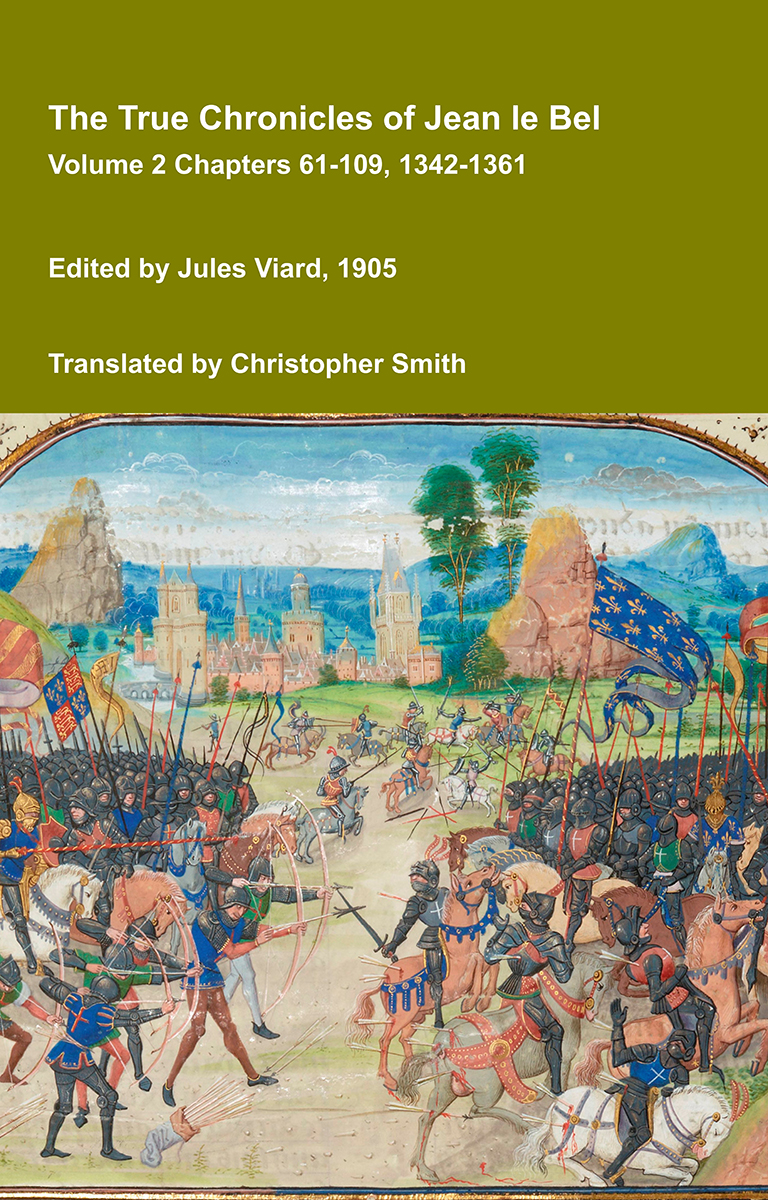
The True Chronicles of Jean le Bel Volume 2 Chapters 61-109 1342-1361
The Chronicle of Jean le Bel, Volume 2 continues one of the most important fourteenth-century accounts of the early Hundred Years’ War. Written by the Liège chronicler Jean le Bel, this vivid narrative follows the fortunes of Edward III, Jean II of France, the Black Prince, the great nobles of France and England, and the soldiers, captains and companies who shaped the conflict. This volume covers some of the most dramatic events of the period, including the battles of Crécy and Poitiers, the siege and capture of Calais, the captivity of King John, the rise of the Jacquerie, the turmoil in Paris under Étienne Marcel and Charles of Navarre, the devastation caused by the free companies, Edward III’s great campaign of 1359–1360, and the negotiations leading to the Treaty of Brétigny. Jean le Bel’s chronicle is especially valuable for its lively detail, its interest in chivalry, warfare, politics and reputation, and its influence on later chroniclers, most famously Froissart. This English translation presents the text in clear, readable British English while preserving the force and character of the original narrative. The translation includes extensive notes to help the reader better understand Jean le Bel's text. Volume 2 also includes translated appendices drawn from royal and administrative records, many from the English Record Office, which illuminate Edward III’s campaigns in Brittany, the siege and occupation of Calais, naval preparations, military finance, appointments, safe conducts and related affairs.
Available at Amazon in eBook and Paperback format.
Afterwards, before taking his place at table, the King entered the hall and created four new earls. He made his uncle, Lord Thomas of Woodstock, Earl of Buckingham, granting him one thousand marks annually from the royal treasury until he could provide him with lands of equivalent value. He also made Lord Guichard d’Angle, formerly his tutor, Earl of Huntingdon, likewise granting him one thousand marks a year until he could provide him with revenues of equal value. He granted the earldom of Nottingham to Lord Mowbray, and the earldom of Northumberland to Lord Henry Percy. On the same day, he also created nine knights.
Postea veniens in Aulam, creavit quatuor novos Comites, antequam accessib ad mensam; Dominum namque Thomam Wodestoke, avuneulum suum, [fecit] Comitem Bokynghamiæ, datis sibi mille marcis annuatim de thesauro regio, donec sibi de terris tanti valoris providisset; Dominum etiam Guyscardum de Angolismo, quondam magistrum suum, fecit Comitem Huntyngdoniæ, datis insuper sibi mille mercis annuis, usquequo providisset sibi de redditibus tanti valoris. Domino de Moubray dedit Comitatum Notynghamiæ, et Domino Henrico Percy Northumbriæ Comitatum. Milites quoque fecit novem eodem die.
When these ceremonies had been completed, the King took his place at the table, where bishops, earls and barons feasted splendidly with him. An immense crowd of common people had gathered there from every part of the kingdom. So great was the press within that enormous hall that, had the Duke of Lancaster, Steward of England, the Earl of Buckingham, Constable of the realm, Lord Henry Percy, the Marshal, and many others not ridden through the hall on great horses to keep the way clear, those carrying the dishes would scarcely have been able to reach the guests. Were I to attempt to describe the preparations for the banquet, the richness of the vessels and the variety of the dishes, the reader might perhaps hesitate to believe me, astonished both by their cost and by their scale. I shall therefore mention only one feature, omitting the rest, which had been devised to display the King’s magnificence. In the middle of the royal palace there had been erected, upon several steps, a hollow marble column. At its summit stood a great gilded eagle, and beneath its feet, from the capital of the column, different kinds of wine flowed in four directions throughout the whole day of the coronation. No one, however poor, was forbidden to draw from it. This coronation took place in the eleventh year of the King’s age.
Quibus expletis, ascendit ad mensam, ubi epulabantur cum eo splendide Episcopi, Comites, et Barones; et innumera multitudo plebis [a cunctis regni finibus congregata; tanta enim multitudo plebis] confluxerat in illam Anlam prægrandem, quod nisi Dux Lancastriæ, videlicet Senescallus Angliæ, et Comes Bokynghamiæ regni Constabularius, eb Dominus Henricus Percy, Marescallus, cam multis aliis, viam super grandes equos servientibus in Aula fecissent, ferentes fereula ad convivas minime penetrassent. Si numerare contenderem convivii apparatum, divitias utensilium, varietatem ferculorum, forsitan lector, perculsus tam tantarum rerum pretio quam magnitudine, credere formidaret. Unum solum, quod, ad magnificentiam regiam ostendendam, fuerat ordinatum, aliis omissis, æstimo proferendum. In medio regalis Palatii elevata fuerat quædam columnaæ marmorea concava, super certos gradus, cujus summitatem occupabat grandis auratæ aquila, sub cujus pedibus in capitello columnæ, per quatuor partes, vina diversi generis decurrebant per totum diem Coronationis regiæ; nec erat qui aliquem, vel pauperrimum virum, haurire vetaret. F'acta est coronatio hæc anno undecimo ætatis ipsius Regis.
On the following day [17th July 1377], a general procession was held for the King and for the peace of the realm. All the prelates took part in their vestments, namely the Archbishop, the bishops and the abbots who had attended the coronation, together with the Duke himself, the magnates and a great multitude of the people. During the procession, the Bishop of Rochester preached to the people, urging that the disputes and divisions which had arisen and long persisted between the commons and the lords should be brought to an end. He showed by many arguments that such dissensions were deeply displeasing to God. He also urged the lords not to burden the people in future with such heavy taxation without good cause. At the same time, he warned the people that, where there was reasonable cause requiring them to support the King and the realm, they should patiently do what was necessary, without murmuring or any inclination towards sedition. He further exhorted all those who would be attached to the King, still a child and innocent, to abandon the vices to which they were addicted, namely sexual immorality, fornication and adultery, and to strive to conform themselves to his purity and innocence. He declared that this was altogether necessary for the father of the realm, for it would be very easy for the King to stray from the right path, and for the kingdom and people to be placed in danger, if those who constantly attended him and served on his council were men of such a kind. When the sermon had ended, the lords and all the prelates departed to their respective lodgings.
In crastino facta est generalis processio pro Rege et pace regni; cui revestiti interfuerunt omnes Prælati, videlicet Archiepiscopus, cum Episcopis et Abbatibus qui Coronationi interfuerant, necnon ipse Dux cum magnatibus et plebis multitudine copiosa. In progressu autem processionis concionatus est ad populum Episcopus Roffensis, hortans ut dissensiones et discordiæ, ortæ et diu continuatæ inter plebem et Dominos, sopirentur, probans per multa argumenta hujuscemodi dissensiones Deo plurimum displicere. Hortatus est insuper Dominos, ne tantis de cætero ‘sine causa taxationibus populum apporiarent. Monuit etiam, ut si causa subesset rationabilis, qua oporteret eos omnino juvare Regem et regnum, ut patienter, et sine murmure atque seditionis scrupulo, facerent quod oporteret. Insuper, exhortatur cos generaliter, qui Regi, puero et innocenti, adhærerent, ut relictis vitiis quibus inserviebant, videlicet stupris in fornicationibus [et] adulteriis, cjus puritati et innocentiæ se conformare studerent; asserens hoc omnino patri patriæ opportunum, perfacileque Regi a recto deviare, regnum et populum periclitari, si tales essent, qui ei sedulo et ejus consilio ministrarent. Sermone finito, Domini et universi Prælati ad sua secedunt.
On the Pride of Walter Tyler
De Superbia Walter Tyler.
For he [Wat Tyler] had first of all desired to obtain a commission for himself and his followers to behead all lawyers, escheators, and everyone who had either studied the law or had dealt with it by virtue of their office. For he had conceived in his mind that, with the learned in the law slain, everything thereafter would be governed according to the common will of the people, and that no law would exist—or, if it did, it would be established solely according to his own whim. Indeed, it is reported that in his great pride he said—this was the day before these things happened—that, putting his hand to his lips, within four days all the laws of England would proceed from his mouth and lips. So, as we have said, when Sir John Newton urged him to hurry, he replied disdainfully: 'If it is urgent for you,' he said, 'then return to your lord the King; as for me, I will come when it pleases me.' After the knight had departed, Wat followed on horseback, though somewhat more slowly. And when he had come near the place where the King was—called Smithfield—the same knight was sent to him again to hear and report his demands. The knight, sitting on his horse, approached him to hear what he had to say. But Wat Tyler, angered that the knight had come mounted rather than on foot, furiously declared that it would have been more fitting for him to approach on foot. The knight, not yet having forgotten the dignity of his former knighthood, at once replied: 'Since you are sitting on a horse, it is no offense that I approach you likewise mounted.' At this, the villain, enraged at the words, immediately drew a dagger (which we commonly call a "dagger") and threatened to strike the knight, adding words in which he called him a traitor. But the knight, hating that name, boldly declared that he lied, and drew his own dagger against him. In turn, the ruffian, unable to bear the insult among his rustic followers, prepared to attack the knight.
Voluit namque, ante alia, commissionem pro se et suis obtinuisse, ad decollandum omnes juridicos, escaetores, et universos, qui vel in lege docti fuere, vel cum jure, ratione officii, communicavere. Mente nempe conceperat, doctis inlege necatis, universa juxta communis plebis scitum de catero ordinari, et nullam omnino legem fore futuram, vel si futura foret, esse pro suo arbitrio statuenda. Fertur revera cum superbin magna dixizse, pridie quam ista fierent, apposita manu sua suis labiis, quod ante quatriduum omnes leges Anglie de ore suo et labiis cmanarent. Igitur cum, ut diximuy, Dominus Johannes Newton pro acceleratione in. staret penes eum, indignando respondit;—"Si tii," ait, "multum festinandum fuerit, redeas ad dominum tuum Regem; ego vero veniam cum placebit." Post regressum vero militis, et ille vectus equo subsccutus, sed tamen paulo tardius; cumque venisset ut esset non procul a lcco in quo Rex constitutus fuerat, "Smythfeld" appellato, destinatus est ad enm sceundo prædictus miles, ad audiendum et referendum vota sua. Miles autem, dextrarium insidens, accessit ad cum, auditnrns quid dicere proponebat. Ile quidem indignatus quia cquo vectus miles accesserat, et non pedes, mox cum furore dixit, decere cum potius pedes quam equum insidens sw presenti: propinquare. Miles vero, nondum oblitus ommnino militin sue veteris probitatis, illico sic repondit;—"Sedenti," inquit, "tibi in equo non est injuriosum me cquitem accessisse." Ad quod verbum indignatus ncbulo, mox extracto cultello, quem "duggere" vulgo dicimus, ictum militi minabatur, cum adjectione verborum quibus! cundem militem proditorem appellavit. At miles, ablorrens illud nomen, eum mentiri asseruit animose, extracto contra eum eque tali cultello. E contrario, ribaldus non ferens inter suos rusticos illatam contumeliam, paravit in militem irruisse.
The King, therefore, seeing that danger was imminent for the knight, in order to calm the fury of the knave for the time being, commanded the knight to dismount and to hand over the dagger he had drawn to the ruffian. Yet, even with this, the man's proud spirit could not be calmed, and by every means he still sought to furiously attack the knight. Then those who stood near the King approached, namely the Mayor of London, William Walworth, along with many of the King's knights and squires, and declared that it would be an unheard-of and everlasting disgrace if, in their presence, the King allowed a noble knight to fall to so shameful a death before his very eyes. Therefore, they urged that action be taken immediately and that the ruffian be arrested.
Rex igitur videns militi periculum imminere, ut mitigaret animum pro tempore ganconis, militem jussit equo descendere, et cultellum, quem extraxerat, reddere nebuloni. Cumque non sic mitigari posset ejus elatus animus, quin omnibus viis et modis vellet in militem irrnere furibunde, accesserunt ad Regem, qui juxta stabant, Major Londoniarum, Willelmus Walworth, et plures de militibus et armigeris regiis, asserentes dedecus inanditum et interminabile, si, illis præsentibus, Rex permitteret nobilem militem tam pudend morti succumbere coram eo. Quapropter succurrendum fore sibi celerius, et ribaldum arestandum.
[15th June 1381] Upon hearing this, the King, although he was but a boy and of tender age, was seized with boldness and ordered the Mayor of London to arrest him. The Mayor, a man of incomparable courage and boldness, immediately and without hesitation arrested him, striking his head with a blow that greatly disoriented him. Soon after, he was surrounded by other royal officers and pierced with swords in various parts of his body. Falling from his horse to the ground, he became the first to show that resistance to the commons was possible, restoring hope to the nearly defeated English nobility. Immediately, when the commons saw his fall, they cried out in grief over his death, saying: "Our captain is dead! Our leader has been treacherously killed! Let us stand together! Let us die with him! Let us shoot our arrows and manfully avenge his death!" So they readied their bows to shoot. But the King, displaying a mind and courage beyond his years, spurred his horse and rode toward them, circling their ranks, and said: "What is this, my people? What are you doing? Would you shoot at your King? Do not stir trouble, nor grieve over the death of a traitor and a knave. I will be your King. I will be your captain and leader. Follow me into the field, and you shall have whatever you wish to ask for."
Quibus aunditis, Rex, quanquam puer esset et tenerioris ætatis, concepta audacia, jussit Majori Londoniarum ut eum arestaret. Major autem, vir incomparabilis animositatis et andaciæ, indubitanter eum illico arestavit, librato ictu ejus capiti, qui eum plurimum perturbavit. At mox ab aliis ministris regiis circumclusus, gladiis diversis in locis corporis transverberatur; corruensque de equo in terram, primum dedit spem Anglicaniæ militiæ, fere mortuæ, communibus posse resisti. Statimque, ut communes viderunt ejus ruinam, præ dolore mortis clamaverunt;—"Mortuus est capitaneus noster, proditiose peremptus est ductor noster. Stemus simul, moriamur cum ipso, sagittemus et vindicemus viriliter mortem ejus." Tensis ergo arcubus, sagittare pararunt. Rex vero ultra ætatem mirabiliter ingenio præventus, et andacia concitus, calcaribus urgens equum ad eos accesgit, et in circnitu eorum equitans, dixit eis;—"Quid est hoc, homines mei? Quid agitis? Nunquid sagittare vultis Regem vestrum? Non causemini, nec sitis tristes de morte proditoris et ribaldi. Ego enim ero Rex vester, ego capitaneus et ductor vester; sequimini me in campum, habituri omnia quecunque vos petere delectabit."
The King did this to prevent the peasants, who were in a state of bitterness of mind, from setting fire to the houses at Smithfield, where they were when their leader, the aforementioned traitor, was killed. So they followed the King and the knights who were with him into an open field, still not fully resolved in their minds whether they should kill the King or submit entirely and return home with the royal charter.
Hoc autem fecit Rex, ne rustici, in amaritudine mentis constituti, ignem immitterent in domibus apud Smythfeld, ubi fuerunt quando ductor eorum, præfatus proditor, est occisus. Igitur in apertum campum secuti sunt Regem et milites qui cum eo erant, nondum plena deliberatione certi, utrum Regem perimere debuissent, an omnino conquiescere et domum cum charta regia remeare.
The knights, therefore, having accepted members of the commons’ company, hurried to carry out the command laid upon them. And when they had come to the town of Ickingham, which is not far from the town called Newmarket, they were unexpectedly met by the Bishop of Norwich, Lord Henry le Despenser, a man quite suitable for handling the weapons of war, and himself armed from head to foot. For he had heard, while he was staying at his manor of Burley, near the king’s castle of Oakham, in the region of Stamford, of the disturbance of the men of Norfolk. Therefore he intended to go down there, to see whether they had fulfilled, or were fulfilling, their outcry by deed. At that time he had in his company no more than eight lances, and a very small number of archers. Seeing the knights and certain men from the commons, he commanded the knights, under their allegiance, to declare whether any of the king’s traitors were present with them. But the knights, whom rustic fear had lately swallowed up, pretended not to answer, thinking that the bishop, because he was young and bold, had spoken such words rashly, and had no one who would help him if they betrayed the traitors. But the bishop, perceiving and considering the matter as it was, urged them to act confidently and, if any were present, to hand over the traitors. Then the knights, wiping away their cowardice and taking up courage, answered that two of the greatest stirrers-up were there among them, while a third had gone elsewhere to buy their dinner. They also related in order the purpose of their journey. The bishop therefore immediately had those two beheaded, and took pains to seek out the third himself: his own sheep, that is, which had gone astray when it had departed from royal loyalty, and which was now to perish, to be punished with death by episcopal decree. Their heads were then fixed up at Newmarket.
Milites ergo, acceptis comitibus de comitiva communium, ad exequendum properant injunctum mandatum; et cum pervenissent ad villam de!Igingham, quæ non multum distat a villa quæ dicitur "Novum Forum," inopinate fit eis obviam Episcopus Northwicensis, Dominus Henricus le Spencer, vir idoneys satis armis gerendis bellicis, et ipse armatus ad unguem. Audierat namque famam, cum moraretur apud manerium suum de Burlee, prope castellum Regis de Okam, in partibus Stanfordiæ, tumultuationis Northfolkensiaum; quare proposuit illue descendere, ad videndum utrum clamorem opere compleverint, vel complevissent. Habebat tune in comitatu suo non plures quam octo lanceas, et sagitfariorum numerum perexilem. Videns autem milites et quosdam e communibus, præcepit, sub ligeantia sua, militibus, ut edicerent, si qui ex proditoribus Regis præsentes essent cum illis. Milites vero, quos dudum rusticalis timor absorbuerat, dissimulabant respondere, æstimantes Episcopum, quiaæ juvenis erat et audax, inconsulte talia verba protulisse, nec habere qui adjuvarent, si proditores prodidissent. Episcopus autem, cernens et considerans rem, ut erat, hortabatur eos ut confidenter agerent, et, si qui adessent, traderent proditores. Tune milites, detersa ignavia et sumpta audacia, responderunt, duos ex maximis concitatoribus inter eos adesse, tertium, pro eorum coemendo prandio, alibi concessisse; sed et causam eorum itineris per ordinem narraverunt. Episcopus ergo statim illos duos decapitari fecit, et tertium ipsemet requirere studuit; ovem suam, quæ videlicet perierat, et dum à regia fide desciverat, et quæ peritura fuerat, tune episcopali decreto capite punienda. Fixis ergo capitibus eorundem apud Novum Forum.
The bishop Bishop Henry Despencer [aged 40], with the knights, then hurried swiftly towards Norfolk, namely to North Walsham, the place where the commons had decided to await the royal answer and the return of their companions. As he passed through the country, the bishop’s number was continually increased, because many of the knightly order, and many gentlemen from the country who had been hiding for fear of the commons, seeing that the bishop had put on a soldier’s equipment, had taken up a metal helmet and a hard coat of mail which arrows could not pierce, and had also seized a material, double-edged sword, joined themselves to his side.
The bishop, therefore, when he [Bishop Henry Despencer] had come to the aforesaid place [on 25th June 1381], accompanied by a suitable force, found the peasants, in the manner of warriors, to have surrounded the place where they had gathered with ditches. Over the ditch they had fixed boards, windows, and doors, together with stakes, for their defence. Behind them he saw their baggage and carts placed, as though they were thinking not at all of flight. Without delay, the warlike bishop, about to fight in open battle, moved by the audacity of the scoundrels, ordered his trumpeters and heralds to sound. Then he himself, taking a lance in his right hand, urged on his horse with sharp spurs, and was carried against them with such courage and such boldness that, at a very swift charge, he reached the ditch before his men, faster than his own arrows. Nor was there any need for bow-bearing archers, since the matter was now being fought hand to hand at close quarters. The warlike prelate, therefore, like a boar gnashing its teeth, sparing neither himself nor his enemies, directed his attack wherever he saw the danger to be greatest. Piercing one man through, throwing down another, wounding another, he did not cease to inflict severe harm, until the whole crowd which had followed him, having reached the ditch, was ready to fight. Therefore the bishop’s men fought fiercely, and the commons no less so, until, as usually happens, the weaker conscience terrified the unjust side and withdrew their spirit from boldness and from the will to die. Nothing is more wretched than to wage wars with a seared conscience, for fear and confusion are always accustomed to be brought upon it, and victory never to come from it. Therefore the fearful common people fled; and because no other way remained except beyond their carts and baggage, which, as we have said, they had placed behind them, they strove to make their way through the woods. But the prelate, everywhere carrying out the office of a watchful commander, crushed these attempts. He hindered those who were thinking of flight by cutting them down, and cut them down by hindering them, until, after the chief stirrers of the crowd had been captured, together with their king, John Litster, and as many of the commons as he wished had been killed, and as many as he wished had been preserved alive, he gained complete victory.
Episcopus cum militibus properat festinanter versus Northfolchiam, ad North Walsham videlicet, locum in quo communes expectasse decreverant responsum regium et reditum sociorum. In pertranseundo ergo patriam, semper numerus episcopalis augebatur, quia de ordine militari et plures e patria generosi, qui delitescebant timore communium, videntes Episcopum militem induisse, et galeam assumpsisse metallicam, et loricam duram, quam non possent penetrare sagittæ, necnon gladium materialem ancipitem arripuisse, ejus lateri se junxerunt.
Episcopus itaque, cum pervenisset ad locum præfatum, stipatus turba decenti, reperit rusticos, more bellatorum, fossata cireumeinxisse locum in quem convenerant, et super fossam tabulas, fenestras, et ostia, cum palis, in defensionem sui fixisse. A tergo autem conspicit eorum cariagium et carectas locatas, tanquam de fuga minime cogitarent. Nec mora, Episcopus Martius, aperto Marte pugnaturus, commotus super audacia nebulonum, jubet tubicinibus et clarigatoribus suis canere; et ipse, arrepta dextra manu lancea, urget cornipedem acutis calcaribus, et tanta animositate, tanta audacia, efferatur in cos, ut cursu velocissimo fossam præoccuparet, citatior sagittis suis; nec erat opus arcitenentibus sagittariis, cum res jam manu ad manum comminus ageretur. Antistes ergo belliger, velut aper frendens dentibus, sibi nec hostibus suis parcens, ubi!majus conspicit esse periculum, dirigit tentum suum, et, hunc perforando, illum dejiciendo, alium vulnerando, non cessat lædere vehementer, donec omnis turba quæ eum secuta fuerat, nacta fossa, ad confligendum parata foret: idcirco pugnatum est acriter ab episcopalibus, nec secus a communibus, donec, ut assolet, infirmior ‘conscientia partem terreret injustam, et animum ab audacia et voluntate subtraheret moriendi. Nihil est infelicius quam bella gerere cauteriata conscientia, qua timor et confusio semper solent ingeri, nunquam victoria provenire. Fugiunt idcirco meticulosi plebani, et quia nulla alia restabat via ultra carectas suas et cariagia, quæ retulimus eos à tergo suo locasse, per saltus iter facere elaborant. Sed Præsul, imperatoris circumspecti ubique gerens officium, hos conatus elidit, et fugere meditantes cædendo impedit, impediendo cædit; donec captis majoribus turbæ concitatoribus, et ipso eorum rege, Johanne Littestere, [et quot volebat occisis e communibus], et quot volebat ad vitam reservatis, plena victoria potiretur.
On this day furthermore, John Ball [aged 43], a priest, having been captured by the men of Coventry, and the day before brought to Saint Albans and into the presence of the King, was found guilty of having grievously offended His Majesty, heard and confessed the most shameful crimes, and was condemned by the same Robert to dragging, hanging, beheading, disemboweling, and quartering; his death was postponed until Monday [15th July 1381], through the intervention of Lord William [aged 39], the Bishop of London, who, concerned about the salvation of his soul, obtained for him this time for repentance. Here, for twenty years and more, always preaching in various places what he knew to be pleasing to the common people, he detracted both ecclesiastical persons and secular lords, seeking the goodwill of the common people more than merit with God. Indeed, he taught that tithes should not be given to the curate unless the giver was wealthier than the vicar or rector who would receive them. He also taught that tithes and offerings should be withheld from curates if it was evident that the parishioner or subject was of a better life than their curate. He also taught that no one was fit for the kingdom of God who was not born in wedlock. He taught also the perverse doctrines of the perfidious John Wycliffe [aged 53], and the opinions he held, and false insanities, and many things that would be too long to recount; because of which, forbidden by the Bishops in whose parishes he presumed to preach, from henceforth he was not allowed to preach in churches, and took to the streets and alleys, or to the fields, to preach. Nor was he lacking listeners from among the common people, whom he always tried to attract to his sermons through slanders of the prelates and pleasing words. Finally excommunicated, when he did not desist, he was imprisoned, where he predicted that he would be freed by twenty thousand friends. This later happened during the aforementioned turmoil of the kingdom, when the commons broke all prisons and compelled the imprisoned to leave. And having been freed in this manner, he followed them, inciting them to commit many evils, and preaching that it must indeed be done. And that his doctrine might infect more people, at Blackheath [Map], where two hundred thousand common people were gathered together, he began a sermon like this:—
"Whan Adam dalf, and Eve span,
"Wo was thanne a gentilman?"
Hoc die præterea, Johannem Balle, presbyterum, captum a viris Coventrensibus, et pridie ductum ad Sanctum Albanum et Regis præsentiam, cujus majestatem convictus est læsisse enormiter, auditum et confessum turpissima scelera, tractioni, suspendio, decollationi, exentrationi, et quarterizationi, ut usu vulgari loguar, idem Robertus adjudicavit; cujus mors dilationem accepit usque in diem Lunæ, interventu Domini Willelmi, Londoniensis Episcopi, qui, circa salutem sollicitus suæ animæ, illud ei spatium pœnitentise impetravit. Hic per viginti annos, et amplius, semper prædicans in diversis locis en quæ scivit vulgo placentia, detrahens tam personis ecclesiasticis quam dominis ssecularibus, benevolentiam magis communis populi quam meritum penes Deum captabat. Docuit nempe plebem decimas non esse dandag curato, nisi is qui daturus esset foret ditior quam vicarius qui acciperet, sive rector. Docuit etiam decimas et oblationes subtrahendas curatis, si constaret subjectum aut parochianum melioris vite fore quam curatum suum. Docuit etiam neminem aptum regno Dei, qui hon in matrimonio natus fuisset. Docuit et perversa dogmata perfidi Johannis Wiclyf, et opiniones quas tenuit, et insanias falsas, et plura que longum foret recitare: propter quæ, prohibitus ab Episcopis in, quorum parochiis hæc præsumpsit, ne in ecclesiis de cætero prædicaret, concessit in plateas et vicos, vel in campos, ad prædicandum. Nec defuerunt ei de communibus auditores, quos semper studuit per detractiones prælatorum, et placentia verba, allicere ad sermonem. Postremo excommunicatus, cum nec desisteret, carceri mancipatur, ubi prædixit se deliberandum per viginti millis amicorum. Quod postea evenit in turbatione regni præfata, cum communes omnes carceres confregerunt, et incarceratos abire compulerunt. Cumque taliter deliberatus fuisset, eos secutus est, instigans ad plura mala perpetranda, et prædicans ita omnino fore faciendum. Et ut sua doctrina plures inficeret, ad le Blakheth, ubi ducenta millia hominum communium fuere simul congregata, hujuscemodi sermonem est exorsus:—
"Whan Adam dalf, and Eve span,
"Wo was thanne a gentilman?"
July 1381. And continuing the sermon he had begun, he strove, through the words of the proverb he had taken as his theme, to introduce and prove that from the beginning all were created equal by nature, and that servitude was introduced by the unjust oppression of wicked men, against the will of God; for, if it had pleased God to create servants, surely at the beginning of the world He would have determined who should be a servant and who a lord. Therefore, they should consider now the time given to them by God, in which, having cast off the yoke of long servitude, they could, if they wished, enjoy the long-coveted freedom. Whereupon he advised that they be wise men, and like a good head of a household who cultivates his field and removes and cuts back the harmful weeds that usually suppress the crops, they too should make haste to act in the present—first, by killing the greater lords of the kingdom; then, by destroying the lawyers, justices, and jurors of the country; finally, by removing any they knew to be harmful to the community in the future from their land; thus, they would finally secure peace and safety for themselves in the future, if, with the nobles removed, there would be among them equal freedom, the same nobility, equal dignity, and similar power.
Continuansque sermonem inceptum, nitebatur, per verba proverbii quod pro themate sumpserat, introducere et probare, ab initio omnes pares creatos a natura, servitutem per injustam oppressionem nequam hominum introductam, contra Dei voluntatem; quia, si Deo placnisset servos creasse, utique in principio, mundi constituisset quis servus, quisve dominus, futurus fuisset. Considerarent igitur jam tempus a Deo datum eis, in quo, deposito servitutis jugo diutinæ, possent, si vellent, libertate diu concupita gaudere. Quapropter monuit ut essent viri cordati, et amore boni patrisfamilias excolentis agrum suum, et extirpantis ac resecantis noxia gramina que fruges solent opprimere, et ipsi in presenti facere festinarent.—Primo, majores regni dominos occidendo; deinde, juridicos, justiciarios, et juratores patriæ, perimendo; postremo, quoscunque scirent in posterum communitati nocivos, tollerent de terra sua; sic demum et pacem sibimet parerent et securitatem in futurum, si, sublatis majoribus, essct inter eos squa libertas, eadem nobilitas, par dignitas, similisque potestas.
[July 1381] After he [John Ball [aged 43]] had preached these and many other delusions, the common people followed him with such favour that they acclaimed him as the future Archbishop and Chancellor of the kingdom; him alone worthy of the archiepiscopal honour; declaring that the Archbishop who then survived was a traitor to the commons and the kingdom, and therefore should be beheaded wherever he could be apprehended in England.
Cum hæc et plura alia deliramenta prædicasset, commune vulgus eum tanto favoure prosequitur, ut acclamarent eum Archiepiscopum futurum, et regni Cancellarium; solum eum dignum Archipræsulatus honoure; Archiepiscopum, qui tunc superstes erat, communium et regni proditorem fuisse, eb idcirco decapitandum, ubicunque posset in Anglia comprehendi.
Chronicle of Abbot Ralph of Coggeshall
The Chronicle of Abbot Ralph of Coggeshall (Chronicon Anglicanum) is an indispensable medieval history that brings to life centuries of English and European affairs through the eyes of a learned Cistercian monk. Ralph of Coggeshall, abbot of the Abbey of Coggeshall in Essex in the early 13th century, continued and expanded his community’s chronicle, documenting events from the Norman Conquest of 1066 into the tumultuous reign of King Henry III. Blending eyewitness testimony, careful compilation, and the monastic commitment to record-keeping, this chronicle offers a rare narrative of political intrigue, royal power struggles, and social upheaval in England and beyond. Ralph’s work captures the reigns of pivotal figures such as Richard I and King John, providing invaluable insights into their characters, decisions, and the forces that shaped medieval rule. More than a simple annal, Chronicon Anglicanum conveys the texture of medieval life and governance, making it a rich source for scholars and readers fascinated by English history, monastic authorship, and the shaping of the medieval world.
Available at Amazon in eBook and Paperback format.
[Around April 1381] He [John Ball [aged 43]] had also sent to the common leaders in Essex a certain letter full of riddles, to encourage them to carry through with what they had begun; which was later found in the sleeve of a man who was hanged for the aforementioned uprising. Its contents were as follows:
Letter of John Ball, sent to the Commons of Essex.
"John Shepp, once St. Mary's priest of York and now of Colchester, sends greetings to John Nameless, and John the Miller's Wife, and John Carter, and urges them to beware of treachery in the town, and to stand together in God's name. He tells Piers Plowman to go to his work, and to punish well Hob the Robber. Take with you John True-man and all his fellows—and no others—and be sure you are united in one purpose, and no more.
Johan the Muller hath ygrownde smal, smal, smal;
The Kyngis sone of hevene shalle pay for alle.
Be ware or ye be wo,
Knoweth your frende fro youre foo,
Haveth ynowe, and seythe 'Hoo:'
And do welle and bettre, and fleth synne,
And seketh pees, and holde therynne.
And so biddeth Johan Trewman and alle his felawes."
Miserat insuper ductoribus communibus in Estsexia quamdam litteram ænigmatibus plenam, ad hortandum eos ut incepta perficerent; que expost inventa est in manica cujusdam suspendendi pro turbatione prefata, cujus tenor talis est:—
Littera Johannis Balle, missa Communibus Essexiæ.
"John Schep, som tyme Seynt Marie prest of Yorke, and nowe of Colchestre, greteth welle Johan Nameles, and Johan the Muliere, and Johan Gartere, and biddeth hem that thei ware of gyle in borugh, and stondeth togiddir in Goddis name, and biddeth Peres Ploughman go to his werke, and chastise welle Hobbe the robber, and taketh with you Johan Trewman, and alle his felaws, and no mo, and loke scharpe you to on heued, and no mo.
Johan the Muller hath ygrownde smal, smal, smal;
The Kyngis sone of hevene shalle pay for alle.
Be ware or ye be wo,
Knoweth your frende fro youre foo,
Haveth ynowe, and seythe 'Hoo:'
And do welle and bettre, and fleth synne,
And seketh pees, and holde therynne.
And so biddeth Johan Trewman and alle his felawes."
This letter John Ball [aged 43] himself confessed to having written and sent to the commons, and he admitted to many other things and actions; because of which, as we have said, he was drawn, hanged, and beheaded at St. Albans on the Ides of July [15th July 1381], in the presence of the King; and his body was quartered and sent to four cities of the kingdom.
Hanc litteram idem Johannes Balle confessns est scripsisse, et communibus transmisisse, et plura alia fatebatur et fecit; propter quæ, ut diximus, tractus, suspensus, et decollatus, apud Sanctum Albanum Idibus Julii, præsente Rege; et cadaver ejus quadripartitum quatuor regni civitatibus missum est.
15th July 1381. This letter, the same John Ball [aged 43] confessed to having written, and sent to the commons, and he admitted to many other deeds and actions; for which, as we said, he was dragged, hanged, and beheaded at Saint Albans on the Ides of July, in the presence of the King; and his corpse was quartered and sent to four cities of the kingdom.
Hanc litteram idem Johannes Balle confessus est scripsisse, et communibus transmisisse, et plura alia fatchatur et fecit; propter que, ut diximus, tractus, suspensus, et decollatus, apud Sanctum Albanum Idibus Julii, presente Rege; et cadaver ejus quadripartitum quatuor regni civitatibus missum est.
Thereupon they proceeded to deal with the affairs of the kingdom and of the king in the present parliament. But much time was spent there to no purpose, and nothing was brought to any effect, although the delay there had not been without great expense. And when it was thought that some result was now about to follow, news arrived of the coming to Calais of the new queen, namely the sister of Wenceslas, king of Bohemia, son of the late king of Bohemia and emperor, who himself too expected to be crowned emperor, and everywhere in his letters styled himself emperor. The king had therefore chosen to have this woman, bought at great price and with many labours, although the daughter of Lord Bernabò of Milan had been offered to him with an inestimable sum of gold. When, therefore, as we have related, the arrival of the future queen was heard of, parliament was dissolved, to be begun again after the royal wedding and the Lord’s Nativity. Moreover, each man laboured according to his means to honour so great a wedding with gifts, and also with services worthy of favour. A party was therefore sent to meet so great a maiden, and she was conducted, with all the glory of the world, as far as the port of Dover, accompanied by many nobles, both of her own country and of this land.
Processum est perinde ad tractandum de regni Regisque negotiis in Parliamento præsenti; sed immoratum est inaniter in eodem diu, nec ad aliquem effectum quiequam productum, quamvis non sine magnis fuisset ibidem sumptibus demoratum. Et cum jam effectus aliquis successisse putaretur, supervenere nova de adventu novæ Reginæ Calesiam, sororis videlicet Regis Boemiæ, Wynceslai, filii quondam Regis Boemiæ et Imperatoris, qui et ipse expectavit in Imperatorem coronari, et se Imperatorem ubique litteraliter nominavit. Hanc igitur magno pretio, multisque coemptam laboribus, habendam Rex præclegerat, quanquam cum inæstimabili auri summa oblata fuisset ei filla Domini Mediolanensis Barnabonis. Audito igitur, ut retulimus, de adventu Reginæ futuræ, solvitur Parliamentum, reincipiendum post regales nuptias et Natale Dominicum. Et insuper laborat unusquisque pro viribus tantas nuptias honorare muneribus, insuper et obsequiis favore dignis. Missum est ergo in obviam tantæ virgini, et conducitur cum omni gloria mundi ad portum usque Doveriæ, comitantibus eam multis nobilibus, tam suæ patriæ quam istius terræ.
On that day there occurred a marvellous omen for all, according to the opinion of many, foreshadowing the favour of God and the happy fortunes that would come to the land. For when she had set foot on land from the ship, and when all had safely disembarked, with the rest of the vessel remaining, there followed immediately such a disturbance of the sea as had not been seen for a long time before. It so shook the ships stationed in the harbour that they were suddenly scattered and dashed together, the ship in which the queen had sat being first broken apart and horribly shattered into many pieces.
Others, however, interpreted the aforesaid things differently, thinking that it was to come to pass that the kingdom would be troubled through her, or that some misfortune would befall the country. But the events that follow will make clear the obscurity of this doubtful perplexity.
Accidit illo die mirabile cunctis auspicium, juxta multorum opinionem, favorem Dei, felicia fata terræ affutura præmonstrans. Nam cum pedem terræ intulisset e navi, et salvo cunctis egressis, navigio reliquo, secuta est e vestigio tantæ maris commotio, quanta diu ante visa non fuerat; et ipsas naves in portu constitutas adeo agitavit, ut dissiparentur subito et colliderentur, navi prius, in qua Regina consederat, dissoluta, et in multas partes horribiliter comminuta.
Quidam vero aliter interpretati sunt supradicta, putantes esse futurum, ut regnum turbaretur per eam, vel regioni incommodum aliquod eveniret. Sed istius dubiæ perplexitatis obscuritatem gesta sequentia declarabunt.
The earl of Suffolk, William Ufford, in this present parliament, after he had been chosen by the knights of the shires to pronounce on their behalf the affairs of the commonwealth, on the day and at the hour when he was to have carried out the business he had undertaken, as he began to climb the steps leading to the chamber in which all the nobility of the realm had assembled, suddenly collapsed, and at once breathed out his spirit in the hands of his men, although, cheerful and feeling no illness, he had entered Westminster Hall a little before, indeed almost immediately before. At his sudden death no small consternation fell, not only upon all the nobles of the realm, but also upon all those of middling rank and the poor, because throughout his whole life he had shown himself lovable to all. After his death, an end was put to the parliament, after the merchants of England had granted to the king, as a subsidy, the customs on wool once again, which common people call the "maltolt", for the four years next following. It was also ordained in this parliament, at the request of the magnates and commons, that Richard Scrope, knight, should be chancellor, as a man who, by conspicuous knowledge and inflexible justice, had no equal of his fortune in the kingdom. To the office of treasurer Lord Hugh Segrave, knight, was appointed.
Comes Sowthfolciæ, Willelmus Ufforde, in isto præsenti Parliamento, dum a militibus Comitatuum fuisset electus ad pronunciandum ex parte illorum negotia reipublicæ, die et hora quibus executus fuisset susceptum negotium, cum gradus ascendere incepisset ducentes ad cameram in qua regni nobilitas tota concesserat, repente corruit, et inter suorum manus illico spiritum exhalavit; quamvis jocundus et nihil mali sentiens Aulam Westmonasterii parum ante, et velut immediate, subintrasset. De cujus morte subitanca non parum consternati sunt, non tantum cuneti regni proceres, sed et omnes mediocres et pauperes, quia cunetis se in omni vita amabilem exhibuerat. Post cujus mortem, finis est impositus Parliamento; postquam mercatores Angliæ concessissent Regi pro subsidio consuetudines lanarum iterum, quas "maltot" vulgares appellant, per quadriennium expost sequens. Ordinatus est etiam in hoc Parliamento, petentibus hoc magnatibus et communibus, Ricardus Scrop, miles, Cancellarius, utpote vir qui spectabili scientia et inflexibili justitia non haberet ex sua fortuna parem in regno. Ad officium vero Thesaurarii Dominus Hugo Segrave, miles, subrogatur.
In this Parliament a new dignity was created, unfamiliar to the English, namely, the earl of Oxford, Lord Robert de Vere, was called and made Marquis of Dublin in Ireland. The other earls took this ill, because they saw that, by the king’s gift, he had received a rank higher than their own, and especially because he did not seem to be superior to the others either in wisdom or in arms.
Creata est in hoc Parliamento nova dignitas, Anglicis insueta; nempe Comes Oxoniæ, Dominus Robertus de Voeor, appellatus et factus est Marchio Dubiliniæ in Hibernia; cæteris Comitibus hoc indigne ferentibus, quod viderent eum gradum celsiorem ipsis, Regis munere, percepisse, et præcipue, quia nec prudentia cæteris, nec armis, valentior videbatur.
Where the lord king, lest he should seem to have done too little, made Lord Robert de Vere, formerly earl of Oxford, but recently, in the last Parliament, created marquis of Dublin, duke of Ireland, intending afterwards to make the duke a king, if fortune favoured him. So greatly was he attached to him, so greatly did he honour and love him, not without the stain, as is said, of obscene intimacy. The other nobles and barons murmured against this and bore it indignantly, that there should be a desire for so great a promotion in a man so mediocre, whom neither the loftiness of his birth nor the gifts of other virtues commended above the rest.
Ubi ne Dominus Rex parum fecisse videretur, Dominum Robertum de Veer, quandoque Comitem Oxoniæ, sed nuper in ultimo Parliamento creatum Marchionem Dubliniæ, Ducem fecit Hiberniæ, facturus expost de Duce Regem, si fortuna faveret; tantum afficiebatur eidem, tantum coluit et amavit cundem, non sine nota, prout fertur, familiaritatis obscœnæ; submurmurantibus cæteris nobilibus et baronibus, ac indigne ferentibus tantæ promotionis appetitum in viro tam mediocri, quem ‘non plus cæteris commendabant vel generis sui sublimitas vel reliquarum virtutum dotes.
The duke of Ireland repudiates his wife, the king’s kinswoman, and marries Launcecrona.
It happened in these days that Robert de Vere, puffed up by the honours which the king was bestowing on him, continually repudiated his wife, a young noblewoman both noble and beautiful, born of Isabella, daughter of the illustrious King Edward, and married another woman, who had come from Bohemia with Queen Anne, as is said, the daughter of a certain saddler, altogether low-born and ugly. Because of this, a great occasion for scandals crept in. Her name, in the common tongue, was "Launcecrona." In all these matters the king himself favoured him, unwilling to distress him in anything, or rather, as is said, unable in any way to oppose his wishes, because, hindered by the sorceries of a certain friar who was with the said Robert, the king was in no way able to discern or pursue what was good and honourable.
Dux Hiberniæ repudiat [uxorem] suam, Regis cognatam, et ducit Lancecron.
Accidit hiis diebus, ut Robertus de Veer, elatus de honoribus quos Rex impendebat eidem, jugiter suam repudiaret uxorem, juveneulam nobilem atque pulchram, genitam de illustris Edwardi Regis filia, Isabella; et aliam duceret, quæ cum Regina Anna venerat de Boemia, ut fertur, cujusdam sellarii filiam, ignobilem prorsus atque fœdam; ob quam causam magna surrepsit occasio scandalorum:—cujus nomen erat, in vulgari idiomate, "Launcecrona." Favebat sibi in hiis omnibus ipse Rex, nolens ipsum in aliquo contristare, vel potius, prout dicitur, non valens suis votis aliqualiter obviare, quia maleficiis cujusdam Fratris, qui cum dicto Roberto fuit, Rex impeditus, nequaquam quod bonum est, et honestum, cernere vel sectari valebat.
The duke of Gloucester is indignant.
The nobles were therefore indignant, but especially the duke of Gloucester, the uncle of the aforesaid young woman. Although he was not at that time able to avenge such great injuries inflicted upon his niece, nevertheless he kept all these things in his heart until the time of future retribution. The duke of Ireland, however, was not unaware of the aforesaid matters. For that reason he resolved to take precautions for himself, and considered removing from the midst the duke of Gloucester, together with all those who favoured him.
Dux Gloverniæ indignatur.
Indignabantur proinde proceres, sed præcipue Dux Gloverniæ, avunculus præfatæ puellæ, qui etsi modo non valebat ulcisei tantas injurias illatas nepti suæ, omnia tamen conservabat in corde suo, usque in tempus retributionis futuræ. Ducem vero Hiberniæ præmissa non latebant, quamobrem et Sibi cavere statuit, eb Ducem Gloverniæ, cum mniversis qui sibi favebant, de medio tollere meditatur.
The Duke of Ireland gathers an army to defeat the lords.
Dux Hiberniæ congregat exercitum ad extinguendum Dominos.
The Deeds of the Dukes of Normandy
The Gesta Normannorum Ducum [The Deeds of the Dukes of Normandy] is a landmark medieval chronicle tracing the rise and fall of the Norman dynasty from its early roots through the pivotal events surrounding the Norman Conquest of England. Originally penned in Latin by the monk William of Jumièges shortly before 1060 and later expanded at the behest of William the Conqueror, the work chronicles the deeds, politics, battles, and leadership of the Norman dukes, especially William’s own claim to the English throne. The narrative combines earlier historical sources with firsthand information and oral testimony to present an authoritative account of Normandy’s transformation from a Viking settlement into one of medieval Europe’s most powerful realms. William’s history emphasizes the legitimacy, military prowess, and governance of the Norman line, framing their expansion, including the conquest of England, as both divinely sanctioned and noble in purpose. Later chroniclers such as Orderic Vitalis and Robert of Torigni continued the history, extending the coverage into the 12th century, providing broader context on ducal rule and its impact. Today this classic work remains a foundational source for understanding Norman identity, medieval statesmanship, and the historical forces that reshaped England and Western Europe between 800AD and 1100AD.
Available at Amazon in eBook and Paperback format.
As the lords retreated, they deemed it unsafe to disband at that time due to the king's unpredictable actions and the notorious treachery of the conspirators, a decision that later proved to be a mark of great wisdom. For, with the king's connivance, the Duke of Ireland had gathered a large force in the regions of Chester and Wales. The leader of this force was the Constable of Chester, named Thomas Molyneux, a wealthy and bold man whose commands the entire province eagerly awaited. However, such a plot could not remain hidden from the lords for long. Once they were informed of all these developments—that the Duke of Ireland was hastening to London with such a large force to join with the Londoners and form an almost invincible army—they immediately armed their forces. They encouraged one another not to neglect their own safety but to act quickly to preempt or destroy those who had deceitfully conspired to bring about their downfall.
Recedentibus Dominis, non est visum eis tutum jam tunc disjungi, propter Regis mobilitatem et proditorum notoriam falsitatem; quod eis expost magnæ sapientiæ loco fuit. Nam de conniventia Regis, Dux Hiberniæ in partibus Cestriæ Walliæ magnam turbam collegerat; quorum campiductor erat Cestriæ Constabularius, dictus "Thomas Molyneux," vir dives et audax, cujus nutum tota illa provincia expectabat. Non diu tamen Dominos latere potuit tantus dolus, sed præmuniti de hiis omnibus, et quod Dux Hiberniæ Londonias properaret cum tanta turba, ut, junctus Londoniensibus, quasi invincibilem exercitum ex duobus faceret, extemplo suos armavit, et invicem cohortantur, ut jam non negligant salutem propriam, sed festinent praoccupare vel extinguere qui in illorum necem conspiraverant fraudulenter.
The lords go out to meet the Duke of Ireland.
Domini exeunt obviam Duci Hibernice.
Therefore, those who went to meet the Duke of Ireland secretly sent out their troops to blockade all the roads where he was expected to pass. But the Duke of Ireland, riding high and proud on his horse with the army he had assembled, believing no one would dare to confront him, suddenly turned his eyes sideways and saw the army of the lords not far from him, awaiting his arrival in the middle of a certain valley. At this sight, his heart trembled with fear, and he said:
Igitur Duci Hiberniæ excuntes obviam, sed occulte, dimiserunt turmas suas ab obsidendum omnes vias, quibus venturus sperabatur. Sed Dux Hiberniæ, cum sublimis et gloriosus equitaret, cum exercitu quem comparaverat, et nullum crederet ausurum obviare sibi, repente dirigens in obliquum oculos, vidit Dominorum exercitum non procul ab eo distantem, et adventum ejus, in cujusdam vallis medio, prastolantem. Quo viso, cor ejus expavit, et dixit:—
The Duke of Ireland addresses his followers.
Dux Hibernwiæ verba facit ad suos.
"My friends," he said, "as I see it, I must flee for now, because the opposing force appears much stronger than ours. Therefore, before we are forced to engage in battle, I will withdraw and save myself if I can. For it is me alone they seek; against you, they hold no grudge. Thus, once I have slipped away, you will easily be able to escape." To this, one of his knights replied: "You are the one who forced us to leave our homeland, the one who persuaded us to trust you, the one who compelled us to join this journey. Therefore, we are ready to fight alongside you, to triumph with you if fate allows, or, if fortune does not favour us, to die bravely with you." The Duke responded, "You will not do so as prepared," and immediately, spurring his horse, he hurried away in flight. As a result, many who had come with him, cursing his cowardice, prepared to surrender and offer their allegiance to the lords.
"Amici," inquit, "ut cerno, mihi fugiendum est ad horam, quia multo major fortitudo in adversa parte videtur quam nostra: unde antequam sit manibus conserendum, me subtraham et salvabo, si potero. Quia me solum quærunt, contra vos autem nihil habent. Quamobrem, me dilapso, vos de facili evadetis." Cui quidam ex militibus suis ait; — "Tu nos e patria exire compulisti, tu fidem nobis suasisti, tu ad hoc iter nos coegisti; tecum ergo parati sumus dimicare, tecum vincere, si contingat, vel, si fortuna non faveat, tecum mori viriliter." "Non," inquit," ita parati sumus facietis," et mox, calcaribus wurgens sonipedem, fugere festinabat. Quare multi qui cum eo venerant, execrantes ejus meticulositatem, ad dandum dextras Dominis paraverunt.
Thomas Molyneux is killed.
Thomas Mulinewes occiditur.
19th December 1387. At that time, there was a certain Thomas Molyneux [aged 49], who prepared himself for battle, as not all the lords had yet gathered at that place, but only one—Henry, the Earl of Derby, son of the Duke of Lancaster. After fighting for some time, Henry, exhausted and despairing, entered the nearby river. Among the many present, Thomas de Mortimer [aged 37], a knight, urged him either to come ashore or be pierced with arrows in the river without a doubt. "If I come ashore," said Thomas, "will you spare my life?" "I make no such promise," replied the knight, "but either come ashore or you will soon perish." To this, Thomas responded, "If that is the case, allow me to come ashore and fight you or any one of you, so that I may die as a man." As he began to ascend, the knight grabbed him by the helmet and pulled it off his head. Immediately, drawing a dagger, the knight pierced Thomas' brain, killing him.
Erat ibi tune dictus Thomas Mulinewes, qui se praparavit ad pugnam, quia nondum Domini cuncti convenerant ad illum locum, sed unus tantum, filius Ducis Lancastriæ, Henricus, Comes Derbeyæ; qui, cum aliquandin pugnasset, fessus et desperans flumen, quod prope erat, ingressus est. Inter multos vero, Thomas de Mortuo Mari, miles, hortabatur ut ascenderet, vel sine dubio eum in flumine sagittis perforaret. "Si," inquit Thomas, "ascendam, visne servare vitam meam?" "Non hoc promitto," ait miles, "sed vel ascendas vel occumbes mox." Cui ille,—"Si sic," inquit, "necesse est, sinas ut ascendam et tecum, vel quocunque vestrum, pugnem, ut moriar sicut homo." In ascendendo autem cepit eum miles per cassidem, et de capite suo traxit, et mox, extracto cultello daggardo, ejus cerebrum perforavit.
19th December 1387. Meanwhile, the Duke of Ireland [aged 25], fleeing, came to a river. When he wished to cross by a bridge, he found it broken. Reaching another bridge, he encountered archers who blocked his passage. Thus, turning away from them and searching for a ford, he urged his horse into the river. There, soon transformed from a rider into a swimmer, he reached the other bank. Since it was night, the servants of the lords did not pursue the fugitive, particularly because they were unfamiliar with the paths of the region. However, his horse, along with his helmet, gauntlets, and breastplate, fell into the possession of the lords. As a result, it was later believed for a long time that he had drowned. Additionally, the lords intercepted his cart and saddlebags, discovering many items, most notably letters from the king addressed to him. These letters instructed him to hasten to London with great force, assuring him that the king was prepared and committed to live and die by his side. These documents provided the lords with strong evidence of the king's inconsistency and fickleness.
Interea, Dux Hiberniæ, fugiens pervenit ad flumen, sed cum transire ad pontem vellet, confractum reperit. Ad alium vero pontem dum pervenisset, arcitenentes invenit, qui ejus transitum prohiberent. Igitur divertens ab eis, et vadum quærens, equum compulit intrare flumen; in quo mox, ex equite natator factus, ad aliam ripam venit. Nox autem erat, ct ideo non sunt secuti fugientem servi procerum, eo maxime, quod diverticula patriæ nesciebant. Equus tamen ejus, cum casside, et, cum cbirotliecis, pectorale, in sortem pervenit Dominorum. Unde expost magno tempore submersus fuisse putabatur. Quadrigam ejus insuper, cum clitellis, proceres interceperunt; in quibus plurima repererunt, et præcipue Regis ad ipsum litteras, in quibus continebatur, ut venire festinaret ad eum Londonias, cum potestate magna, et Rex paratus esset, et cor apponeret, ad vivendum ct moriendum cum eo. Qui apices magnam fidem fecerunt Dominis de Regis inconstantia et mutabilitate.
Lastly, Simon Burley was beheaded, although the Earl of Derby had applied all his strength to his rescue. For this reason a great dissension arose between him and the Duke of Gloucester, but it was quickly, thanks be to God, quieted. This man, in all the places where he went, displayed himself not according to the fortunes of a knight, but in all his array as a duke or prince. He was also Keeper of the Castle of Dover, which, at the king’s nod, he had agreed to sell to the French. And he had been intolerably proud and arrogant, an oppressor of the poor, a hater of the Church, a fornicator and an adulterer.
Novissime, decollatus est Symon Burley, quamvis Comes de Derby omnes vires apposuisset ejus ereptioni. Ob quam causam magna dissensio orta est inter eum et Ducem Gloverniae; sed cito, laudes Deo, sopita. Hic, in cunctis locis ubi incedebat, non suas fortunas militem, sed in omni apparatu Ducem vel Principem seipsum exhibebat, eratque Custos castelli de Doveria, quod, ad nutum Regis, consenserat Gallicis vendidisse; fueratque intolerabiliter superbus et arrogans, oppressor pauperum, osor Ecclesiae, moechus et adulter.
For he foretold many dangers that were close at hand; among them he prophesied that a most burning summer was to come, whose heat would melt the lead of churches, unless God should stretch forth helping hands. Indeed, we felt the heat, and we believe that we would have undergone something even more intolerable if the prayers of the faithful had not stood in the way. At that time the lead of churches was melted by heavenly fires, when in Sussex, in the vill of Maunfeld, the collegiate church of the Archbishop of Canterbury was burned, together with almost the whole vill; and certain estates in Essex, and ships too, with their sailors, were consumed in some places by strokes of lightning.
Prædixit enim plura pericula imminentia; inter quæ prophetavit æstatem fervidissimam affuturam, cujus fervor plumbum ecclesiarum liquefaceret, nisi Deus manus apponeret adjutrices. Fervorem utique sensimus, aliqualem intolerabiliorem subituri, ut credimus, nisi preces fidelium obstitissent. Plumbum ecclesiaram per ignes cœlestes eo tempore liquefactum est; cum in Sowtsexia, in villa de Maunfeld, Ecclesia Collegialis Cantuariensis Archiepiscopi conflagrata est, cum omni pene villa; et quædam prædia in Estsexia, navesque, cum nautis, quibusdam in locis ictibus fulminum sunt consumpta.
The truce confirmed
Around the feast of the Nativity of St John the Baptist [24th June 1389], a three-year truce was confirmed between the realms of England and France; Sir John Clanvowe and Richard Rounhale, clerk, receiving in France the oath on behalf of the King of France. And shortly afterwards, namely around the feast of St Lawrence [10th August 1389], there came into England the Count of Saint-Pol [aged 34], who had married Maud de Courtenay1, sister of the King of England, together with other honourable men, to receive the oath on behalf of the King of England that the truce would be faithfully observed; and he was received with the greatest honour.
Treugæ furmate.
Circa festum Nativitatis Sancti Johannis Baptistæ, firmatæ sunt treugæ triennales inter regna Angliæ et Franciæ; Johanne Clanbow, milite, et Ricardo Rouhale, clerico, suscipientibus in Francia juramentum ex parte Regis Franciæ; et paulo post, scilicet, circa festum Sancti Laurentii, venit in Angliam Comes Sancti Pauli, qui desponsaverat sororem Regis Angliæ Matildem de Courtenay, cum aliis honorabilibus, ad suscipendum juramentum de treugis servandis fideliter ex parte Regis Angliæ; qui cum honore maximo susceptus
Note 1. Maud Holland Countess of Saint-Pol [aged 30], half-sister of King Richard II, had married Hugh Courtenay in 1363. He died in 1374 after which she married Waleran, Count of Saint Pol and
Queen Anne also died, and was buried at Westminster. Her funeral rites were the more notorious for infamies, the more splendid they were in expense, because, at the beginning of the funeral office, the King polluted the place with the blood of the Earl of Arundel.
Obiit quoque Anna Regina, quæ apud Westmonasterium est sepulta. Cujus exequiæ quanto celebriores fuerunt in expensis, tanto notabiliores infamiis; quia Rex polluit locum sanguine Comitis Arundeliæ, in principio officii funeralis.

Chronicle of a Bourgeois of Valenciennes
Récits d’un bourgeois de Valenciennes aka The Chronicle of a Bourgeois of Valenciennes is a vivid 14th-century vernacular chronicle written by an anonymous urban chronicler from Valenciennes in the County of Hainaut. It survives in a manuscript that describes local and regional history from about 1253 to 1366, blending chronology, narrative episodes, and eyewitness-style accounts of political, military, and social events in medieval France, Flanders, and the Low Countries. The work begins with a chronological framework of events affecting Valenciennes and its region under rulers such as King Philip VI of France and the shifting allegiances of local nobility. It includes accounts of conflicts, sieges, diplomatic manoeuvres, and the impact of broader struggles like the Hundred Years’ War on urban life in Hainaut. Written from the perspective of a burgher (bourgeois) rather than a monastery or royal court, the chronicle offers a rare lay viewpoint on high politics and warfare, reflecting how merchants, townspeople, and civic institutions experienced the turbulence of the 13th and 14th centuries. Its narrative style combines straightforward reporting of events with moral and civic observations, making it a valuable source for readers interested in medieval urban society, regional politics, and the lived experience of war and governance in pre-modern Europe.
Available at Amazon in eBook and Paperback format.
In the same year died Lady Isabella, Duchess of York, uterine sister of the Duchess of Lancaster, a soft and delicate woman, but at the end, as is said, sufficiently penitent and converted.
Eodem anno, obiit Domina Isabella, Ducissa Eboraci, soror uterina Ducissæ Lankastriæ, mulier mollis et delicata, sed in fine, ut fertur, satis pœnitens et conversa. Hæc sepulta est jussu Regis, apud Langle, suum manerium, inter Fratres.
In this year, in the month of November, the King of England had the body of his once-beloved Robert de Vere brought from Louvain. He had created him Duke of Ireland, and he would indeed have been fortunate had he not aspired to high rank, but through his pride he was brought under misfortune. The King held solemn obsequies for him at the Priory of Colne in Essex, attending there in person and magnifying the funeral office. He had the cypress-wood chest, in which the body lay, embalmed, opened, looked upon the face, touched it with his finger, and publicly showed the love which he had formerly bestowed upon the dead man while he was alive. There were present with the King the mother of the dead man, the Countess of Oxford, the Archbishop of Canterbury, very many bishops, with abbots and priors and other religious persons. But there were few nobles, because the hatred which they had conceived against him had not yet been digested.
Hoc anno, mense Novembris, Rex Angliæ, apportato de Lovania corpore quondam dilecti sui Roberti de Veer, quem creaverat Ducem Hiberniæ, — felicis quidem si non aspirasset ad gradus sublimes, sed propter extollentiam infelicitati subacti, — fecit apud Prioratum de Colne in Estsexia solemnes exequias, ibidem exhibens suam præsentiam, magnificans officium funerale. Curavitque thecam cypressinam, in qua corpus, balneo delibutum, jacebat, aperire, faciem considerare digitoque tractare, et publice monstrare dilectionem defuncto quam impenderat prius vivo. Erant ibi, cum Rege, mater defuncti, Comitissa Oxoniæ, Archiepiscopus Cantuariæ, plurimique Episcopi, cum Abbatibus et Prioribus, aliisque religiosis; sed proceres pauci, quia nondum digestum erat odium quod conceperant contra illum.
In the year of the Lord 1396, the Duke of Lancaster, to whom the King had granted the Duchy of Aquitaine, after he had already spent an inestimable sum of treasure in those regions to gain the goodwill of the local people, and had achieved his purpose, was suddenly recalled by royal command. Nevertheless, he obeyed the recall and returned to England, arriving at Langley, where the King kept Christmas that year. He was received by the King with fitting honor, though, as some assert, not with affection.
Anno Domini millesimo trecentesimo nonagesimo sexto, Dux Lancastriæ, cui Rex donaverat Ducatum Aquitanniæ, cum jam inæstimabilem summam thesauri expcndisset in illis partibus pro adipiscenda patriotarum benevolentia, consectusque fuisset propositum, subito per maudatum regium revocatur. Qui nihilominus revocanti paruit, et redivit in Angliam, pervenitque Lagleyam ubi Rex Natalc Domini tenuit isto anno. Susceptus est a Rege, prout decuit, cum honore, sed, ut quidam asserunt, non amore.
Accordingly dismissed by the King, he departed from the court and hastened to Lincoln, where Katherine de Swynford was then living; and after the Octave of Epiphany [13th January 1396], to the amazement of all at so extraordinary an event, he married her, since such a turn of fortune seemed scarcely fitting for a woman of such exalted station.
Licentiatus proinde a Rege, recessit a Curia et properavit Lincolniam, ubi Katerina do Swynford tunc morabatur; quam post Octabas Epiphaniæ, cunctis admirantibus facti miraculum, desponsavit, quia fortuna talis fœminaæ tantaæ sublimitatis error minime competebat.
On Saturday, the feast of the Apostles Simon and Jude [28th October 1396], the King of England and the King of France conferred concerning certain articles of their treaty; and when this had been done, they swore upon the Gospels to observe the agreements. Then the King of England asked the King of France that he would dine with him on the following day.
Die Sabbati in festo Apostolorum Symonis et Judae, Rex Angliæ et Franciæ collocuti sunt de certis articulis tractatus sui; quo facto, jurati sunt super Evangelia de pactis servandis. Tunc Rex Angliæ rogavit Regem Franciffl ut pranderet cum eo die sequente.
On Monday [30th October 1396] the King of France came to the tent of the King of England. At that time the Queen was brought to our King's pavilion. The King of France gave her to our King; and our King took her by the hand and kissed her, giving thanks to her father, the King of France, for so noble and gracious a gift; declaring that he accepted her on the conditions made between them, so that through this alliance each king might live in peace and tranquility, and that they might come to a good end and conclusion of a perpetual peace to be made between the realms, and lest Christian blood be shed, the shedding of which might very likely occur if this alliance were not made at this time.
When these events had taken place, the Kings went to dine in the tent of the King of England. The King of France was seated on the right side of the hall, where he was served in regal fashion according to the custom of his country: all the dishes of the first course were brought together on a grand serving tray, and the same was done for the second course. The King of England, on the other hand, was served in the custom of his own country. After the meal, the Kings embraced and mounted their horses. The King of England accompanied the King of France on his way, and finally, holding hands, they parted from each other on horseback. The King of France rode to Ardres, while the King of England returned to Calais, where he married [on 4th November 1396] the daughter of the King of France, a young girl of seven or eight years old.
This gathering of the Kings was indeed grand and lavish in gifts and expenses; for beyond the gifts that the King of England gave to the King of France and other nobles of that kingdom, which exceeded the sum of ten thousand marks, the King is said to have spent three hundred thousand marks or more on this occasion. Soon afterward, he returned safely to England with his wife, but during the return journey, a sudden storm caused him to lose his tents and a large portion of his household furnishings.
Now, this royal undertaking was magnificent and costly in gifts and expenses; for besides the presents which the King of England gave to the King of France and to other lords of that kingdom, which exceeded the sum of ten thousand marks, the King spent, as it is said, three hundred thousand marks and more on that occasion. He therefore soon returned safely to England, and his wife likewise; but, when the weather turned against them, he lost his tents and a great part of the furnishings of his household.
Die Lunæ venit Rex Franciæ ad tentorium Regis Angliæ. Ea hora Regina fuit adducta ad tentoria Regis nostri. Rex Francæ donavit earn Regi nostro; quam Rex noster cepit per manum, et osculabatur earn, regratiando patri suo, Regi Franciæ, de dono tam honorabili et gratioso; asserens se eam sub conditionibus accipere factis inter cos, ut, per istam affinitatem possit uterque Rex vivere in pace et tranquillitate, et pervenire ad bonum finem et conclusionem pacis perpctuæ faciendæ inter regna, et ne sanguis Christianus effundatur, cujus effusio possit verisimiliter evenire, si ista affinitas inter cos non fieret ista vice.
Quibus ita gestis, Reges accesserunt ad prandium in tentorio Regis Anglorum. Rex Francie consedit in dextera parte aula; cui servitum fuit regaliter more sue patrie, id est, de omnibus cibariis primi cursus simul in magna parapside, et de secundo cursu eodem modo. Regi vero Angliz servitum fuit patriee sue more. Post prandium Reges osculati sunt pariter, et ascenderunt equos; duxitque Rex Angliz Regem Francie in viam suam, et tandem, vinetis manibus, super equos discesserunt ab invicem. Rex Francie equitavit ad Arde, Rex autem Anglie ad Calesiam se convertit, ubi filiam Regis Francie duxit uxorem, pusiolam septennem vel octennem.
Fuit autem iste Regum apparatus grandis, et sumptuosus in donariis et expeusis; nam praeter dona quaæ Rex Angliæ dedit Regi Franciæ, aliisque proceribus illius regni, quæ superaverunt summam decem millium marcarum, Rex expendit, ut dicitur, trecenta millia marcarum et amplius, ea vice. Rediit igitur cito post in Angliam salvus, et uxor sua, sed aversa tempestate perdidit tentoria sua, et magnam partem supellectilis domus suæ.
Fuit autem iste Regum apparatus grandis, et sumptuosus in donariis et expensis; nam proster dona quæ Rex Angliæ dedit Regi Franciæ, aliisque proceribus illius regni, quæ superaverunt summam decern millium marcarum, Rex expendit, ut dicitur, trecenta millia marcarum et amplius, ea vice. Rediit igitur cito post in Angliam salvus, et uxor sua, sed aversa tempestate perdidit tentoria sua, et magnam partem supellectilis domus suæ.
[31st July 1396]. In this year, Master William Courtenay [aged 54], Archbishop of Canterbury, departed from this world. He was succeeded, by the election of the General Chapter, by Thomas Arundel [aged 43], brother of the Earl of Arundel [aged 50] and Chancellor of the Kingdom, who soon resigned from the office and responsibilities of Chancellor with the King's consent, entrusting them to Master Edmund Stafford [aged 52].
Hoc anno valefecit mundo Magister Willelmus Courtenay, Arckiepiscopus Cantuariensis; cui successit, postulatione Communis Capituli, Thomas Arundel, frater Comitis Arundelliæ, regnique Cancellarius; qui mox Cancellariæ dimisit officium, et illius sollicitudinem, per Regis assensum, Magistro Edmundo Stafforde commendavit.
In the year of grace 1397, after Christmas, a Parliament was held in London, in which the Duke of Lancaster had the children he had fathered with Katherine Swynford legitimized.
Anno gratiæ millesimo trecentesimo nonagesimo septimo, post Natale Domini factum fuit Parliamentum Londoniis, in quo Dux Lankastriag legitimari fecit sobolem quam susceperat de Katerina Sywnforde.
[10th February 1397]. In the same Parliament, it was decreed that henceforth the Justices should not have assessors. Additionally, Thomas Beaufort [aged 24] [A mistake for John], son of the Duke of Lancaster and the said Katherine (for the Duke thus chose to give the children of Katherine his own surname), whom he had fathered with her, was created Earl of Somerset.
In eodem Parliamento fuit ordinatum ut Justiciarii de cagtero non habeant assessores. Item Thomas Beuford, filius Ducis Lankastriæ et dictas Katerinæ, (nam sic censuit Dux cognominari filios ejusdem Katerinæ, quos sibi genuerat,) creatus est Comes de Somersete.
[8th September 1397] Meanwhile, because it did not seem safe to the king that the Duke of Gloucester [aged 42] should make his defense publicly, on account of the favor of the people, who were excessively devoted to him, the king ordered the Earl Marshal [aged 29] to have him secretly killed. And he, having sent instruments of wickedness, caused him to be suffocated, mattresses and feather-beds being heaped over his face. Thus perished that most noble man, both the king's son and the king's uncle, in whom had been placed the hopes and consolation of the whole community of the realm. Afterwards the king craftily arranged for that parliament to be postponed until after Christmas, when it was to be resumed, or rather continued, at Shrewsbury, on the borders of Wales.
Interea, quia non videbatur tutum Regi ut Dux Gloverniæ responsis astaret publice, propter favorem populi, qui ei nimis afficiebatur, Rex jussit Comiti Marescallo, ut eum occulte occideret; qui, missis iniquitatis ministris, fecit eum suffocari, superjectis culcitris et lectis, pluma refertis, super os ejus: sic que mortuus est ille vir optimus, Regis filius et Regis patruus, in quo posita fuere spes et solatium totius regni communitatis. Postea Rex astute fecit illud Parliamentum differri usque post Natale Domini, quod reincipitur, vel potius, continuaretur apud Salopian in confinibus Walliarum.

Around this time [16th September 1398] the Duke of Hereford [aged 31] brought a formal charge against the Duke of Norfolk [aged 30] for certain words he had spoken which reflected disgrace upon the king. For this cause a duel was appointed between them at Coventry. When at length they had entered the lists, as boldly as splendidly, the king took the matter into his own hands and had it proclaimed that the Duke of Hereford had honourably discharged his duty. Nevertheless, almost immediately afterward, the king, without any lawful cause, ordered the said Duke of Hereford to be banished for ten years, and commanded this contrary to justice, the laws of chivalry, and the customs of this realm. He also condemned the Duke of Norfolk to perpetual exile, mercilessly decreeing under heavy penalties that no one should ask or presume to intercede with the king for grace to be shown to the aforesaid dukes. These things were done on the very day, a year to the day, on which that same Duke of Norfolk had caused the Duke of Gloucester to be suffocated.
Circa praesens tempus appellavit Dux Herfordiæ Ducem Nortfolchiæ, de quibusdam verbis per eum dictis, quae in Regis dedecus redundabant. Ob quam causam indictum fuit eis duellum apud Coventre. Tandem cum listas intrassent tam animose quam magnifice, Rex in manu sua causam suscepit, et fecit proclamari quod Dux Herfordiæ debitum suum honorifice adimplesset. Sed tamen, vebut immediate postea, Rex, sine causa quacunque legitima, dictum Ducem Herfordiæ ad decennium relegari fecit, et mandavit, contra justitiam et jura militaria, et consuetudines hujus regni. Ducem quoque Northfolchæ perpetuo damnavit exilio, immisericorditer statuens, sub pœnis gravibus, quod nullus rogaret, vel apud ipsum Regem intercedere praesumeret, pro gratia facienda Ducibus supradictis. Facta sunt haec ea die ad annum, quo idem Dux Northfolchæ Ducem Gloverniæ fecerat suffocari.
[3rd February 1399] At this time, John, Duke of Lancaster [aged 58], died; whose body was buried in the Church of St. Paul in London.
Hoc tempore obiit Johannes Dux Lankastriæ; cujus corpus in Ecclesia Sancti Pauli Londoniis est humatum.
After whose death [John of Gaunt's], the King decreed that Lord Henry, his son—whom he had previously banished for ten years—should now be exiled in perpetuity; revoking his general letters patent, which had earlier been granted to him, allowing his attorneys during his absence (while he was banished) to prosecute claims for the release to him of any inheritances or successions that might fall to him, and that his homage might be deferred upon payment of a reasonable fine. By this action, it became clearer that the King did not sincerely love the Duke of Hereford, nor had he banished him merely because of the quarrels that had arisen between his family and that of the Duke of Norfolk, as had been alleged; but rather, as many said, for the purpose of seizing the goods of both Dukes.
Post cujus mortem, Rex Dominum Henricum, filium ejus, quem relegaverat ad decennium, exulare decrevit in perpetuum; revocans suas patentes litteras generales, quas sibi prius concesserat, quod in absentia ipsius, dum fuerat relegatus, geneles attornati sui possent prosequi pro liberatione sibi facienda petual de quibuscunque hæsreditatibus sive successionibus ipsum extunc contingentibus, et quod homagium suum respectaari posset pro fine rationabili faciendo. Quo facto, constabat manifestius Regem [non] sincere diligere Ducem Herfordia, nec eum relegasse nisi pro dissensionibus quæ potuissent oriri inter familias suas et Ducis Northfolchiæ, ut prætensum fuerat, sed occasione bona Ducubus occupandi, ut multi dicebant.
August 1399. But when he [King Richard II [aged 32]] reached England and learned of the Duke's preparations for battle, he lost heart, being certain that the people gathered against him would rather die than yield, both because of their hatred of him and their fear. He therefore dismissed his household, advising them through the Steward, Lord Thomas Percy, to save themselves for better times. The King himself, seeking refuge, wandered here and there for many days, with the Duke [Henry Bolingbroke] and his army always pursuing him. Finally, having taken up a position at the castle of Conwy, he requested a conference with Lord Thomas Arundel [aged 46], whom he had expelled from the Archbishopric of Canterbury, and with the Earl of Northumberland, since there was no further hope of escape. He informed them that he was willing to abdicate the throne if he were granted an honourable livelihood and security for the lives of eight persons whom he would name, under a pledge of good faith.
4 [Sed] cum Angliam attigisset, et cognosset de Ducis apparatu, pugnandi dimisit animum, pro certo tenens quod populus contra eum congregatus citing mori vellet quam cedere, tam propter ejus odium quam timorem. Dimisit igitur familiam, monens per Senescallum, Dominum Thomam Percy, ut se reservarent ad tempora meliora. Ipse vero Rex, quwerens divortia, hue illucque contulit multis diebus, semper eum Duce cum exercitu insequente. Tandem apud castellum de Conewey constitutus, petiit habere colloquium eum Domino Thoma Arundelle, quem expulerat de Archiepiscopatu Cantuariæ, et Comite Northumbriæ, cum nulla spes esset ulterius fugiendi. Quibus indicavit se velle regno cedere, si sibi victus honourificus, vitæque securitas octo personis quas nominare vellet, fide interposita, donaretur.


[19th August 1399] These terms being agreed upon and confirmed, he [King Richard II [aged 32]] came to Flint Castle [Map], where, after a brief conversation with the Duke of Lancaster [Henry Bolingbroke], they mounted their horses and came to Chester Castle that night with the army that had followed the Duke, which was exceedingly numerous. The King, however, surrendered himself to the Duke on the twentieth day of August, on the forty-seventh day after the Duke's entry into England. The King's treasury, along with his horses, other ornaments, and all the furnishings of his household, fell into the hands of the Duke. However, the King's household members, both magnates, lords, and lesser men, were despoiled by the Welsh and the Northumbrians. The King himself was led to London, to be kept in the Tower until the next Parliament.
Quibus concessis et firmatis venit ad castrum de Flynt; ubi habito brevi collogquio cum Duce Lancastrize, mox ascensis equis venerunt ad castellum Cestriæ ea nocte, cum exercitu, qui Ducem secutus fuerat, Inumeroso valde. Reddidit autem se Rex Dueci vicesimo die mensis Augusti, et quadragesimo septimo die ab ingressu Ducis in Angliam: thesaurus Regis, cum equis et aliis ornamentis, et universa domus supellectili, venit ad manus Ducis; sed familiares Regis, magnates, domini, et mediocres, per Wallicos et Northumbrenses despoliati sunt. Rex vero perductus est Londonias, conservandus in Turri usque ad Parliamentum proximo celebrandum.
[29th September 1399] Meanwhile writs were directed to the persons of the realm who by right ought to attend Parliament, in the name of King Richard, that they should assemble at London, at Westminster, on the morrow of Saint Michael. When they had gathered, on the very day of Saint Michael, before the Archbishop of Canterbury, Thomas Arundel, the Archbishop of York, Richard le Scrope, and John, Bishop of Hereford; as well as Lord Henry, Duke of Lancaster, Henry, Earl of Northumberland, Ralph, Earl of Westmorland, Hugh, Lord Burnell, Lord Thomas Berkeley, the Abbot of Westminster, the Prior of Canterbury, the lords de Roos, de Willoughby, de Bergevenny; William Thirning and John Markham, Justices; Thomas Stoke and John Burbach, Doctors of Law; Thomas Erpingham and Thomas Gray, knights; William Ferby and Dionysius Lopham, public notaries — in the Tower of London, King Richard, gratefully, as it seemed, and with cheerful countenance, distinctly read aloud the form of his abdication. He absolved his lieges from their oath of fealty and homage, released them from all other oaths whatsoever, renounced and gave up his dominions, swore, said and recited such things in reading, and with his own hand subscribed, as is more fully contained in the form of abdication. And he immediately added that he desired the Duke of Lancaster to succeed him in the kingdom; but since this was not within his power, he appointed the Archbishop of York and the Bishop of Hereford for the time being as his procurators, to declare and make known such abdication and renunciation to all the estates of the said realm.
Interim directa sunt brevia ad personas regni, qui de jure debeant interesse Parliamento, sub nomine Regis Ricardi, ut convenirent Londoniis, apud Westmonasterium, in crastino Sancti Michaelis. Quibus convenientibus, ipso die Sancti Michaelis, coram Archiepiscopo Cantuariensi, Thoma de Arundele, Archiepiscopo Eboracensi, Ricardo Le Scroop, et Johanne Episcopo Herfordensi; necnon Domino Henrico, Duce Lancastriae, Henrico Comite Northumbriaa, Raclulpho Comite Westmerlondife, Hugone Domino de Burnele, Domino Thoma de Berkeley, Abbate Westmonasterii, Priore de Cantuaria, dominis de Roos, de Wylby, de Bergenneye, W. Thirnyngge et J. Makeham, Justiciariis; T. Stoke et Johanne Burbache, Legum Doctoribus; T. Herpingham et T. Gray, militibus; Willelmo de Ferby et Dionysio Lopham, notariis publicis; in Turri Londoniarum, Rex Ricardus gratanter, ut apparuit, et vultu hilari, perlegit distincte formam cessationis suaj, et absolvit ligeos suos a juramento fidelitatis et homagii, et relaxavit ab omnibus aliis juramentis quibuscunque, et suis dominiis renunciavit et cessit, juravit, talia dixit, et protulit in legendo, et manu propria se subscripsit, prout in forma cessationis plenius continetur. Et mox adjunxit, quod desideravit ut Dux Lancastriee succederet sibi in regno; sed quia hoc in potestate sua non erat, Archiepiscopum Eboracensem et Episcopum Herfordensem pro tunc suos constituit procuratores, ad declarandum et intimandum cessationi et renunciationi hujusmodi omnibus statibus dicti regni.
Chronicle of Walter of Guisborough
A canon regular of the Augustinian Guisborough Priory, Yorkshire, formerly known as The Chronicle of Walter of Hemingburgh, describes the period from 1066 to 1346. Before 1274 the Chronicle is based on other works. Thereafter, the Chronicle is original, and a remarkable source for the events of the time. This book provides a translation of the Chronicle from that date. The Latin source for our translation is the 1849 work edited by Hans Claude Hamilton. Hamilton, in his preface, says: 'In the present work we behold perhaps one of the finest samples of our early chronicles, both as regards the value of the events recorded, and the correctness with which they are detailed; Nor will the pleasing style of composition be lightly passed over by those capable of seeing reflected from it the tokens of a vigorous and cultivated mind, and a favourable specimen of the learning and taste of the age in which it was framed.'
Available at Amazon in eBook and Paperback format.
Per idem tempus Dominus Thomas Le Spencer, qui dicebatur "Comes Gloucestriæ," dum fugisse proposuerat, repente captus, ductus est Bristoldum, ubi juxta vota communium decollatus est. Capti sunt quamplures alii hujus conspirationis conscii, et morte multati sunt, quidam Oxoniis, quidam Londoniis. Damnati sunt nempe Londoniis clerici, J.5 Mawde et Willelmus Ferby, qui tractione, suspensione, et capitis detruncatione, finierunt vitam. Bernardus Brokays et6J. Schevele milites, alii quoque plures, acceperunt similem mortis sortem. Episcopus Karleolensis, impetitus7est de conjuratione; damnatus est, sed vite Regis misericordia reservatus.
Note 5. The word "Maudleyn" is inserted here in orig. and the printed texts, before Mawde, probably from the fact that "——Maudelene" only is given here in (1) MS. Corp. Chr. vii., and that Maudeley is inserted in the margin of (5) MS. Corp. Chr. vii.
Note 6. Johannes in the printed texts.
Note 7. est omitted in (1) MS. Corp. Chr. vii. and the printed texts.
At that time, while the King was holding a great council at London with the magnates of the realm, the Earl of Northumberland [aged 66] and Lord Thomas Bardolf [aged 38], pressed by adverse fate, returned into England. After a long ride, when they came to the town of Thirsk, they caused proclamation to be made that whoever desired liberty should take up arms and eagerly follow them. And so many followed them, thinking all would turn out according to their wishes. But the sheriff of York, with the knights of the country, came against them; and near Haselwood, a fierce battle being joined, he slew the Earl, whose head was immediately cut off. Lord Bardolf, wounded from the blows he had received, was taken alive, but soon afterwards died of his wounds. These things, as far as concerned the battle, were done 11 days before the Kalends of March [19th February 1408]; and it was thought that the prophecy, which had been foretold earlier in this veiled form, was fulfilled;—
"The Percy line shall perish in a shattered ruin."
For this lord was the last stock of all of the name of Percy that survived, the others having ended by various disasters. Over whose misfortune the common people grieved not a little, recalling the man's magnificence, favor, and glory, applying to him the mournful verse of Lucan, saying thus;—
But neither the blood nor the many wounds of our old man so deeply moved us,
as when we saw the face of the leader,
borne through the city, disfigured on the spear that transfixed it.
For his head, adorned with venerable gray hairs, was set upon a spear, carried publicly through the city of London, and was shamefully fixed upon the Bridge.
The Bishop of Bangor, taken with the aforesaid lords, obtained the grant of life, because he had been captured unarmed.
Eo tempore, Rege tenente Consilium grande Londoniis, cum regni magnatibus, Comes Northumbriæ Dominusque Thomas de Bardolf, fatis iniquis urgentibus, in Angliam rediere. Qui, post longam equitationem, cum pervenissent ad villam de Thrisk, proclamari fecerunt, ut quisquis libertatem cuperet, arreptis armis, eos alacriter sequeretur. Igitur secuti sunt eos plurimi, putantes sibi cuncta pro votis accidere. Vicecomes vero de Euerwyk, cum militibus patriee, illis occurrens, juxta Heselwode commisso gravi prœlio, Comitem interemit; cujus caput illico præcisum est. Dominus de Bardolf, ex vulneribus acceptis saucius, captus est vivus, sed cito postea defecit in mortem. Acta sunt hæc, quantum ad bellum, undecimo Kilendas Martii; completaque putabatur prophetia que preemissa preenunciaverat sub hoc involucro;—
"Stirps Persitina periet confusa ruina."
Nempe dominus iste stirps fuit cunctorum de nomine Percy superstitum, et aliorum plurimorum variis cladibus finitorum. De cujus infortimio vulgus non parum doluit, recolens viri magnificentiam, favorem, et gioriam, applicans sibi Lucani carmen lugubre, sic dicentis;—
"Sed nos nee sanguis, nee tantuni vulnera nostri
Affecere senis, quantum gestata per urbem
Ora ducis; quæ transfixo deformia pile
Vidimus. — "
Nam caput ejus, veneranda decoratum canitie, pilo superpositum, per urbem Londoniarum publice deportatum, super Pontem confusibiliter est locatum,
Pontifex Bangorensis, captus cum prasdictis dominis, donari vita meruit, eo quod inermis captus fuit.
After the death of the said lords, envy took strength, and the number of informers increased in the northern country, who strove to accuse the patriots of the support they had given to the said lords. At their outcry the king, aroused, went to York to hold judgment upon the transgressors; where, after condemning many, confiscating much, and pacifying the country, having hanged the Abbot of Hales, who had stood armed with the aforesaid lords, he returned to the southern parts.
Post mortem prædictorum procerum, vires assumpsit iuvidia, succrevitque delatoruni turba in Boreali patria, quæ patriotas accusare studuit de impenso favore dictis dominis. Quorum clamore Rex excitus, perrexit Eboracum ad faciendum judicium transgressorum; ubi cum multos damnasset, plurima confiscasset, patriam pacificasset, suspenso Abbate de Hales, qui cum præfatis dominis armatus steterat, rediit ad partes Australes.
After the death of the aforesaid nobles, envy took strength, and in the northern country there arose a multitude of informers, eager to accuse the patriots of having shown great favor to those lords. Stirred by their outcry, the King went to York to conduct judgment upon the transgressors; where, after condemning many, confiscating much property, and bringing the land to peace, he hanged the Abbot of Hales [Map], who had stood armed with the aforesaid lords, and then he went on to the Parliament at Westminster.
Post mortem prædictorum procerum, vires assumpsit invidia, succrevitque delatorum turba in Boreali patria, quæ patriotas accusare studuit de 1mpenso favore dictis dominis. Quorum clamore Rex excitus, perrexit Eboracum ad faciendum judicium transgressorum; ubi cum multos damnasset, plurima confiscasset, patriam pacificasset, suspenso Abbate de Hales, qui cum præfatis dominis armatus steterat, vediit ad parle Austales.
[15th September 1408] Lord Thomas [aged 24], Earl of Kent, while besieging the castle of Briaut in Brittany, was struck in the head by a bolt from a crossbow. Nevertheless, he captured the castle and completely destroyed it; but not long afterwards, when his brain had become putrid, he met his death.
Dominus Thomas Comes Canciæ, dum obsidet castrum de Briaut in Britannia, spiculo balistæ vulneratus in capite, cepit tamen castrum et destruxit funditus; nec multo post, putrefacto cerebro, mortem incurrit.
[31st July 1415] While the King was awaiting the arrival of his nobles at Southampton, who were to cross the sea with him, three powerful men, in whom he placed particular trust, conspired to kill him. If I wanted to withhold their names, the notoriety of the crime would still expose them, even if I kept silent. So I will say what I regret to say, and I will not hide the names of these parricides. The first and foremost was Lord Henry le Scrope, in whose fidelity and constancy the King entirely reposed his trust. Under a cloak of hypocrisy, he paled outwardly, all the while—
"bearing a crafty fox beneath his heated chest,"
displaying the sheepish appearance of innocence in all things, but —
"He had learned to feign loyalty, to conceal threatening looks,
Cloaking deceit with a flattering smile;
Burning with cruelty and greedy for gain,
Skilled in sowing discord among loyal companions."
Such was his reputation with the King, that whenever private or public counsel was held, it would be settled by Scrope's judgment. He affected such gravity in his face, such modesty in his manner, and such piety in his speech, that whatever he pronounced, the King deemed as if it had fallen from Heaven itself.
If a diplomatic mission was to be sent to France, the King believed it necessary that Scrope handle it, either for his intellect or his person. But it was he who negotiated with the enemy, himself the King's secret foe, deceiving the King with empty pledges, misleading the council with hollow promises, and reporting falsehoods to both sides, outwardly favouring the English, but inwardly serving the French.
Since the innocent King had entrusted him with much, and lavished special gifts upon him, this treacherous ingrate, in return for such kindness, plotted to take the King's life, just as the fleet was ready and the troops assembled for departure. It is said he had promised this to the French, for a bribe of money; and when the French returned home, they rejoiced, claiming the King of England had either returned home in fear or, as they hoped, had been assassinated.
He had as accomplices Richard, Earl of Cambridge, brother of the Duke of York, whom the King had created an earl, enriched with lands, and honoured above others due to his noble birth and Sir Thomas Grey, a northern knight.
Yet no favour, no honour, no royal generosity could restrain them from arming themselves for the murder of their greatest benefactor.
But, before they could carry out the deed, by God's will, their plot was discovered, and they were condemned by their peers to be beheaded. The King pardoned other penalties due by law, except for Henry le Scrope, who is said to have been drawn (i.e. dragged to execution). He is also reported to have wept over their misfortunes.
Because of the King's gentleness, compassion, and mercy, some have applied to him the words once spoken by Ovid about Augustus:
"Slow to punish, swift to reward,
And grieving whenever he is forced to be harsh."
Dum Rex suorum procerum, qui cum eo transfretare debebant, apud Southamtoniam præstolaretur adventum, tres viri potentes, in quibus pre ceteris confidebat, in ejus necem conjuraverunt. Quorum nomina si vellem supprimere, fama flagitii divulgaret, etiam me tacente. Dicam ergo quod me dicturum doleo, parricidarumque nomina non celabo. Primus et. praecipuus Dominus Henricus Le Serop, in cujus fide sive constantia totus animus regius requievit. Qui sub hypoerisi cuncta gerenda foris suppallians, et
"stutam vapido gestans sub pectore vulpem,"
in cunctis agendis agninam simplicitatem publice praeferebat. —
"Edidicit," nempe, " simulare fidem, vultusque minaces
"Protegere, et blando fraudem prcetexere risu;
"Plenus soevitice, lucrique cupidine fervens,
"Doctus et unanimes odio turbare sodales."
Hic tante fuit æstimationis penes Regem, ut si quando consilia privata vel publica tractabantur, hujus diffinitione terminabantur. Prætendebat namque tantam gravitatem in vultu, tantam in gestu modestiam, tantam in affatu religionem, ut quicquid ipse dictasset, velut oraculum e ccelo lapsum Rex oportere fieri judicaret. Si legatio solemnis emittenda foret in Franciam, ingenio vel persona Henrici Le Secrop exequi necesse putabat. Ille proinde tractabat cum hostibus, ipse domino suo Regi hostis occultus, muleebatque Regem vanis sponsionibus; delusit Consilium promissis inanibus, referens utrisque alia pro aliis, fronte favens suis, mente vero Gallis. Cumque Rex innocens, propter magnam confidentiam, hujus se arbitrio in pluribus commisisset, et ei multa donaria specialia tribuisset, ille tantis beneficiis retributor iniquus, dominum suum, cum jam in procinctu foret profectionis sua, parata classe et aggregatis militum copii, repente vita pris vare moliebatur. Spoponderat ista Francis, ut fertar, pacta sibi pro proditione pecunia; qui, jam ad sua regressi, leotificavere suos, asserentes Regem Angliæ, mutato proposito, vel ad sua regressum, vel certe, quod veriug putavere, peremptum. Habuit consortes proditionis Ricardum Comitem Cantabrigiæ, fratrem scilicet Ducis Eboraci, et Thomam Grey, militem Borealem. Quem quidem Ricardum Comitem Rex creaverat, et multis bonis ditaverat, et pre ceteris honouraverat ratione generis et parentelæ. Sed nulla impensa benevolentia, nullum collatum beneficium, proditores prævertere poterant, quin in necem tanti benefactoris mutuo se armarent. Attamen priusquam conceptum facinus possent ad effectum perducere, Deo volente, detecti sunt, et judicio parium suorum condemnati decapitationis sententiam subire; Rege alias pœnas, de jure debitas, perdonante, (præterquam Henrico Scrop, qui dicitur fuisse tractus), qui etiam deflevisse vices eorum fertur. Quamobrem mnonnulli propter Regis modestiam, compasgionem, et pietatem, landes Aungusti in eum transferunt, guondam editas a Nasone, eo quod
"Sit piger ad poenas princeps, ad prasmia velox,
"Quique dolet quoties cogitur esse ferox."
The French, however, were unwilling, on account of the muddiness of the ground, to advance far out into the field; rather, they wished to see what the English, whose small numbers they held in the utmost contempt, intended to do. Between the two armies the field stretched widely, to a distance, it is said, of nearly a thousand paces. But the movements of the two forces were not alike; for while the French maintained their first position without stirring, the English, if they wished to join battle with the enemy, were obliged to cross on foot the intervening ground, encumbered as they were by their armor. Meanwhile the king, perceiving the stratagems of the French, namely that they stood thus immobile in one place so as not to tire themselves by marching on the muddy field,
"Borne on his noble steed he flies around the ranks,
Encouraging the leaders and strengthening their hearts for battle.
O most faithful companions," he said, "we go forth into the field
'To a mighty deed of courage, and to the utmost labors.'
Behold! The very day which your valour has so often demanded! Now, therefore, pour forth all your strength. Let your lances, your axes, your swords, your arrows prove their worth in the hand of the mighty. Whoever among you longs for wealth, for honours, or for rewards, here shall he find them; indeed
Non tamen voluere Frauci, propter loci lutositatem, procul in campum procedere, sed videre cupiebant quod Angli, quorum paucitatem maxime contemnebant, lacere proponebant. Inter utrumque cuneum campus late patuit, ad spatium, prout fertur, pene mille passuum; sed non utrinque pari procurrunt agmina motu, quia, Gallis immobiliter primam servantibus stationem, Anglis necessc fuit, si cum hoste vcllent couserere, spatium medium armis onustos pedibus emetiri. Rex interea, Gallorum perpendens astutias, quod sic perstabant immobiles in uno loco, ne peditando per campum lutosum fatigarentur,
"Sublimi vectus cquo volat agmiiia circum,
Hortaturque duces, et animos ad prœlia firmat.
"O fidissimi," inquiens, "socii, vadimus in campum
"'Ad magnum virtutis opus, summosque labores. — '
En! ipsam diem quam flagitavit sæpius vestra virtus; totas ergo vestras effundite vires. Experiamini quid laucea, quid securis, quid gladius, quid sagitta, valent, in manu potentis. Quisquis ergo census, hunores, aut præmia cupit, isthic reperict hæc; nempe
The French, seeing that our men had crossed the field with the greatest difficulty, thought the time had now come to fall upon them while exhausted, believing they could take them captive without any trouble. They therefore rushed terribly into the field, sending forward their horsemen first, who were to crush our archers beneath the armored breasts of their chargers and trample them under their horses' hooves. But, by God's will, the outcome was far otherwise than they had hoped. For the archers, running in from either flank to meet the horsemen, loosed so many arrows at once that the hailstorm of shafts scattered the cavalry in an instant. For, God guiding it, nowhere did a hand shoot in vain, nowhere did a missile fly without a wound, nor was there any rest for the hurling right hand; every shaft struck home, for no blow was without bloodshed. So, as soon as the horses were pierced with iron, their riders, turning the reins, plunged headlong into their own ranks; and all the horsemen who survived fled from the field. Then, as the battle lines closed, a great shout from our men rose to the heavens, and the vast air was filled, as it were, with the sound of voices. Thereupon a new storm of missiles flew on every side, and iron rang against iron as the arrows, constantly launched, struck helmets, plates, and cuirasses. Many of the French then fell, pierced through by arrows, fifty here, sixty there.
The King himself, acting not so much in the part of a king as in that of a soldier, was the first to rush upon the enemy. He struck and endured fierce blows, setting a noble example of courage to his men by his own deeds — with an axe drawn, he scattered the opposing ranks. Nor was it otherwise with the men of war, who, emulating their sovereign's exploits, strove with all their strength to hew down that wild forest of raging Frenchmen with steel. At length, force prevailing over force, the French gave way — not so much yielding as falling dead. And in truth, when the French beheld on the field those lying slain whom they had deemed invincible, their courage soon
"Their spirits were struck with awe, and a chilling tremor ran through the1
depths of their bones." —
so great was their terror that they stood motionless and senseless, while our men wrenched the axes from their very hands and slaughtered them with their own weapons, like beasts for the sacrifice. Then the killing passed all measure, it was no longer a battle, but a butchery of throats; nor could the English strike down as many as there were on the enemy's side ready to perish.
Thus, well-nigh all the glory of France perished, by the hands of a few whom, but a little before, they had held in the utmost contempt. There fell the Dukes of Alençon, Brabant, and Bar, together with five Counts, the Constable of France, and other lords of renown, in number nearly a hundred. Of knights and squires, four thousand and sixty-nine are said to have been slain. The number of the common soldiery was not reckoned by the messengers of arms. Taken captive there were the Dukes of Orléans and of Bourbon, the Counts of Eu and Vendôme, and Arthur, brother of the Duke of Brittany, who calls himself "Count of Richmond", and one Bourgalde, a knight of the highest honour in the realm of France, and others, as is reported, to the number of seven hundred. On the King's side fell the Lord Edward, Duke of York, and Lord Michael, Earl of Suffolk, four knights, and one esquire named "David Game", and of the common men twenty-eight.
While the King and his men were engaged in close combat against the multitude of the French, the French camp-followers, attacking from the rear, seized upon the baggage that had been left behind and immediately carried it off. Among the spoil they found the royal crown, and, rejoicing in their vain delight, made their comrades glad also, to such a degree that they caused the banners to be solemnly raised, and the "Te Deum laudamus," the Song of Praise, to be chanted with the utmost exultation. For they had falsely proclaimed that the King himself had been taken and would be brought to them forthwith. But shortly thereafter, when they learned the truth of the matter from a sorrowful messenger, their song was turned into mourning, and their joy into grief.
Galli videntes nostros campum cum summo labore emensos fuisse, rati jam tcmpus arrisisse quo fatigatos invaderent, quos putabant imllo negotio captivandos, horribiliter in campum ruunt, prsemissis equitibus qui nostros arcitenentes pectoribus. dextrariorum pra3ferratis obruerent, et suorum caballorum pedibus conculcarent. Sed, Deo volente, secus accidit quam sperabant. Quia sagittarii, hinc inde occurrentes equitibus, tot simul emisere jacula, ut ilia procella grandinea primitus equites dissiparent. Nam, regente Deo, nusquam cassa nianus, nusquam sine vulnere fugit missile, nullaque fuit requies mittentis dextrse, sed et omne sedet telum, quia nulli fuere sine csedibus ictus. Ut ergo primum sonipedes ferro transfixi sunt, sesscres, conversis fraenis, in sua agmina preecipites corruere, omnesque equites qui evaserant campo cessere. Exhinc, nt acies convenere, ingens nostratum clamor ad sidcra tollitur, et impletur quodammodo vocibus vastus aer. Tunc iterato volat undique telorum nubes, et ferrum ferro sonat, dum jacula constanter emissa cassides feriunt, laminas, et loricas. Cadunt proinde de Gallis plurimi, sagittis terebrati, bine quinquageni, hinc pariter sexageni.
Rex ipse, non tantum Regis, quantum militis, exequendo vices, primus in hostes advolat, crudcles ictus infert et tolerat, exempla suis audendi fortia præbons in persona propria, stricto securi oppositas acies dissipando. Nec secus militares viri, æmulantcs acta regia, totis viris collaborabant oppositam illani sylvam Francorum frementium ferro prosternere; donec tandem via vi facta, Galli non tantum cessere, quam mortui cecidere. Et re vera Franci, cum prostratos in acie belli cernerent quos autumabant indomabiles, eorum mox
Obstupuere animi; gelidusque per ima cucurrit
Ossa tremor," —
tantus, ut immobiles et sine sensu starent; dum nostri secures ab eorum extorquerent manibus, et eos mactarent, velut pecudes, cum eisdem. Perdidit inde modum cædes, et velut nulla secuta est pugna; sed jugulis bellum geritur, nee valent Angli tot prosternere, quot perire possunt de adversa parte.
Sic ergo pene Francias periit omne decus, per manus paucorum quos parum ante summo despectui habuere. lllie interempti sunt Duces de Alasoun, de Braban, et de Baar, cum quinque Comitibus, et Constabulario Francia et aliis nominatis dominis, ad numerum pene centum. De militibus et armigeris, quatuor millia sexaginta novem feruntur occisa. Numerus vulgi non fuit ab armorum nunciis computatus. Capti sunt ibidem Duces Aureliancnsis et Burbonensis, Comites vero de Ew et de Wendone, et Arturus frater Ducis Britanniæ, qui se dicit "Comitem Richemundiæ" et quidam Burdegaldus, miles honoratissimus regni Franciæ, et alii, ut ferunt, ad numerum septingentorum. De parte Regis cecidere Dominus Edwardus Dux Eboraci, et Dominus Michael Comes Southfolchiæ, quatuor milites et unus arraiger, dictus "David Game," et de communibus viginti octo.
Dum Rex et sui bello detincrentur contra Gallorum multitudinem pugnando comminus, vispiliones Francorum, invadentes a tergo, dimissas sarcinas rapuerunt et protinus abduxerunt; in quiuus cum reperissint coronam regiam, inani gaudio lætificavere suos, in tantum ut signa solemniter pulsari facerent, et Canticum laudis, "Te Deum laudamus," cum summo tripudio decantari. Ementiti enim fuerant Regem captum sine mora venturum. Sed post pusillum, cum extristi nuncio cognovissent vcritatem rei gestæ, versus est in luctum chorus eorum, et gaudium in mœrorem.
Note 1. Virgil, Æneid, ii. 120.
[14th December 1417] When this answer had been received, since there was no need for witnesses, he was without delay ordered to be dragged and hanged upon the gallows, and to be burned while hanging from them. And when several honourable persons were present at this spectacle, he spoke his last words, as they say, to Sir Thomas Erpingham [aged 62], adjuring him that if he should see him rise again on the third day, he should procure peace for his followers. So lost was he in madness that he believed he would rise from the dead after three days.
Quo responso accepto, quia non opus erat testibus, sine mora jussus est trahi et suspendi super furcas, atque comburi, pendens in eisdem. Ubi cum plures personae honorabiles huic spectaculo interessent, Domino Thomae Erpingham, prout dicunt, novissima verba locutus est, adjurans eum, ut si cerneret eum resurgere die tertia, pacem procuraret sectm suae. Tanta perditus fuit dementia, ut putaret se post triduum a mortuis resurrecturum.
The widow of the late King Henry is imprisoned on suspicion!
1419. This year the step-mother of the King, Queen Joanna [aged 49], defamed by some for a crime, which would have been invented to hurt the King, having removed all her servants, was placed in the custody of John Pelham [aged 64] who brought her to Pevensey Castle [Map], where she remained under his control.
Hoc anno noverca Regis, Anna Regina, per quosdam infamata de quodam maleficio, quod in læsionem Regis commentata fuisset, amotis cunctis suis famulis, commendata est custodiæ Pellam; qui, adhibitis sibi1 novem servientibus, introduxit eam in castrum de Pereneseye [Map], sub ejus providentia gubermandam.
Note 1. nomen in orig.; corrected from the printed texts.
The Duchess of Clarence crosses to Normandy
1st November 1419. About the Feast of All Saints, the Duchess of Clarence [aged 34]1, with many othe English ladies, crossed over to Normandy.
Circa festum Omnium Sanctorum, Ducissa Clarentiee, cum multis aliis dominabus Anglicæ, Neustriam transfretavit.
Note 1. in Neustriam in (5) MS. Corp. Chr. vii. and the printed texts.
Balthazar Gossa, recently styled "Pope John 23rd", as decreed at the Council of Constance, was degraded and incarcerated, because of his low demeanour, by Pope Martin, was freed from prison, and restored to the dignity of a Cardinal. [Note. he was restored to Cardinal Bishop of Frascati.]
Balthazar Gossa, nuper dictus "Johannes Papa Vicesimus-tertius," decreto Concilii Constantiensis, degradatus et incarceratus, propter humilem summissionem qua se summisit to Papæ Martino, liberatur a carcere, et ad Cardinalatus restituitur dignitatem.
Dominus Humfridus, Dux Gloverniæ, frater Regis minimus, factus est Custos regni Angliæ, loco fratris suis Domini Johannis, Ducis Bedfordiæ; qui vocatus a Rege, navigavit in Neustriam cum valida bellatorum1[manu,] postquam gloriose regimen regni tenuerat per duos annos.
Note 1. Omitted in orig.; supplied from the printed texts.
Lord Humphrey, Duke of Gloucester, younger brother of the King, became Keeper of the Kingdom, in place of his brother John, Duke of Bedford, to speak for the King, who sailed to Normandy [Map] with an army, after which he governed the country for two years.
31st August 1422. The king, having suffered from prolonged illness, which he had contracted from excessive and long-lasting exertion, eventually succumbed to an acute fever accompanied by severe dysentery. This illness had so greatly weakened his strength that the doctors did not dare to administer any internal medicines to him, and they entirely despaired of his life. Seeing, therefore, that death was near, the Lord King, having summoned his dukes and others who could be present, wisely arranged matters concerning the kingdoms of both France and England, as well as the Duchy of Normandy. He made a will and designated that his debts be paid from his abundant treasures and valuables. Having received the life-giving Sacrament of the Body of the Lord and other sacraments pertaining to a Christian, in true repentance, with right faith, certain hope, and perfect charity, and with a sound mind, he bade farewell to this world and his people, and returned his soul to his Creator on the penultimate day of August, after having reigned for nine years, five months, and fourteen days. He left behind none like him among Christian kings or princes; thus, his death is rightly mourned, not only by the people of England and France but by all of Christendom.
Rex itaque diutina intemperie, quam ex nimio et diutino labore contraxerat, interim mcidit m lebrem acutam, cum dysenteria vehementi, quæ in tantum ejus vires consumpserant, quod medici eidem medicinas aliquas intrinsecas apponere non audebant, sed de ejus vita penitus desperabant. Cernens igitur Dominus Rex sibi mortem proximam imminere, convocatis suis Ducibus et aliis qui adesse poterant, pro regnis tarn Franciæ quam Angliæ, ac Ducatu Normanniæ, sapienter disposuit, testamentum confecit, et debita sua de suis thesauris et jocalibus superabundantibus solvenda constituib; sumptisque vivificis1 Corporis Dominici, et aliis [quæ]2 ad Christianum pertinent, Sacramentis, in vera pœnitentia, fide recta, spe certa, et caritate perfecta, et bona memoria, huic sæculo et suis valefaciens, animam suam suo reddidit Creatori, penultimo3 die mensis Augusti, postqnam regnasset novcm annis, quinque mensibus, et quatuordecim diebus: sibique similem inter Christianos Reges vel Principes non reliquit; unde ejus mors, non solum regnicolis Angliæ et Franciæ, verum toti Christianitati, non immerito4 est deflenda.
Note 1. vivifici in the printed texts.
Note 2. Omitted in orig.; supplied from (5) MS. Corp. Chr. vii. and the printed texts.
Note 3. Correctly, "ultimo", i.e. 31st August.
Note 4. merito in orig. and the printed texts; corrected from (5) MS. Corp. Chr. vii.

The True Chronicles of Jean le Bel Volume 1 Chapters 1-60 1307-1342
The True Chronicles of Jean le Bel offer one of the most vivid and immediate accounts of 14th-century Europe, written by a knight who lived through the events he describes, and experienced some of them first hand. Covering the early decades of the Hundred Years’ War, this remarkable chronicle follows the campaigns of Edward III of England, the politics of France and the Low Countries, and the shifting alliances that shaped medieval warfare. Unlike later historians, Jean le Bel writes with a strong sense of eyewitness authenticity, drawing on personal experience and the testimony of fellow soldiers. His narrative captures not only battles and sieges, but also the realities of military life, diplomacy, and the ideals of chivalry that governed noble society. A key source for Jean Froissart, Le Bel’s chronicle stands on its own as a compelling and insightful work, at once historical record and literary achievement. This translation builds on the 1905 edition published in French by Jules Viard, adding extensive translations from other sources Rymer's Fœdera, the Chronicles of Adam Murimuth, William Nangis, Walter of Guisborough, a Bourgeois of Valenciennes, Geoffrey le Baker of Swinbroke and Richard Lescot to enrich the original text and Viard's notes.
Available at Amazon in eBook and Paperback format.
He was, therefore, pious in spirit, rare and discreet in speech, prudent in counsel, wise in judgment, modest in appearance, magnanimous in action, steadfast in his undertakings, frequent in pilgrimages, and generous in almsgiving. He was devoted to God, promoting and honouring the prelates and ministers of the Church. He was also a distinguished and fortunate warrior, always gaining victory in all military engagements. In constructing buildings and founding monasteries, he was magnificent; in giving gifts, he was generous, and above all, he was relentless in pursuing and opposing the enemies of the faith and the Church.
Fuit itaque pius in animo, rarus et discretus in verbo, providus in consilio, prudens in judicio, modestus in vultu, magnanimus in actu, constans in agendis, in peregrinationibus frequens, et eleemosynis largus; Deo devotus, et Ecclesiæ prælatos et ministros promovens et honourans; belliger quoque, insignis, et fortunatus: qui in cunctis congressibus bellicis semper victoriam reportabat. In sedificiis construendis et monasteriis fundandis, magnificus, in donis munificus, inimicos fidei et EcclesisD super omnia persequens et impugnans.
Reflecting upon these things and his notable deeds, his subjects greatly feared and deeply mourned the sudden and terrible change of the hand of the Most High; and no wonder, since in place of such a powerful and wise King and Lord, adorned with all good virtues, they received as their King and Lord his son, not yet of age, weak and inexperienced, to rule so many and such great kingdoms and dominions inherited by him. Fearing that saying of Solomon, 'Woe2 to the land whose king is a child,' etc., unless the mercy of His goodness should intervene, who works wonders as much in small things as in great, whose hand is not shortened that it cannot do good, provided that, like our King, we become humble and small in His eyes and in ours, and remain undivided in our actions and good counsel.
Hæc et ejus gesta notabilia ejus subditi animo revolventes, do tam subitanea et terribili mutatione dextræ Excelsi plurimum formidabant, ac indicibiliter condolebant; nec mirum, cum pro tam potentissimo Rege et Domino sapiente, et omnibus bonis moribus adornato, reciperent pro eorum Rege et Domino ejus filium nondum annalem, invalidum et improvidura, ad regendum tot et tanta regna et dominia sibi hæreditaria1 pcrtinentia; illud "Væ," Salomonis metuentes, "cujus2 terræ rex puer est, etc.;" nisi Ejus bonitatis dementia subveniat, qui asque mirabilia operatur in minimis ut in magnis, cujus manus non est abbreviata quin faciat bonum, dummodo in ejus et nostris oculis, ad modum nostri Regis, humiles efficiamur et parvuli, et in nostris actibus et bonis consiliis indivisi.
Note 1. hæreditarie in the printed texts.
Note 2. Eccles. X. 16.
Therefore, Charles, King of France, upon hearing of the death of his son-in-law, the aforementioned King of England, after the solemn funeral rites and Masses for his soul were solemnly celebrated in his chapel, summoned by his decree a large number of his prelates and other lords who had recently agreed to the peace between the kingdoms of France and England. He had the same peace read aloud in their presence and confirmed anew both by his own oath and theirs, sworn on the Body of Christ and the Holy Gospels of God. Then, wasting away in grief and desolation, he too bade farewell to the fleeting light of this world on the thirteenth day following. But almost all the French, who had experienced the just and fair rule of the same King of England after the tumultuous and wicked tyranny of others, mourned with the greatest lamentation. Especially the Parisians and the people of Rouen honoured the body of the same King with lawful funeral rites and offerings, according to their means, giving large sums of gold for the honour of burying his body among them, for their unique honour and comfort. But this could not be done, because he had previously bequeathed by his will that he should be buried at Westminster, which was later accomplished with great honour, as will be related below.
Rex itaque Franciæ Karolus, audita morte sui generi Angliæ prænotati, post solemnes exequias et Missas in sua Capella pro ejus anima solemniter celebratas, accersito ejus edicto, suorum prælatorum et aliorum dominorum, qui concordiæ nuper pridium1 inter regna Franciæ et Angliæ consenserant, numero copioso, fecit eandem concordiam coram ipsis perlegi, et tam suo quam illorum juramento super Corpus Dominicum et Sancta Dei Evangelia denuo confirmari. Deinde dolore et desolatione contabescens, tertio-decimo die subsequenti et ipse instabili luci sæculi valefecit. Sed et omnes pene Francigenæ, qui ejusdem Regis Angliæ æquum3 et discretum regimen, post tam turbulentam et improbam aliorum tyrannidem, experti fuerant, planctu maximo condolebant; præcipue Parisienses et Rothomagenses, ejusdem Regis corpus in funeralibus obsequiis legitime, et oblationibus, pro eorum viribus multipliciter honourantes, offerentes auri summas maximas pro ejus corpore inter eosdem tumulando, pro eorum honoure et solamine singulari. Sed hoc fieri non poterat, pro eo quod testamentarie primitus legaverat se apud Westmonasterium tumulandum; quod postmodum, ut sequitur, satis honourifice est completum.
Note 1. pidiū in orig. and in (5) MS. Corp. Chr. vii.: its meaning seems doubtful.
Note 2. sæculo in orig., by inadvertence.
Note 3. omnis in the printed texts.
Note 4. Apparently parium in orig. corrected from the printed texts.
Meanwhile, a Great Council of both kingdoms was convened in Paris and Rouen, with Lord John, the King's brother, Duke of Bedford, and Guardian of the Duchy of Normandy, and the Lord Duke of Burgundy, Regent of the King and kingdom of France, as the same King of England had arranged during his lifetime. The Earl of Salisbury, the Earl of Suffolk, and many other nobles were left behind to guard the castles and towns there. However, almost all the other earls and lords, along with the body of the King and the Queen, returned to Calais and then to England, with the King's treasures and jewels being sent ahead to be stored in the Tower of London.
Congregato interea apud Parisium et Rotomagum Magno Consilio utriusque regni, Dominoque Johanne fratre Regis, Duce Bedfordiæ1, et Custode Ducatus Normanniæ, ac Domino Duce Burgundiæ, Regente Regis et regni Francis, prout idem Rex Angliæ vivens ordinaverat, constitutis; necnon Comite Salusburiensi, Comiteque Suthfolchiæ, et aliis pluribus proceribus, ad tutelam castrorum et villarum inibi relictis2; reliqui pene Comites et Domini, cum Regis corpore et Regina, ad Calesiam, deinde in Angliam, redierunt, præmissis Regis thesauris et jocalibus, in Turri Londoniensi conservandis.
Note 1. Ducis in orig.; corrected from (5) MS. Corp. Chr. vii. and the printed texts.
Note 2. relictarum in orig. and the printed texts, by inadvertence.
After the royal funeral rites had been solemnly celebrated at Canterbury, St. Paul's in London, and Westminster, as befitted such a great Prince, a Parliament, which had been summoned earlier by the authority and writs of Henry, King of England, the Sixth of that name, the son of the said King, was convened at Westminster, presided over by his uncle, Lord Humphrey, Duke of Gloucester, previously the Protector of England, by commission of the said King. During this Parliament, the solemn funeral rites of the King were celebrated by all estates, as has been described
Regiis quoque exequiis apud Cantnariam, et Sanctum Paulum Londoniis, et Westmonasterium, ut tantum Principem decuit, solemniter celebratis, inceptum fuerat Parliamentum auctoritate et brevibus Henrici, Regis Angliæ, Sexti, dicti Regis filii, pridem summonitum1 apud Westmonasterium, presidente eidem ejus avunculo Domino Humfrido, Duce Gloucestræ, prius Custode Angliæ, commissione dicti Regis. Infra quod Parliamentum, solemnes exequiæ Regis ab omnibus statibus, ut preeseribitur, fuerant celebratæ.
Note 1. summoniti in the printed texts.
If one wishes to know the funeral arrangements of this dead King, they were as follows: An effigy, very similar in stature and face to the deceased King, was placed upon the casket in which his body was held. The effigy was dressed in a long and wide purple cloak lined with ermine fur, holding a sceptre in one hand and a golden orb with a cross affixed in the other; a golden crown was placed on the head, over the royal cap, and royal sandals were on the feet. The effigy was elevated on a carriage so that it could be seen by everyone, increasing mourning and sorrow, and that his friends and subjects might more fervently pray to the Lord for his soul. It is also said that a thousand large torches were carried by venerable persons around his body, and gold and silk cloths were offered for the same purpose. Three war horses were brought to the high altar of Westminster, with their riders, as is customary, fully armed with the arms of the King of England and France, and the riders were disarmed there. The arms were entirely removed, and banners were carried around the body of the deceased, continuously displaying the arms of Saint George, England, and France, as well as images of the Holy Trinity and Saint Mary.
Cujus Regis mortui apparatus si scire libeat, talis erat.— Superposita namque fuerat cistæ, in qua corpus ejus habebatur, quædam imago stature et faciei Regis mortui simillima, chlamyde purpurea satis longa et larga, cum furrura de ermyn induta, sceptrum in una manu, et pila rotunda aurea, cum cruce infixa, in altera; corona aurea in capite, super capellum regium1, et sandaliis regiis in pedibus, impositis. Et taliter elevatur in curru, ut a singulis videri potuisset, ut per hoc mœror et dolor accresceret, et ejus amici et subditi pro ejus anima Dominum tenerius exorarent. Fertur etiam mille torticios magnos per venerabiles personas circa ejus corpus delatos, et pannos aureos et sericos pro eodem oblatos. Adducti etiam fuerant ad majus altare Westmonasterii tres dextrarii, cum eorum sessoribus2, ut moris est, armis Regis Angliæ et Francæ optime armatis, et sessores inibi inde expoliati. Arma vero integre ablata, vexilla insuper, circa corpus defuncti ferebantur, arma Sancti Georgii, Angliæ, et Franciæ, ac imaginum Sancte Trinitatis, Sancte Marie, continenter3.
Note 1. regni in the printed texts.
Note 2. cessoribus in orig.
Note 3. continentur in the printed texts.
And thus the body of the said King was conveyed to the Monastery, and, with the service of the prelates and nobles of the realm, it was honourably interred among the Kings of England there, between the shrine of Saint Edward and the Chapel of Saint Virgin, in the place where the relics had previously been kept; and the Parliament was continued.
Sicque corpus dicti Eegis usque ad Monasterium deducitur, et, ministerio prselatorum et procerum regni, inter Reges Angliae ibidem, inter feretrum Sancti Edwardi et Oapellam Sanctse Yirginis, loco quo reliquiae ibidem fuerant reconditae, honourifice fuerat tumulatum: ac Parliamentum continuatum.
In which Parliament, with the assent of all the estates of the realm, the same Duke [i.e., the Duke of Gloucester] was appointed and named as Defender or Protector of England, in the absence of his elder brother, the Duke of Bedford; and all the offices and benefits of the realm were entrusted to his disposition.
In quo quidem Parliamento, ex1 assensu omnium statuum ejusdem, idem Dux Defensor, seu Protector, Angliae, in absentia sui fratris senioris, Ducis videlicet Bedfordiee, fuerat ordinatus ac nominatus; omniaque regni officia et beneficia2 ejus dispositioni sunt commissa3.
Note 1. et in orig.; corrected from the printed texts.
Note 2. The words præter beneficia are inserted here in orig. and (5) MS. Corp. Chr. vii.; by inadvertence.
Note 3. Here occur the words, in page 182 of (5) MS. Corp. Chr. vii., in a hand of the 16th century, — "Here ends the History of Thomas of Walsingham", and, in a later hand, "who compiled his History from this work."
"Hiis istis verbis finitur Historia Thomæ de Walsingham," and, in a later hand, "qui ex hoc opere suam Histo riant compilavit."