

Paternal Family Tree: Courtenay
Maternal Family Tree: Etienette Countess Provence and Arles
On 11th August 1325 Hugh Courtenay 2nd or 10th Earl Devon [aged 22] and [his mother] Margaret Bohun Countess Devon [aged 14] were married. She the daughter of [his grandfather] Humphrey Bohun 4th Earl Hereford 3rd Earl Essex and [his grandmother] Princess Elizabeth of Rhuddlan Countess Essex, Hereford and Holland. He the son of Hugh Courtenay 1st or 9th Earl Devon [aged 48] and Agnes St John Countess Devon [aged 50]. They were fifth cousin once removed. She a granddaughter of King Edward I of England.
Around 1342 Archbishop William Courtenay was born to Hugh Courtenay 2nd or 10th Earl Devon [aged 38] and Margaret Bohun Countess Devon [aged 30]. He a great grandson of King Edward I of England.
On 25th February 1355 John Cobham 2nd Baron Cobham [aged 70] died at Cobham, Kent. His son John [aged 34] succeeded 3rd Baron Cobham. [his sister] Margaret Courtenay Baroness Cobham by marriage Baroness Cobham.
On 17th March 1360 Archbishop William Courtenay [aged 18] was consecrated Bishop of Hereford.
On 12th September 1375 Archbishop William Courtenay [aged 33] was translated to Bishop of London.
On 2nd May 1377 Hugh Courtenay 2nd or 10th Earl Devon [aged 73] died at Exeter, Devon [Map]. His grandson Edward [aged 20] succeeded 3rd Earl Devon, 6th Baron Okehampton.
Walsingham Chronica Majora. On this day furthermore, John Ball [aged 43], a priest, having been captured by the men of Coventry, and the day before brought to Saint Albans and into the presence of the King, was found guilty of having grievously offended His Majesty, heard and confessed the most shameful crimes, and was condemned by the same Robert to dragging, hanging, beheading, disemboweling, and quartering; his death was postponed until Monday [15th July 1381], through the intervention of Lord William [aged 39], the Bishop of London, who, concerned about the salvation of his soul, obtained for him this time for repentance. Here, for twenty years and more, always preaching in various places what he knew to be pleasing to the common people, he detracted both ecclesiastical persons and secular lords, seeking the goodwill of the common people more than merit with God. Indeed, he taught that tithes should not be given to the curate unless the giver was wealthier than the vicar or rector who would receive them. He also taught that tithes and offerings should be withheld from curates if it was evident that the parishioner or subject was of a better life than their curate. He also taught that no one was fit for the kingdom of God who was not born in wedlock. He taught also the perverse doctrines of the perfidious John Wycliffe [aged 53], and the opinions he held, and false insanities, and many things that would be too long to recount; because of which, forbidden by the Bishops in whose parishes he presumed to preach, from henceforth he was not allowed to preach in churches, and took to the streets and alleys, or to the fields, to preach. Nor was he lacking listeners from among the common people, whom he always tried to attract to his sermons through slanders of the prelates and pleasing words. Finally excommunicated, when he did not desist, he was imprisoned, where he predicted that he would be freed by twenty thousand friends. This later happened during the aforementioned turmoil of the kingdom, when the commons broke all prisons and compelled the imprisoned to leave. And having been freed in this manner, he followed them, inciting them to commit many evils, and preaching that it must indeed be done. And that his doctrine might infect more people, at Blackheath [Map], where two hundred thousand common people were gathered together, he began a sermon like this:—
"Whan Adam dalf, and Eve span,
"Wo was thanne a gentilman?"
Hoc die præterea, Johannem Balle, presbyterum, captum a viris Coventrensibus, et pridie ductum ad Sanctum Albanum et Regis præsentiam, cujus majestatem convictus est læsisse enormiter, auditum et confessum turpissima scelera, tractioni, suspendio, decollationi, exentrationi, et quarterizationi, ut usu vulgari loguar, idem Robertus adjudicavit; cujus mors dilationem accepit usque in diem Lunæ, interventu Domini Willelmi, Londoniensis Episcopi, qui, circa salutem sollicitus suæ animæ, illud ei spatium pœnitentise impetravit. Hic per viginti annos, et amplius, semper prædicans in diversis locis en quæ scivit vulgo placentia, detrahens tam personis ecclesiasticis quam dominis ssecularibus, benevolentiam magis communis populi quam meritum penes Deum captabat. Docuit nempe plebem decimas non esse dandag curato, nisi is qui daturus esset foret ditior quam vicarius qui acciperet, sive rector. Docuit etiam decimas et oblationes subtrahendas curatis, si constaret subjectum aut parochianum melioris vite fore quam curatum suum. Docuit etiam neminem aptum regno Dei, qui hon in matrimonio natus fuisset. Docuit et perversa dogmata perfidi Johannis Wiclyf, et opiniones quas tenuit, et insanias falsas, et plura que longum foret recitare: propter quæ, prohibitus ab Episcopis in, quorum parochiis hæc præsumpsit, ne in ecclesiis de cætero prædicaret, concessit in plateas et vicos, vel in campos, ad prædicandum. Nec defuerunt ei de communibus auditores, quos semper studuit per detractiones prælatorum, et placentia verba, allicere ad sermonem. Postremo excommunicatus, cum nec desisteret, carceri mancipatur, ubi prædixit se deliberandum per viginti millis amicorum. Quod postea evenit in turbatione regni præfata, cum communes omnes carceres confregerunt, et incarceratos abire compulerunt. Cumque taliter deliberatus fuisset, eos secutus est, instigans ad plura mala perpetranda, et prædicans ita omnino fore faciendum. Et ut sua doctrina plures inficeret, ad le Blakheth, ubi ducenta millia hominum communium fuere simul congregata, hujuscemodi sermonem est exorsus:—
"Whan Adam dalf, and Eve span,
"Wo was thanne a gentilman?"
On 30th July 1381 Archbishop William Courtenay [aged 39] was appointed Archbishop of Canterbury.
Chronicle of Adam of Usk [~1352-1430]. 1382. According to the saying of Solomon: "Woe to thee, O land, when thy king is a child,"1 in the time of the youth of the same Richard many misfortunes, both caused thereby and happening therefrom, ceased not to harass the kingdom of England, as has been before said and as will hereinafter more fully appear, even to the great disorder of the state and to the last undoing of king Richard [aged 14] himself and of those who too fondly clung to him. Amongst all other misfortunes, nay, amongst the most wicked of all wicked things, even errors and heresies in the catholic faith, England, and above all London and Bristol2, stood corrupted, being infected by the seeds which one master John Wycliffe [aged 54] sowed, polluting as it were the faith with the tares of his baleful teaching. And the followers of this master John, like Mahomet, by preaching things pleasing to the powerful and the rich, namely, that the withholding of tithes and even of offerings and the reaving of temporal goods from the clergy were praiseworthy, and, to the young, that self-indulgence was a virtue, most wickedly did sow the seed of murder, snares, strife, variance, and discords, which last unto this day, and which, I fear, will last even to the undoing of the kingdom. Whence, in many parts of the land, and above all in London and in Bristol, they, like the Jews at Mount Horeb on account of the molten calf (Exodus xxxij.), turning against each other, righteously had to grieve for three-and-twenty thousand of their fellows who suffered a miserable3. The people of England, wrangling about the old faith and the new, are every day, as it were, on the very point of bringing down upon their own heads rebellion and ruin. And I fear that in the end it will happen as once it did, when many citizens of London true to the faith rose against the duke of Lancaster to slay him, because he favoured the said master John, so that, hurrying from his table into a boat hastily provided, he fled across Thames and hardly escaped with his life4. Such errors and heresies grew in the city of London to so great a height (seeing that from such cause spring strife and variance), that, when such as were accused thereof came to answer before their ordinaries, the people were wont to run together in thousands, some accusing, others defending, them, with clamour and strife, as if they were just rushing at each other's throats5. So great, too, grew their malice, that, at the time of the second parliament of king Henry the fifth, hereinafter written, these Lollards, flocking to London from all parts of the land, thought to have utterly destroyed the clergy there at that time assembled6. But my lord of Canterbury [aged 40], forewarned of their evil design, found fitting remedies, as will hereinafter be told.
Note 1. Eccles. x. 16.
Note 2. Adam of Usk, as a native of Monmouthshire, would naturally take an interest in what went on in the neighbouring city of Bristol. John Purvey, Wycliffe's follower and part-translator of the Bible, preached there; and it is not improbable that Wycliffe himself also did so, as, in 1875, he was presented by Edward III to the prebend of Aust, in the collegiate church of Westbury-on-Trym.—Seyer, Memoirs of Bristol, ij. 164.
Note 3. The round number of 23,000 may be intended to represent the total of sufferers down to the time when the chronicle was finished, that is, towards the close of the reign of Henry V.
Note 4. In February, 1377, when Wycliffe appeared in St. Paul's to answer the charges brought against him. A quarrel arising between the duke of Lancaster [aged 41], who was present as a supporter of Wycliffe, and William Courtenay, bishop of London, the duke made use of violent language, which roused the anger of the Londoners, who attacked the Savoy and would have done the duke mischief, had he not escaped by boat on the Thames.— Walsingham, Hist. i. 8325; Archeolog. xxij. 256; Chronicon Anglie, 13828-1388 (Rolls series), 119, 397. A.D. 1882. p. 4.
Note 5. Compare the passage in Walsingham: "Insuper nec illud esse silendum estimo, cum episcopi predicti cum isto schismatico in capella archiepiscopi apud Lambhith convenissent, non dico cives tantum Londonienses, sed viles ipsius civitatis, se impudenter ingerere presumpserunt in eandem capellam, et verba facere pro eodem, et istud negotium impedire."—Hist, Angl. i. 356, ij. 65.
Note 6. The MS. reads "Henrici quarti," but this is a clerical blunder, The gathering in St. Giles's-fields, under sir John Oldcastle, is referred to. But Adam is not accurate: the actual date of the rising was in January, while Henry the fifth's second parliament, which was held at Leicester, did not meet till April, 1414. See below, p. 300.
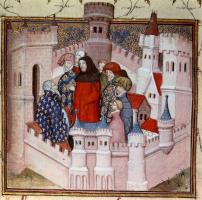


On 22nd January 1382 Anne of Bohemia Queen Consort England [aged 15] was crowned Queen Consort England by Archbishop William Courtenay [aged 40] (even though he had not received his Pall from the Pope.)
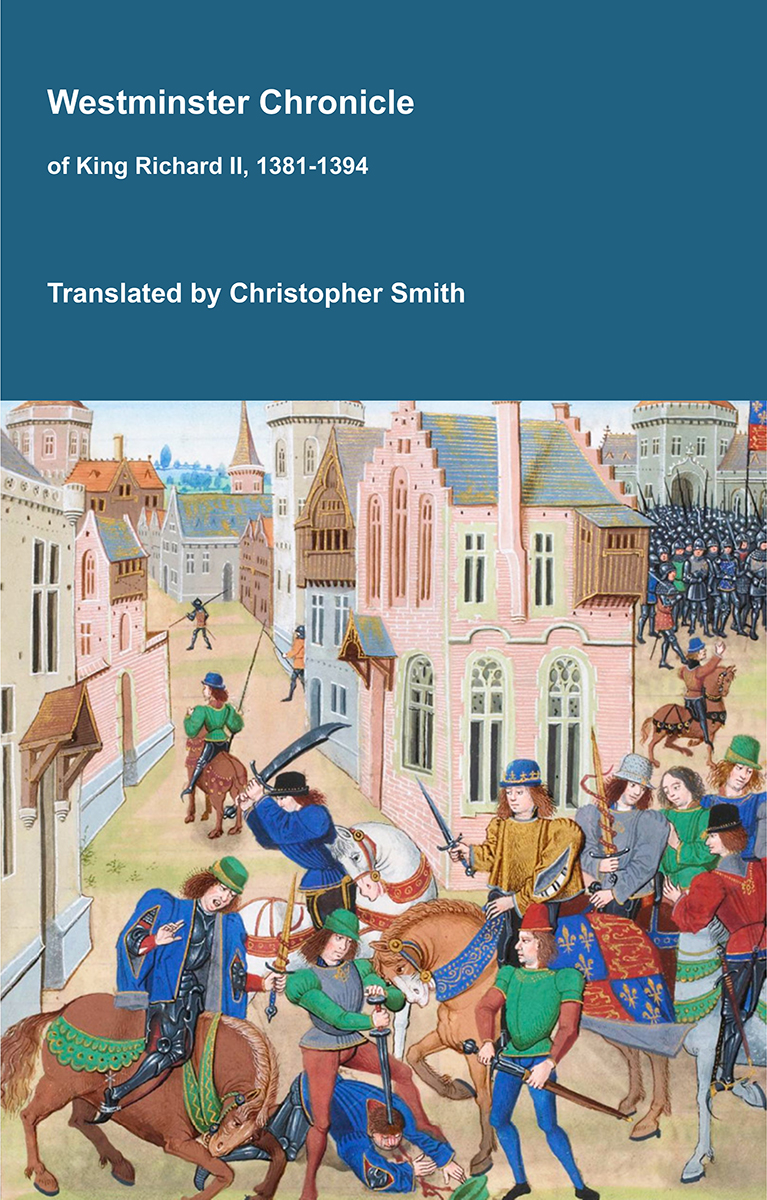 Westminster Chronicle. On the eighteenth day of the month of January [1382], the sister1 of the aforesaid emperor was received with the highest honour by the citizens of London, and was led to Westminster with great glory, while lords performed the office of equerry, for she was seated on a single destrier. On the thirteenth day before the Kalends of February [20th January 1382], she was married to the king in Westminster Church, and on the following feast of Saint Vincent [22nd January 1382] she was crowned queen by the hands of Lord William Courtenay [aged 40], archbishop. The bishop of London2 performed the solemnities of the marriage, wherefore the archbishop, though unjustly, was indignant. He nevertheless completed the sacred rites of the coronation, although he had not yet obtained the pallium from the pope. Of this queen someone wrote in verse: "Worthy Anna, noble, is given to the English to enjoy as manna." But to those who examined the truth, she seemed not to be given, but rather bought. For the king of England paid out no small sum of money for so small a portion of flesh3.
Decimo octavo die mensis Januarii cum summo honore Londoniensium civium recepta fuit soror prædicti Imperatoris et ad Westmonasterium cum ingenti gloria perducta stratoris officium gerentibus dominis residebat enim in uno dextrario, quæ tertiodecimo kalendas Februarias in ecclesia Westmonasterii regi desponsata est, et in die sancti Vincentii proxime subsequente per manus domini Willelmi Courteneye archiepiscopi in reginam coronabatur. Desponsationis peragebat solemnia episcopus Londoniensis quare archiepiscopus inindignatus, licet injuste, coronationis sacra complevit, quanquam pallium a papa nondum obtinuerat. De ista regina quidam scripsit metrice, "Digna frui manna datur Anglis nobilis Anna," sed scrutantibus verum videbatur non dari sed potius emi. Nam non modica pecunia refundebat rex Angliæ pro tantilla carnis portione.
Note 1. Anne of Bohemia, 1366-1394, sister of Holy Roman Emperor Sigismund.
Note 2. Robert Braybrooke, 1337-1404. Appointed Bishop of London in 1381 when the previous Bishop William Courtenay was appointed Archbishop of Canterbury.
Note 3. Anne of Bohemia did not bring a dowry. Rather King Richard paid 20,000 florins to her brother King Wenceslaus of Bohemia. Walsingham, St Albans Chronicle: The Chronica Maiora: "The king had therefore chosen to have this woman, bought at great price and with many labours, although the daughter of Lord Bernabò of Milan had been offered to him with an inestimable sum of gold."
Westminster Chronicle. On the fourth day before the Nones of October [4th October 1382], Isabella [aged 50], countess of Bedford and daughter of King Edward III, died in London. She was buried at the Friars Minor in London. Around the feast of Saint Edmund the King [20th November 1382], the bishops and a multitude of the clergy were gathered at Oxford by the archbishop of Canterbury [aged 40] for the examination of the heresy of which mention is made above. It was granted to the king that he should have half a tenth, provided that it should be used for the more necessary needs of the kingdom. For they asserted that the tenths granted up to that time had tended rather to the advantage of the enemies than of the kingdom. They concluded this from the expedition made into Spain by the earl of Cambridge1, which took place around the feast of Saint John the Baptist [24th June], in the year of the Lord 1381. And this gathering was, as it were, a synod.
Quarto nonas Octobres obiit Londoniæ Isabella comitissa de Bedeforde et filia regis Edwardi tertii, quæ apud fratres minores Londoniæ sepulta est. Circa festum sancti Edmundi regis congregatis episcopis et cleri multitudine apud Oxoniam per archiepiscopum Cantuariensem pro hæresis examinatione de qua superius fit mentio concessum fuit regi dimidia decima dum cederet in usus regni magis necessarios, Asserebant enim quod decimæ hactenus concessæ potius cedebant in commodum inimicorum quam regni; quod concludebant ex expeditione facta in Hispaniam per comitem de Cantabrigia quæ fuit circa festum sancti Johannis Baptistæ, Anno Domini MCCCLXXXI. Et ista congregatio fuit quasi synodus.
Note 1. The Earl of Cambridge, Edmund of Langley [aged 41], 1341-1402, son of King Edward III and Philippa of Hainaut, subsequently Duke of York. Married 1. in 1372 Isabella of Castile, illegitimate daughter of King Peter I of Castile and Maria Padilla, and sister of Constance of Castile, wife of Edmund's older brother John of Gaunt and 2. in 1393 Joan Holland, daughter of Thomas Holland, Earl of Kent, and Joan the Fair Maid of Kent. In 1381 Edmund sailed to Portugal intending to support King Ferdinand of Portugal against King John of Castile. Kings Ferdinand and John agreed a peace leaving Edmund's expedition without a purpose.
Chronicle of Adam of Usk [~1352-1430]. 1385. And thus alas! it is known to fall. Further, there fled before the face of this king Richard that most perfect man, William Courtney, archbishop of Canterbury [aged 43], for that he was ready to stand up against such tax; and, pursued on Thames by the same king, he fled for his life in the garb of a monk, and sought safety in the parts of Devon1. Yet did they who were the movers of this persecution by the king die an evil death, of whom we have heard above, to wit sir Simon Burley [aged 45] and others.
Note 1. William Courtenay, successively bishop of Hereford and London, and archbishop of Canterbury, was son of Hugh, earl of Devon. Walsingham, under the year 1385, tells us of the archbishop's opposition to a tax being imposed upon the clergy; but on this occasion the king acted with him as against the designs of the nobles upon the possessions of the church. Earlier in the year, however, there was a quarrel between the king and archbishop, according to Walsingham, "ob leves occasiones" (ij. 128), when the latter was threatened with deprivation of temporalities. The Monk of Evesham gives as the cause of his disgrace the king's anger at his remonstrance against bad government, and adds that the archbishop had to hide himself. Has our chronicler confused the two events?
Westminster Chronicle. Immediately afterwards, when a council was held at Westminster, the archbishop of Canterbury [aged 43] and other prelates of the churches, together with some of the temporal lords, complained gravely about those counsellors moving about the king, because they had induced the king to consent to the killing of the duke of Lancaster so cruelly in private. This was both because it was a matter of evil example, and because it would follow from this that whenever the king bore a hateful heart or mind towards some great or middling person, perhaps, in like manner, God forbid, he would order that person to be killed. Thus, by this, the approved laws and customs would suffer no slight injury, and quarrels, lawsuits, disputes, contentions, dissensions, and other such things would perhaps arise everywhere in the realm, God forbid. Therefore such crimes must be avoided in future, lest, because of unlawful acts of this kind, it should plainly happen that the realm be made worse. These words, or words like them, the archbishop of Canterbury delivered to the king on behalf of the lords then present there. When the king had heard them, he rose at once in anger against the archbishop and threatened him. On that day the king dined with the mayor of London. When the meal was finished, the king went onto the river Thames, and between his palace and Lambeth he met the archbishop. For the aforesaid archbishop had come to the king under the safe-conduct of the earl of Buckingham [aged 30]. Then, when the matter which the archbishop had pursued before dinner had been recited again, the king, drawing his sword, would have pierced the archbishop through at once, had not the earl of Buckingham, Lord John Devereux [aged 48], and Sir Thomas Trivet [aged 54] strongly resisted him. Since the king was angry with them, they immediately leapt out of the king’s boat, through fear, into the archbishop’s boat, and so at that time they departed from him in discord.
Incontinenti postea apud Westmonasterium consilio celebrato, archiepiscopus Cantuariensis, aliique ecelesiarum prælati ac de dominis temporalibus aliqui de istis consiliariis Circa regem conversantibus graviter sunt conquesti, co quod induxerunt regem assentire interfectioni ducis Lancastriæ tam crudeliter in privato tum quia fuit res mali exempli tum quia sequeretur ex hoc quod quandocunque rex versus magnam sive mediocrem personam cor sive animum gestierat odiosum consimili modo forsitan illam, quod absit, mandaret occidi. Ut sic per hoc leges et consuetudines approbatæ læsionem non modicam paterentur, rixæ lites jurgia contentiones dissensiones et cetera talia in regno, quod absit, ubique forsitan nascerentur, ‘Igitur abstinendum est a talibus sceleribus in futurum ne propter hujusmodi illicita deterioratio regni fieri manifesti contingat. Ista verba sive consimilia archiepiscopus Cantuariensis retulit regi ex parte dominorum tunc ibidem existentium. Quibus auditis rex iratus versus archiepiscopum illico surrexit et minas ei intulit. Ilo namque die comedit rex cum majore Londoniæ finito prandio rex flumen Thamense ,intravit et inter palatium suum et Lambheth archiepiseopum habuit obvium. Venerat enim præfatus archiepiscopus ad regem sub salvo conductu comitis de Buckyngham. Demum recitata materia quam ante prandium archiepiscopus fuerat proseeutus, rex extracto ense archiepiscopum illico perfodisset nisi comes Buckyngham, dominus Johannes Deuereye et dominus Thomas Tryvet eidem fortiter restitissent. Quibus rex iratus igitur de seapha regis propter metum in cymbam archiepiscopi statim prosiliebant et sic ab eo protunc in discordia recesserunt.
On 2nd August 1385 [his sister] Margaret Courtenay Baroness Cobham died.
Westminster Chronicle. On the thirteenth day of January, at the monastery of Westminster, there was held the solemn consecration of the bishop of Coventry and Lichfield, namely Master Walter Skirlaw, clerk of the lord king’s privy seal. It was performed by William Courtenay [aged 44], archbishop of Canterbury, in the presence of the kings of England and Armenia, the archbishop of York and five other bishops, the dukes of Lancaster and Gloucester, together with no small number of other nobles of England.
Tertio decimo die Januarii apud monasterium de Westminster facta est solemnis consecratio episcopi Cestrensis ’de magistro Waltero Skyrlowe clerico privati sigilli domini regis per Willelmum Courteneye archepiscopum Cantuariæ, præsentibus regibus Angliæ et Armeniæ, Eboracensi archepiscopo et quinque aliis episcopis, ducibus Lancastriæ et Gloucestriæ cum aliis Angliæ mnobilibus profecto non paucis.
Westminster Chronicle. Therefore, on the eighteenth day of January, at the Guildhall of London, there assembled the Archbishop of Canterbury [aged 46], the Bishops of Winchester [aged 68], Bath, Ely [aged 35]1, Hereford and Exeter, and the aforesaid lords, together with the clerk of the lord king’s privy seal and other noble, prudent and discreet men. First of all, since the Londoners were bound by unlawful oaths, the said archbishop absolved them from such oaths. Then the Bishop of Ely2, Treasurer of England, said to them that no one should speak any ill of the aforesaid lords on account of the bad governance of the king and kingdom which had now been set in motion. Since they, and we all too for the greater part, have been wickedly and most falsely indicted, and since there are among you certain men who have also been indicted, whether justly or unjustly we do not know at all. It will, however, appear in the end when it has been declared by parliament. But now, if there are any grievances or complaints amongst you, bring them forward before us. Now is the time for hearing them, for it is clear to all of us that you are by no means of one mind on either side, since it appears that one craft of this city wishes to destroy another, which is absurd, especially to endure such discord among citizens of this kind. Indeed, if you are willing to foster peace and concord amongst yourselves, you may hope that no adversity will gain mastery over you. Yet little was brought forward in response to these things, because it seemed to them that the lords did not stand equally with all men, as was proper. Therefore perhaps they were unwilling to accept them as judges, nor to allege anything before them.
Igitur xviii die Januarii apud Gyldam Aulam Londoniensem occurrerunt archiepiscopus Cantuariensis, Wyntoniensis, Bathoniensis, Eliensis, Herefordiensis, Exoniensis episcopi et prædicti domini cum clerico de privato sigillo domini regis et aliis nobilibus providis et discretis. Primo quidem ante omnia quia Londonienses erant illicitis juramentis astricti dictus archiepiscopus ab hujusmodi eosdem absolvit. Tunc dixit eis episcopus Elyensis, thesaurarius Angliæ, quod nullus obloqueretur aliquod sinistrum de prædictis dominis propter malam gubernationem regis et regni jam motis. Cum ipsi etiam et nos omnes pro majore parte simus nequiter et falsissime indictati ac inter vos sunt quidam etiam indictati si vero juste sive injuste penitus ignoramus. Apparebit quoque in fine cum per parliamentum fuerit declaratum. Nunc autem si quæ gravamina sive querimoniæ inter vos versantur producite in medium coram nobis ; jam est tempus audiendi, nam constat omnibus nobis vos nullatenus esse unanimes utrobique quia ut apparet una ars istius civitatis aliam delere affectat, quod est absurdum, præsertim inter cives tales inter illos discordias sustinere. Immo si pacem et concordiam inter vos fovere volueritis nullam adversitatem vobis dominari sperare poteritis. Pauca vero ad ista erant prolata quia videbatur cis non æqualiter cos stare cum omnibus prout decet. Ideo forte noluerint eos tanquam judices acceptare nec coram illis aliquid allegare.
Note 1. Archbishop Thomas Fitzalan aka Arundel, a younger brother of Richard, Earl of Arundel and Surrey.
Note 2. The Latin text has the 'Bishop of Ely' but the Lord Treasurer at the time was John Gilbert, Bishop of Hereford.
Westminster Chronicle. Also, on the 4th day of May, the Lord de la Warre and Sir David Lindsay, a Scottish knight, well armed, first charged against one another on horseback with very sharp lances; then they fought on foot with axes, and finally with daggers. All these things, according to report, they performed very vigorously. Also, on the 8th day of May, Brother Alexander1 was consecrated Bishop of Ross at Westminster by the Archbishop of Canterbury [aged 48]. He was the lord king’s confessor, of the Order of Preachers, and a master in theology. The king and queen, and other noble and gentle persons, came to that solemnity. Indeed, when this friar first came to the king, he was very humble and devout in gesture, expression, diet, manner of seeking, and in all his actions plainly moderate. He would not ride, but, following the court, went on foot from one place to another. At first he refused the bishopric; but a little afterwards, his will having changed, he began to act more insolently against all the aforesaid things, as the outcome of the matter has now proved.
Quarto quoque die Maii dominus de la Welle, et dominus David Lyndeseye miles Scoticus, bene armati primo cum lanceis acutissimis in equis hostiliter concurrerunt, deinde cum securibus postremo cum daggeris pedestres certarunt, quæ omnia peregerunt satis strenue seeundum relata. Item octavo die Maii consecratus est frater Alexander in episcopum Assanensem apud Westmonasterium ab archiepiscopo Cantuariensi, qui fuit et est confessor domini regis, de ordine prædicatorum magister in theologia. Ad istam solemnitatem accesserunt rex et regina ac alii nobiles generosi. Erat nempe frater iste quando primo venit ad regem satis humilis et devotus in gestu, vultu, in victu, in quæstu et in omnibus suis actibus perspicue moderatus nec voluit equitare, sed de uno loco ad alium sequendo curiam pedester transire, episcopatum vero primitus recusabat, sed parum postea mutata voluntate cœpit insolentius agere contra universa præmissa, ut jam rei effectus probavit.
Note 1. The surname is absent from the Latin text. Bishop Alexander de Kylwos, died 1398.
Westminster Chronicle. After these things, in the month of June, a council was held, and it was decreed in that council that the Bishop of Durham should cross to Calais to negotiate with the French about a final peace. He remained there negotiating until the 13th day of July. In that negotiation many things were asked for on both sides. All these were drawn up in writing and presented to both kings, so that they themselves, with their councils, might more advisedly settle the aforesaid matters. When the council at Westminster had ended, before his departure from London, the lord king caused solemn jousts to be proclaimed, to be held at Smithfield on the 10th day of October, declaring that he himself, with certain men joined to him, would very swiftly answer all who came. Immediately afterwards the king moved to Gloucester, greatly desiring to translate his great-grandfather1, who lay there. There met him the Archbishop of Canterbury [aged 48], the Bishop of London, and certain other bishops, together with clerks and men learned in law, concerning the attestation of miracles to be sent to the lord pope. First, it was to be examined by them whether they were true miracles or fabricated ones. Concerning this business, the pope had previously sent a certain bull to the Bishop of London, ordering him to inquire into the truth of the said miracles and to certify him how the truth of the matter stood in the aforesaid business.
Post hæc mense Junii consilio celebrato decretum est in eodem quod episcopus Dunelmensis transiret Calesias tractaturus cum Francigenis de pace finali, fuitque ibidem tractando usque xiii diem Julii. In quo tractatu plura fuerunt petita ex utraque parte, quæ omnia erant in scriptis redacta, et ambobus regibus præsentata ut ipsi prædicta cum eorum consilio consultius terminarent. Consilio apud Westmonasterium terminato, dominus rex ante recessum suum de Londoniis fecit solemnia hastiludia prohæcclamari apud Smethefeld fieri xmo die Octobris prohæctestans quod ipse, cum certis sibi adjunctis, omnes adventantes citissime liberaret. Confestim post rex transtulit se Gloverniam multum appetens proavum suum ibi jacentem transferre, ubi occurrebant ei Canhæctuariensis archiepiscopus, episcopus Londoniensis et quidam alii episcopi cum clericis et juris peritis super attestatione miraculorum domino papæ dirigenda. Primo discutiendum per eos utrum sint vera miracula seu conficta, super quo negotio prius papa misit epishæccopo Londoniensi quandam bullam ad inquirendum veritatem dictorum miraculorum et ad certificandum sibi quomodo rei veritas se habeat in negotio antedicto.
Note 1. King Richard II's great grandfather was King Edward II who had died, probably murdered, at Berkeley Castle in 1327, and buried at Gloucester Cathedral.
On 16th December 1391 [his mother] Margaret Bohun Countess Devon [aged 80] died.
On 31st July 1396 Archbishop William Courtenay [aged 54] died at Maidstone, Kent [Map]. He was buried in the quire of Canterbury Cathedral [Map].
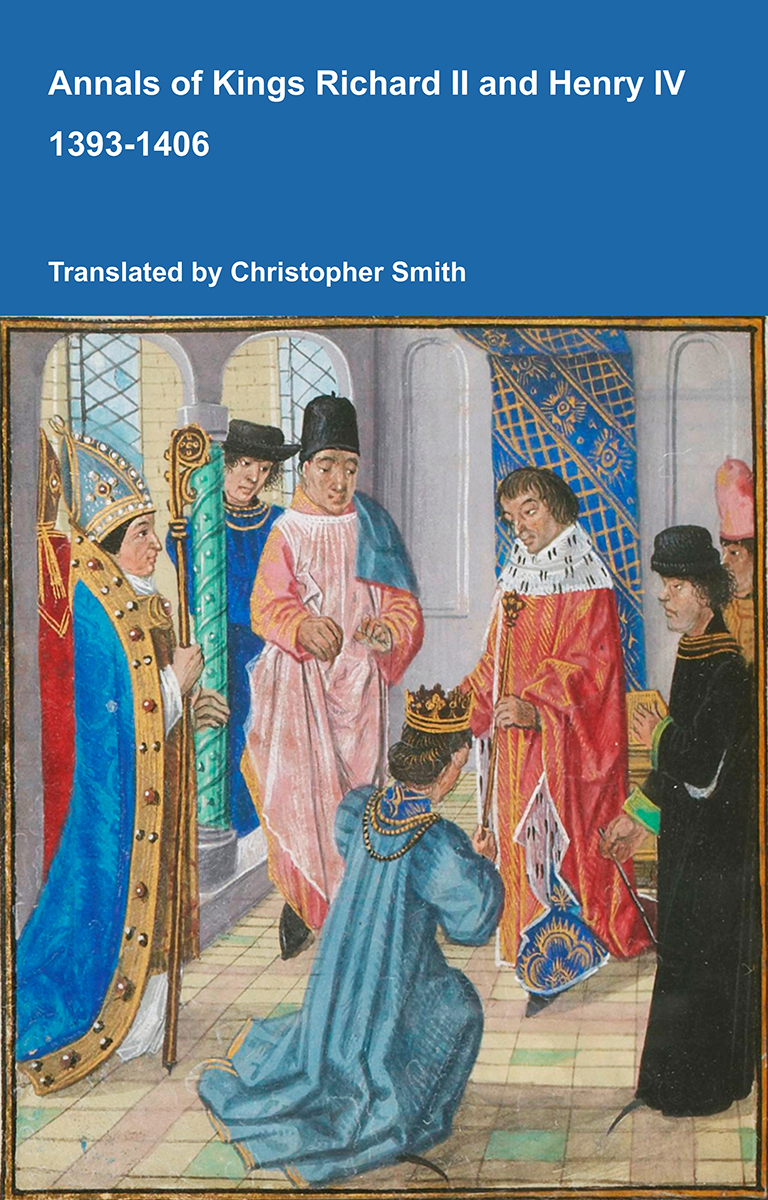 Annals of Kings Richard II and Henry IV. In this year, Master William Courtenay [aged 54], Archbishop of Canterbury, bade farewell to the world [on 31st July 1396]. He was succeeded, by the postulation of the Chapter, by Sir Thomas Arundel, brother of the Earl of Arundel [aged 50], Archbishop of York and Chancellor of the realm. Arundel immediately resigned the office of Chancellor and its burdens, and, with the King’s assent, entrusted it to Master Edmund Stafford [aged 52], Bishop of Exeter. He was succeeded in the archbishopric of York by [....]1, a friar of the Order [....], by papal provision, against the wishes of the whole clergy of York.
Hoc anno, Magister Willelmus Courtenay, Cantuariensis Archiepiscopus, sæculo valefecit; cui successit, postulatione Capituli, Dominus Thomas Arundele, frater Comitis Arundeliæ, [Archiepiscopus Eboraci] regnique Cancellarius; qui mox Cancellariæ dimisit officium, et illius sollicitudinem, per assensum regium, Magistro Edmundo de Stafford commendavit, Episcopo, videlicet, Exoniensi; successitque in Archipræsulatu Eboracensi [....], Frater de Ordine [....], provisione Papali, contra vota totius cleri Eboracensis.
Note 1. The names are missing in the Latin text. The missing name is Robert Waldby, an Augustinian friar. So the end would be: "He was succeeded in the archbishopric of York by Robert Waldby, a friar of the Order of Saint Augustine, by papal provision, against the wishes of the whole clergy of York."
Walsingham Chronica Majora. [31st July 1396]. In this year, Master William Courtenay [aged 54], Archbishop of Canterbury, departed from this world. He was succeeded, by the election of the General Chapter, by Thomas Arundel [aged 43], brother of the Earl of Arundel [aged 50] and Chancellor of the Kingdom, who soon resigned from the office and responsibilities of Chancellor with the King's consent, entrusting them to Master Edmund Stafford [aged 52].
Hoc anno valefecit mundo Magister Willelmus Courtenay, Arckiepiscopus Cantuariensis; cui successit, postulatione Communis Capituli, Thomas Arundel, frater Comitis Arundelliæ, regnique Cancellarius; qui mox Cancellariæ dimisit officium, et illius sollicitudinem, per Regis assensum, Magistro Edmundo Stafforde commendavit.
Parliament Rolls Richard II. 27. Be it remembered that the venerable father Thomas, archbishop of Canterbury, primate of all England, earnestly prayed to the lord king in the present parliament that whereas his church of Canterbury, by the gift and grant of his noble and holy progenitors, which the same king graciously confirmed, had such prerogative over the other churches of England that whatsoever archbishop of Canterbury for the time being had custody of all lordships, manors, tenements, and rents with appurtenances which were held of the same church in chief during the minority of the heirs of their tenants, even though the same tenants elsewhere held in chief of the lord king; and now concerning the castle and manor of Tonbridge, Kent [Map], which by virtue of this prerogative were in the custody of William de Courtenay, late archbishop of Canterbury now deceased, predecessor of the present archbishop, on the day on which he died, by reason of the minority of the heir of the earl of Stafford deceased, who held the aforesaid castle and manor from the aforesaid former archbishop in chief, dispute and controversy between the present archbishop and the executors of the will of the aforesaid late archbishop are pending at present. And whereas a certain composition was drawn up a short while ago between the archbishop of Canterbury and the prior and chapter of the church of Canterbury on the matter, it pleased the lord king, having inspected and examined that composition, to order a view and settlement of the matter for the peace and right of his said church of Canterbury, as should seem best to his royal majesty, to whose ordinance and decree on the foregoing the same archbishop proclaimed himself to be firmly obedient in all things, whereupon the same lord king immediately appointed the venerable fathers Robert archbishop of York, Robert Bishop of London and John Bishop of Ely, and John duke of Aquitaine and Lancaster, and John Earl of Huntingdon, and Thomas the earl marshal, to inspect and examine that composition, and further to discuss and settle the matter at their discretion, and fully to inform the lord king of what their deed and action should be. And later on Monday, the last day of the aforesaid parliament [10 February 1397], the archbishop of York, and the bishops, and the aforesaid duke and earls thus appointed by order of the lord king in the same parliament returned their decree and ordinance on the aforesaid matter by Walter Clopton, the lord king's justice, in this form - namely, that the third part of all manors, lands, and tenements of the inheritance of the aforesaid heir, and the issues, profits, and revenues of the same from the time of the death of the aforesaid late archbishop, should, according to the form of the aforesaid composition, remain and be in the hands of the aforesaid prior and chapter, to be used for their own purposes; and that two parts of the aforesaid lands and tenements, with the issues, profits, and revenues of the same two parts, should remain likewise in the hands of that prior and chapter, safely and securely to keep until the lord king shall have ordained to whom those said two parts of the issues, profits, and revenues shall be delivered and has declared his will thereon. And the castle of Tonbridge [Map] will be delivered to the aforesaid present archbishop of Canterbury without delay, to remain in his hands and keeping until the the coming of age of the aforesaid heir. The which ordinance and decree thus rendered by the archbishop of York, bishops, duke and earls, the aforesaid lord king, approving thereof, ordered to be placed on record on the roll of parliament at the request of the aforesaid present archbishop of Canterbury.
Westminster Chronicle. At that time a serious matter of dissension arose between the archbishop of Canterbury and the bishop of Exeter1, in this way. The aforesaid archbishop had resolved to visit his province, and first began his visitation in Devon. He came to the cathedral church of Exeter. The canons of that same church were making certain accusations against their bishop. Therefore the archbishop sent for the aforesaid bishop, that he should come to him, answer the charges, and in other matters undergo his visitation as was fitting. But before the archbishop’s messenger reached the bishop, the bishop’s servants intercepted him. When they learnt the reason for which he had come, they made the messenger himself swallow the letters which the archbishop had directed to the aforesaid bishop. The archbishop, seeing his messenger so contemptibly dishonoured, became wholly inflamed with anger, and pronounced grave censures against the aforesaid bishop. Certain members of the archbishop’s household, with some others, entered a certain fair, and there found one of the aforesaid bishop’s esquires. They forced him to chew and swallow the points or tips of his shoes, [though he did not eat them, although he had been forced to eat them]2. After these ridiculous acts had thus been wickedly performed on both sides, they quickly stirred up the fuel of greater hatred between them [....] whereupon the often-mentioned bishop, feeling himself aggrieved, went to Salisbury and there addressed the bishops gathered for the sake of parliament, explaining to them how, in certain matters, the said archbishop had exceeded due measure in his visitation, and that, if he ought to resist in such matters, he wished to use their counsel. The bishops said to him: "We consider you to be as powerful in your diocese as the archbishop is. Therefore defend yourself against him in the best way you can. As for us, when the aforesaid archbishop happens to turn aside to our churches for the purpose of visitation, we shall do as seems best and most expedient to us on our side." After the said bishop had learnt their will, he sent to the archbishop men of clear judgement and illustrious birth. Through their mediation and industry peace was restored between them, and the archbishop, having obtained what he wished, proceeded further in his visitation.
Quo in tempore inter archiepiscopum Cantuariensem et episcopum Exoniensem grave dissensionis materia hoc modo fuit exorta. Disposuit enim præfatus archiepiscopus suam provinciam visitare et primo in Devonia suam visitationem incepit, venitque ad ecclesiam cathedralem Exoniensem. Canonici vero ejusdem ecclesi; contra suum episcopum aliqua objieiebant. Quare archiepiscopus misit pro memorato episcopo ut veniret ad eum et ad objecta responderet ac in aliis prout decet suam visitationem subiret. Sed antequam archiepiscopi nuntius prevenit ad episcopum, ejus ministri ipsum interceperunt; cognita vero causa pro qua venerat literas quas archiepiscopus prwdieto episcopo direxerat per eundem ipsum deglutire fecerunt. Archiepiscopus namque videns suum nuntium ita contemptabiliter dehonestatum totus ira incaluit ac in episcopum prelibatum graves censuras dictavit. Familiares quidam dicti archiepiscopi eum quibusdam aliis in quasdam nundinas ingressi quendam sceutiferorum prefati episcopi ibidem inventum summitates sive aculeos sotularium suorum masticare et deglutire coegerunt, [sed non comedit licet comedere fuisset coactus] Istis ridieclis sic ex utraque parte nequiter peractis majoris odii fomitem inter illos citius [....]. Suscitavit unde ssepe dietus episcopus sentiens se gravatum perrexit Sarum et illie episcopos parliamenti causa congregatos alloquitur exponens eis qualiter in aliquibus dietus archiepiscopus in sua visitatione modum excessit; et si in hujusmodi debuerit resistere eorum consilio uti vellet. Cui episcopi dixerunt: "Nos reputamus te ita potentem in tua diocesi sicut archiepiscopum, igitur defende te ab eo meliori modo quo poteris. Nos vero cum præfatus archiepiscopus gratia visitandi ad ecclesias nostras contigerit declinare, faciemus prout nobis melius nostra parte videbitur expedire." Postquam vero dictus episcopus cognovit voluntatem eorum misit archiepiscopo viros perspicuos et genere przclaros quorum mediatione et industria pax inter illos reformata est archiepiscopus voti compos effectus ulterius in visitatione sua processit.
Note 1. Thomas Brantingham, died 1394. Appointed Bishop of Exeter in 1370, Lord Treasurer from 1377 to 1381, and again in 1389.
Note 2. The words in [ ] are on the margin.
Kings Wessex: Great x 9 Grand Son of King Edmund "Ironside" I of England
Kings Gwynedd: Great x 12 Grand Son of Maredudd ab Owain King Deheubarth King Powys King Gwynedd
Kings Seisyllwg: Great x 14 Grand Son of Hywel "Dda aka Good" King Seisyllwg King Deheubarth
Kings Powys: Great x 12 Grand Son of Maredudd ab Owain King Deheubarth King Powys King Gwynedd
Kings England: Great Grand Son of King Edward I of England
Kings Scotland: Great x 7 Grand Son of King Malcolm III of Scotland
Kings France: Great x 10 Grand Son of Hugh I King of the Franks
Kings Duke Aquitaine: Great x 13 Grand Son of Ranulf I Duke Aquitaine
Kings Spain: Great x 5 Grand Son of Alfonso VII King Castile VII King Leon
Great x 4 Grandfather: Renaud Courtenay  5 x Great Grandson of Hugh I King of the Franks
Great x 3 Grandfather: Robert Courtenay 1st Baron Okehampton 6 x Great Grandson of Hugh I King of the Franks
Great x 4 Grandmother: Hawise Courcy
Great x 2 Grandfather: John Courtenay 2nd Baron Okehampton 3 x Great Grandson of King Henry I "Beauclerc" England
Great x 4 Grandfather: William Redvers 5th Earl Devon 
Great x 3 Grandmother: Mary Vernon Redvers Baroness Okehampton 2 x Great Granddaughter of King Henry I "Beauclerc" England
Great x 4 Grandmother: Mable de Beaumont  Great Granddaughter of King Henry I "Beauclerc" England
Great x 1 Grandfather: Hugh Courtenay 3rd Baron Okehampton 4 x Great Grandson of King Henry I "Beauclerc" England
Great x 4 Grandfather: Robert de Vere 3rd Earl of Oxford 
Great x 3 Grandfather: Hugh de Vere 4th Earl of Oxford
Great x 4 Grandmother: Isabel de Bolebec Countess of Oxford
Great x 2 Grandmother: Isabel Vere Baroness Okehampton 7 x Great Granddaughter of Hugh I King of the Franks
Great x 4 Grandfather: Saer Quincy 1st Earl Winchester 9 x Great Grandson of King Edward "Elder" of the Anglo Saxons
Great x 3 Grandmother: Hawise Quincy Countess Oxford 6 x Great Granddaughter of Hugh I King of the Franks
Great x 4 Grandmother: Margaret Beaumont Countess Winchester 5 x Great Granddaughter of Hugh I King of the Franks
Grandfather: Hugh Courtenay 1st or 9th Earl Devon 5 x Great Grandson of King Henry I "Beauclerc" England
Great x 4 Grandfather: Thomas Despencer 
Great x 3 Grandfather: Hugh Despencer
Great x 4 Grandmother: Recuara Harcourt 
Great x 2 Grandfather: Hugh Despencer
Great x 1 Grandmother: Eleanor Despencer Baroness Okehampton 4 x Great Granddaughter of King Henry I "Beauclerc" England
Great x 4 Grandfather: Alan Basset 
Great x 3 Grandfather: Philip Basset 2 x Great Grandson of King Henry I "Beauclerc" England
Great x 4 Grandmother: Aline Fitzrobert  Great Granddaughter of King Henry I "Beauclerc" England
Great x 2 Grandmother: Aline Basset 3 x Great Granddaughter of King Henry I "Beauclerc" England
Great x 4 Grandfather: Matthew Reginar 9 x Great Grandson of King Edward "Elder" of the Anglo Saxons
Great x 3 Grandmother: Hawise Reginar 10 x Great Granddaughter of King Edward "Elder" of the Anglo Saxons
Father: Hugh Courtenay 2nd or 10th Earl Devon  6 x Great Grandson of King Henry I "Beauclerc" England
Great x 2 Grandfather: Robert St John 
Great x 1 Grandfather: John St John
Great x 4 Grandfather: William Cantilupe Baron 
Great x 3 Grandfather: William Cantilupe
Great x 2 Grandmother: Agnes Cantilupe
Grandmother: Agnes St John Countess Devon
Great x 4 Grandfather: Herbert Fitzherbert 
Great x 3 Grandfather: Piers Fitzherbert
Great x 2 Grandfather: Reginald Fitzpiers
Great x 1 Grandmother: Agnes Fitzpiers
Archbishop William Courtenay Great Grandson of King Edward I of England
Great x 4 Grandfather: Henry Bohun 1st Earl Hereford  Great Grandson of King David I of Scotland
Great x 3 Grandfather: Humphrey Bohun 2nd Earl Hereford 1st Earl Essex 2 x Great Grandson of King David I of Scotland
Great x 4 Grandmother: Maud Mandeville Countess Hereford 
Great x 2 Grandfather: Humphrey Bohun 3 x Great Grandson of King David I of Scotland
Great x 4 Grandfather: Raoul Lusignan Count of Eu 
Great x 3 Grandmother: Matilda Lusignan Countess Hereford and Essex
Great x 4 Grandmother: Alix Eu
Great x 1 Grandfather: Humphrey Bohun 3rd Earl Hereford 2nd Earl Essex 4 x Great Grandson of King David I of Scotland
Great x 4 Grandfather: Reginald de Braose 8th Baron Abergavenny 6th Baron Bramber  6 x Great Grandson of Maredudd ab Owain King Deheubarth King Powys King Gwynedd
Great x 3 Grandfather: William de Braose 9th Baron Abergavenny 7th Baron Bramber 7 x Great Grandson of Maredudd ab Owain King Deheubarth King Powys King Gwynedd
Great x 4 Grandmother: Graecia Briwere
Great x 2 Grandmother: Eleanor de Braose 7 x Great Granddaughter of Hugh I King of the Franks
Great x 4 Grandfather: William Marshal 1st Earl Pembroke 
Great x 3 Grandmother: Eva Marshal 6 x Great Granddaughter of Hugh I King of the Franks
Great x 4 Grandmother: Isabel Clare Countess Pembroke 5 x Great Granddaughter of Hugh I King of the Franks
Grandfather: Humphrey Bohun 4th Earl Hereford 3rd Earl Essex 5 x Great Grandson of King David I of Scotland
Great x 4 Grandfather: Engeurrand "Crusader" Fiennes 
Great x 3 Grandfather: William Fiennes 8 x Great Grandson of King Edward "Elder" of the Anglo Saxons
Great x 4 Grandmother: Sibylle Flanders 7 x Great Granddaughter of King Edward "Elder" of the Anglo Saxons
Great x 2 Grandfather: Enguerrand Ingleram Fiennes 9 x Great Grandson of King Edward "Elder" of the Anglo Saxons
Great x 4 Grandfather: Alberic Dammartin
Great x 3 Grandmother: Agnes Dammartin 10 x Great Granddaughter of Charles "Charlemagne aka Great" King of the Franks King Lombardy Holy Roman Emperor
Great x 4 Grandmother: Mathilde Clermont 9 x Great Granddaughter of Charles "Charlemagne aka Great" King of the Franks King Lombardy Holy Roman Emperor
Great x 1 Grandmother: Maud Fiennes Countess Essex and Hereford 10 x Great Granddaughter of King Edward "Elder" of the Anglo Saxons
Great x 2 Grandmother: Isabel Provence 
Mother: Margaret Bohun Countess Devon Granddaughter of King Edward I of England
Great x 4 Grandfather: King Henry "Curtmantle" II of England  Grandson of King Henry I "Beauclerc" England
Great x 3 Grandfather: King John of England son of King Henry "Curtmantle" II of England
Great x 4 Grandmother: Eleanor of Aquitaine Queen Consort Franks and England 4 x Great Granddaughter of Hugh I King of the Franks
Great x 2 Grandfather: King Henry III of England son of King John of England
Great x 4 Grandfather: Aymer I Count Angoulême  12 x Great Grandson of Charles "Charlemagne aka Great" King of the Franks King Lombardy Holy Roman Emperor
Great x 3 Grandmother: Isabella of Angoulême Queen Consort England 5 x Great Granddaughter of Hugh I King of the Franks
Great x 4 Grandmother: Alice Courtenay Countess Angoulême  4 x Great Granddaughter of Hugh I King of the Franks
Great x 1 Grandfather: King Edward I of England son of King Henry III of England
Great x 4 Grandfather: Alfonso Barcelona II Count Provence  son of Alfonso II King Aragon
Great x 3 Grandfather: Raymond IV Count Provence Grandson of Alfonso II King Aragon
Great x 4 Grandmother: Gersenda II Sabran Countess Provence
Great x 2 Grandmother: Eleanor of Provence Queen Consort England Great Granddaughter of Alfonso II King Aragon
Great x 4 Grandfather: Thomas Savoy I Count Savoy 12 x Great Grandson of Charles "Charlemagne aka Great" King of the Franks King Lombardy Holy Roman Emperor
Great x 3 Grandmother: Beatrice Savoy Countess Provence 13 x Great Granddaughter of Charles "Charlemagne aka Great" King of the Franks King Lombardy Holy Roman Emperor
Great x 4 Grandmother: Margaret Geneva Countess Savoy
Grandmother: Princess Elizabeth of Rhuddlan Countess Essex, Hereford and Holland daughter of King Edward I of England
Great x 4 Grandfather: Ferdinand II King Leon  son of Alfonso VII King Castile VII King Leon
Great x 3 Grandfather: Alfonso IX King Leon Grandson of Alfonso VII King Castile VII King Leon
Great x 4 Grandmother: Urraca Burgundy Queen Consort Leon  4 x Great Granddaughter of Hugh I King of the Franks
Great x 2 Grandfather: Ferdinand III King Castile III King Leon Great Grandson of Alfonso VII King Castile VII King Leon
Great x 4 Grandfather: Alfonso VIII King Castile Grandson of Alfonso VII King Castile VII King Leon
Great x 3 Grandmother: Berengaria Ivrea I Queen Castile Granddaughter of King Henry "Curtmantle" II of England
Great x 4 Grandmother: Eleanor Plantagenet Queen Consort Castile daughter of King Henry "Curtmantle" II of England
Great x 1 Grandmother: Eleanor of Castile Queen Consort England 2 x Great Granddaughter of Alfonso VII King Castile VII King Leon
Great x 4 Grandfather: Alberic Dammartin
Great x 3 Grandfather: Simon Dammartin 10 x Great Grandson of Charles "Charlemagne aka Great" King of the Franks King Lombardy Holy Roman Emperor
Great x 4 Grandmother: Mathilde Clermont 9 x Great Granddaughter of Charles "Charlemagne aka Great" King of the Franks King Lombardy Holy Roman Emperor
Great x 2 Grandmother: Joan Dammartin Queen Consort Castile and Leon 2 x Great Granddaughter of Alfonso VII King Castile VII King Leon
Great x 4 Grandfather: William Montgomery IV Count Ponthieu 6 x Great Grandson of Hugh I King of the Franks
Great x 3 Grandmother: Marie Montgomery Countess Ponthieu Great Granddaughter of Alfonso VII King Castile VII King Leon
Great x 4 Grandmother: Alys Capet Countess Ponthieu Granddaughter of Alfonso VII King Castile VII King Leon