

Paternal Family Tree: Braybrooke
1382 Marriage of Richard II and Anne of Bohemia and her Coronation
Bishop Robert Braybrooke was born to Gerard Braybrooke.
On 17th March 1358 [his father] Gerard Braybrooke [aged 51] died.
On 5th January 1382 Bishop Robert Braybrooke was appointed Bishop of London.
On 20th January 1382 King Richard II of England [aged 15] and Anne of Bohemia Queen Consort England [aged 15] were married at Westminster Abbey [Map] by Bishop Robert Braybrooke. She by marriage Queen Consort England. She the daughter of Charles IV King Bohemia Holy Roman Emperor Luxembourg and Elizabeth Pomerania Holy Roman Empress Luxembourg [aged 35]. He the son of Edward "Black Prince" and Joan "Fair Maid of Kent" Princess Wales [aged 53]. They were fourth cousins. He a grandson of King Edward III of England.
It was the first royal wedding that including a Royal Procession from the Tower of London [Map] to Westminster Abbey [Map].
Arranged by Michael de la Pole 1st Earl Suffolk [aged 52] the marriage not popular since it brought no dowry and little prospect of increased trade since Bohemia not a primary English trade partner.


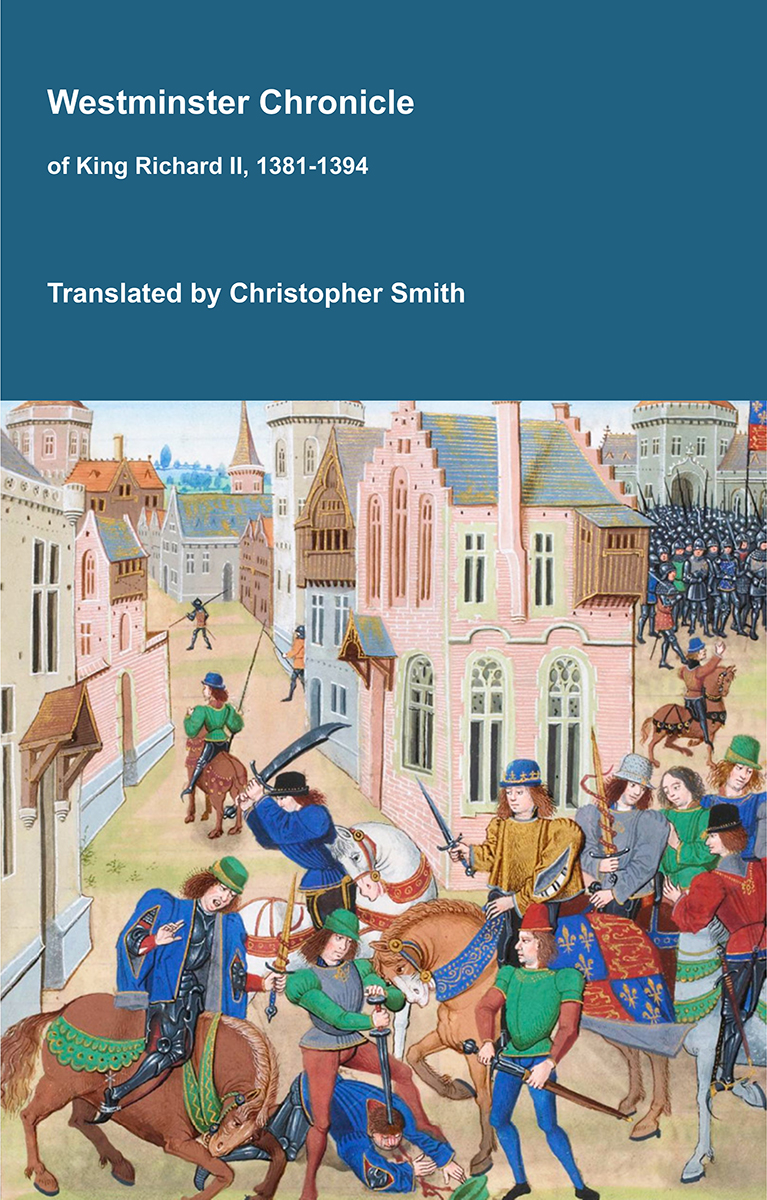 Westminster Chronicle. On the feast of Processus and Martinian [2nd July 1382], Robert Aston, the bishop of Hereford, Sir John Devereux, Richard Stury, and Master John Sheppey returned from overseas. On the fourth day before the Ides of July [4th July 1382], Sir Richard Scrope was removed from the office of the chancery. At the same time there was an epidemic in London, but chiefly among girls and boys. The bishop of London [Robert Braybrooke] was made chancellor on the second day of the month of August, in a council held at Woodstock. In the quindene of Saint Michael [24th September], a parliament was held in London, in which, after many disputes among many men, one fifteenth was granted to the king on the part of the laity, but the clergy at that time granted nothing.
In die Processi et Martiniani reversus est episcopus Herefordensis Robertus Aston, dominus Johannes Deurose de partibus transmarinis et Ricardus Stury, magister Johannes Shepeye. Quarto idus Julii dominus Ricardus Scrope remotus fuit ab officio cancellariæ. Eodem tempore fuit epidemia Londoniæ sed maxime puellarum et puerorum. Episcopus Londoniensis fuit cancellarius effectus, secundo die mensis Augusti in concilio tento apud Wodestoke. In quindena sancti Michaelis fuit parliamentum celebratum Londoniæ in quo post multas multorum altercationes fuit concessum regi ex parte laicorum una quinta decima, sed clerus tunc nihil concessit.
On 20th September 1382 Bishop Robert Braybrooke was appointed Lord Chancellor.
Westminster Chronicle. After these things, in the month of June, a council was held, and it was decreed in that council that the Bishop of Durham should cross to Calais to negotiate with the French about a final peace. He remained there negotiating until the 13th day of July. In that negotiation many things were asked for on both sides. All these were drawn up in writing and presented to both kings, so that they themselves, with their councils, might more advisedly settle the aforesaid matters. When the council at Westminster had ended, before his departure from London, the lord king caused solemn jousts to be proclaimed, to be held at Smithfield on the 10th day of October, declaring that he himself, with certain men joined to him, would very swiftly answer all who came. Immediately afterwards the king moved to Gloucester, greatly desiring to translate his great-grandfather1, who lay there. There met him the Archbishop of Canterbury [aged 48], the Bishop of London, and certain other bishops, together with clerks and men learned in law, concerning the attestation of miracles to be sent to the lord pope. First, it was to be examined by them whether they were true miracles or fabricated ones. Concerning this business, the pope had previously sent a certain bull to the Bishop of London, ordering him to inquire into the truth of the said miracles and to certify him how the truth of the matter stood in the aforesaid business.
Post hæc mense Junii consilio celebrato decretum est in eodem quod episcopus Dunelmensis transiret Calesias tractaturus cum Francigenis de pace finali, fuitque ibidem tractando usque xiii diem Julii. In quo tractatu plura fuerunt petita ex utraque parte, quæ omnia erant in scriptis redacta, et ambobus regibus præsentata ut ipsi prædicta cum eorum consilio consultius terminarent. Consilio apud Westmonasterium terminato, dominus rex ante recessum suum de Londoniis fecit solemnia hastiludia prohæcclamari apud Smethefeld fieri xmo die Octobris prohæctestans quod ipse, cum certis sibi adjunctis, omnes adventantes citissime liberaret. Confestim post rex transtulit se Gloverniam multum appetens proavum suum ibi jacentem transferre, ubi occurrebant ei Canhæctuariensis archiepiscopus, episcopus Londoniensis et quidam alii episcopi cum clericis et juris peritis super attestatione miraculorum domino papæ dirigenda. Primo discutiendum per eos utrum sint vera miracula seu conficta, super quo negotio prius papa misit epishæccopo Londoniensi quandam bullam ad inquirendum veritatem dictorum miraculorum et ad certificandum sibi quomodo rei veritas se habeat in negotio antedicto.
Note 1. King Richard II's great grandfather was King Edward II who had died, probably murdered, at Berkeley Castle in 1327, and buried at Gloucester Cathedral.
Westminster Chronicle. When the feast of the Translation of St Edward [13th October 1390] came, the king was in the monastery of Westminster at first vespers and at compline, with his whole chapel. He was also present at matins at midnight with his chapel. At the procession on the day itself, and at high mass, he was present; he sat in the choir with his chapel surrounding the crown. Shortly after the beginning of high mass, the queen entered the choir solemnly crowned, and withdrew to the north side. The divine office was performed by the Bishop of London. On that same day, the citizens of London proceeded to the election of a new mayor, and unanimously elected Adam Bamme, goldsmith, as their mayor.
Veniente itaque festo translationis sancti Edwardi rex fuit in monasterio Westmonasterii ad primas vesperas et ad completorium cum tota sua capella. Ad matutinas etiam media nocte aderat cum sua capella. Ad processionem vero in die erat et missam magnam, in choro residebat cum sua capella circumdante corona. Parum post principium magnæ missæ intravit regina solemniter coronata in chorum et in aquilonali parte secessit. Officium quoque divinum episcopus Londoniensis peregit. Eo etiam die Londoniis processerunt ad electionem novi majoris ac Adam Bamme aurifabrum in eorum majorem concorditer elegerunt.
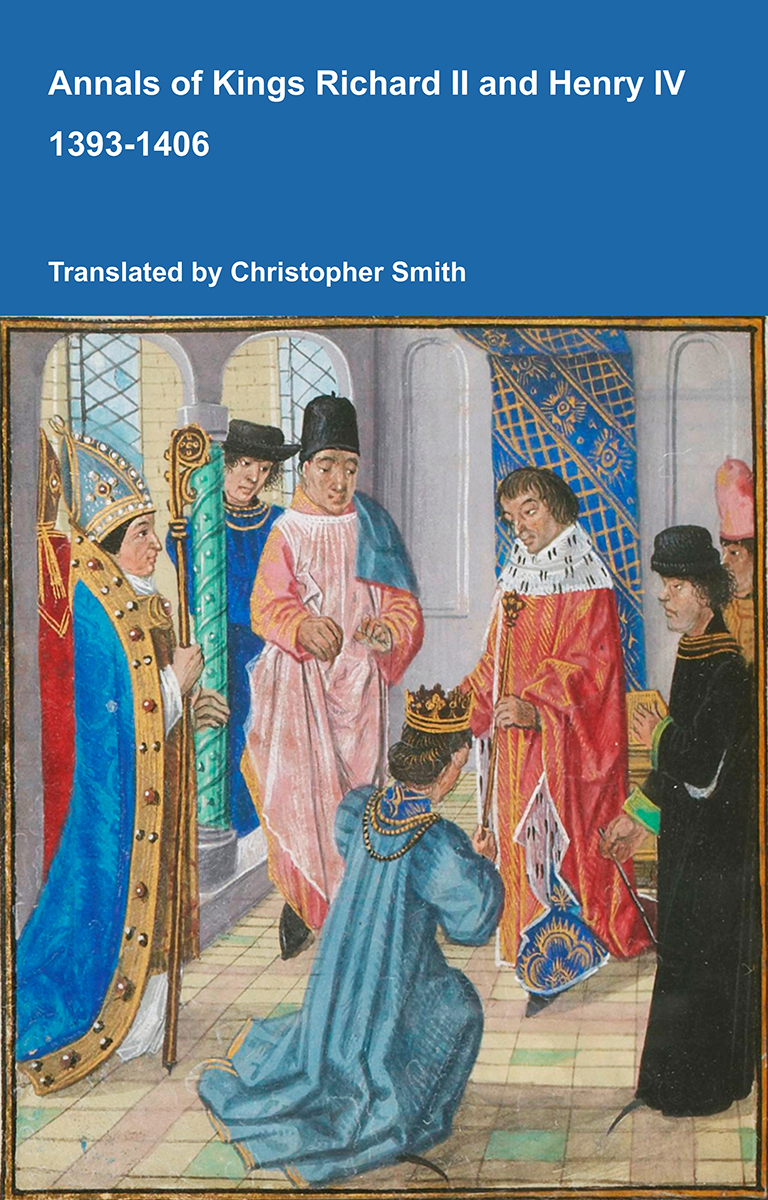 Annals of Kings Richard II and Henry IV. The King kept Christmas at Dublin with great solemnity, and remained in Ireland until after the feast of Easter. During this time the Archbishop of York, the Bishop of London1, and other messengers sent by the clergy of the kingdom of England came to the King in Ireland, asking that he would deign to return home as quickly as possible, in order to aid the faith and the Church, since it was being incredibly afflicted by the Lollards and their supporters. For they devoted themselves solely to devising how they might defame the clergy, take away the possessions of the Church, and destroy all canonical sanctions. When he heard this, the King, inflamed by the divine spirit, returned to England as quickly as he could, judging it more necessary to aid the faith in peril than to contend over temporal kingdoms. But these matters will have to be treated more fully in what follows.
Tenuit autem Rex Natale Domini apud Dubliniam, cum magna solemnitate, et morabatur in Hibernia usque post festum Paschæ. Per id tempus venerunt ad Regem in Hiberniam Archiepiscopus Eboracensis et Episcopus Londoniensis, et alii nuncii missi per clerum regni Angliæ, rogantes ut quantocius repatriare dignaretur, ad succurrendum fidei et Ecclesiæ; quoniam per Lollardos, et eorum fautores, incredibiliter affligebatur. Nam ad hoc vacabant solummodo, ut imaginarentur qualiter clerum infamarent, possessiones Ecclesiæ tollerent, et cunctas canonicas destruerent sanctiones. Hiis auditis, Rex inflammatus divino spiritu, quam cito potuit, reversus est in Angliam, arbitrans magis necessarium fidei periclitanti succurrere, quam circa regna temporalia decertare. Sed hæec in sequentibus diffusius erunt tractanda.
Note 1. Robert Braybroke, died 1404. Appointed Bishop of London in 1382. Officiated at the marriage of King Richard and Anne of Bohemia, subsequently Chancellor. Assisted at the coronation of King Henry IV. He is mentioned by Samuel Pepys is his diary entry for 12th November 1666: "This afternoon going towards Westminster, Creed and I did stop, the Duke of York being just going away from seeing of it, at Paul's, and in the Convocation House Yard did there see the body of Robert Braybrooke, Bishop of London, that died 1404. He fell down in his tomb out of the great church into St. Fayth's this late fire, and is here seen his skeleton with the flesh on; but all tough and dry like a spongy dry leather, or touchwood all upon his bones. His head turned aside. A great man in his time, and Lord Chancellor, and his skeletons now exposed to be handled and derided by some, though admired for its duration by others. Many flocking to see it."

Parliament Rolls Richard II. 32. The king [aged 30] to his archbishops, bishops, abbots, priors, dukes, earls, barons, justices, sheriffs, reeves, ministers, and other his bailiffs and faithful men, greeting. Know that we, considering the strenuous probity and prudent mind, distinguished conduct and nobility of birth of our beloved and faithful kinsman John Beaufort [aged 24], knight, son of our beloved uncle John duke of Aquitaine and Lancaster [aged 56], and willing therefore deservedly to exalt the same John Beaufort with the prerogative of honour, we do appoint and create John Beaufort earl of Somerset in our present parliament, and invest him with the style and name and honour of the aforesaid earl by girding him with the sword, to have to him and his male heirs issuing from his body in perpetuity. And that the same earl and his aforesaid heirs, given such name and honour, may the better and more honourably support the burdens incumbent upon the same, of our special grace in our present parliament we have given and granted, and by this our charter confirmed, to the same earl and his aforesaid heirs twenty pounds to be received each year from the issues of the aforesaid county by the hand of the sheriff of that county for the time being, at the terms of Easter and Michaelmas [29 September] in equal portions, in perpetuity. Witnessed by these, the venerable father Thomas archbishop of Canterbury [aged 44] primate of all England, John of Aquitaine and Lancaster, and Edmund of York [aged 55], dukes; Robert of London, William of Winchester [aged 77], John of Ely, Edmund of Exeter, our chancellor [aged 53], bishops; Henry of Derby [aged 29], Edward of Rutland [aged 24], Thomas of Nottingham and marshal of England [aged 28], earls; Reginald Grey [aged 35], Ralph Neville [aged 33], John Lovell, knights; Roger Walden dean of York, our treasurer, Thomas Percy [aged 54], steward of our household, Guy Mone, keeper of our privy seal, and others. Given by our hand at Westminster on 10 February in the twentieth year of our reign [10th February 1397].
On 13th October 1399 King Henry IV of England [aged 32] was crowned IV King of England at Westminster Abbey [Map]. Archbishop Thomas Fitzalan aka Arundel [aged 46] officiated. Bishop Robert Braybrooke carried the sacraments and said mass.
The future King Henry V of England [aged 13] carried the Sword Curtana. Thomas Beauchamp 12th Earl Warwick [aged 61] and/or John Beaufort 1st Marquess Somerset and Dorset [aged 26] carried a sword wrapped in red and bound with golden straps symbolising two-fold mercy. Henry Percy 1st Earl of Northumberland [aged 57] carried the Lancaster Sword.
Thomas Percy 1st Earl of Worcester [aged 56] carried the Steward's baton. Thomas Erpingham [aged 44] carried a Sword.
Edmund Stafford 5th Earl Stafford [aged 21] was appointed Knight of the Bath. John Lancaster 1st Duke Bedford [aged 10], John Arundell [aged 33] and Richard Beauchamp 13th Earl Warwick [aged 17] were knighted.
Archbishop Richard Scrope [aged 49] attended.
On 28th August 1404 Bishop Robert Braybrooke died.
Samuel Pepys' Diary. 12th November 1666. Home to dinner, though Sir R. Viner [aged 35] would have staid us to dine with him, he being sheriffe; but, poor man, was so out of countenance that he had no wine ready to drink to us, his butler being out of the way, though we know him to be a very liberal man. And after dinner I took my wife out, intending to have gone and have seen my Lady Jemimah, at White Hall, but so great a stop there was at the New Exchange, that we could not pass in half an houre, and therefore 'light and bought a little matter at the Exchange [Map], and then home, and then at the office awhile, and then home to my chamber, and after my wife and all the mayds abed but Jane, whom I put confidence in-she and I, and my brother, and Tom, and W. Hewer [aged 24], did bring up all the remainder of my money, and my plate-chest, out of the cellar, and placed the money in my study, with the rest, and the plate in my dressing-room; but indeed I am in great pain to think how to dispose of my money, it being wholly unsafe to keep it all in coin in one place. 'But now I have it all at my hand, I shall remember it better to think of disposing of it. This done, by one in the morning to bed. This afternoon going towards Westminster, Creed and I did stop, the Duke of York [aged 33] being just going away from seeing of it, at Paul's, and in the Convocation House Yard did there see the body of Robert Braybrooke, Bishop of London, that died 1404: He fell down in his tomb out of the great church into St. Fayth's [Map] this late fire, and is here seen his skeleton with the flesh on; but all tough and dry like a spongy dry leather, or touchwood all upon his bones. His head turned aside. A great man in his time, and Lord Chancellor, and his skeletons now exposed to be handled and derided by some, though admired for its duration by others. Many flocking to see it.


Westminster Chronicle. Also, on the twenty-third day of October [1385], through the mediation of the bishop of London, the archbishop of Canterbury was reconciled to the lord king. The king, eager for glory and desiring to be venerated by all as befitted a king, allowed the archbishop, as he sought pardon from him, to kneel before him. But if such effective steadfastness, fortified by the strength of reason, had at that time shone forth powerfully in the said archbishop as is known to have flourished perseveringly in blessed Thomas the martyr, he would never, for having spoken the truth, while always preserving the path of right justice, have bowed his head or knee in that manner to anyone. Rather, according to the canonical sanctions, the necks of kings and princes ought to be bowed and submitted to the knees of bishops. The pope, having been freed from the hand of King Charles, and being in a sufficiently prosperous state with his cardinals in the city of Genoa, resumed his curia, which had long been vacant, around the end of the month of October, and dispatched as quickly as possible all those flocking to him. Many inhabitants also of the surrounding provinces, abandoning the antipope, adhered to him as the vicar of Christ.
Item xxiij die Octobris mediante episcopo Londoniæ reconciliatus est domino regi archepiscopus Cantuariæ. Rex autem gloriæ cupidus appetensque ob omnibus prout regi decuit venerari permisit archepiscopum veniam ab eo petentem genuflectere coram ipso, sed si tam effectualis constantia vigoreque rationis munita in dicto archepiscopo protunc eflicaciter claruisset, quanta perseveranter in beato Thoma martyre dinoscitur floruisse nunquam pro veritatis prolatione salva semper tramite rectæ justitiæ caput eo modo alicui inclinaret aut genu, cum potius juxta canonicas sanctiones regum colla et principum genibus pontifieum inclinari debeant et submitti. Papa vero de manu regis Caroli liberatus et apud urbem Januensem cum cardinalibus suis in prospero satis statu existens curiam suam, quæ diu vacavit, circa finem mensis Octobris resumpsit et omnes confluentes ad eum quantocius expedivit. Nonnulli etiam habitatores circumadjacentium provinciarum antipapam relinquentes sibi ut Christi vicario adhærebant.
Parliament Rolls Richard II. 27. Be it remembered that the venerable father Thomas, archbishop of Canterbury, primate of all England, earnestly prayed to the lord king in the present parliament that whereas his church of Canterbury, by the gift and grant of his noble and holy progenitors, which the same king graciously confirmed, had such prerogative over the other churches of England that whatsoever archbishop of Canterbury for the time being had custody of all lordships, manors, tenements, and rents with appurtenances which were held of the same church in chief during the minority of the heirs of their tenants, even though the same tenants elsewhere held in chief of the lord king; and now concerning the castle and manor of Tonbridge, Kent [Map], which by virtue of this prerogative were in the custody of William de Courtenay, late archbishop of Canterbury now deceased, predecessor of the present archbishop, on the day on which he died, by reason of the minority of the heir of the earl of Stafford deceased, who held the aforesaid castle and manor from the aforesaid former archbishop in chief, dispute and controversy between the present archbishop and the executors of the will of the aforesaid late archbishop are pending at present. And whereas a certain composition was drawn up a short while ago between the archbishop of Canterbury and the prior and chapter of the church of Canterbury on the matter, it pleased the lord king, having inspected and examined that composition, to order a view and settlement of the matter for the peace and right of his said church of Canterbury, as should seem best to his royal majesty, to whose ordinance and decree on the foregoing the same archbishop proclaimed himself to be firmly obedient in all things, whereupon the same lord king immediately appointed the venerable fathers Robert archbishop of York, Robert Bishop of London and John Bishop of Ely, and John duke of Aquitaine and Lancaster, and John Earl of Huntingdon, and Thomas the earl marshal, to inspect and examine that composition, and further to discuss and settle the matter at their discretion, and fully to inform the lord king of what their deed and action should be. And later on Monday, the last day of the aforesaid parliament [10 February 1397], the archbishop of York, and the bishops, and the aforesaid duke and earls thus appointed by order of the lord king in the same parliament returned their decree and ordinance on the aforesaid matter by Walter Clopton, the lord king's justice, in this form - namely, that the third part of all manors, lands, and tenements of the inheritance of the aforesaid heir, and the issues, profits, and revenues of the same from the time of the death of the aforesaid late archbishop, should, according to the form of the aforesaid composition, remain and be in the hands of the aforesaid prior and chapter, to be used for their own purposes; and that two parts of the aforesaid lands and tenements, with the issues, profits, and revenues of the same two parts, should remain likewise in the hands of that prior and chapter, safely and securely to keep until the lord king shall have ordained to whom those said two parts of the issues, profits, and revenues shall be delivered and has declared his will thereon. And the castle of Tonbridge [Map] will be delivered to the aforesaid present archbishop of Canterbury without delay, to remain in his hands and keeping until the the coming of age of the aforesaid heir. The which ordinance and decree thus rendered by the archbishop of York, bishops, duke and earls, the aforesaid lord king, approving thereof, ordered to be placed on record on the roll of parliament at the request of the aforesaid present archbishop of Canterbury.
Parliament Rolls Richard II. 33. Also, on the same Saturday [10 February 1397], a charter of the king made to the earl marshal touching his office of marshal of England, and the gold staff adorned with the emblem of the king's arms which he will carry in his office, was read and delivered to the said earl. The tenor of which charter follows:
The king to the same, greeting. Know that whereas recently by our letters patent of our special grace we granted to our beloved kinsman Thomas, Earl of Nottingham, the office of marshal of England, together with the name and honour of earl marshal, to have to him and his male heirs issuing from his body, with all the fees, profits, and appurtenances whatsoever pertaining in any way to the said office, in perpetuity; as is fully contained in the same letters. We, mindful of the gracious and laudable services often performed by the aforementioned earl, on either side of the sea, for the benefit and honour of us and our kingdom, at no small effort, cost, and charge to him; and wishing therefore to provide for the estate and honour of that earl, of our special grace have granted in our present parliament for us and our heirs to the same earl the said office, and the name, title, and honour of earl marshal of England, to have to him and his male heirs issuing from his body, together with all offices, commodities, profits and other appurtenances whatsoever, both in our courts and elsewhere, relating or pertaining in any way to the same office, in the same manner and as fully, freely, wholly, and peacefully as Thomas Brotherton, lately Earl of Norfolk and marshal of England, father of our beloved kinswoman Margaret Countess of Norfolk, [widow] of the aforesaid late earl, or Roger Bigod sometime Earl of Norfolk and marshal of England, or any other after the death of the same former earl, or the same present earl, had or held the said office of marshal of England in their time.
Willing further and granting for us and our heirs, that the office of marshal of our Bench before us, which John Wicks holds for the term of his life by our grant, and the office of marshal in our treasury which Richard Gascoigne holds for his life by grant of our beloved brother Thomas Earl of Kent, lately marshal of England, by our confirmation; and also the office of herald of the marshal before the steward and marshal of our household, which Guy Allesley holds for his life by grant of the lord Edward [III], late king of England, our grandfather, and by our confirmation; which offices after the death of the aforesaid John, Richard and Guy should revert to us and our heirs, after the death of the same John, Richard, and Guy shall remain to the aforementioned earl marshal, to have to him and his male heirs in perpetuity. And that the same offices, and all other offices in any of our courts and elsewhere, which pertained, and used to pertain to the said office of marshal of England in times past, shall be fully restored, annexed, and reunited to the said office of marshal of England in perpetuity. And that the same earl and his male heirs may give, grant, or confer those offices on any suitable persons freely and without hindrance as soon as they shall have fallen vacant by death, demise, resignation, surrender, or in any other way, notwithstanding any of our letters patent made to the contrary.
Considering also the vigour and nobility of that earl, and that he may in future the more fittingly and honourably perform and exercise the aforesaid office, we have granted for us and our heirs to the same present earl that he and his said male heirs, marshals of England, by virtue of their aforesaid office should have, carry, and bear, as well in the presence as in the absence of us and our heirs, a certain gold staff, with both ends enamelled in black, and with the emblem of our arms decorating the top of the said staff, and with the emblem of the arms of that earl decorating the bottom of the said staff; notwithstanding that the same present earl in his time, or the aforementioned former earls, or any other who had the said office of marshal of England before this time, used to carry or bear a wooden staff. Witnessed by these, the venerable fathers Thomas archbishop of Canterbury, primate of all England, Robert of London, William of Winchester, John of Ely, Edmund of Exeter, our chancellor, bishops; John of Aquitaine and Lancaster, Edmund of York, dukes, our beloved uncles; Henry of Derby, Edward of Rutland, Henry of Northumberland, earls; Reginald Grey of Ruthin, Ralph Neville, John Lovell, knights; Roger Walden, dean of York, our treasurer, Thomas Percy, steward of our household, and others. Given by our hand at Westminster on 10 February 1397.
Parliament Rolls Richard II. 5. The following are assigned to be triers of petitions from England, Ireland, Wales, and Scotland:
The duke of Guyenne and duke of Lancaster.
The Bishop of London.
William Thirning.
William Rickhill.
John Wadham.
to act all together, or at least six of the aforesaid prelates and lords; consulting with the chancellor, treasurer, steward, and chamberlain, and also the king's serjeants when necessary. And they shall hold their session in the chamberlain's room near the Painted Chamber [Map].