

Around 1355 Thomas Erpingham was born to Thomas Erpingham of Erpingham in Norfolk in Erpingham, Norfolk.
In 1372 Thomas Erpingham [aged 17] served under William Ufford 2nd Earl Suffolk [aged 33] and was with Ufford in France in 1373.
In 1380 Thomas Erpingham [aged 25] joined John of Gaunt's [aged 39] service as an Esquire.
Around 1380 Thomas Erpingham [aged 25] was knighted by John of Gaunt 1st Duke Lancaster [aged 39].
In 1399 Thomas Erpingham [aged 44] was appointed Lord Chamberlain of the Household.
The Deposition of King Richard II. August 1399. He formed his menm into two bodies under the rough and lofty cliffs of a rock; they were fresh and eager, persecuting traitors as they were, to take the king. Alas! what men were they, and what could be their thoughts? When for the space of two and twenty years they had upheld him in great joy and honour; to ruin him afterwards is in my mind so great an error that they ought to be for ever looked upon as the wickedest of mortals; and recorded in chronicles, that their deeds and their reproof might be seen at distant times.
Note m. These men were commanded by Sir Thomas Erpingham [aged 44], MS. Ambassades, p. 136, who came over with Henry from France, was one of the commissioners that passed sentence of deposition upon Richard II. and in his advanced age gave the signal for the battle of Agincourt.1
Note 1. Rapin, I. p. 513.
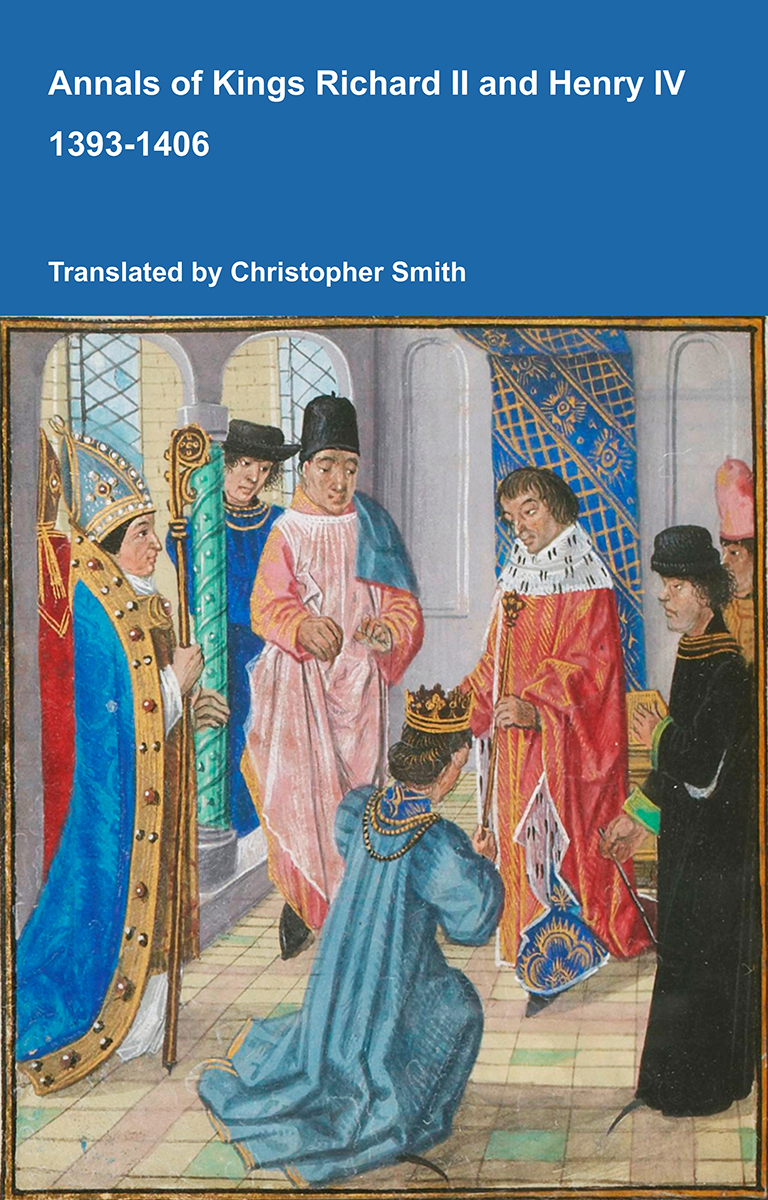 Annals of Kings Richard II and Henry IV. On the following day [7th October] there was a Convocation of the clergy of Canterbury at the church of St Paul, in the Chapel of the Blessed Virgin there. First, Mass of the Holy Spirit was celebrated by the Bishop of London at the high altar, while the Archbishop of Canterbury sat beside the said altar in the priests’ seats there, and the other prelates who were not exempt were in the choir. The Bishop of Rochester1 preached a sermon, in which he urged courtier-clerks to return to their benefices and henceforth reside in them. He also inveighed vehemently against those holding pluralities2, likening them to monsters in nature which have many superfluous limbs, and concluding that such men were compelled to have hearts divided among as many parts as they possessed benefices.
To this Convocation there came envoys on the King’s behalf, the Earls of Northumberland and Westmorland, and the King’s Chamberlain, Lord Thomas Erpingham [aged 44], giving thanks to the clergy on the King’s behalf for the devotions made to the Lord for him, and beseeching them in his name that they would continue similar prayers for him, by which he acknowledged himself to have been undoubtedly assisted. And as they proceeded, they said that the King did not wish to burden them this time with a tax, nor in future without evident necessity, which could be publicly clear to all. And therefore he begged that, if at any time such necessity should arise, they would be liberal and well disposed towards him, as they had always been towards his good predecessors. And he, with God’s grace, would show himself such a man to ecclesiastics that they would find cause both to honour him more warmly and to pray for him more devoutly.
In crastino fuit Convocatio cleri Cantuariæ apud ecclesiam Sancti Pauli, in Capella Beatæ Virginis dicti loci; ubi primo celebrato Missa de Sancto Spiritu ab Episcopo Londoniensi ad majus altare, residente Archiepiscopo Cantuariæ juxta dictum altare in sedibus sacerdotum ibidem, et aliis prælatis, non exemptis, existentibus in choro, Episcopus Roffensis Sermonem fecit; in quo monuit ut clerici curiales redirent ad sua beneficia, et in eisdem de cætero residerent. Contra vero pluralitates habentes vehementer invectus est, assimilans eos monstris in natura habentibus membra multa superflua, concludens quod tales compellebantur habere corda inter partes divisa quot possidebant beneficia.
Ad hanc Convocationem venerunt missi de parte Regis Comites Northumbriæ et Westmerlandiæ, Regisque Camerarius, Dominus Thomas Erpyngham, gratias agentes clero, ex parte Regis, pro devotionibus factis ad Dominum pro eodem, et vice deprecantes ejusdem, ut pro eo consimiles orationes continuarent; per quas fatebatur se indubitanter adjutum. Et in progressu dixerunt, quod Rex noluit eos ista vice gravare talliagio, nec in posterum, sine evidenti necessitate, quæ constare publice cunctis posset. Et idcirco deprecabatur, ut si quando talis necessitas emergeret, essent sibi liberales et benevoli, sicut semper suis bonis antecessoribus extiterunt; et ipse se talem ecclesiasticis exhiberet, cum Dei gratia, quod materiam invenirent et colendi eum propensius et orandi devotius pro eodem.
Note 1. William Bottlesham, died 1400. He was translation to Rochester from Llandaff in 1389.
Note 2. Pluralities means the holding of more than one church benefice at the same time.
On 13th October 1399 King Henry IV of England [aged 32] was crowned IV King of England at Westminster Abbey [Map]. Archbishop Thomas Fitzalan aka Arundel [aged 46] officiated. Bishop Robert Braybrooke carried the sacraments and said mass.
The future King Henry V of England [aged 13] carried the Sword Curtana. Thomas Beauchamp 12th Earl Warwick [aged 61] and/or John Beaufort 1st Marquess Somerset and Dorset [aged 26] carried a sword wrapped in red and bound with golden straps symbolising two-fold mercy. Henry Percy 1st Earl of Northumberland [aged 57] carried the Lancaster Sword.
Thomas Percy 1st Earl of Worcester [aged 56] carried the Steward's baton. Thomas Erpingham [aged 44] carried a Sword.
Edmund Stafford 5th Earl Stafford [aged 21] was appointed Knight of the Bath. John Lancaster 1st Duke Bedford [aged 10], John Arundell [aged 33] and Richard Beauchamp 13th Earl Warwick [aged 17] were knighted.
Archbishop Richard Scrope [aged 49] attended.


On 12th January 1400 Thomas Blount [aged 48] was hanged, drawn and quartered at Oxford, Oxfordshire [Map]. Thomas Erpingham [aged 45] was present to witness the execution. See Accounts and Extracts.
Accounts and Extracts. [12th January 1400] Sir Thomas Blount [aged 48], and one Bennet Selly, his companion, were drawn from Oxford (above three miles) to the place of execution, where they were hanged; but the ropes were soon cut, and these gentlemen were made to talk, and sit on a bench before a great fire, and the executioner came with a razor in his hand, and knelt down before Sir Thomas Blount, whose hands were tied, begging him to pardon him his death, as he must do his office, Then Sir Thomas asked him, "Are you the person appointed to deliver me from this world?" The executioner answered, " Yes," saying, "Sir, I pray you pardon me;" and Sir Thomas kissed him, and forgave him his death, The executioner knelt down, and Sir Thomas Blount (Le Blonc) made himself ready; and then the executioner opened his belly, and cut out his bowels strait from below the stomach, and tied them with a string, that the wind of the heart should not escape, and threw the bowels into the fire. Then Sir Thomas le Blonc was sitting before the fire, his belly open, and saw his bowels burning before him. Sir Thomas D'Arpeghen [aged 45], king Henry's chamberlain, insulting Blount, said to him with derision, "Go seek a master that can cure you," Blount only answered by putting his hands together, saying, Te Deum laudamus, and blessed be the hour that I was born, and blessed be this day, for I shall die in the service of my sovereign lord, the noble king Richard."
Arpeghen wished to compel him to reveal the accomplices of his treason. "The words traitor and treason," said he, "belong to thee and the infamous Rutland, by whom the flower of English chivalry is this day destroyed. I summon you both before the face of Jesus Christ, for your great treason against our sovereign lord the noble king Richard." The executioner then asked him, if he would drink? "No," said he, "you have taken from me the place into which I should put it. God be praised, my bowels are in the fire." He afterwards entreated the executioner to deliver him from this world, saying, "It hurts me much to see the traitors who are present." The executioner then knelt down before him, and kissed him in a very humble manner, and soon after his head was cut off, and he was quartered.
Chronicle of the Betrayal of Richard II. [13th January 1400] ... King Henry sent the Earl of Rutland [aged 27] and Sir Thomas Erpingham [aged 45] to seize the Lord Despencer [aged 26] who was [formerly] Earl of Gloucester,1 who took him and beheaded him; and the Earl of Rutland sent his head also to London.
Note 1. Thomas Despencer, son of Edward Lord Despencer, although he excused himself for the part he had taken on the plea of compulsion (Rot. Pari. iii. 451), was yet degraded from his title of Earl of Gloucester by Henry in his first Parliament. He escaped over the roofs of some houses at Cirencester, and fled to his castle of Cardiff. Hearing that King Henry had despatched a party to bring him to London, willing or unwilling, he disposed his affairs in the best manner he could, and, taking with him his jewels, entered a boat in the Severn; but, when they had reached the middle of the river, the captain refused to carry him anywhere but to Bristol. An altercation then commenced; twenty armed men, concealed in the hold, rushed upon deck; he defended himself manfully, and wounded some of the sailors, but was overpowered, and carried to the mayor of Bristol. Henry wished to have had an interview with him before he was put to death; but the second day after his capture the people cried out, 'Bring forth the traitors!' and, the mayor having failed to appease them, he was beheaded before the market-cross. His body was buried in the choir at Tewkesbury. (Monk of Evesham, Cotton. MS. Tiberius C. ix.) Henry gave to William Flaxman the cloak of motley velvet and furred damask which Lord Despencer wore when he was captured. (Rot. Pat. 1 Hen. IV. p. 5. m. 8.)
Annals of the six Kings of England by Nicholas Trivet
Translation of the Annals of the Six Kings of England by that traces the rise and rule of the Angevin aka Plantagenet dynasty from the mid-12th to early 14th century. Written by the Dominican scholar Nicholas Trivet, the work offers a vivid account of English history from the reign of King Stephen through to the death of King Edward I, blending political narrative with moral reflection. Covering the reigns of six monarchs—from Stephen to Edward I—the chronicle explores royal authority, rebellion, war, and the shifting balance between crown, church, and nobility. Trivet provides detailed insight into defining moments such as baronial conflicts, Anglo-French rivalry, and the consolidation of royal power under Edward I, whose reign he describes with particular immediacy. The Annals combines careful year-by-year reporting with thoughtful interpretation, presenting history not merely as a sequence of events but as a moral and political lesson. Ideal for readers interested in medieval history, kingship, and the origins of the English state, this chronicle remains a valuable and accessible window into the turbulent world of the Plantagenet kings.
Available at Amazon in eBook and Paperback format.
Around 1401 Thomas Erpingham [aged 46] was appointed 103rd Knight of the Garter by King Henry IV of England [aged 33].
Chronicle of Gregory. 16th August 1415.... and the 16th day of the same month he landed at Kytkawys, and the Saturday he laid siege unto the town of Harfleur, and that was the Saturday next after of the Assumption of our Lady; and the siege continued unto the Sunday next before the feste of Saint Michael [29th of September], on the which Sunday the town of Harfleur was delivered up to the king, that was 22nd day of September. But it is to wit that the Tuesday before, that is to say the 16th day of the same month, at 2 of the clock within night, the lords that were the captains and governors of the town, that is to wite the lord Gawcorte, the lord Tutville, and more other lords, send out heralds of arms unto the Duke of Clarence [aged 27], praying him at the reverence of God that he would of his high lordship that he would grant them live and leave for to treat with what persons that the king would assign unto them; and the king at the reverence of God and at their request he assigned the Duke of Exeter, the lord Fehewe, and Sir Thomas Erpingham, to hear what they would say and desire.
And they desired that the king would not war on them from that hour of midnight unto the Sunday next after the feast of Saint Michael, and but it were rescued by battle by that day by the French king or by the Dauphin, else at that day to deliver the town unto the King, and they to have her lives and her goods. Ande the king sent them word if that they would deliver the town on the morne after, by the hour of midnight above said, without any condition, he would accept it, and in none other wise he bade them for to treat.
And yet the French lords prayed our lords that they would vouchsafe to beseech the King at the reverence of God and of our Lady that he would grant them respite from the same Tuesday at night unto the Sunday next after till one hour afternoon; and in the meantime the lords that were captains of the town to come to the King with twenty-four knights and squires with them, of the most sufficient men with in the town, and they to be sworn on God's body openly before all the people. But if it so were that the French King or the Dauphin rescued them by that Sunday by the hour of noon, other else anon after noon, they for to deliver the town to the king and all her bodies and goods to don with them what so them every last, with any condition. With that the King suffered them to send unto France eight persons out of the town letting him wit in what plight that they stood in, and the king granted them; and upon the Wednesday by the moon the lords come out, and twenty-two knights and squires with them; and then come the procession solemnly and stately, with twenty-four copes of clothe of gold before God's body, with many worshipful lords, knights, and squires, and other multitude of people from the king's tent, solemnly and stately as ever was done such a thing before time. But the king was not here present. And the French lords made there their oaths upon the sacrament; and, the others done, the French lords were brought unto the king's tent, and there they dined in the king's hall, but in all this time they saw not the King. And when that they had eaten they departed and delivered to certain for to keep in hostage till the Sunday on noon, as it was accordingly made before time when that they took her oaths. And the Sunday at the same hour assigned the king had a tent put upon a hill before the town, and there he sat in his estate, royally, and alle his lords about him. And then come the French lords, with sixty-four with them of the most sufficient men that were withing the town, to the king's own proper person, and delivered up the keys of the town and her bodies and her goods to the King's grace, with out any condition. And this was the 22nd day of Septembre, the year of our lord 1415
... and the xvj day of the same monythe he londyd at Kytkawys, and the Satyrday he leyde sege unto the towne of Arflewe, and that was the Satyrday nexte aftyr of the Assompsyon of our Lady; and the sege contynuyd unto the Sonday nexte be fore the feste of Synt Mychelle, on the whiche Sonday the towne of Arflewe was delyveryd uppe to the kyng, that was XXij day of Septembre. But hit is to wyte that the Tewysday before, that is to saye the xvj day of the same monythe, at xij of the clocke whytheynne nyght, the lordys that were the capytaynys and governowrys of the towne, that is to wete the lord Gawcorte14, the lord Tutvyle, and moo othyr lordys, sende out herodys of armys unto the Duke of Clarens, prayng him at the reverens of God that he wolde of his hyghe lordeschippe that he wolde graunte them lyve and leve for to trete whythe what personys that the kyng wolde a-sygne unto hem; and the kyng at the reverens of God and at hyre requeste he assygnyde the Duke of Exceter [Note. Unclear as to who this is? Possibly Thomas Beaufort 1st Duke Exeter [aged 38] who was created Duke the following year?], the lord Fehewe, and Syr Thomas Erpyngham [aged 60], to hyre whatt they wolde say and desyre. And they desyryd that the kyng wolde nought warre on them fro that our of mydnyght unto the Sonday nexte aftyr the feste of Synt Mychell, and but it were rescwyd by batayle by that day by the Frenysche kyng or by the Dolfynne, ellys at that daye to delyver the towne unto the King, and they to have her lyvys and her goodys. Ande the kyng sende them worde yf that they wolde delivery the towne on the morne aftyr, be the our of mydnyght a bove said, without any condyscyon, he wolde accepte it, and in non othyr wyse he bade them for to trete. Ande yette the Fraynysche lordys prayde our lordys that they wolde fochesave to be-seche the King at the reverens of God and of our Lady that he wolde graunte them respyte fro the same Twysday at nyght unto the Sonday nexte aftyr tylle one owre aftyr none; and in the mayne tyme the lordys that were captaynys of the towne to come to the King whithe XXiiij knyghtys and squyers with hem, of the moste suffycyent men whithe in the towne, and they to be sworne on Goddys body opynly before alle the pepylle. But yf15 hit soo were that the Fraynysche King or the Dolfynne rescwyde them by that Sonday by the owre of none, othyr ellys a-non aftyr none, they for to delyvery the towne to the kyng and alle her bodys and goodys to don whythe them what so them evyr lyste, whythe16 any condiscyon. Whythe that the King sufferde them to sende unto Frauns viij personys out of the towne lettyng him wytte in what plytte that they stode yn, and the kyng grauntyd hem; and uppe the Wanysday by [th]e mone the lordys come owte, and XXij knyghtys and squyers whythe hem; and thenne come the prosessyon solempny and stately, whithe XXiiij copys of clothe of golde by-fore Goddys body, whythe many worschipfulle lordys, knyhtis, and squyers, and othyr multytude of pepylle from [th]e kyngys tente, solempny and stately as evyr was done suche a thyng be-for tyme. But the kyng was nott here present. And the Franysche lordys made thare her othys a-pon the sacrament; and, the othys done, the Fraynysche lordys were brought unto the kyngys tente, and there they dynyd in the kyngys halle, but in alle this tyme they sawe nought the King. And whanne that they hadde etyn they departyd and delyveryd to sartayne for to kepe yn ostage tylle the Sonday on none, as it was a cordyment i-made before tyme whenne that they toke her othys. And the Sonday at the same owre a-signyd the kyng hadde a tente phyght a-pone a hylle be-fore the towne, and there he sate in his estate, ryally, and alle his lordys aboute hym. And thenne come the Fraynysche lordys, with lxiiij whythe them of the moste suffycyentt men that were whythe yn the towne, to the kyngys owne propyr person, and delyveryd uppe the keyes of the towne and her boodys and her goodys to the Kings grace, whithe out any condyscyon. And this was the XXij day of Septembre, the year of our lord Ml cccc xv.
Note 14. Sawcortein our MS. by a misreading; Gawcourte in Vit.
Note 15. But if, i. e. unless.
Note 16. whythe. withoute, Vit.
25th October 1415. At the Battle of Agincourt the English included: Louis Robbessart [aged 25], Richard Beauchamp 13th Earl Warwick [aged 33], William Botreaux 3rd Baron Botreaux [aged 26], William Bourchier 1st Count of Eu [aged 41], Thomas Rokeby [aged 35], John Cornwall 1st Baron Fanhope 1st Baron Milbroke [aged 51], Edward Courtenay [aged 30], Ralph Cromwell 3rd Baron Cromwell [aged 12], Thomas Dutton [aged 19], Edmund Ferrers 6th Baron Ferrers of Chartley [aged 29], Roger Fiennes [aged 31], Henry Fitzhugh 3rd Baron Fitzhugh [aged 57], John Grey [aged 28], John Grey 1st Earl Tankerville [aged 31], William Harrington [aged 42] as the King's Standard Bearer, Walter Hungerford 1st Baron Hungerford [aged 37], Piers Legh [aged 26] (wounded), Alfred Longford, Thomas Montagu 1st Count Perche 4th Earl Salisbury [aged 27], Thomas Morley 6th Baron Marshal 5th Baron Morley [aged 22], John Rodney, Richard Scrope 3rd Baron Scrope of Bolton [aged 22], Robert Strelley [aged 18], James Tuchet 5th Baron Audley, 2nd Baron Tuchet [aged 17], Robert Umfraville [aged 52], Thomas West 2nd Baron West [aged 35], Robert Willoughby 6th Baron Willoughby [aged 30]. Thomas Erpingham [aged 60] commanded the archers. Thomas Rempston [aged 26] was present. Thomas Strickland [aged 48] carried the Banner of St George.
Thomas Tunstall [aged 57] was killed.
The Welsh included: William ap Thomas "Blue Knight of Gwent" Herbert [aged 35], Walter Sais [aged 95], Roger Vaughan [aged 70] and his son Roger Vaughan [aged 5]. Owen Tudor [aged 15] is believed to have been present as a squire.
Walsingham Chronica Majora. [14th December 1417] When this answer had been received, since there was no need for witnesses, he was without delay ordered to be dragged and hanged upon the gallows, and to be burned while hanging from them. And when several honourable persons were present at this spectacle, he spoke his last words, as they say, to Sir Thomas Erpingham [aged 62], adjuring him that if he should see him rise again on the third day, he should procure peace for his followers. So lost was he in madness that he believed he would rise from the dead after three days.
Quo responso accepto, quia non opus erat testibus, sine mora jussus est trahi et suspendi super furcas, atque comburi, pendens in eisdem. Ubi cum plures personae honorabiles huic spectaculo interessent, Domino Thomae Erpingham, prout dicunt, novissima verba locutus est, adjurans eum, ut si cerneret eum resurgere die tertia, pacem procuraret sectm suae. Tanta perditus fuit dementia, ut putaret se post triduum a mortuis resurrecturum.
On 27th June 1428 Thomas Erpingham [aged 73] died without issue.
Annals of Kings Richard II and Henry IV. The French, among whom he had been staying, also urged him to reclaim his rights, from which, contrary to justice, he had been excluded, promising him, if need arose, military assistance in this matter. He, however, returned countless thanks to the French for their goodwill, but was unwilling to bring with him an armed force from those parts, declaring that he had such confidence in the loyalty and favour of his own countrymen that, for the present, he did not need the help of the French. He asked, however, that if matters turned out otherwise than he hoped, namely if he were deprived of the support of his own people, they should be ready to assist him in the aforesaid enterprise. Then, having received permission to return to his country, he came to Boulogne-sur-Mer with Thomas, the former Archbishop of Canterbury, and with the son and heir of the Earl of Arundel. With him also came Lord Thomas Erpingham1, a famous and excellent knight, and John Norbury2, a most valiant esquire, full of prudence and, as was said, to be preferred before rich men for the abundance of his wealth. Committing himself to the counsels of these men, neither in his banishment nor in his return could fortune harm him, but all things, both abroad and at home, with God’s help, turned out prosperously for him. There also came with him certain English merchants, whom he found in those parts ready to return to their own country, and these, together with the rest of his household, as it is said, made up no more than fifteen lances. Yet he is said to have had with him ten or twelve ships. With such a small company, it is remarkable that he dared to attempt the kingdom of England, and still more remarkable that, in so short a time, as will be said below, he brought the whole kingdom into peace under himself.
Instigabant etiam eum Gallici, inter quos moram traxerat, ut reposceret jura sua, a quibus, contra justitiam, exclusus fuerat; promittentes ei, si opus esset, adjutorium in hoc negotium militare. Ille vero Gallicis pro benevolentia grates rependit innumeras; non tamen voluit secum trahere de illis partibus manum militarem, asserens se tantum confidere in fide et favore suorum [patriotarum], quod non indigeret ad præsens auxilium Gallicorum. Rogabat tamen, si secus accideret quam sperabat, ut, videlicet, destitueretur suorum suffragiis, parati forent ad suffragandum ei in negotio prætaxato. Ille vero, accepta repatriandi licentia, venit Boloniam supra Mare, cum Archiepiscopo quondam Cantuariensi, Thoma, et filio Comitis Arundeliæ, et hærede. Cum eo venerunt insuper Dominus [Thomas de] Erpyngham, miles famosus et optimus, Johannes Northburi, seutifer valentissimus, plenus prudentia, et, ut dicebatur, divitiarum [opulentia] divitibus præferendus. Horum consiliis se committens, nec in relegatione nec in reversione potuit sibi fortuna nocere, sed cuncta prospera foris et extra sibi, cum Dei adjutorio, contigere. Venerunt quoque eum eo quidam mercatores Anglici, quos reperit in illis partibus ad repatriandum paratos; qui, cum reliqua sua familia, prout dicitur, non fecerunt amplius quam quindecim lancens. Habuisse tamen [secum, ut] dicitur, naves decem vel duodecim. Cum hac tam parva manu, mirum est quod regnum Angliæ ausus sit aggredi; et plus mirandum, quod tam parvo tempore, prout dicetur inferius, totum regnum reddiderit pacatum sibi.
Note 1. Thomas Erpingham, 1355-1428. Subsequently Lord Chamberlain and Garter Knight.
Note 2. John Norbury, died 1414. Subsequently Lord Treasurer, Keeper of the Privy Wardrobe and Ambassador to France.