

In 1320 or 1324 Bishop William of Wykeham was born William Longe.
On 8th May 1360 King Edward III of England [aged 47] and King John "The Good" II of France [aged 41], and their eldest sons Edward "Black Prince" [aged 29] and the future King Charles V of France [aged 21], ratified the Treaty of Brétigny at Calais [Map]. Louis Valois Anjou I Duke Anjou [aged 20] and John Valois 1st Duke Berry [aged 19] were given as hostages.
Philip "Bold" Valois II Duke Burgundy [aged 18] was ransomed. The treaty confirmed lands held by King Edward III of England including Aquitaine.
King John "The Good" II of France was ransomed for three million écus being released after the payment of the first third.
Bishop William of Wykeham [aged 40] was present.
The Treaty was signed on 24th October 1360 at Calais.
In January 1361 Edward III [aged 48] and John II of France [aged 41] jointly petitioned Pope Innocent VI, to make Bishop William of Wykeham [aged 41] a canon at Lincoln Cathedral [Map].
In June 1363 Bishop William of Wykeham [aged 43] was appointed Lord Privy Seal.
In October 1366 Bishop William of Wykeham [aged 46] was elected Bishop of Winchester.
In 1367 Bishop William of Wykeham [aged 47] was appointed Lord Chancellor which post he resigned in 1371.
On 10th October 1367 Bishop William of Wykeham [aged 47] was consecrated Bishop of Winchester at St Paul's Cathedral [Map].
In July 1368 Bishop William of Wykeham [aged 48] was enthroned Bishop of Winchester at Winchester Cathedral [Map].
In 1379 Bishop William of Wykeham [aged 59] founded New College, Oxford University.
In 1382 Bishop William of Wykeham [aged 62] founded Winchester College, Winchester.
Patent Rolls. 12th February 1385. Commission to W. Bishop of Winchester [aged 65], Thomas, Bishop of Exeter, Richard, Earl of Arundel [aged 39], Robert, Earl of Oxford [aged 23], Thomas, Earl of Nottingham [aged 16], Hugh de Segrave [aged 89], treasurer of England, Simon de Burley [aged 45], under-chamberlain, Nicholas Brembre, mayor of London, John Clanvowe [aged 44] and Robert Plesyngton, knights, Master Walter Skirlawe, keeper of the privy seal, John Waltham, keeper of the rolls of Chancery, John Appelby, dean of St. Paul's, London, Richard Rounhale and Thomas Bacton, clerks,
Chronicle of Adam of Usk [~1352-1430]. September 1386. Owing to the many ill-starred crises of king Richard's [aged 19] reign, which were caused by his youth, a solemn parliament was holden at Westminster, wherein twelve of the chief men of the land were advanced, by full provision of parliament, to the government of the king and the kingdom, in order to bridle the wantonness and extravagance of his servants and flatterers, and, in short, to reform the business of the realm; but alas! only to lead to the weary deeds which are hereinafter written1.
Note 1. The actual number of the commissioners appointed by the Wonderful Parliament of 1386 was eleven, or fourteen if the three principal officers of state be included. The eleven were: the archbishops of Canterbury [aged 44] and York [aged 45], the dukes of York [aged 45] and Gloucester [aged 31], the bishops of Winchester [aged 66] and Exeter, the abbot of Waltham, the earl of Arundel, John de Cobham, Richard le Scrope, and John Devereux. Thomas Arundel [aged 33], bishop of Ely, had replaced Michael de la Pole [aged 25], earl of Suffolk, as chancellor; John Gilbert, bishop of Hereford, was treasurer; and John de Waltham, keeper of the privy seal. It will be remembered that John of Gaunt [aged 46] was at this time in Spain, as a reason for his name not appearing on the commission.

The True Chronicles of Jean le Bel Volume 1 Chapters 1-60 1307-1342
The True Chronicles of Jean le Bel offer one of the most vivid and immediate accounts of 14th-century Europe, written by a knight who lived through the events he describes, and experienced some of them first hand. Covering the early decades of the Hundred Years’ War, this remarkable chronicle follows the campaigns of Edward III of England, the politics of France and the Low Countries, and the shifting alliances that shaped medieval warfare. Unlike later historians, Jean le Bel writes with a strong sense of eyewitness authenticity, drawing on personal experience and the testimony of fellow soldiers. His narrative captures not only battles and sieges, but also the realities of military life, diplomacy, and the ideals of chivalry that governed noble society. A key source for Jean Froissart, Le Bel’s chronicle stands on its own as a compelling and insightful work, at once historical record and literary achievement. This translation builds on the 1905 edition published in French by Jules Viard, adding extensive translations from other sources Rymer's Fœdera, the Chronicles of Adam Murimuth, William Nangis, Walter of Guisborough, a Bourgeois of Valenciennes, Geoffrey le Baker of Swinbroke and Richard Lescot to enrich the original text and Viard's notes.
Available at Amazon in eBook and Paperback format.
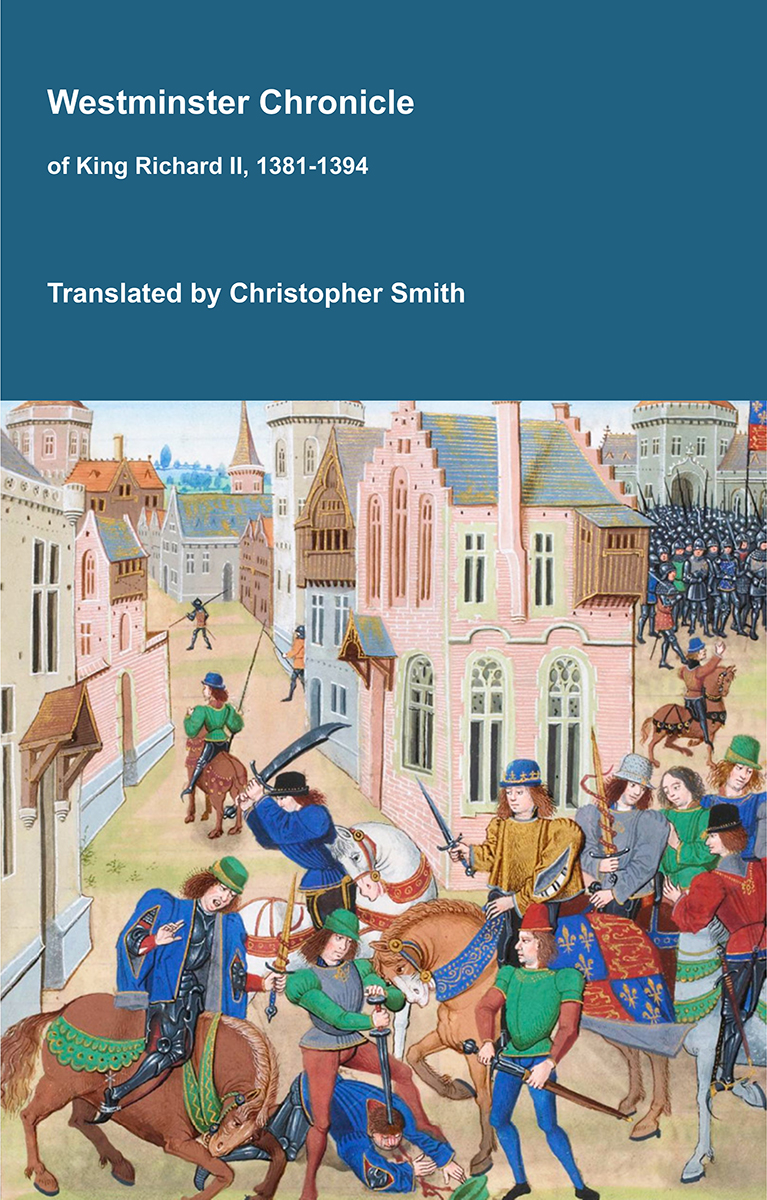 Westminster Chronicle. Also, for the continual governance of the king, they appointed the bishop of Winchester [aged 68]1, the bishop of Bath2, Sir John Cobham, Lord Richard Scrope [aged 61], and Lord John Devereux [aged 51], whom they also made steward of the lord king’s household and constable of Dover Castle. Also, on the second day of January, the said lords removed from the court all the king’s household men, especially those closest to the lord king, and in their place substituted others at their own pleasure. This deed indeed filled the king’s heart with sorrow, although it could not then be done otherwise, and therefore he bore these and other things with the utmost patience.
Item pro gubernatione regis continua ordinarunt episcopum Wyntoniensem, episcopum Bathoniensem, dominum Johannem Coboham, dominum Ricardum Serop, et dominum Johannem Deverose, quem statuerunt etiam senescallum hospitii domini regis et constabularium castri de Dovoria. Item secundo die Januarii omnes familiares præcipue domino regi proximiores dicti domini a curia removerunt et loco eorum alios ad libitum subrogarunt. Hoc quidem factum cor regis mœrore implevit quamvis aliter protunc fieri non potuit idcirco hæc et alia patientissime toleravit.
Note 1. William Wykeham, 1320-1404. In 1367 he was appointed Lord Chancellor and consecrated Bishop of Winchester.
Note 2. Walter Skirlaw, died 1406. In 1382 he was appointed Lord Privy Seal, in 1385 Bishop of Lichfield. August 1386 Bishop of Bath and Wells. April 1388 Bishop of Durham.
Westminster Chronicle. Therefore, on the eighteenth day of January, at the Guildhall of London, there assembled the Archbishop of Canterbury [aged 46], the Bishops of Winchester [aged 68], Bath, Ely [aged 35]1, Hereford and Exeter, and the aforesaid lords, together with the clerk of the lord king’s privy seal and other noble, prudent and discreet men. First of all, since the Londoners were bound by unlawful oaths, the said archbishop absolved them from such oaths. Then the Bishop of Ely2, Treasurer of England, said to them that no one should speak any ill of the aforesaid lords on account of the bad governance of the king and kingdom which had now been set in motion. Since they, and we all too for the greater part, have been wickedly and most falsely indicted, and since there are among you certain men who have also been indicted, whether justly or unjustly we do not know at all. It will, however, appear in the end when it has been declared by parliament. But now, if there are any grievances or complaints amongst you, bring them forward before us. Now is the time for hearing them, for it is clear to all of us that you are by no means of one mind on either side, since it appears that one craft of this city wishes to destroy another, which is absurd, especially to endure such discord among citizens of this kind. Indeed, if you are willing to foster peace and concord amongst yourselves, you may hope that no adversity will gain mastery over you. Yet little was brought forward in response to these things, because it seemed to them that the lords did not stand equally with all men, as was proper. Therefore perhaps they were unwilling to accept them as judges, nor to allege anything before them.
Igitur xviii die Januarii apud Gyldam Aulam Londoniensem occurrerunt archiepiscopus Cantuariensis, Wyntoniensis, Bathoniensis, Eliensis, Herefordiensis, Exoniensis episcopi et prædicti domini cum clerico de privato sigillo domini regis et aliis nobilibus providis et discretis. Primo quidem ante omnia quia Londonienses erant illicitis juramentis astricti dictus archiepiscopus ab hujusmodi eosdem absolvit. Tunc dixit eis episcopus Elyensis, thesaurarius Angliæ, quod nullus obloqueretur aliquod sinistrum de prædictis dominis propter malam gubernationem regis et regni jam motis. Cum ipsi etiam et nos omnes pro majore parte simus nequiter et falsissime indictati ac inter vos sunt quidam etiam indictati si vero juste sive injuste penitus ignoramus. Apparebit quoque in fine cum per parliamentum fuerit declaratum. Nunc autem si quæ gravamina sive querimoniæ inter vos versantur producite in medium coram nobis ; jam est tempus audiendi, nam constat omnibus nobis vos nullatenus esse unanimes utrobique quia ut apparet una ars istius civitatis aliam delere affectat, quod est absurdum, præsertim inter cives tales inter illos discordias sustinere. Immo si pacem et concordiam inter vos fovere volueritis nullam adversitatem vobis dominari sperare poteritis. Pauca vero ad ista erant prolata quia videbatur cis non æqualiter cos stare cum omnibus prout decet. Ideo forte noluerint eos tanquam judices acceptare nec coram illis aliquid allegare.
Note 1. Archbishop Thomas Fitzalan aka Arundel, a younger brother of Richard, Earl of Arundel and Surrey.
Note 2. The Latin text has the 'Bishop of Ely' but the Lord Treasurer at the time was John Gilbert, Bishop of Hereford.
Westminster Chronicle. At the beginning of the month of May [1389], the king held his council at Westminster. In it he put forward and declared on his own behalf, affirming that he was of full and perfect age, in the manner of an heir claiming his inheritance when he has reached his 21st year. Therefore he asked all the lords whether he could rightly take upon himself alone the government of the realm, or not. They all answered and said that he could well do so, and that he ought to assume such a burden upon himself. Then he said to them: "You know very well how, for these twelve years since I was made king, I have been governed by others, and so too has the whole realm. And I have well observed that my people have always, from year to year, been troubled by various impositions, and yet we have not seen our realm strengthened in any way on account of this. Therefore, since we have taken up the burden, we judge it fitting also to take up the rule, since we are of such mature age that, all negligence being removed, with the Lord’s help, we intend henceforth to labour continually for the safety and profit of our people and realm, so that our subjects may be able to live more quietly hereafter, and our realm may prosper more abundantly and be reformed for the better in future." And so, consequently, he removed the Chancellor and Treasurer from their offices. He also removed all other officers, both greater and lesser, including those overseas, some for a time and some permanently, from their offices with due discretion, especially those who had recently been appointed to various offices by the said lords who had been governing the realm and the king. Also, he expelled from his household about four hundred persons, especially those who had been brought into his court by the aforesaid lords, or who were joined to them by some bond of friendship. He appointed the Bishop of Winchester [aged 69]1 as his Chancellor, the Bishop of Exeter2 as his Treasurer, and Master Edmund Stafford [aged 45]3 as Keeper of his Privy Seal.
In principio mensis Maii rex tenuit suum consilium apud Westmonasterium. In quo proposuit et declaravit pro se ipso affirmans ipse fore plenæ et perfectæ ætatis ad modum heredis petentis hereditatem cum ipse pervenit ad vicesimum primum annum. Unde quæsivit a dominis universis an posset super se rite suscipere solum regni gubernaculum aut non. Qui respondentes dixerunt omnes quod bene potuit et debere super se tale onus assumere, Quibus ipse ait, "Optime scitis quomodo per istos duodecim annos ex quo factus sum rex fui per alios gubernatus ac etiam totum regnum ; et bene perpendi populum meum semper de anno in annum diversis impositionibus fore vexatum et in nullo propter hoc regnum nostrum vidimus roboratum, Igitur ex quo suscepimus onus dignum arbitramur etiam accipere et regimen cum simus tam profectæ ætatis quatinus negligentia quacunque remota, Domino auxiliante, circa salutem et commodum populi nostri et regni intendimus de cætero assidue laborare ut subditi nostri deinceps quietius vivere valeant et regnum nostrum uberius prosperetur ac in posterum in melius reformetur." Sicque consequenter cancellarium et thesaurarium de officiis eorum amovit, necnon et omnes alios officiarios tam majores quam minores etiam illos de ultra mare, quosdam ad tempus et quosdam pro perpetuo, ab eorum officiis prævia discretione removit et præsertim illos qui nuper per dictos dominos regnum et regem regentes fuerant in quibusvis officiis constituti. Item ejecit de familia sua circiter quadringentos et præcipue illos qui per prædictos dominos in suam curiam fuerant introducti aut eis aliquo amicitiæ fœdere copulati, Cancellarium suum constituit episcopum Wyntonensem, et suum thesaurarium episcopum Oxoniensem ac portitorem sui privati sigilll magistrum Edmundum de Stafford.
Note 1. William of Wykeham was consecrated Bishop of Winchester on 10th October 1367 in which year he was also appointed Chancellor resigning in 1371. In May 1389 he was re-appointed Chancellor which office he held until 1391.
Note 2. Thomas de Brantingham was consecrated Bishop of Exeter on 12th May 1371. He was Treasurer to King Edward III 1369-1371, and King Richard II, 1377-1381 and in 1389.
Note 3. Edmund Stafford, appointed Keeper of the Privy Seal 4th May 1389 which office he held until 1396. Consecrated Bishop of Exeter on 20th June 1395 following the death of Thomas de Brantingham.
Parliament Rolls Richard II. 32. The king [aged 30] to his archbishops, bishops, abbots, priors, dukes, earls, barons, justices, sheriffs, reeves, ministers, and other his bailiffs and faithful men, greeting. Know that we, considering the strenuous probity and prudent mind, distinguished conduct and nobility of birth of our beloved and faithful kinsman John Beaufort [aged 24], knight, son of our beloved uncle John duke of Aquitaine and Lancaster [aged 56], and willing therefore deservedly to exalt the same John Beaufort with the prerogative of honour, we do appoint and create John Beaufort earl of Somerset in our present parliament, and invest him with the style and name and honour of the aforesaid earl by girding him with the sword, to have to him and his male heirs issuing from his body in perpetuity. And that the same earl and his aforesaid heirs, given such name and honour, may the better and more honourably support the burdens incumbent upon the same, of our special grace in our present parliament we have given and granted, and by this our charter confirmed, to the same earl and his aforesaid heirs twenty pounds to be received each year from the issues of the aforesaid county by the hand of the sheriff of that county for the time being, at the terms of Easter and Michaelmas [29 September] in equal portions, in perpetuity. Witnessed by these, the venerable father Thomas archbishop of Canterbury [aged 44] primate of all England, John of Aquitaine and Lancaster, and Edmund of York [aged 55], dukes; Robert of London, William of Winchester [aged 77], John of Ely, Edmund of Exeter, our chancellor [aged 53], bishops; Henry of Derby [aged 29], Edward of Rutland [aged 24], Thomas of Nottingham and marshal of England [aged 28], earls; Reginald Grey [aged 35], Ralph Neville [aged 33], John Lovell, knights; Roger Walden dean of York, our treasurer, Thomas Percy [aged 54], steward of our household, Guy Mone, keeper of our privy seal, and others. Given by our hand at Westminster on 10 February in the twentieth year of our reign [10th February 1397].


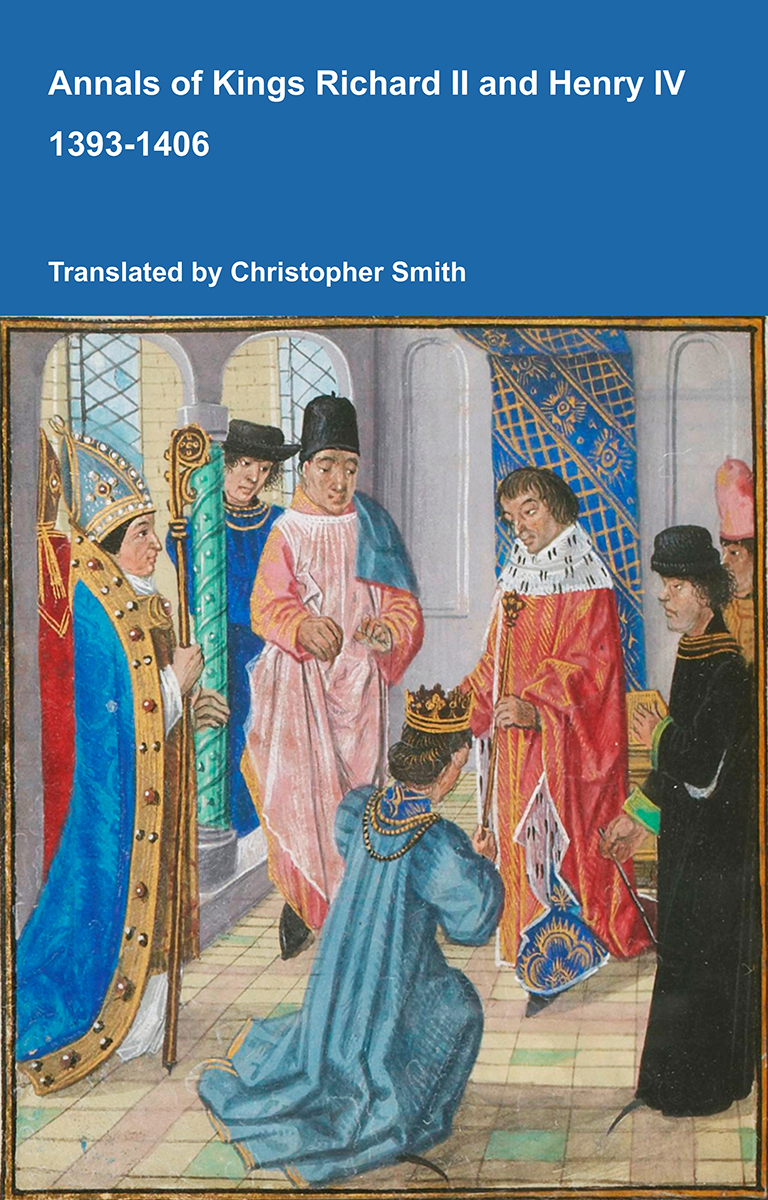 Annals of Kings Richard II and Henry IV. In this year, on 26th September, the distinguished Lord William of Wykeham [aged 84], Bishop of Winchester, died. Whatever he lacked in learning, he made up for through his commendable generosity, founding a college of scholars at Winchester1 and establishing another at Oxford for the higher branches of learning, at such expense that his wealth might have rivalled that of a king. He was succeeded by Henry Beaufort [aged 29], son of John, Duke of Lancaster, by Katherine Swynford. At the King’s request, he was translated by the Pope from Lincoln to Winchester and was enthroned there. Philip of Repton was Abbot of the Augustinian canons at Leicester.
Hoc anno, sexto Kalendas Octobris, obiit vir insignis, Dominus Willelmus de Wikam, Episcopus Wyntoniensis, qui, quod minus habuit litteraturæ, laudabili compensavit [liberalitate], dum Collegium clericorum fundavit Wyntoniæ, et aliud, sublimiorum facultatum, construxit Oxoniæ, impensis talibusque divitias regias æquipararet. Cui successit Henricus Beuford, filius Ducis Lancastriæ, Johannis, ex Katerina Swynford: translatus per Papam Wyntoniam de Lincolnia, prece Regis, intronizatus est. Abbas Canonicorum Leycestriæ, Philippus de Ripendena.
Note 1. Winchester College, a fee paying school, has operated continuously since 1382 to the present day. It was founded by Wykeham to supply students to New College, Oxford, which Wykeham had founded in 1379.
On 27th September 1404 Bishop William of Wykeham [aged 84] died at Bishop's Waltham [Map]. He was buried in a chantry chapel on the south side of Winchester Cathedral [Map].
Parliament Rolls Richard II. 33. Also, on the same Saturday [10 February 1397], a charter of the king made to the earl marshal touching his office of marshal of England, and the gold staff adorned with the emblem of the king's arms which he will carry in his office, was read and delivered to the said earl. The tenor of which charter follows:
The king to the same, greeting. Know that whereas recently by our letters patent of our special grace we granted to our beloved kinsman Thomas, Earl of Nottingham, the office of marshal of England, together with the name and honour of earl marshal, to have to him and his male heirs issuing from his body, with all the fees, profits, and appurtenances whatsoever pertaining in any way to the said office, in perpetuity; as is fully contained in the same letters. We, mindful of the gracious and laudable services often performed by the aforementioned earl, on either side of the sea, for the benefit and honour of us and our kingdom, at no small effort, cost, and charge to him; and wishing therefore to provide for the estate and honour of that earl, of our special grace have granted in our present parliament for us and our heirs to the same earl the said office, and the name, title, and honour of earl marshal of England, to have to him and his male heirs issuing from his body, together with all offices, commodities, profits and other appurtenances whatsoever, both in our courts and elsewhere, relating or pertaining in any way to the same office, in the same manner and as fully, freely, wholly, and peacefully as Thomas Brotherton, lately Earl of Norfolk and marshal of England, father of our beloved kinswoman Margaret Countess of Norfolk, [widow] of the aforesaid late earl, or Roger Bigod sometime Earl of Norfolk and marshal of England, or any other after the death of the same former earl, or the same present earl, had or held the said office of marshal of England in their time.
Willing further and granting for us and our heirs, that the office of marshal of our Bench before us, which John Wicks holds for the term of his life by our grant, and the office of marshal in our treasury which Richard Gascoigne holds for his life by grant of our beloved brother Thomas Earl of Kent, lately marshal of England, by our confirmation; and also the office of herald of the marshal before the steward and marshal of our household, which Guy Allesley holds for his life by grant of the lord Edward [III], late king of England, our grandfather, and by our confirmation; which offices after the death of the aforesaid John, Richard and Guy should revert to us and our heirs, after the death of the same John, Richard, and Guy shall remain to the aforementioned earl marshal, to have to him and his male heirs in perpetuity. And that the same offices, and all other offices in any of our courts and elsewhere, which pertained, and used to pertain to the said office of marshal of England in times past, shall be fully restored, annexed, and reunited to the said office of marshal of England in perpetuity. And that the same earl and his male heirs may give, grant, or confer those offices on any suitable persons freely and without hindrance as soon as they shall have fallen vacant by death, demise, resignation, surrender, or in any other way, notwithstanding any of our letters patent made to the contrary.
Considering also the vigour and nobility of that earl, and that he may in future the more fittingly and honourably perform and exercise the aforesaid office, we have granted for us and our heirs to the same present earl that he and his said male heirs, marshals of England, by virtue of their aforesaid office should have, carry, and bear, as well in the presence as in the absence of us and our heirs, a certain gold staff, with both ends enamelled in black, and with the emblem of our arms decorating the top of the said staff, and with the emblem of the arms of that earl decorating the bottom of the said staff; notwithstanding that the same present earl in his time, or the aforementioned former earls, or any other who had the said office of marshal of England before this time, used to carry or bear a wooden staff. Witnessed by these, the venerable fathers Thomas archbishop of Canterbury, primate of all England, Robert of London, William of Winchester, John of Ely, Edmund of Exeter, our chancellor, bishops; John of Aquitaine and Lancaster, Edmund of York, dukes, our beloved uncles; Henry of Derby, Edward of Rutland, Henry of Northumberland, earls; Reginald Grey of Ruthin, Ralph Neville, John Lovell, knights; Roger Walden, dean of York, our treasurer, Thomas Percy, steward of our household, and others. Given by our hand at Westminster on 10 February 1397.
Parliament Rolls Richard II. 5. The following are assigned to be triers of petitions from England, Ireland, Wales, and Scotland:
The duke of Guyenne and duke of Lancaster.
The Bishop of Winchester.
William Thirning.
William Rickhill.
John Wadham.
to act all together, or at least six of the aforesaid prelates and lords; consulting with the chancellor, treasurer, steward, and chamberlain, and also the king's serjeants when necessary. And they shall hold their session in the chamberlain's room near the Painted Chamber [Map].