

1360-1369 Black Monday Hailstorm is in 14th Century Events.
In 1360 King Edward III of England [aged 47] created new Garter Knights:
31st Thomas Ughtred 1st Baron Ughtred [aged 68].
32nd Walter Manny 1st Baron Manny [aged 50].
33rd Frank Hale.
34th Thomas Ufford [aged 27].
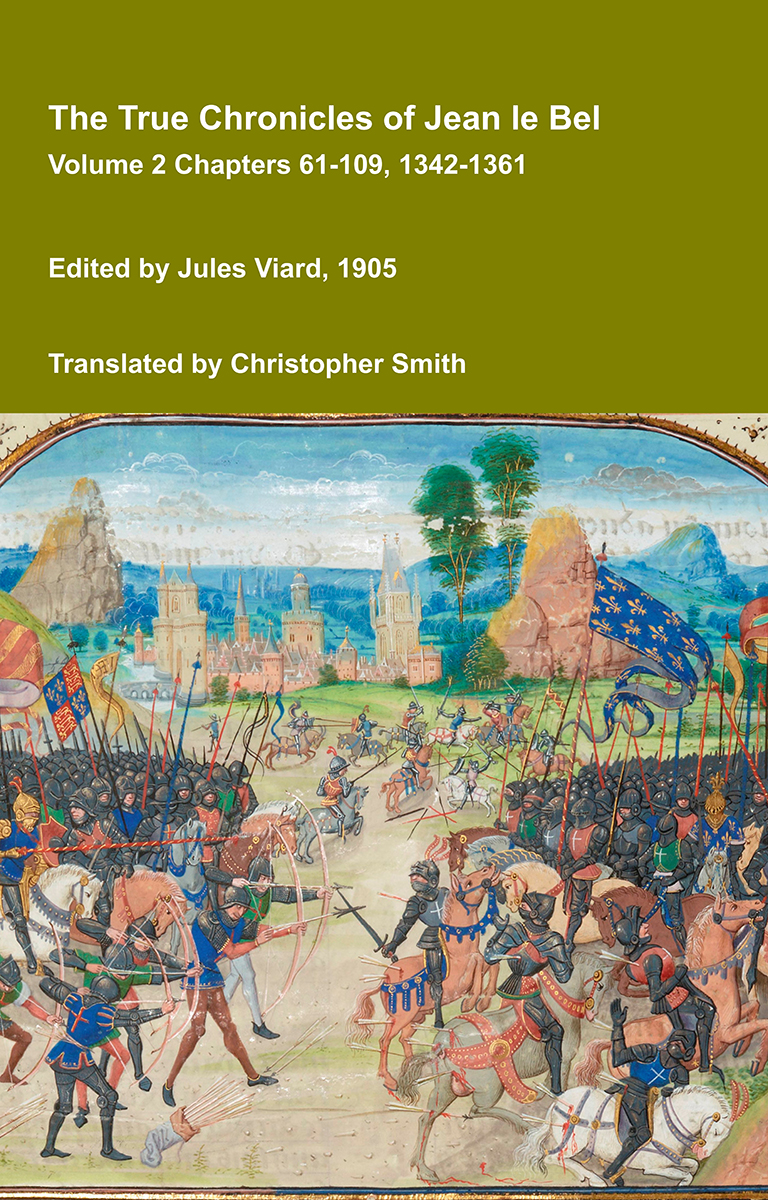 Chronicle of Jean le Bel Volume 2. When he had laid waste the whole country, the Duke of Burgundy was very glad to give him two hundred thousand florins au mouton, so that he would leave and have a truce with him for the space of three years1.
Quant il eust tout gasté le pays, le duc de Bourgongne fut bien joyeux de luy donner II foys CM flourins au mouton, affin qu'il s'en partist et eust treves à luy par l'espace de III ans.
Note 1. Jean le Bel is alluding to the Treaty of Guillon, Yonne, 10th March 1360. The text of this treaty is published in Rymer 3.473–474, and in Dom Plancher, Histoire de Bourgogne.
1. C'est au traité de Guillon (Yonne, arr. d'Avallon, ch.-l. de cant.), conclu le 10 mars 1360 (n. st.), que Jean le Bel ait allusion. Le tete de ce traité est publié dans Rymer op. cit., 1. I, p. 473 et 474, et dans dom Plancher, Histoire de Bourzogne, 1. Il, Preuves, p. ceum, n° 295.
On 8th May 1360 King Edward III of England [aged 47] and King John "The Good" II of France [aged 41], and their eldest sons Edward "Black Prince" [aged 29] and the future King Charles V of France [aged 21], ratified the Treaty of Brétigny at Calais [Map]. Louis Valois Anjou I Duke Anjou [aged 20] and John Valois 1st Duke Berry [aged 19] were given as hostages.
Philip "Bold" Valois II Duke Burgundy [aged 18] was ransomed. The treaty confirmed lands held by King Edward III of England including Aquitaine.
King John "The Good" II of France was ransomed for three million écus being released after the payment of the first third.
Bishop William of Wykeham [aged 40] was present.
The Treaty was signed on 24th October 1360 at Calais.
Chronicle of Jean le Bel Volume 2. Thus, riding in this way, they came before Paris to seek battle, as you have heard above, and then drew towards the city of Chartres, always seeking the richest country. Then they went towards Bonneval and towards the march of Vendôme. Then the noble king, at the request of the Abbot of Cluny, drew towards Chartres1 and remained there for the space of twenty-one days2, negotiating peace, which was made and agreed in the manner that follows.
Ainsy chevauchant, tant firent qu'ilz vindrent devant Paris pour avoir bataille, ainsy que vous avez ouy cy devant, et puis se trairent par devers la cité de Chartres, tousjours querant le plus gras pays, et puis alerent par devers Bonyvaulx et par devers la marche de Vendosme. Adoncques le noble roy, par la priere de l'abbé de Clugny, se tray par devers Chartres et y demoura par l'espace de XXI jours, traittant de paix, laquelle fut faitte et acordée en la maniere que s'ensuit.
Note 1. Jean le Bel neglects to mention an events that many other contemporary chroniclers mention; the Black Monday Hailstorm, which may have been a factor in King Edward III deciding to sue for peace. Knighton: 'For as they were returning from the city of Paris toward the region of Orléans in the Beauce, a terrible storm suddenly arose [on 13th April 1360], with thunder, lightning, and then hail, and it killed an uncountable number of people and more than 6,000 horses, so that the baggage train of the army was almost entirely lost. It became absolutely necessary to return toward England. But God turned the misery of necessity into a moment of honour for royal majesty. For the pope sent solemn envoys with letters to the king of England to begin negotiations for peace and reconciliation. And they negotiated at Morancez near Chartres, and the negotiations continued on the fifth day of May. Then the king prepared to return to England, both because of necessity and because of the form of the treaty; and whatever they had, they consigned to flame and fire due to the lack of transport, tents, utensils, wagons, saddles, and almost all other things.' and Jean de Venette: 'On the following day [13th April 1360], that is, the following Monday, throughout the whole day there was such an abundance of rain and hail that the greater part of the English carts and wagons remained stuck on the roads and tracks, which were soaked by the excessive rain, the horses failing and unable to pull them. Rather, many of them, together with their drivers, were miserably suffocated by the hailstones and the immeasurable rainwater. So much so that, on that day, because of this hindrance, the English suffered a very great loss of their goods and of the bodies of many men who failed, as is said. And so, leaving the region of Paris, the English went towards the lands of Chartres, while nevertheless occupying many strongholds, destroying others, and likewise plundering and burning towns.'
Note 2. According to the Grandes Chroniques the French negotiators left Paris on 27th April 1360, and, on 1st May, the talks began at Brétigny between the representatives of the Kings of France and England. These negotiations led, on 8th May, to the conclusion of the peace treaty.
1. D'après les Grandes chroniques, t. VI, p. 172, les négociateurs français quittèrent Paris le 27 avril 1560, et, le 1% mai, commencérent à Brétigny les pourparlers entre les représentants des rois de France et d'Angleterre, qui aboutirent, le 8 mai, à la conclusion du de paix.
On 30th June 1360 King John "The Good" II of France [aged 41] left the Tower of London [Map] and proceeded to Eltham Palace, Kent [Map] where Queen Philippa [aged 50] had prepared a great farewell entertainment. Passing the night at Dartford, Kent [Map], he continued towards Dover, Kent [Map], stopping at the Maison Dieu of St Mary at Ospringe, and paying homage at the shrine of St Thomas Becket at Canterbury [Map] on 4th July 1360. He dined with the Black Prince [aged 30] at Dover Castle [Map], and reached English-held Calais [Map] on 8th July 1360.
Chronicle of Jean le Bel Volume 2. Then King Jean departed from Calais1, and the Prince of Wales and the Duke of Lancaster conducted him as far as Saint-Omer. The said king held a great court there at the feast of All Saints, and for all three days the said Prince of Wales, the Duke of Lancaster and those of his company were splendidly feasted there. Then the lords of England departed and returned to England in great joy2. King Jean went towards Arras3, and proceeded from good town to good town until, quite near Christmas, he arrived in Paris, where he remained throughout the winter, with all the princes around him. Everywhere he was presented with many noble and beautiful jewels, but never did he speak great thanks for them with his own mouth.
Adoncques se departi le roy Jehan de Kalaist, et le conduisirent le prince de Galles et le duc de Lencaste jusques à Saint Omer, et tint ledit roy là une grande court à la feste de Toussains, et là y furent durement festiez tous les nr jours ledit prince de Galles, et le duc de Lencaste, et ceulx de sa compaignie, puis se partirent les seigneurs d'Angleterre, et à grand joye retournerent en Angleterre. Et le roy Jehan s'en vint vers Arras et ala de bonne ville en bonne ville jusques bien prez de Noël, qu'il arriva à Parys, où il demoura tout l'yver, et tous les princes avecques luy. Partout on luy presenta assez de nobles et beaulx joyaulx, mais oncques n'en dit grand mercys de sa bouche.
Note 1. Jean le Bon left Calais for Boulogne on the morning of Sunday, 25th October 1360. He was accompanied by the Prince of Wales and his brothers only as far as that town, and not as far as Saint-Omer; Grandes Chroniques. On Thursday, 29th October 1360, Jean went from Boulogne to Saint-Omer, where great festivities were held in his honour; Grandes Chroniques.
1. Jean le Bon partit de Calais pour aller à Boulogne le dimanche 25 octobre, au matin. Il fut accompagné par Le prince de Galles et ses frères, seulement jusqu'à cette ville et non jusqu'à Saint-Omer, (Grandes chroniques, t. VI, p. 217 et 218; Froïssart, éd. Luce, 1. VI, p. 54.) Le jeudi 29 octobre, Jean se rendit de Boulogne à Saint-Omer, où de grandes fêtes furent données en son honneur. (Grandes chroniques, t. VI, p. 218 à221)
Note 2. Edward III embarked at Calais with the hostages to return to England on Saturday, 14th October 1360, before daybreak; Grandes Chroniques.
2. Édouard III s'embarqua à Calais avec les otages pour retourner en Angleterre le samedi 14 octobre, avant le jour. (Grandes chroniques, t. VI, p. 219.)
Note 3. Jean le Bon did not pass through Arras, but, according to the Grandes Chroniques, from Saint-Omer he passed through Hesdin, Amiens, Noyon, Compiègne, Senlis and Saint-Denis, and made his entry into Paris on 13th December 1360.
3. Jean le Bon ne passa pas par Arras, mais, d'après les Grandes chroniques, t. VI, p. 220 à 223, de Saint-Omer il passa par Hesdin, Amiens, Noyon, Compiègne, Senlis, SaintDenis et fit son entrée le 13 décembre 1360 à Paris. (Cf. Froissant, éd. Luce, t. VI, p. xv et xvi.)
In 1361 King Edward III of England [aged 48] created three of his sons as Garter Knights...
35th Lionel of Antwerp 1st Duke of Clarence [aged 22].
36th John of Gaunt 1st Duke Lancaster [aged 20].
37th Edmund of Langley 1st Duke of York [aged 19].
38th Edward Despencer 1st Baron Despencer, Baron Burghesh [aged 25].
On 4th October 1361 John Mowbray 3rd Baron Mowbray [aged 50] died of plague. His son John [aged 21] succeeded 4th Baron Mowbray.
On 5th October 1361 Reginald Cobham 1st Baron Cobham [aged 66] died of plague at Lingfield, Surrey. He was buried at Lingfield, Surrey. His son Reginald [aged 13] succeeded 2nd Baron Cobham.

The True Chronicles of Jean le Bel Volume 1 Chapters 1-60 1307-1342
The True Chronicles of Jean le Bel offer one of the most vivid and immediate accounts of 14th-century Europe, written by a knight who lived through the events he describes, and experienced some of them first hand. Covering the early decades of the Hundred Years’ War, this remarkable chronicle follows the campaigns of Edward III of England, the politics of France and the Low Countries, and the shifting alliances that shaped medieval warfare. Unlike later historians, Jean le Bel writes with a strong sense of eyewitness authenticity, drawing on personal experience and the testimony of fellow soldiers. His narrative captures not only battles and sieges, but also the realities of military life, diplomacy, and the ideals of chivalry that governed noble society. A key source for Jean Froissart, Le Bel’s chronicle stands on its own as a compelling and insightful work, at once historical record and literary achievement. This translation builds on the 1905 edition published in French by Jules Viard, adding extensive translations from other sources Rymer's Fœdera, the Chronicles of Adam Murimuth, William Nangis, Walter of Guisborough, a Bourgeois of Valenciennes, Geoffrey le Baker of Swinbroke and Richard Lescot to enrich the original text and Viard's notes.
Available at Amazon in eBook and Paperback format.
On 7th September 1362 Joan of the Tower Queen Consort Scotland [aged 41] died of plague at Hertford Castle [Map]. She was buried at either Christ Church, Greyfriars [Map] or Greyfriars Church Farringdon Within [Map].
On 23rd March 1361 Henry of Grosmont 1st Duke Lancaster [aged 51] died at Leicester Castle [Map]. He was buried at Church of the Annunciation of our Lady of the Newark [Map]. Duke Lancaster, Earl Lincoln extinct.
Blanche Duchess of Lancaster [aged 18] succeeded 5th Countess Lancaster and 2nd Countess Derby. John of Gaunt 1st Duke Lancaster [aged 21] by marriage Earl Lancaster, Earl Derby.
Maud Plantagenet Duchess Lower Bavaria [aged 20] succeeded 5th Countess of Leicester.
Inquisitions Post Mortem 118. Leicester. Inq. taken at Leycestre, Saturday after St. George, 35 Edward III.
Leycestre. The castle, manor and honor, held of the king in chief. The manor (extent given) includes £8 sterling from perquisites of 'portmonnesmot,' 106s. 8d. from perquisites of views of frankpledge of the town, 100s. from the assize of ale, 40s. from butchers' stalls, 10s. from rents of booths (seldarum) in the market, a watermill charged with 100s. yearly to Master Nicholas le Cok, a windmill, and a wood called 'le Frith.'
Hynkeleye. The manor (extent given), held of the king in chief as parcel of the above honor. The extent includes 4s from perquisites of halimotes and the reversion of a plot called the Castle and a carucate of land after the death of Joan Hastinges and John, her son. The manor is charged with a yearly rent of 10 marks to Richard de Schelton, knight, for life.
Schelton. The manor (extent given). The extent includes agistments in Tolou park and 3s. 4d. from perquisites of haUmotes. The manor is charged with lOZ. yearly for life to Peter de Melborne, 81. yearly for life to John Marreys, 40s. yearly for life to Nicholas Spicer, 30s. yearly for life to Robert Porter, 13s. 4rf. yearly for life to Hugh Cok, 13s. 4d. yearly for life to Richard Carters, and 100s. [yearly] for life to John de Claybroke.
Hynkeley. The manor is also charged with 10 marks yearly for life to John de Hastinges and 20s. yearly for life to Wilham de Stillinton.
Leyoestre. The manor is charged with 3Os. yearly for life to William Squiler, 30s. 5d. yearly for life to Beatrice, recluse there, 100s. yearly for life to Adam de Derby, 30s. yearly for life to Wilham Fauconer, 26s. 8d. yearly for life to John Knotting, 5 marks yearly for life to Wilham de Isham, clerk, 40s. yearly for life to John Hastinges, 91. [yearly] for ever to the prior of Ware, £7. 19s. 1½d. yearly to the brethren of the hospital of St. Leonard and their successors, 6L [yearly] to the abbot of Leycestre and his successors, 10s. yearly to the canons of St. Mary de Castro, 10s. yearly for ever to the master and brethren of Burton Lazars, 10s. yearly for ever to the nuns of Wroxale, 6s. 8d. [yearly] to the prior of Oselescroft, and 101s. 8d, yearly to the abbess of Preaux (de Pratellis) in Normandy.
Schelton. The manor is also charged with 62s. 2d. yearly to Walter de Legh for life.
Dersford. The manor (extent given). The extent includes 3s. from perquisites of halimotes, 10s. from herbage of a garden and of 'les Leyes' called 'le Grete,' and 30s. from the farm of a watermiU. The manor is charged with 100s. yearly to John Haward, receiver, for life, 20s. yearly to Simon del Halle for life, 305. yearly to Richard de Cravene for life, and 5 marks yearly to Walter de Irland for life.
There are in the county four views of frankpledge in the baihwick of Selby, four in that of Carleton, and two in that of Schulton. There are also two views yearly at Dersford, and two at Hynkeley. Of all these the duke died seised.
He died on Tuesday before the Annunciation last. Maud [aged 20] and Blanche [aged 18] his daughters, aged respectively 22 years and more and 19 years and more, are his heirs.
On 10th October 1361 Edward "Black Prince" [aged 31] and Joan "Fair Maid of Kent" Princess Wales [aged 33] were married at Windsor Castle [Map]. She by marriage Princess of Wales. His first wife, her second (or third depending on how you count them) husband. She had four children already. They had known each other since childhood. Thirty-one and thirty-three respectively. A curious choice for the heir to the throne; foreign princesses were usual. They were married nearly fifteen years and had two children. She the daughter of Edmund of Woodstock 1st Earl Kent and Margaret Wake Countess Kent. He the son of King Edward III of England [aged 48] and Philippa of Hainaut Queen Consort England [aged 51]. They were half first cousin once removed. She a granddaughter of King Edward I of England.
Rymer's Fœdera Volume 3. The Bull of Pope Innocent VI concerning the dispensation for marriage between the Prince of Wales and the Countess of Kent.
Innocent, Bishop, servant of the servants of God, to our venerable brothers, the Archbishop of Canterbury, the Bishop of London, and to our beloved son, the Abbot of the Monastery of Cluny in the diocese of Mâcon, greeting and apostolic blessing.
There was presented to us, on behalf of our dearest son in Christ, Edward, the illustrious King of England, and of our beloved son the noble man Edward of Woodstock, Prince of Wales, the first-born of the said King, and of our beloved daughter in Christ, the noble woman Joan, Countess of Kent, a petition which set forth…
That although the said first-born son and the countess were well aware that, descending from one common stock, the said first-born in the third degree and the countess in the second were thereby related to one another in the third degree of consanguinity, and that moreover the said first-born had stood as sponsor at the sacred font for one of the sons of the said countess, nevertheless the said first-born and the countess, for the strengthening of the royal throne, from which the countess herself also draws her lineage, for the good estate of the kingdom, and for the increase of mutual affection among their common kinsmen and friends, not in contempt of the keys [of the Church], but in the hope of mercifully obtaining the grace and dispensation of the Apostolic See, contracted marriage with each other by words expressed in the present tense.
But since, as the same petition further stated, the said first-born son and the countess, on account of the aforesaid impediments, could not lawfully remain in the said marriage without obtaining an apostolic dispensation in this matter, and since from the approbation of that marriage many good things, with the Lord as author, were hoped to result, and on the other hand many scandals might arise, it was humbly supplicated to us, on behalf of the king, the first-born, and the said countess, that we might mercifully deign to provide for the said first-born and countess in these matters, by granting them the appropriate benefit of absolution from the sentence of excommunication, and of the remission and relaxation of the penalties which they are known to have incurred on account of the aforesaid, together with the grace of dispensation.
We therefore, who gladly strive to avert dangers to souls, and who earnestly desire among the faithful of Christ—especially among princes and magnates—the blessings of peace and concord, and who, as far as we are able with God, seek to prevent scandals, being moved by such supplications, commit and command to your discretion by these apostolic letters, that you, or two, or even one of you, if they humbly request it, shall, first separating the said Edward the first-born and Joan the countess from one another, according as you shall deem expedient, absolve them by our authority from the said sentence of excommunication, in accordance with the form of the Church; and remit and relax to them the aforesaid penalties, enjoining them penance such as you shall judge expedient for the salvation of their souls, together with the other things which of right ought to be enjoined. And, among other things, that under the obligation of an oath they promise that henceforth they will not commit the like, nor give counsel, aid, or favor to those who do commit it; and that within one year they shall build, or cause to be built and founded, two chapels, each of which shall be endowed by them with an annual revenue of twenty marks of silver.
And thereafter, if, after considering the aforesaid matters, and other things which in so great a business must be considered, it shall seem to you expedient that such a dispensation be granted, then with the same Edward the first-born and Joan the countess you shall, by the same authority, dispense: that, notwithstanding the impediments arising from the said consanguinity and spiritual kinship, they may freely contract marriage together anew, and, after it has been contracted, may lawfully remain therein; declaring the offspring to be conceived from that marriage legitimate.
Given at Avignon, on the seventh day before the Ides of September [7th September 1361], in the ninth year of our pontificate. By the hand of Peter Eustace of Transmontana. With the leaden seal pendant from cords of hemp.
Bulla Innocentii VI. Papæ, super dispensatione matrimonii, inter principem Walliæ et comitissam Cantiæ.
Innocentius, episcopus, servus servorum DEI, venerabilibus fratribus, archiepiscopo Cantuariensi, episcopo Londoniensi, ac, dilecto filio, abbati monasterii Cluniacensis, Matisconensi diocese, salutem et apostolicam benedictionem.
Exhibita nobis, pro parte, carissimi in CHRISTO filii nostri, Edwardi Regis Angliæ illustris, ac dilecti filii nobilis viri Edwardi de Wodestok, principis Walliæ, dicti Regis primogeniti, et dilectæ in CHRISTO filiæ, nobilis mulieris Johannæ comitissæ Cantiæ, petitio continebat;
Quod, licet olim iidem, primogenitus et comitissa, non ignorarent quod ipsi, ab uno communi stipite descendentes, et ab eo promogenitus tertio et comitissa prædicti secundo gradibus distantes, ex hoc tertio consanguinitatis gradu se invicem contingebant, et quod etiam dictus primogenitus quendam ejusdem comitissæ filium de sacro fonte levaverat, ipsi tamen primogenitus et comitissa, pro consolidatione regii solii, à quo etiam eadem comitissa ducit originem, ac bono statu regni, et mutuæ inter eorum communes consanguineos et amicos dilectionis augmento, non in contemptum clavium, sed sub spe gratiæ et dispensationis apostolicæ misericorditer obtinendæ, matrimonium, per verba de præsenti invicem contraxerunt.
Cum autem, sicut eadem petitio subjungebat, ipsi primogenitus et comitissa, propter impedimenta præmissa, nequeant in dicto matrimonio. licitè remanere, dispensatione super hoc apostolicâ non obtentâ, et ex approbatione dicti matrimonii multa bona sperentur, auctore DOMINO, proventura, et ex contrario multa possent scandala exoriri, fuit nobis, pro parte Regis primogeniti et comitissæ prædictorum, humiliter supplicatum, ut eisdem primogenito et comitissæ super hiis, de oportuna absolutionis, ab excommunicationis sententiâ, ac remissionis et relaxationis pœnarum, quas propter præmissa incurrisse noscuntur, beneficio, et dispensationis gratiâ providere misericorditer dignaremur;
Nos itaque, qui animarum periculis libenter occurrimus, et inter CHRISTI fideles, præsertim principes et magnates, quietis et pacis commoda ferventer appetimus, et, quantum cum DEO possumus, scandala, præcavemus, hujusmodi supplicationibus inclinati, discretioni vestræ per apostolica scripta committimus et mandamus, quatinùs vos, vel duo, aut unus vestrûm, prædictos Edwardum primogenitum et Johannam comitissam, si hoc humiliter petierint, ipsis priùs juxta formam sanctionis canonice separatis ab invicem, prout vobis videbitur expedire, ab eadem excommunicationis sententiâ, juxta formam ecclesiæ, auctoritate nostrâ absolvatis, eisque pœnas hujusmodi remittatis et etiam relaxetis; injunctis eis pœnitentiâ, quam saluti animarum suarum videritis expedire, et aliis, quæ de jure fuerunt injungenda: et, inter cætera, sub debito juramenti præstandi, quod ipsi de cætero similia non committant, nec committentibus præbeant consilium, auxilium, vel favorem; et quod, infra unum annum, duas capellas, quarum quælibet de viginti annuis marchis argenti per eos dotetur, construere seu construi facere debeant et fundare.
Et deindè, si, consideratis præmissis, et aliis, quæ in tanto negotio consideranda fuerint, vobis videatur expediens quod hujusmodi sit dispensatio concedenda, cum eisdem Edwardo primogenito et Johanna comitissa, ut, impedimentis, quæ ex dictis consanguinitate et compaternitate proveniunt, nequaquam obstantibus, matrimonium insimul de novo liberè contrahere, et in eo, postquam contractum fuerit, licitè remanere valeant, eadem auctoritate dispensetis; prolem, ex ipso suspiciendam matrimonio, legitimam nunciando.
Dat' Avinion', vii. id' Septembr', Pontificatûs nostri anno nono. P. Eustacii, Transmontan'. Plumbeo sigillo à filo canabeo pendente.
In 1362 the Pleading in English Act 36 Edward III c 15 required Parliamentary and judicial business to be conducted in English rather than Norman French.
Around 16th January 1362 St Marcellus' Flood was an intense extratropical cyclone, coinciding with a new moon, which swept across the British Isles, the Netherlands, northern Germany, and Denmark causing at least 25,000 deaths. In England the town of Dunwich, Suffolk was destroyed.
On 6th April 1362 Jacques Bourbon I Count La Marche and Ponthieu [aged 43] was killed at the Battle of Brignais. His son Jean [aged 18] succeeded I Count La Marche. His son Pierre Bourbon [aged 20] was also killed.
Samuel Pepys' Diary. 23rd August 1662. So we parted, and Mr. Creed by appointment being come, he and I went out together, and at an ordinary in Lombard Street [Map] dined together, and so walked down to the Styllyard [Map], and so all along Thames-street, but could not get a boat: I offered eight shillings for a boat to attend me this afternoon, and they would not, it being the day of the Queen's [aged 23] coming to town from Hampton Court [Map].
Samuel Pepys' Diary. 23rd August 1662. Anon come the King [aged 32] and Queen [aged 23] in a barge under a canopy with 10,000 barges and boats, I think, for we could see no water for them, nor discern the King nor Queen. And so they landed at White Hall Bridge, and the great guns on the other side went off: But that which pleased me best was, that my Baroness Castlemaine's [aged 21] stood over against us upon a piece of White Hall, where I glutted myself with looking on her. But methought it was strange to see her Lord [aged 28] and her upon the same place walking up and down without taking notice one of another, only at first entry he put off his hat, and she made him a very civil salute, but afterwards took no notice one of another; but both of them now and then would take their child, which the nurse held in her armes, and dandle it.


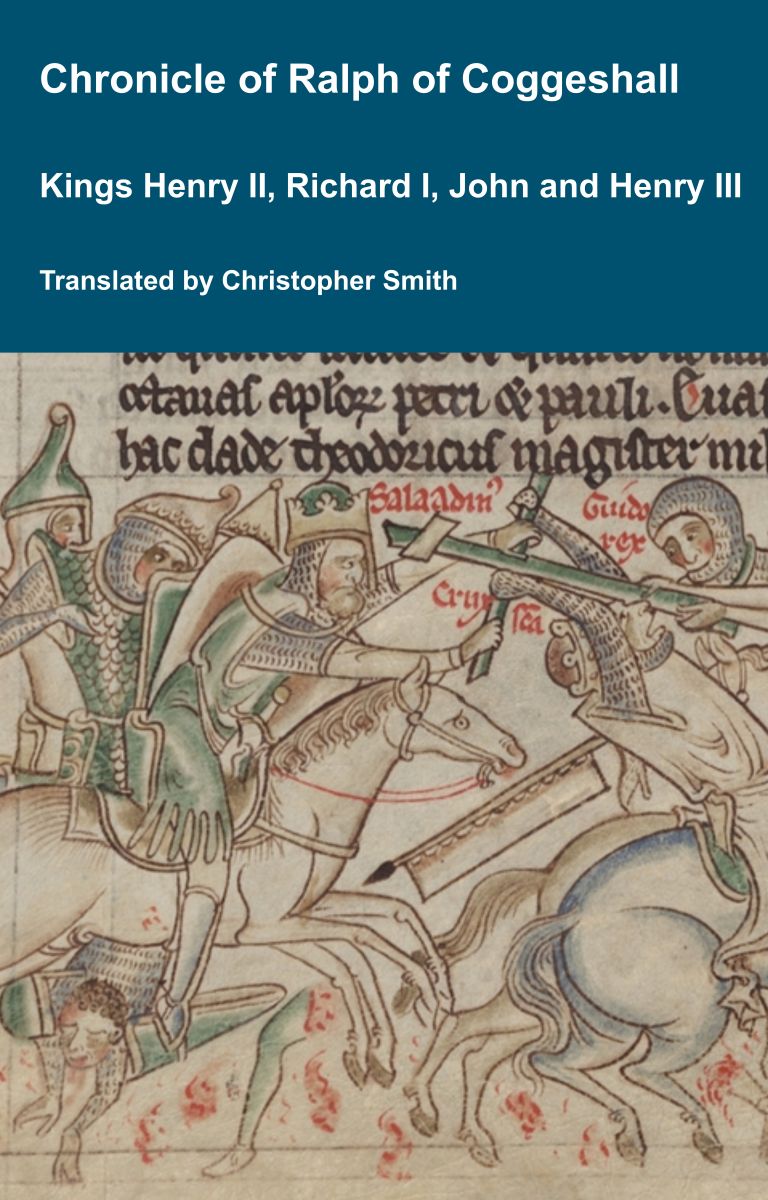
Chronicle of Abbot Ralph of Coggeshall
The Chronicle of Abbot Ralph of Coggeshall (Chronicon Anglicanum) is an indispensable medieval history that brings to life centuries of English and European affairs through the eyes of a learned Cistercian monk. Ralph of Coggeshall, abbot of the Abbey of Coggeshall in Essex in the early 13th century, continued and expanded his community’s chronicle, documenting events from the Norman Conquest of 1066 into the tumultuous reign of King Henry III. Blending eyewitness testimony, careful compilation, and the monastic commitment to record-keeping, this chronicle offers a rare narrative of political intrigue, royal power struggles, and social upheaval in England and beyond. Ralph’s work captures the reigns of pivotal figures such as Richard I and King John, providing invaluable insights into their characters, decisions, and the forces that shaped medieval rule. More than a simple annal, Chronicon Anglicanum conveys the texture of medieval life and governance, making it a rich source for scholars and readers fascinated by English history, monastic authorship, and the shaping of the medieval world.
Available at Amazon in eBook and Paperback format.
On 13th November 1362, his fiftieth birthday, King Edward III of England [aged 50] created two sons as Dukes...
Lionel of Antwerp 1st Duke of Clarence [aged 23] was created 1st Duke Clarence. Elizabeth Burgh Duchess of Clarence [aged 30] by marriage Duchess Clarence.
John of Gaunt 1st Duke Lancaster [aged 22] was created 1st Duke Lancaster. Blanche Duchess of Lancaster [aged 20] by marriage Duchess Lancaster.
On 8th April 1364 King John "The Good" II of France [aged 44] died at Savoy Palace [Map] of an unknown illness. He was buried at the Basilica of St Denis [Map]. His son Charles [aged 25] succeeded V King France: Capet Valois.
 Bourgeois de Valenciennes. When Sir Jean Joyel saw that the French were withdrawing across the bridge, as has just been described, he said to the Captal de Buch that the French were defeated. But the Captal told him they were not. Nevertheless Jean Joyel departed with his company, despite the Captal’s wishes; and when the Captal saw this, he said that he would not fight without him, and so he followed after, drawn up and in good order. When the French saw them come out from their strong position, they were greatly pleased, and they turned back, well ordered and closely ranked, their divisions properly arrayed. Then the Captal clearly perceived that he had done wrong to have moved so far from his stronghold. The English then began to shoot, and the thirty mounted Frenchmen advanced against the Captal’s banner, which was well guarded. But the French, with the help of their supports, seized it, struck it down, tore it away, and cast it to the ground. There the Captal was taken, securely bound and led across the bridge, and he swore to remain prisoner and to submit as such. Afterwards there was fierce fighting; but in the end the Navarrese and the English were defeated and utterly overthrown, and not one foot escaped from that battle who was not either killed or taken. This took place on the field called Cocherel, where there are many bushes, and the battle and defeat occurred on a Thursday, the 16th day of May, in the year of grace 1364. On the French side Sir Baudouin d’Annequin was slain; and the Archpriest withdrew with three companions, leaving his banners and his men on the field, at which his followers greatly marvelled.
Quant monseigneur Jehan Joyel vid que les Franchois retournoient par delà le pont, ainsy comme nous venons de faire mention, il dist au catal de Beuf que les François estoient desconfis, et le catal luy dist que non estoient. Et touttesfois Jehan Joyel se party, luy et sa routte, raaugrë le catal, et quant le catal vid ce, il dist que jà ne se combateroit sans luy, et adont le siëvy tout rengiés et ordonnés. Et quant les François les virent hors de leur fort, ils en furent moult lies, et retournèrent rengiés et serrés en bon aroy, leurs batailles toutes ordonnées. Et adont perchut bien le catal qu'il avoit fait mal d'estre sy eslongiés de son fort. Dont commenchèrent les Englès à traire, et les XXX François à cheval vindrent au guidon du catal qui estoit bien gardés; mais certainement les François parmy leurs aydes le prinrent, l'abatirent, le destachèrent et jettèrent par terre. Et là fut prins le catal, et bien loyés et emmenés delà le pont, et jura de tenir prison et à estre prisonnier. Et depuis y eult forte bataille, mais finablement Navarrois et Englès furent vaincus et desconfîs, et n'en eschappa onques pied de toute ceste bataille qu'ils tous ne fussent mors ou pris. Et cela fut au champ qu'on dist de Coquerel, où il y a maints buissons, et fut ceste bataille et desconfiture faite par ung joeudy l'an de grâce mil IIIc LX et IIII, XVIe jour du mois de may, et y morut de par les Franchois monseigneur Bauduin d'Anequin, et l'Arceprestre s'en ala luy IIIe, et ses bauières et ses gens deraourèrent au champ, de quoy ses gens s'esmervillèrent moult.
On 29th September 1364 Battle of Auray decided the Breton Succession in favour of John Montfort V Duke Brittany [aged 25]. The Breton and English army was commanded by John Chandos [aged 44] and included William Latimer 4th Baron Latimer of Corby [aged 34], Miles Stapleton [aged 44] and Hugh Calverley [aged 40]. Charles of Blois Duke Brittany [aged 45] was killed. Bertrand Geusclin [aged 44] surrendered.
Bourgeois de Valenciennes. When John Chandos learned for certain that Charles de Blois and his forces were approaching [on 29th September 1364], he brought his men out into the open field and arranged four divisions. He himself took command of the first battle. With him was Sir Matthew de Gournay and a great number of archers, whom he placed on the right. The second division, on the left, he entrusted to Sir Robert Knolles, who likewise had many archers with him. The third division he assigned to Sir John of Montfort, count of Montfort. The fourth division, which formed the rearguard, he gave to Sir Olivier de Clisson and Sir Hugh Calveley, telling them that he could not assign them a better position than that. "You shall remain on the flank without entering the battle, in such a manner that if you see any of our divisions wavering, you shall at once go to their aid." At this Hugh was so angered with Chandos, because he was not placed in the vanguard and would not have the first battle, that he wished to withdraw.
Quant monseigneur Jehan Chando sceult pour vray que Charles de Blois et ses gens avoient ainsy approchiet, il fist traire ses gens tous à plains champs, et ordonna IIII batailles, et se prendoit la première bataille. Sy avoit avoecques lui monseigneur Mathieu de Gournay et grant plenté d'archiers, lesquels il metoit à destre; et la seconde bataille à senestre il le charga à monseigneur Robert Canolle, et avoit avoec luy grant plenté d'archiers; la tierche bataille ordonna-il à monseigneur Jehan de Clermont, conte de Monfort; et l'arrière-garde qu'il faisoit et la IlIIe délivra-il à monseigneur de Clichon et à monseigneur Hue de Cavrelée, et luy dist qu'à railleur de luy ne le pooit-il ordonner. "Et sur esle vous tenrez sans entrer en la bataille, par tele manière que, se vous véez voiler aucunnes batailles, que tantost vous les confortez." Adont fut Hue sy courouchiet sur Chando qu'il se volut partir, pour ce qu'il n'estoit point devant et qu'il n'aroit point la première bataille.
On 23rd April 1366 King Edward III of England [aged 53] created new Garter Knights:
42nd Enguerrand de Coucy 1st Earl Bedford 1st Count Soissons [aged 26].
43rd Henry Percy 1st Earl of Northumberland [aged 24].


On 3rd April 1367 the forces of Peter "Cruel" I King Castile [aged 32] commanded by Edward "Black Prince" [aged 36] defeated the army of Henry "Fratricide" II King Castile [aged 33] at the Battle of Nájera at Nájera [Map]. The English forces included John of Gaunt 1st Duke Lancaster [aged 27], William Scrope, Peter Courtenay [aged 21], John Devereux 1st Baron Devereux [aged 30], John Savile of Shelley and Golcar [aged 42], Bernard Brocas [aged 37] and Thomas Banastre [aged 33].
The forces of Henry "Fratricide" II King Castile included Bertrand Geusclin [aged 47]. The battle achieved little since Bertrand Geusclin escaped.
John Ferrers 4th Baron Ferrers of Chartley [aged 36] was killed. His son Robert [aged 9] succeeded 5th Baron Ferrers of Chartley. Margaret Despencer Baroness Ferrers of Chartley by marriage Baroness Ferrers of Chartley.
Edward "Black Prince" thereafter returned home, taking Peter's daughters Constance [aged 13] and Isabella [aged 12] as hostages to ensure Peter would pay the money owed to Edward. Constance married John of Gaunt 1st Duke Lancaster, Isabella married Edmund of Langley 1st Duke of York [aged 25].
In 1368 King Edward III of England [aged 55] created new Garter Knights:
44th Ralph Basset 3rd Baron Basset Drayton [aged 33].
45th Richard Pembridge [aged 48].
On 14th March 1369 the army of Henry "Fratricide" II King Castile [aged 35] defeated that of his half-brother Peter "Cruel" I King Castile [aged 34] at the Battle of Montiel. Henry "Fratricide" II King Castile 1334-1379's army was commanded by Bertrand Geusclin [aged 49]. Peter "Cruel" I King Castile escaped to the castle of Montiel, La Mancha.
On 23rd March 1369 Peter "Cruel" I King Castile [aged 34] was murdered by his half-brother Henry "Fratricide" II King Castile [aged 35] outside the wall of the castle of Montiel, La Mancha. His half brother Henry succeeded II King Castile.
On 23rd April 1369 King Edward III of England [aged 56] created new Garter Knights
46th John Neville 3rd Baron Neville of Raby [aged 32].
47th Robert Dampierre [aged 46].
48th John Hastings 2nd Earl Pembroke [aged 21]. Some sources say 1370 but that would be inconsistent with the numbering?
49th Thomas Grandison 4th Baron Grandison [aged 30].
50th Guy de Bryan [aged 50]. Possibly on 31st December 1369?.