

 Antwerp
 Eltham Palace, Kent
 Dublin
 Kilkenny, Ireland
 Church of Santa Maria Maggiore, Milan
 Alba
Alba
 St Pietro Ciel d'Oro Church, Pavia
 Clare Priory, Suffolk
1328 Marriage of King Edward III and Philippa of Hainaut
1361 Creation of Garter Knights
1361 Marriage of Edward "The Black Prince" and Joan "The Fair Maid of Kent"
On 24th January 1328 King Edward III of England and Philippa of Hainaut were married at York Minster by Archbishop William Melton. She by marriage Queen Consort England. She was crowned the same day. She the daughter of William of Avesnes I Count Hainaut III Count Avesnes III Count Holland II Count Zeeland and Joan Valois Countess Zeeland Holland Avesnes and Hainaut. He the son of King Edward II of England and Isabella of France Queen Consort England.
The marriage was the quid pro quo for her father William of Avesnes I Count Hainaut III Count Avesnes III Count Holland II Count Zeeland having supported his mother Isabella of France Queen Consort England and Roger Mortimer 1st Earl March returning to England to usurp the throne of Edward's father King Edward II of England.
Annals of Ulster. 6th June 1333. William Burke, Earl of Ulster2, was killed by the English of Ulster. The Englishmen who committed this deed were put to death, in divers ways, by the people of the King of England; some were hanged, others killed, and others torn asunder2, in revenge of his death.
Note 1. Earl of Ulster. There is a much more circumstantial account of the death of this Earl of Ulster given by Pembridge and Grace under this year. Lodge gives the following particulars of it: "He was murdered on Sunday, June 6, 1333, by Robert Fitz-Richard Mandeville (who gave him his first wound), and others his servants, near to the Fords, in going towards Carrickfergus, in the 21st year of his age, at the instigation, as was said, of Gyle de Burgh, wife of Sir Richard Mandeville, in revenge for his having imprisoned her brother Walter and others."
This young earl left an only child, Elizabeth, who was married in the year 1352 to Lionel, third son of King Edward III., and this prince was then created, in her right, Earl of Ulster and Lord of Connaught, and these titles were enjoyed through marriage or descent by different princes of the royal blood, until at length, in the person of Edward IV, they became the special inheritance and revenue of the crown of England. Immediately on the Earl's death the chiefs of the junior branches of the family of Burke or De Burgo, then seated in Connaught, fearing the transfer of his possessions into strange hands by the marriage of the heiress, seized upon his estates in Connaught. The two most powerful of these were Sir William or Ulick, the ancestor of the Earls of Clanrickard, and Sir Edmund Albanagh the progenitor of the Viscounts of Mayo. These having confederated together and declared themselves independent, renounced the English dress and language, and adopted Irish names, Sir William taking the name of Mac William Oughter, or the Upper, and Sir Edmund that of Mac William Eighter, or the Lower. Under these names these two powerful chieftains tyranized over the entire province of Counaught, and though Lionel Duke of Clai'ence, in right of his wife, laid claim to their usurped possessions, the government apears to have been too weak to assert, the authority of the English laws, so that the territories of the Burkes were allowed to descend in course of tanistry and gavelkind. See Hardiman's History of Galway, pp. 56, 57.
Note 2. Torn asunder, i.e. torn limb from limb. Mageoghegan renders it "hanged, drawn, and quartered."
On 6th June 1333 William Donn Burgh 3rd Earl of Ulster was murdered by Richard de Mandeville in revenge for the murder of Richard's wife's brother Walter Liath de Burgh the year before. Earl of Ulster and Baron Burgh extinct. There is some argument that his daughter [his future wife] Elizabeth Burgh Duchess of Clarence succeeded as Countess of Ulster although her husband Lionel of Antwerp 1st Duke of Clarence appears to have been Earl of Ulster of a new creation. See Annals of Ulster.
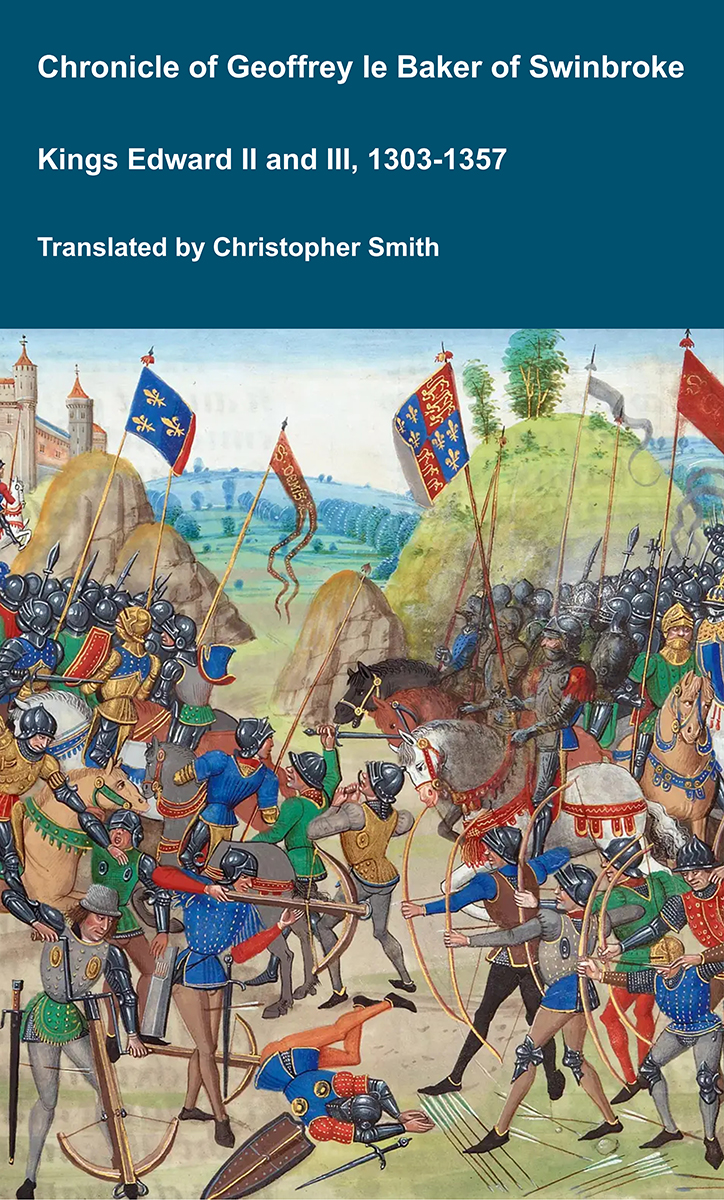 Chronicle of Geoffrey le Baker of Swinbroke. In this year, the King of England spent the whole winter at Antwerp, where the queen gave birth [29th November 1338] to Lord Lionel, Earl of Ulster.
Hoc anno rex Anglie per totam hyemem apud Andewerp perendinavit, ubi regina sibi peperit dominum Leuencium, comitem Dolvestier.
On 29th November 1338 Lionel of Antwerp 1st Duke of Clarence was born to King Edward III of England and Philippa of Hainaut Queen Consort England at Antwerp.
On 24th June 1340 [his father] King Edward III of England attacked the French fleet at anchor during the Battle of Sluys capturing more than 200 ships, killing around 18000 French. The English force included John Beauchamp 1st Baron Beauchamp Warwick, William Bohun 1st Earl of Northampton, Henry Scrope 1st Baron Scrope of Masham, William Latimer 4th Baron Latimer of Corby, John Lisle 2nd Baron Lisle, Ralph Stafford 1st Earl Stafford, Henry of Grosmont 1st Duke Lancaster, Walter Manny 1st Baron Manny, Hugh Despencer 1st Baron Despencer and Richard Pembridge.
Thomas Monthermer 2nd Baron Monthermer died from wounds. Margaret Monthermer Baroness Montagu 3rd Baroness Monthermer succeeded 3rd Baroness Monthermer.
On 12th May 1343 [his brother] Edward "Black Prince" was created Prince of Wales.
On 26th August 1346 the army of [his father] King Edward III of England defeated the French army at the Battle of Crécy. The English army was commanded by King Edward III of England, his son [his brother] Edward "Black Prince", Thomas Beauchamp 11th Earl Warwick, William Bohun 1st Earl of Northampton and John Beauchamp 1st Baron Beauchamp Warwick.
The English army was included: Bishop Thomas of Hatfield, Hugh Despencer 1st Baron Despencer, Bernard Brocas, Thomas Felton, James Audley, Robert Bourchier 1st Baron Bourchier, Bartholomew "The Elder" Burghesh 1st Baron Burghesh, Bartholomew "The Younger" Burghesh 2nd Baron Burghesh, Reginald Cobham 1st Baron Cobham, John Darcy 1st Baron Darcy of Knayth, Robert Ferrers 3rd Baron Ferrers of Chartley, Richard Scrope 1st Baron Scrope of Bolton, William Scrope, Stephen Scrope, William Latimer 4th Baron Latimer of Corby, John Lisle 2nd Baron Lisle, Gerard Lisle 1st Baron Lisle, Nicholas Longford, Edward Montagu 1st Baron Montagu, Walter Paveley 4th Baron Burghesh, Michael Poynings 1st Baron Poynings, Robert Ufford 1st Earl Suffolk, John de Vere 7th Earl of Oxford, Thomas West, John Willoughby 2nd Baron Willoughby, John Wingfield, Henry Percy 11th and 3rd Baron Percy, Hugh Courtenay 2nd or 10th Earl Devon (possibly), Walter "Elder" Devereux, John Devereux, Enion Sais Brecon, John Chandos, Richard Pembridge and John Sully.
The French army suffered significant casualties. King Philip "Fortunate" VI of France was wounded. William de Coucy and his son Enguerrand 6th Lord de Coucy and were killed.
Charles II Count Alençon was killed. Archbishop Charles Valois succeeded Count Alençon.
Louis Chatillon II Count Blois I Count Chatillon was killed. Louis Chatillon III Count Blois Count Soissons succeeded III Count Blois.
Louis Dampierre II Count Nevers I Count Flanders was killed. Louis of Male III Count Nevers II Count Flanders succeeded III Count Nevers, II Count Flanders.
King John I of Bohemia was killed. Charles IV King Bohemia Holy Roman Emperor Luxembourg succeeded IV King Bohemia, Holy Roman Emperor Luxemburg. Blanche Valois Holy Roman Empress Luxembourg by marriage Holy Roman Empress Luxemburg.
Rudolph "Valiant" Metz I Duke Lorraine was killed. John Metz I Duke Lorraine succeeded I Duke Lorraine.
Jean IV de Harcourt was killed.
On 22nd February 1347 John Graham Earl Menteith was condemned to be executed as a traitor. The sentence was carried out on the 28th February 1347 when John Graham Earl Menteith was hanged, drawn and quartered by direct orders of [his father] King Edward I to whom he had previously sworn fealty.
In 1351 Henry of Grosmont 1st Duke Lancaster was created 1st Duke Lancaster by [his father] King Edward III of England. Isabel Beaumont Duchess Lancaster by marriage Duchess Lancaster.
Lionel of Antwerp 1st Duke of Clarence was created 1st Earl of Ulster.
[his brother] John of Gaunt 1st Duke Lancaster was created 1st Earl Richmond.
Ralph Stafford 1st Earl Stafford was created 1st Earl Stafford.
Chronicle of Geoffrey le Baker of Swinbroke. In the year of Christ 1351, and the 25th year of the king's reign, after the octave of the Purification of the Glorious Virgin [2nd February 1351], at the parliament held in London at Westminster, Lord Henry, son of Henry, Earl of Lancaster, himself Earl of Lincoln, Leicester, Derby, Grismond, and Ferrers, was made Duke of Lancaster, receiving liberties and privileges from the royal bounty such as no other earl had ever held. Also Lord Lionel of Antwerp, the king's son, was made Earl of Ulster in Ireland, Lord John of Gaunt, his brother, was made Earl of Richmond and Lord Ralph of Stafford, formerly a baron, was created Earl of the same name.
Anno Christi MCCCLJ et regis XXV post octabas Purificacionis Virginis gloriose, in parliamento Londoniis apud Westmonasterium celebrato, dominus Henricus filius Henrici comitis Lancastrie, ipse comes Lincolnie, Leicestrie, Derbie et Grossimontis atque de Ferrariis, factus est dux Lancastrie, datis sibi libertatibus atque privilegiis munificencia regali qualia nullus comitum habebat. Item, dominus Leunecius de Andewerpe, regis filius, fit comes de Holvestria in Hybernia, et dominus Tohannes de Gandavo, germanus eius, fit comes Richemundie, et dominus Radulfus de Staffordia, pridem baro, comes eiusdem tituli creabatur.
In 1352 Lionel of Antwerp 1st Duke of Clarence and Elizabeth Burgh Duchess of Clarence were married. He by marriage Earl of Ulster. She was the sole heir of her father and brought the de Burgh inheritance of the lands of Ulster to the marriage. As a consequence of their earlier betrothal he had been called Earl Ulster since 1347. She the daughter of William Donn Burgh 3rd Earl of Ulster and Maud Plantagenet Countess Ulster. He the son of King Edward III of England and Philippa of Hainaut Queen Consort England.
On 16th August 1355 [his daughter] Philippa Plantagenet Countess March 2nd Countess Ulster was born to Lionel of Antwerp 1st Duke of Clarence and [his wife] Elizabeth Burgh Duchess of Clarence at Eltham Palace, Kent. At the time of her birth she was Heir to the Throne of England since her uncle [his brother] Edward "Black Prince" was yet to be married. She married 24th August 1369 Edmund Mortimer 3rd Earl March, Earl of Ulster, son of Roger Mortimer 2nd Earl March and Philippa Montagu Countess March, and had issue.
On 19th September 1356 the army of [his brother] Edward "Black Prince" defeated the French and Scottish army led by King John "The Good" II of France at the Battle of Poitiers
King John "The Good" II of France was captured by three captains including Ivon aka John Fane.
The the English army included: Bernard Brocas, Thomas Felton, James Audley, Thomas Beauchamp 11th Earl Warwick, Bartholomew "The Younger" Burghesh 2nd Baron Burghesh, Reginald Cobham 1st Baron Cobham, Edward Despencer 1st Baron Despencer, Baron Burghesh, Ralph Ferrers, William Scrope, William Montagu 2nd Earl Salisbury, Walter Paveley 4th Baron Burghesh, Robert Ufford 1st Earl Suffolk, William Ufford 2nd Earl Suffolk, John de Vere 7th Earl of Oxford, John Willoughby 3rd Baron Willoughby, Thomas Arderne, Enion Sais Brecon, John Chandos, Richard Pembridge, Jean Grailly, Robert de Fouleshurst and John Sully
John Savile of Shelley and Golcar probably fought having received letters of protection to travel overseas.
Hugh Courtenay 2nd or 10th Earl Devon protected the baggage train.
The French and Scottish army included: King John "The Good" II of France, Philip "Bold" Valois II Duke Burgundy, Jean Bourbon I Count La Marche, Archibald "Grim" Douglas 3rd Earl Douglas, [his uncle] John "Sans Terre" Artois 1st Count of Eu; all captured.
Guichard d'Angle 1st Earl Huntingdon and William Douglas 1st Earl Douglas fought.
Peter Bourbon Duke Bourbon was killed. Louis Bourbon II Duke Bourbon succeeded II Duke Bourbon.
Gauthier VI Comte de Brienne was killed.
Archaeologia Volume 35 1853 XXXIII. On the 1st of March [1358], the Earl of Ulster, Lionel, afterwards Duke of Clarence, son of Edward III., takes supper with the [his grandmother] Queen. It will be remembered that Lionel's daughter, Philippa, subsequently brought a claim to the English crown into the family of the Mortimers, by her marriage with Edmund Earl of March.
On 19th May 1359, or thereabouts, a double-royal wedding celebration took place at Reading Abbey, Berkshire whereby two children of [his father] King Edward III of England were married:
[his brother] John of Gaunt 1st Duke Lancaster and [his sister-in-law] Blanche Duchess of Lancaster were married. She by marriage Countess Richmond. She the daughter of Henry of Grosmont 1st Duke Lancaster and Isabel Beaumont Duchess Lancaster. He the son of King Edward III of England and Philippa of Hainaut Queen Consort England.
John Hastings 2nd Earl Pembroke and Margaret Plantagenet Countess of Pembroke were married. At the time John Hastings 2nd Earl Pembroke was a ward of King Edward III of England who would enjoy the benefit of the substantial revenue of the Earldom of Pembroke until John came of age nine years later in 1368. She died two or so years later probably of plague. She the daughter of King Edward III of England and Philippa of Hainaut Queen Consort England. He the son of Laurence Hastings 1st Earl Pembroke and Agnes Mortimer Countess of Pembroke.
On 13th April 1360 a freak weather event known as Black Monday Hailstorm occurred as the army of [his father] King Edward III of England were camped outside Chartres. Thomas Beauchamp 11th Earl Warwick, William Bohun 1st Earl of Northampton, Henry of Grosmont 1st Duke Lancaster, [his brother] Edward "Black Prince" and Walter Mauny were present. Around one thousand English were killed, with up to six thousand horses. King Edward III of England believed the event to be an Act of God and proceeded to negotiate with the French resulting in the Treaty of Brétigny.
On 28th April 1360 Guy Beauchamp died from injuries received during the Black Monday Hailstorm.
In 1361 [his father] King Edward III of England created three of his sons as Garter Knights...
35th Lionel of Antwerp 1st Duke of Clarence.
36th [his brother] John of Gaunt 1st Duke Lancaster.
On 10th October 1361 [his brother] Edward "Black Prince" and [his sister-in-law] Joan "Fair Maid of Kent" Princess Wales were married at Windsor Castle. She by marriage Princess of Wales. His first wife, her second (or third depending on how you count them) husband. She had four children already. They had known each other since childhood. Thirty-one and thirty-three respectively. A curious choice for the heir to the throne; foreign princesses were usual. They were married nearly fifteen years and had two children. She the daughter of Edmund of Woodstock 1st Earl Kent and Margaret Wake Countess Kent. He the son of [his father] King Edward III of England and [his mother] Philippa of Hainaut Queen Consort England.
Before November 1361 Lionel of Antwerp 1st Duke of Clarence landed at Dublin having been appointedd Governor of Ireland.
Before 16th January 1362 Thomas de Vere 8th Earl of Oxford and [his sister-in-law] Maud Ufford Countess of Oxford were married. She by marriage Countess of Oxford. She the daughter of Ralph Ufford and [his mother-in-law] Maud Plantagenet Countess Ulster. He the son of John de Vere 7th Earl of Oxford and Maud Badlesmere Countess of Oxford.
On 10th April 1362 Maud Plantagenet Duchess Lower Bavaria died. [his sister-in-law] Blanche Duchess of Lancaster succeeded 6th Countess of Leicester. [his brother] John of Gaunt 1st Duke Lancaster by marriage Earl of Leicester adding a fourth Earldom to the ones he already held: Earl Richmond, Earl Lancaster and Earl Derby.
On 13th November 1362, his fiftieth birthday, [his father] King Edward III of England created two sons as Dukes...
Lionel of Antwerp 1st Duke of Clarence was created 1st Duke Clarence. [his wife] Elizabeth Burgh Duchess of Clarence by marriage Duchess Clarence.
[his brother] John of Gaunt 1st Duke Lancaster was created 1st Duke Lancaster. [his sister-in-law] Blanche Duchess of Lancaster by marriage Duchess Lancaster.
On 28th May 1363 John Harrington 2nd Baron Harington died at Gleaston Castle. Robert Harrington 3rd Baron Harington succeeded 3rd Baron Harington. Given his young age Robert Harrington 3rd Baron Harington became a ward of [his father] King Edward III of England who granted his wardship to his daughter [his sister] Isabella Countess Bedford and Soissons and her husband [his future brother-in-law] Enguerrand de Coucy 1st Earl Bedford 1st Count Soissons.
On 10th December 1363 [his wife] Elizabeth Burgh Duchess of Clarence died at Dublin. She was buried at Clare Priory, Suffolk.
On 27th July 1365 [his brother-in-law] Enguerrand de Coucy 1st Earl Bedford 1st Count Soissons and [his sister] Isabella Countess Bedford and Soissons were married at Windsor Castle. She the daughter of [his father] King Edward III of England and [his mother] Philippa of Hainaut Queen Consort England.
In 1366 [his brother-in-law] Enguerrand de Coucy 1st Earl Bedford 1st Count Soissons was created 1st Earl Bedford. [his sister] Isabella Countess Bedford and Soissons by marriage Countess Bedford.
In 1366 Lionel of Antwerp 1st Duke of Clarence held a Parliament at Kilkenny, Ireland. The Parliament enacted thirty-five statutes known as the Statutes of Kilkenny which began:
... now many English of the said land, forsaking the English language, manners, mode of riding, laws and usages, live and govern themselves according to the manners, fashion, and language of the Irish enemies; and also have made divers marriages and alliances between themselves and the Irish enemies aforesaid; whereby the said land, and the liege people thereof, the English language, the allegiance due to our lord the king, and the English laws there, are put in subjection and decayed...
In 1367 Lionel of Antwerp 1st Duke of Clarence returned to England.
On 3rd April 1367 the forces of Peter "Cruel" I King Castile commanded by [his brother] Edward "Black Prince" defeated the army of Henry "Fratricide" II King Castile at the Battle of Nájera at Nájera. The English forces included John of Gaunt 1st Duke Lancaster, William Scrope, Peter Courtenay, John Devereux 1st Baron Devereux, John Savile of Shelley and Golcar, Bernard Brocas and Thomas Banastre.
The forces of Henry "Fratricide" II King Castile included Bertrand Geusclin. The battle achieved little since Bertrand Geusclin escaped.
John Ferrers 4th Baron Ferrers of Chartley was killed. Robert Ferrers 5th Baron Ferrers of Chartley succeeded 5th Baron Ferrers of Chartley. Margaret Despencer Baroness Ferrers of Chartley by marriage Baroness Ferrers of Chartley.
Edward "Black Prince" thereafter returned home, taking Peter's daughters Constance and Isabella as hostages to ensure Peter would pay the money owed to Edward. Constance married John of Gaunt 1st Duke Lancaster, Isabella married Edmund of Langley 1st Duke of York.
In June 1368 Lionel of Antwerp 1st Duke of Clarence and Violante Visconti were married in the Church of Santa Maria Maggiore, Milan. The wedding festivities were lavish and ostentatious. The banquet, held outside, included 30 courses of meat and fish presented fully gilded. Between the courses the guests were given gifts such as suits of armour, bolts of cloth, war horses, arms, and hunting dogs. Among the guests were Geoffrey Chaucer, Petrarch, Jean Froissart and John Hawkwood. He the son of King Edward III of England and Philippa of Hainaut Queen Consort England.
On 7th October 1368 Lionel of Antwerp 1st Duke of Clarence died from poisoning at Alba. Duke Clarence extinct. [his daughter] Philippa Plantagenet Countess March 2nd Countess Ulster succeeded 2nd Countess of Ulster. He was buried at the St Pietro Ciel d'Oro Church, Pavia.
There was strong speculation he had been poisoned by his [his wife] wife's [his father-in-law] father.
Around 1377 Lionel of Antwerp 1st Duke of Clarence was reburied at Clare Priory, Suffolk. [his daughter] Philippa Plantagenet Countess March 2nd Countess Ulster succeeded 5th Countess of Ulster.
In November 1386 [his former wife] Violante Visconti died in Pavia.