

Paternal Family Tree: Devereux
Around 1337 John Devereux 1st Baron Devereux was born to John Devereux [aged 35] and Margaret Barre. He a great x 4 grandson of King John of England.
After 26th August 1346 [his father] John Devereux [deceased] died.
Before 1361 Henry Beaumont 3rd Baron Beaumont [aged 20] and [his future wife] Margaret Vere Baroness Devereux and Beaumont were married. She by marriage Baroness Beaumont. She the daughter of John de Vere 7th Earl of Oxford and Maud Badlesmere Countess of Oxford [aged 52]. He the son of John Beaumont 2nd Baron Beaumont and Eleanor Plantagenet Countess Arundel and Surrey [aged 42]. They were fourth cousin once removed. He a great x 2 grandson of King Henry III of England. She a great x 5 granddaughter of King Henry "Curtmantle" II of England.
On 3rd April 1367 the forces of Peter "Cruel" I King Castile [aged 32] commanded by Edward "Black Prince" [aged 36] defeated the army of Henry "Fratricide" II King Castile [aged 33] at the Battle of Nájera at Nájera [Map]. The English forces included John of Gaunt 1st Duke Lancaster [aged 27], William Scrope, Peter Courtenay [aged 21], John Devereux 1st Baron Devereux [aged 30], John Savile of Shelley and Golcar [aged 42], Bernard Brocas [aged 37] and Thomas Banastre [aged 33].
The forces of Henry "Fratricide" II King Castile included Bertrand Geusclin [aged 47]. The battle achieved little since Bertrand Geusclin escaped.
John Ferrers 4th Baron Ferrers of Chartley [aged 36] was killed. His son Robert [aged 9] succeeded 5th Baron Ferrers of Chartley. Margaret Despencer Baroness Ferrers of Chartley by marriage Baroness Ferrers of Chartley.
Edward "Black Prince" thereafter returned home, taking Peter's daughters Constance [aged 13] and Isabella [aged 12] as hostages to ensure Peter would pay the money owed to Edward. Constance married John of Gaunt 1st Duke Lancaster, Isabella married Edmund of Langley 1st Duke of York [aged 25].
On 21st March 1373 John Devereux 1st Baron Devereux [aged 36] was captured during the Battle of Chiset at Chizé at which the English were defeated by the French forces commanded by Bertrand Geusclin [aged 53]. The battle brought an end to English control in Poitou.
In 1376 John Devereux 1st Baron Devereux [aged 39] was appointed High Sheriff of Hertfordshire.
In 1377 John Devereux 1st Baron Devereux [aged 40] and Margaret Vere Baroness Devereux and Beaumont were married. She the daughter of John de Vere 7th Earl of Oxford and Maud Badlesmere Countess of Oxford. They were fifth cousins. He a great x 4 grandson of King John of England. She a great x 5 granddaughter of King Henry "Curtmantle" II of England.
Around 1378 [his son] John Devereux 2nd Baron Devereux was born to John Devereux 1st Baron Devereux [aged 41] and [his wife] Margaret Vere Baroness Devereux and Beaumont. He married 17th August 1390 his fourth cousin Phillipe Bryan Baroness Scrope Masham Baroness Devereux.
On 1st March 1378 John Devereux 1st Baron Devereux [aged 41] was appointed Constable of Leeds Castle.
Around 1379 [his daughter] Joan Devereux 3rd Baroness Devereux Baroness Burnell was born to John Devereux 1st Baron Devereux [aged 42] and [his wife] Margaret Vere Baroness Devereux and Beaumont. She married 1. 1397 her third cousin once removed Walter Fitzwalter 5th Baron Fitzwalter, son of Walter Fitzwalter 4th Baron Fitzwalter and Philippa Mohun Duchess York, and had issue 2. before 29th January 1408 her fifth cousin once removed Hugh Burnell 2nd Baron Burnell, son of Nicholas Haudlo Burnell 1st Baron Burnell.
After 1384 [his step-daughter] Eleanor Beaumont [deceased] died.
On 28th September 1384 John Devereux 1st Baron Devereux [aged 47] was created 1st Baron Devereux. [his wife] Margaret Vere Baroness Devereux and Beaumont by marriage Baroness Devereux.
William of Worcester's Chronicle of England
William of Worcester, born around 1415, and died around 1482 was secretary to John Fastolf, the renowned soldier of the Hundred Years War, during which time he collected documents, letters, and wrote a record of events. Following their return to England in 1440 William was witness to major events. Twice in his chronicle he uses the first person: 1. when writing about the murder of Thomas, 7th Baron Scales, in 1460, he writes '… and I saw him lying naked in the cemetery near the porch of the church of St. Mary Overie in Southwark …' and 2. describing King Edward IV's entry into London in 1461 he writes '… proclaimed that all the people themselves were to recognize and acknowledge Edward as king. I was present and heard this, and immediately went down with them into the city'. William’s Chronicle is rich in detail. It is the source of much information about the Wars of the Roses, including the term 'Diabolical Marriage' to describe the marriage of Queen Elizabeth Woodville’s brother John’s marriage to Katherine, Dowager Duchess of Norfolk, he aged twenty, she sixty-five or more, and the story about a paper crown being placed in mockery on the severed head of Richard, 3rd Duke of York.
Available at Amazon in eBook and Paperback format.
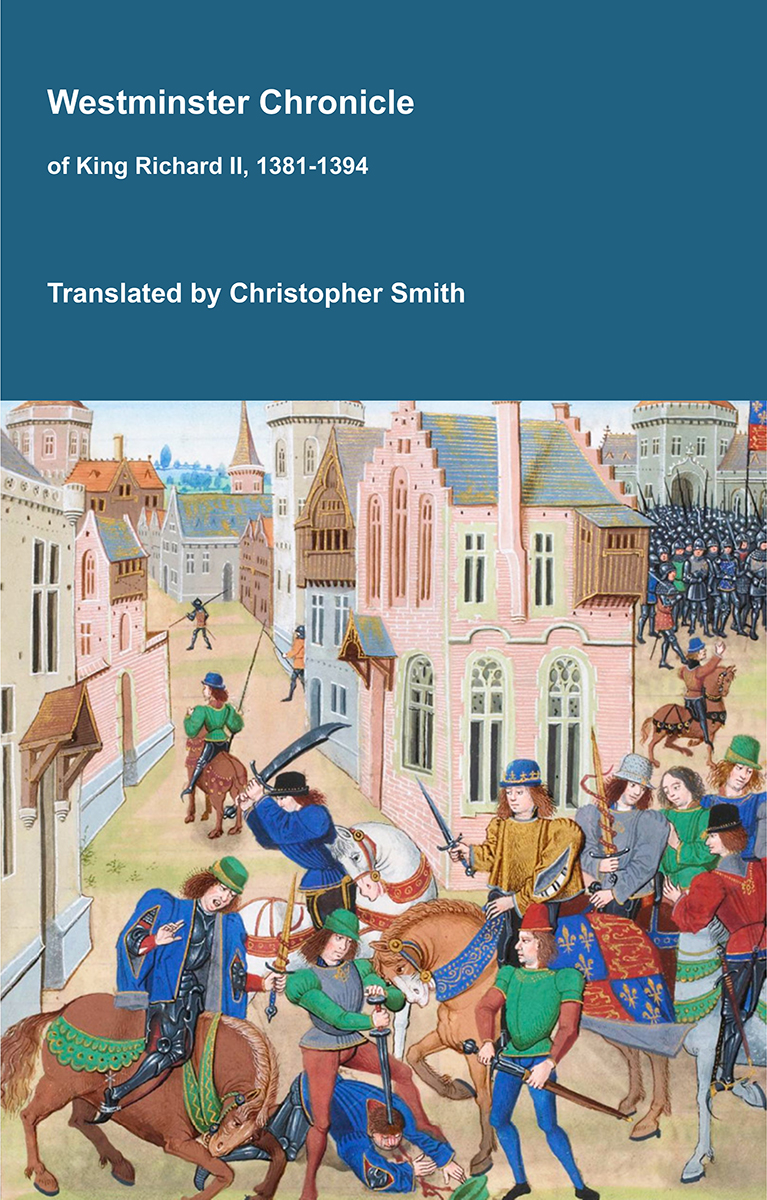 Westminster Chronicle. Immediately afterwards, when a council was held at Westminster, the archbishop of Canterbury [aged 43] and other prelates of the churches, together with some of the temporal lords, complained gravely about those counsellors moving about the king, because they had induced the king to consent to the killing of the duke of Lancaster so cruelly in private. This was both because it was a matter of evil example, and because it would follow from this that whenever the king bore a hateful heart or mind towards some great or middling person, perhaps, in like manner, God forbid, he would order that person to be killed. Thus, by this, the approved laws and customs would suffer no slight injury, and quarrels, lawsuits, disputes, contentions, dissensions, and other such things would perhaps arise everywhere in the realm, God forbid. Therefore such crimes must be avoided in future, lest, because of unlawful acts of this kind, it should plainly happen that the realm be made worse. These words, or words like them, the archbishop of Canterbury delivered to the king on behalf of the lords then present there. When the king had heard them, he rose at once in anger against the archbishop and threatened him. On that day the king dined with the mayor of London. When the meal was finished, the king went onto the river Thames, and between his palace and Lambeth he met the archbishop. For the aforesaid archbishop had come to the king under the safe-conduct of the earl of Buckingham [aged 30]. Then, when the matter which the archbishop had pursued before dinner had been recited again, the king, drawing his sword, would have pierced the archbishop through at once, had not the earl of Buckingham, Lord John Devereux [aged 48], and Sir Thomas Trivet [aged 54] strongly resisted him. Since the king was angry with them, they immediately leapt out of the king’s boat, through fear, into the archbishop’s boat, and so at that time they departed from him in discord.
Incontinenti postea apud Westmonasterium consilio celebrato, archiepiscopus Cantuariensis, aliique ecelesiarum prælati ac de dominis temporalibus aliqui de istis consiliariis Circa regem conversantibus graviter sunt conquesti, co quod induxerunt regem assentire interfectioni ducis Lancastriæ tam crudeliter in privato tum quia fuit res mali exempli tum quia sequeretur ex hoc quod quandocunque rex versus magnam sive mediocrem personam cor sive animum gestierat odiosum consimili modo forsitan illam, quod absit, mandaret occidi. Ut sic per hoc leges et consuetudines approbatæ læsionem non modicam paterentur, rixæ lites jurgia contentiones dissensiones et cetera talia in regno, quod absit, ubique forsitan nascerentur, ‘Igitur abstinendum est a talibus sceleribus in futurum ne propter hujusmodi illicita deterioratio regni fieri manifesti contingat. Ista verba sive consimilia archiepiscopus Cantuariensis retulit regi ex parte dominorum tunc ibidem existentium. Quibus auditis rex iratus versus archiepiscopum illico surrexit et minas ei intulit. Ilo namque die comedit rex cum majore Londoniæ finito prandio rex flumen Thamense ,intravit et inter palatium suum et Lambheth archiepiseopum habuit obvium. Venerat enim præfatus archiepiscopus ad regem sub salvo conductu comitis de Buckyngham. Demum recitata materia quam ante prandium archiepiscopus fuerat proseeutus, rex extracto ense archiepiscopum illico perfodisset nisi comes Buckyngham, dominus Johannes Deuereye et dominus Thomas Tryvet eidem fortiter restitissent. Quibus rex iratus igitur de seapha regis propter metum in cymbam archiepiscopi statim prosiliebant et sic ab eo protunc in discordia recesserunt.
Before 15th August 1385 [his brother-in-law] Aubrey de Vere 10th Earl of Oxford [aged 47] and Alice Fitzwalter Countess of Oxford were married. She by marriage Countess of Oxford. He the son of John de Vere 7th Earl of Oxford and Maud Badlesmere Countess of Oxford. They were second cousin once removed. He a great x 5 grandson of King Henry "Curtmantle" II of England. She a great x 4 granddaughter of King Henry "Curtmantle" II of England.
Westminster Chronicle. Also, for the continual governance of the king, they appointed the bishop of Winchester [aged 68]1, the bishop of Bath2, Sir John Cobham, Lord Richard Scrope [aged 61], and Lord John Devereux [aged 51], whom they also made steward of the lord king’s household and constable of Dover Castle. Also, on the second day of January, the said lords removed from the court all the king’s household men, especially those closest to the lord king, and in their place substituted others at their own pleasure. This deed indeed filled the king’s heart with sorrow, although it could not then be done otherwise, and therefore he bore these and other things with the utmost patience.
Item pro gubernatione regis continua ordinarunt episcopum Wyntoniensem, episcopum Bathoniensem, dominum Johannem Coboham, dominum Ricardum Serop, et dominum Johannem Deverose, quem statuerunt etiam senescallum hospitii domini regis et constabularium castri de Dovoria. Item secundo die Januarii omnes familiares præcipue domino regi proximiores dicti domini a curia removerunt et loco eorum alios ad libitum subrogarunt. Hoc quidem factum cor regis mœrore implevit quamvis aliter protunc fieri non potuit idcirco hæc et alia patientissime toleravit.
Note 1. William Wykeham, 1320-1404. In 1367 he was appointed Lord Chancellor and consecrated Bishop of Winchester.
Note 2. Walter Skirlaw, died 1406. In 1382 he was appointed Lord Privy Seal, in 1385 Bishop of Lichfield. August 1386 Bishop of Bath and Wells. April 1388 Bishop of Durham.
Patent Rolls. 3rd January 1388. Appointment, during pleasure, of John Devereux [aged 51], knight, to be constable of Dover castle and warden of the Cinque Ports, receiving therefor for the maintenance of himself and the chaplains, servants, watchmen and one carpenter abiding therein, £300. a year, viz. from, wards belonging to the castle £146., from the issues of the customs in the port of Sandwich 100 marks and the residue at the Exchequer, without rendering account, as Simon de Bureley [aged 48], knight, late constable and warden, saving to the king chattels of felons and fugitives, fines, ransoms, amercements, etc. from the said ports belonging to the king, for which he is to render account at the Exchequer; provided that he stay in person upon the custody as is reasonably needful and as necessity demands. By K. & C. Mandate in pursuance to the said Simon to deliver the castle to him. Mandate de intendendo in pursuance to the barons, bailiffs, good men and whole commonalty of the liberty of the Cinque Ports.
On 12th March 1388 John Devereux 1st Baron Devereux [aged 51] was appointed Constable of Dover Castle.
Patent Rolls. 12th March 1388. Grant, for life, to John Devereux [aged 51], one of the king's bannerets, of the offices of constable of Dover castle and warden of the Cinque Ports, as held by Simon de Burleye [aged 48]. By p.s. Vacated because otherwise below.
In 1389 [his step-son] John Beaumont 4th Baron Beaumont [aged 28] and Katherine Everingham Baroness Beaumont were married. She by marriage Baroness Beaumont.
In 1389 John Devereux 1st Baron Devereux [aged 52] was appointed 78th Knight of the Garter by King Richard II of England [aged 21].
Around 17th August 1390 [his son] John Devereux 2nd Baron Devereux [aged 12] and [his daughter-in-law] Phillipe Bryan Baroness Scrope Masham Baroness Devereux were married. She by marriage Baroness Devereux. They were fourth cousins. He a great x 5 grandson of King John of England.
On 22nd November 1392 Robert de Vere 1st Duke Ireland [aged 30] was killed whilst hunting at Louvain [Map]. His uncle [his brother-in-law] Aubrey [aged 54] succeeded 10th Earl of Oxford.
The Deeds of the Dukes of Normandy
The Gesta Normannorum Ducum [The Deeds of the Dukes of Normandy] is a landmark medieval chronicle tracing the rise and fall of the Norman dynasty from its early roots through the pivotal events surrounding the Norman Conquest of England. Originally penned in Latin by the monk William of Jumièges shortly before 1060 and later expanded at the behest of William the Conqueror, the work chronicles the deeds, politics, battles, and leadership of the Norman dukes, especially William’s own claim to the English throne. The narrative combines earlier historical sources with firsthand information and oral testimony to present an authoritative account of Normandy’s transformation from a Viking settlement into one of medieval Europe’s most powerful realms. William’s history emphasizes the legitimacy, military prowess, and governance of the Norman line, framing their expansion, including the conquest of England, as both divinely sanctioned and noble in purpose. Later chroniclers such as Orderic Vitalis and Robert of Torigni continued the history, extending the coverage into the 12th century, providing broader context on ducal rule and its impact. Today this classic work remains a foundational source for understanding Norman identity, medieval statesmanship, and the historical forces that reshaped England and Western Europe between 800AD and 1100AD.
Available at Amazon in eBook and Paperback format.
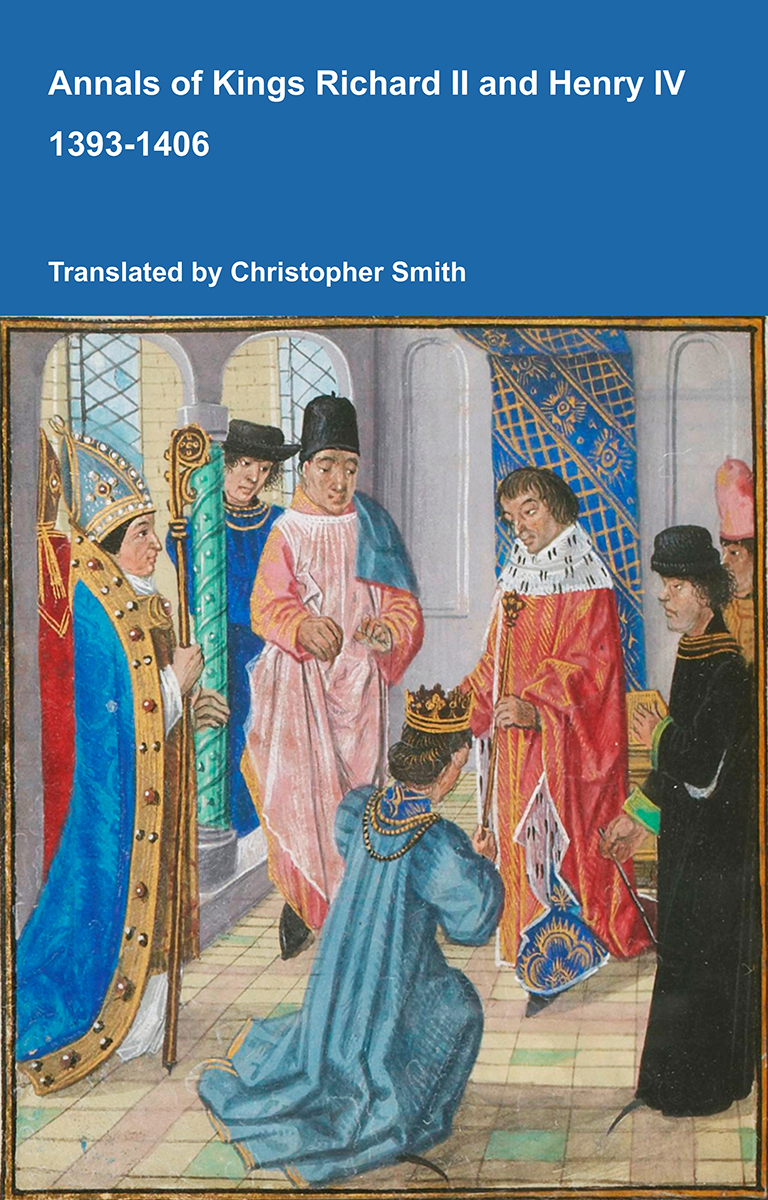 Annals of Kings Richard II and Henry IV. In that year, on the feast of the Chair of Saint Peter1 [22nd February 1393], Sir John Devereux [aged 56], knight, the King’s Steward and Constable of Dover, died suddenly, while he was preparing himself for the sea crossing with the Dukes of Lancaster and Gloucester, for the treaty of peace mentioned above. Sir Thomas Percy [aged 50] succeeded him in the office of Steward, having previously been the King’s Sub-Chamberlain. Sir [his step-son] Beaumont [aged 32] succeeded him as Constable of Dover, and William Scrope [aged 43] was made the King’s Sub-Chamberlain.
Isto anno, in festo Cathedræ Sancti Petri, obiit repente Dominus Johannes Devros, miles, Regis Senescallus et Doveriæ Constabularius, dum parasset se ad maris transitum cum Ducibus Lancastriæ et Gloverniæ, pro tractatu pacis prælocutæ. Cui successit, in officio Senescalli, Dominus Thomas Percy, qui fuerat prius Subcamberlanus regius: in Constabulariam Doveriæ Dominus de Bemond successit eidem, et Willelmus Scrop Regis Subcamerarius est effectus.
Note 1. The 'chair' to which this feast refers is the cathedra, or office, of the Apostle Peter. Given by Christ to St. Peter (Matthew 16:13-18). A cathedral is the church that contains the bishop’s cathedra.
On 22nd February 1393 John Devereux 1st Baron Devereux [aged 56] died. He was buried at Greyfriars Church Farringdon Within [Map]. His son John [aged 15] succeeded 2nd Baron Devereux.
Westminster Chronicle. Also, on the twenty-second day of February, Sir John Devereux [aged 56]1 died, an excellent knight and steward of the household of the lord King. In his place Sir Thomas Percy was appointed [steward]. Then Sir William Scrope was made Chamberlain of the lord King.
Item xxii die Februarii obiit dominus Johannes Deverose miles egregius et senescallus hospitii domini regis. In cujus loco dominus Thomas Percy fuit subrogatus. Tunc dominus Willelmus Serop factus est camberlanus domini regis.
Note 1. John Devereux, 1337-1393, 1st Baron Devereux.
On 16th June 1398 [his former wife] Margaret Vere Baroness Devereux and Beaumont died.
[his father] John Devereux and [his mother] Margaret Barre were married.
Kings Wessex: Great x 10 Grand Son of King Edmund "Ironside" I of England
Kings Gwynedd: Great x 5 Grand Son of Owain "Great" King Gwynedd
Kings Seisyllwg: Great x 11 Grand Son of Hywel "Dda aka Good" King Seisyllwg King Deheubarth
Kings Powys: Great x 6 Grand Son of Maredudd ap Bleddyn King Powys
Kings England: Great x 4 Grand Son of King John of England
Kings Scotland: Great x 8 Grand Son of King Malcolm III of Scotland
Kings France: Great x 10 Grand Son of Hugh I King of the Franks
Kings Duke Aquitaine: Great x 14 Grand Son of Ranulf I Duke Aquitaine
Great x 4 Grandfather: Walter Devereux 
Great x 3 Grandfather: Stephen Devereux
Great x 4 Grandmother: Cecilia Longchamp
Great x 2 Grandfather: William Devereux
Great x 4 Grandfather: William Cantilupe Baron 
Great x 3 Grandmother: Isabel Cantilupe
Great x 1 Grandfather: William Devereux 1st Baron Devereux Lyonshall 7 x Great Grandson of Hugh I King of the Franks
Great x 4 Grandfather: Hugh Bigod 1st Earl Norfolk 
Great x 3 Grandfather: Roger Bigod 2nd Earl Norfolk
Great x 4 Grandmother: Juliana de Vere 
Great x 2 Grandmother: Margery Bigod 6 x Great Granddaughter of Hugh I King of the Franks
Great x 4 Grandfather: Ralph Tosny  8 x Great Grandson of King Edward "Elder" of the Anglo Saxons
Great x 3 Grandmother: Ida Tosny Countess Norfolk 5 x Great Granddaughter of Hugh I King of the Franks
Great x 4 Grandmother: Margaret Beaumont  4 x Great Granddaughter of Hugh I King of the Franks
Grandfather: Walter Devereux 8 x Great Grandson of Hugh I King of the Franks
Great x 2 Grandfather: Pierre Grandison
Great x 1 Grandmother: Alice Grandison
Father: John Devereux 3 x Great Grandson of King John of England
Great x 4 Grandfather: William de Braose 4th Baron Bramber  5 x Great Grandson of Maredudd ab Owain King Deheubarth King Powys King Gwynedd
Great x 3 Grandfather: William de Braose 6 x Great Grandson of Maredudd ab Owain King Deheubarth King Powys King Gwynedd
Great x 4 Grandmother: Maud "Lady of Hay" St Valery Baroness Bramber
Great x 2 Grandfather: John "Tadody aka Fatherless" Braose 8th Baron Bramber 3 x Great Grandson of King Henry I "Beauclerc" England
Great x 4 Grandfather: Richard Clare 3rd Earl Hertford 
Great x 3 Grandmother: Maud de Clare 2 x Great Granddaughter of King Henry I "Beauclerc" England
Great x 4 Grandmother: Amice Fitzrobert Countess Hertford Great Granddaughter of King Henry I "Beauclerc" England
Great x 1 Grandfather: Richard de de Braose Great Grandson of King John of England
Great x 4 Grandfather: Iorwerth "Drwyndwn aka Flat Nosed" Aberffraw son of Owain "Great" King Gwynedd
Great x 3 Grandfather: Llewellyn "The Great" Aberffraw Grandson of Owain "Great" King Gwynedd
Great x 4 Grandmother: Marared ferch Madog Mathrafal Granddaughter of King Gruffudd ap Cynan of Gwynedd
Great x 2 Grandmother: Margred verch Llewellyn Baroness Clifford Granddaughter of King John of England
Great x 4 Grandfather: King John of England  son of King Henry "Curtmantle" II of England
Great x 3 Grandmother: Joan Plantagenet daughter of King John of England
Great x 4 Grandmother: Adela Plantagenet 5 x Great Granddaughter of Hugh I King of the Franks
Grandmother: Margery de Braose 2 x Great Granddaughter of King John of England
Great x 2 Grandfather: William Le Rus
Great x 1 Grandmother: Alice Le Rus
John Devereux 1st Baron Devereux 4 x Great Grandson of King John of England
Mother: Margaret Barre