

Paternal Family Tree: Scrope
Maternal Family Tree: Katherine Norwich 1306-1381
In 1350 William Scrope 1st Earl Wiltshire was born to Richard Scrope 1st Baron Scrope of Bolton [aged 23] and Blanche Pole Baroness Scrope Bolton [aged 22].
In or before 1369 [his father] Richard Scrope 1st Baron Scrope of Bolton [aged 41] and [his mother] Blanche Pole Baroness Scrope Bolton [aged 40] were married. She by marriage Baroness Scrope of Bolton.
In 1371 [his father] Richard Scrope 1st Baron Scrope of Bolton [aged 44] was created 1st Baron Scrope of Bolton.
Around 1378 [his mother] Blanche Pole Baroness Scrope Bolton [aged 50] died at Bolton, North Yorkshire.
Annals of King Richard II. About the present time, Sir William Scrope, a prudent and very wealthy knight, bought from Sir William Montagu, Earl of Salisbury, the island of Eubonia, together with the crown. It is the right of that island that whoever is its chief lord should be called "King", and it is also lawful for him to be crowned with a golden crown. This island is commonly called the "Isle of Man".
Circa tempus præsens, Dominus Willelmus Scrop, miles providus et prædives, emit de Domino Willelmo de Monte Acuto, Comite Saresbiriæ, insulam Euboniæ, cum corona. Est autem jus illius insulæ, ut quisquis illius fuerit dominus capitalis "Rex" vocetur; cui etiam fas est corona aurea coronari. Hæc insula vulgari vocabulo "Insula Man" vocatur.
In or before 1393 [his brother] Roger Scrope 2nd Baron Scrope of Bolton [aged 24] and [his sister-in-law] Margaret Tiptoft Baroness Scrope Bolton [aged 27] were married. She by marriage Baroness Scrope of Bolton.
Annals of King Richard II. In that year, on the feast of the Chair of Saint Peter1 [22nd February 1393], Sir John Devereux, knight, the King’s Steward and Constable of Dover, died suddenly, while he was preparing himself for the sea crossing with the Dukes of Lancaster and Gloucester, for the treaty of peace mentioned above. Sir Thomas Percy succeeded him in the office of Steward, having previously been the King’s Sub-Chamberlain. Sir Beaumont succeeded him as Constable of Dover, and William Scrope was made the King’s Sub-Chamberlain.
Isto anno, in festo Cathedræ Sancti Petri, obiit repente Dominus Johannes Devros, miles, Regis Senescallus et Doveriæ Constabularius, dum parasset se ad maris transitum cum Ducibus Lancastriæ et Gloverniæ, pro tractatu pacis prælocutæ. Cui successit, in officio Senescalli, Dominus Thomas Percy, qui fuerat prius Subcamberlanus regius: in Constabulariam Doveriæ Dominus de Bemond successit eidem, et Willelmus Scrop Regis Subcamerarius est effectus.
Note 1. The 'chair' to which this feast refers is the cathedra, or office, of the Apostle Peter. Given by Christ to St. Peter (Matthew 16:13-18). A cathedral is the church that contains the bishop’s cathedra.
In 1394 William Scrope 1st Earl Wiltshire [aged 44] was appointed 85th Knight of the Garter by King Richard II of England [aged 26].
In 1396 William Scrope 1st Earl Wiltshire [aged 46] and Isabel Russell Countess Wiltshire were married.
In 1397 William Scrope 1st Earl Wiltshire [aged 47] was created 1st Earl Wiltshire. [his wife] Isabel Russell Countess Wiltshire by marriage Countess Wiltshire.
In 1398 William Scrope 1st Earl Wiltshire [aged 48] was appointed Lord High Treasurer.
On 16th April 1399 King Richard II of England [aged 32] wrote his Last Will from which the following extracts are taken … Also we bequeath to our beloved nephew Thomas Holland 1st Duke Surrey [aged 25] ten thousand marks and to our beloved brother Edward 2nd Duke of York 1st Duke Albemarle [aged 26] two thousand marks and to our beloved brother John Holland 1st Duke Exeter [aged 47] three thousand marks and to our faithful and beloved William Scrope 1st Earl Wiltshire [aged 49] two thousand marks... we ordain and set aside for the fulfilment of all and singular the premises the sum of ninety-one thousand marks, of which sixty-five thousand marks are in the keeping of Sir John Ikelyngton and twenty-four thousand marks in the hands and keeping of our dear nephew Thomas Holland 1st Duke Surrey.
Of this our royal testament we nominate make and depute executors the venerable fathers in Christ Bishop Richard Mitford, Bishop Edmund Stafford [aged 55], Bishop Robert Tideman of Winchcombe, Bishop Thomas Merke and Bishop Guy Mone Aka Mohun; our beloved brother Edward 2nd Duke of York 1st Duke Albemarle, our nephew Thomas Holland 1st Duke Surrey, our brother John Holland 1st Duke Exeter and William Scrope 1st Earl Wiltshire to each of whom we bequeath a gold cup of the value of twenty pounds and our beloved and faithful clerks Master Bishop Richard Clifford Keeper of our Privy Seal, Master Richard Maudeleyn, Master William Fereby and Master John Painter Ikelyngton clerks and John Lufwyk and William Serle laymen, to each of whom we will shall be paid their expenses and necessary costs while it shall happen that they or any of them are employed about the execution of our present last will, but according to the discretion of their said co-executors...
Whom all and singular we have charged and charge that they shall do as much as in them is for the due execution and fulfilment of this our last will as they shall wish to answer before God. We create ordain depute and make overseers of this our will the reverend fathers in Christ Archbishop Roger Walden and Archbishop Richard Scrope [aged 49], William bishop of Winchester and William abbot of the monastery of Westminster Edward 2nd Duke of York 1st Duke Albemarle our uncle and Henry Percy 1st Earl of Northumberland [aged 57] our cousin.


On 7th July 1399 Edmund of Langley 1st Duke of York [aged 58] appointed William Scrope 1st Earl Wiltshire [aged 49], Henry Green of Drayton, Northamptonshire [aged 52] and John Bussy [aged 49] to protect Kent against invasion by Henry Bolingbroke Earl of Derby [aged 32].
On 28th July 1399 William Scrope 1st Earl Wiltshire [aged 49], Henry Green of Drayton, Northamptonshire [aged 52] and John Bussy [aged 49] were captured at Bristol Castle, Gloucestershire [Map].
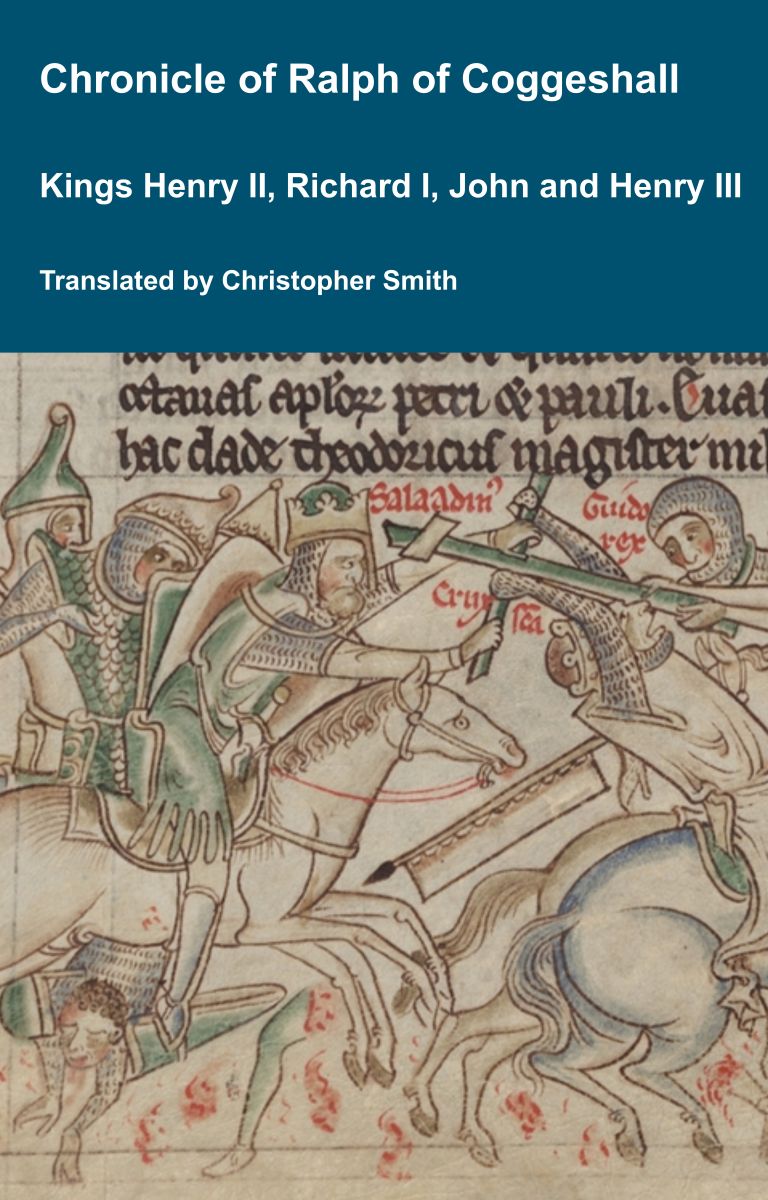
Chronicle of Abbot Ralph of Coggeshall
The Chronicle of Abbot Ralph of Coggeshall (Chronicon Anglicanum) is an indispensable medieval history that brings to life centuries of English and European affairs through the eyes of a learned Cistercian monk. Ralph of Coggeshall, abbot of the Abbey of Coggeshall in Essex in the early 13th century, continued and expanded his community’s chronicle, documenting events from the Norman Conquest of 1066 into the tumultuous reign of King Henry III. Blending eyewitness testimony, careful compilation, and the monastic commitment to record-keeping, this chronicle offers a rare narrative of political intrigue, royal power struggles, and social upheaval in England and beyond. Ralph’s work captures the reigns of pivotal figures such as Richard I and King John, providing invaluable insights into their characters, decisions, and the forces that shaped medieval rule. More than a simple annal, Chronicon Anglicanum conveys the texture of medieval life and governance, making it a rich source for scholars and readers fascinated by English history, monastic authorship, and the shaping of the medieval world.
Available at Amazon in eBook and Paperback format.
On 29th July 1399 William Scrope 1st Earl Wiltshire [aged 49], Henry Green of Drayton, Northamptonshire [aged 52] and John Bussy [aged 49] were beheaded at Bristol Castle, Gloucestershire [Map]. Earl Wiltshire forfeit.
Annals of King Richard II. When the Duke of Lancaster came to Bristol with his uncle, the Duke of York, the Earl of Northumberland, Henry, the son of the said Earl, and almost countless other lords and commoners, he sent to the keeper of the castle, Lord Peter Courtenay, whom the Duke of York had some time before appointed keeper there, ordering him to surrender the castle together with the aforementioned persons. He, however, resisted as much as he could, until the Duke of York, by the authority of his commission, ordered him to surrender the castle. The castle was surrendered, and permission was given for everyone to depart freely, except for three persons, namely William le Scrope, John Bussy, and Henry Green. These men were seized and committed to close custody in the evening, and in the morning [of 29th July 1399] were beheaded. For the lords were urged to pass such a sudden sentence upon them by the persistent clamour of the commons, who would have torn them to pieces if they could have done so in any way, and also by the news which came that day of the King’s landing in Wales, he having come from Ireland with a large army. They did not think it safe to carry these men about alive while such pressing anxiety remained. And therefore, as has been said, at the insistent demand of the people, they received the sorrowful sentence, while all the middling people of the realm rejoiced that so quickly, and so graciously, as it seemed to them, they were being freed from their most bitter enemies.
Cum enim Dux Lancastriæ, cum patruo suo, Duce Eboraci, Comiteque Northumbriæ, et Henrico, filio dicti Comitis, aliisque velut innumeris dominis et communibus, Bristolliam venisset, misit ad custodem Castri, Dominum Petrum Courtenay, quem ibi dudum [Dux] : Eboraci custodem constituerat, ut Castrum [cum] personis redderet prænotatis. Ille vero, quantum poterat, renitebatur; donee Dux Eboraci, auctoritate suæ commissionis, ut Castrum redderet demandasset. Redditum est Castrum, et facultas data cuilibet recedendi libere, exceptis personis tribus, videlicet, Willelmi Le Scrop, Johannis Bussy, et Thomæ Grene; hii namque capti sunt, et custodiæ forti commissi vespere, et mane decapitati. Urgebat nempe dominos ad ferendum in eos tam repentinam sententiam clamor importunus communitatis, quæ voluisset eos in frusta decerpsisse, si quomodolibet potuisset ; et nova quæ eo die venerunt de Regis applicatione in Walliam, qui cum exercitu de Hibernia venerat numeroso; quos non reputabant tutum vivos cireumducere, dum instaret tanta sollicitudo; et idcirco, ut præfertur, ad plebis importunam instantiam, tristem exceperunt sententiam, lætantibus cunetis regni mediocribus, quod tam cito, tam gratiose, prout eis videbatur, de infestissimis liberabantur hostibus.
Kings Gwynedd: Great x 11 Grand Son of Maredudd ab Owain King Deheubarth King Powys King Gwynedd
Kings Seisyllwg: Great x 13 Grand Son of Hywel "Dda aka Good" King Seisyllwg King Deheubarth
Kings Powys: Great x 11 Grand Son of Maredudd ab Owain King Deheubarth King Powys King Gwynedd
Great x 4 Grandfather: Simon Scrope  5 x Great Grandson of Maredudd ab Owain King Deheubarth King Powys King Gwynedd
Great x 3 Grandfather: Henry Scrope 6 x Great Grandson of Maredudd ab Owain King Deheubarth King Powys King Gwynedd
Great x 2 Grandfather: William Scrope 7 x Great Grandson of Maredudd ab Owain King Deheubarth King Powys King Gwynedd
Great x 4 Grandfather: Roger Brun
Great x 3 Grandmother: Juliane Brun
Great x 1 Grandfather: William Scrope 8 x Great Grandson of Maredudd ab Owain King Deheubarth King Powys King Gwynedd
Grandfather: Henry Scrope 9 x Great Grandson of Maredudd ab Owain King Deheubarth King Powys King Gwynedd
Father: Richard Scrope 1st Baron Scrope of Bolton 10 x Great Grandson of Maredudd ab Owain King Deheubarth King Powys King Gwynedd
William Scrope 1st Earl Wiltshire 11 x Great Grandson of Maredudd ab Owain King Deheubarth King Powys King Gwynedd
Great x 1 Grandfather: William Pole 
Grandfather: William Pole
Mother: Blanche Pole Baroness Scrope Bolton
Great x 1 Grandfather: Walter Norwich
Grandmother: Katherine Norwich