

In or before 1350 [his father] William Bussy [aged 24] and [his mother] Isabell Paynell were married.
Around 1350 John Bussy was born to William Bussy [aged 25] and Isabell Paynell.
On 24th October 1380 [his father] William Bussy [aged 55] died.
Before 27th October 1382 John Bussy [aged 32] and Matilda Neville [aged 21] were married.
Before 28th June 1386 [his wife] Matilda Neville [aged 25] died.
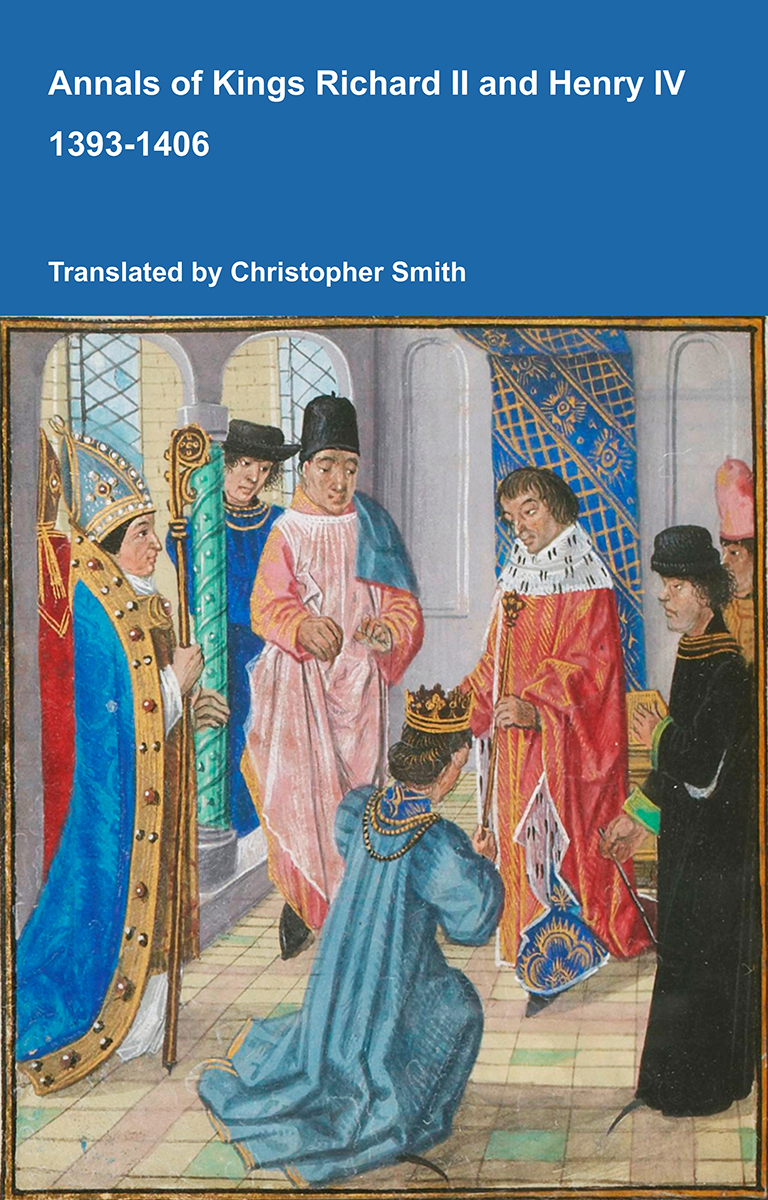 Annals of Kings Richard II and Henry IV. When the purpose of Parliament had therefore been read out, in which it was stated that the King had ordained it for the reform of various transgressions, oppressions, and armed ridings committed against the peace and against the King by the Duke of Gloucester and the Earls of Arundel and Warwick, treasonably and against the royal majesty, John Bussy [aged 47] immediately added his prologue, rehearsed long beforehand. Speaking on behalf of the whole Commons, he begged the King’s high excellency that such grave offences, and such harmful and weighty traitors, should be punished as they deserved; and especially the Archbishop of Canterbury, who sat beside the King, whom they called the greatest traitor of all. For although he ought, for many reasons, to have been more faithful to the King than the rest, he had craftily circumvented him by evil counsel and treasonous suggestions, by inducing the King to grant charters of pardon to his greatest traitor, the Earl of Arundel, his brother.
When the Archbishop wished to reply to these things, the King refused to give him an opportunity to answer. Instead, signalling silence to him with his hand, he ordered him to sit back down in his place, promising that all would be well enough for him if, on that occasion, he kept silent as the King had commanded. Next, John Bushy, pressing the business forward, asked that no time should be granted to the Archbishop to answer. "For," he said, "his intelligence is so great, and so far surpasses our understanding, that we fear his cunning would circumvent and injure us all." Therefore the Archbishop was not given the chance to reply. Instead, the King merely promised him very good hope, and a favourable end to the present disturbance.
John Bushy, in all his speeches, paid the King not human honours, but divine ones, inventing flattering and unusual words, wholly unfitting for mortals. Thus, whenever he addressed the King as he sat on his throne, with arms outstretched and hands raised in supplication, he would adore him, beseeching his, so to speak, exalted, lofty, adorable majesty, that he would deign to grant this or that. But the young King, eager for honours and fond of flattery, did not restrain these things as he ought to have done; rather, he took excessive delight in them.
Lecta igitur causa Parliamenti, in qua continebatur, quod Rex illud ordinaverat pro reformatione diversarum transgressionum, et oppressionum, et equitationum, contra pacem factarum, ac contra Regem, per Ducem Gloucestriæ, Comites Arundelliæ et Warwici, proditorie, et contra regiam majestatem; mox Johannes Bushy subjunxit suum prologum, diu ante repetitum, orans celsam Regis excellentiam, ex parte totius communitatis, ut tam graves defectus, tam nocivi, tam ardui proditores, ad condignum punirentur; et præcipue Archiepiscopum Cantuariensem, qui juxta Regem sedit, quem appellabant proditorem maximum; qui cum fuisse multis de causis fidelior Regi cæteris debuisset, eum per malum consilium, proditiosasque suggestiones, callide cireumvenit, inducendo Regem ut concederet chartas perdonationis suo maximo proditori, Comiti Arundellir, fratri suo.
Ad hæc cum Archiepiscopus respondisse voluisset, Rex noluit dare ei locum respondendi, sed manu sibi indicens silentium, jussit ut resideret in loco suo, promittens quod satis bene foret illi, si taceret, ut Rex jusserat, ea vice. Consequenter, Johannes Bussy, urgens negotium, rogavit ne concederetur Archiepiscopo tempus ad respondendum; — "Quia," inquit, "ejus ingenium tantum est, tamque nostros sensus præcellit, quod timemus quod ejus astutia nos omnes circumveniret, atque læderet." Igitur Archiepiscopo non dabatur respondendi copia, sed modo a Rege promittebatur spes optima, præsentisque perturbationis bonus finis.
Johannes Bussy in cunctis suis propositionibus non humanos honores exhibuit Regi, sed divinos, adinveniens verba adulatoria et insueta, mortalibus minime congruentia; ita ut quotiens Regem alloqueretur, in throno sedentem, extentis brachiis, supplicibus manibus eum adoraret, deprecans suam, ut ita dicam, excelsam, altam, adorandam, majestatem, ut hæc vel illa concedere dignaretur. At Rex juvenis, honores ambiens, adulationes diligens, hæc non repressit, ut decuit; sed in hiis nimium delectabatur.
Annals of Kings Richard II and Henry IV. The King had erected a very large building in the Palace of Westminster, which occupied almost the whole space of the palace. In it an extremely high throne was prepared for him, with a spacious place for all the estates of the realm; a place was specially assigned for the appellants on one side, and on the other side a place was assigned for the accused to make their answers. A separate place was provided for the knights of Parliament, who had not been elected by the community, as custom requires, but by the royal will. Their leader was Sir John Bussy [aged 47], a most cruel man, excessively ambitious, and greedy for another’s property; a man who, for earthly substance or for the attainment of honours, thought little of abandoning faith and conscience. Yet he was full of worldly prudence and cunning, and surpassed in eloquence all the knights of his rank; for this reason the King appointed him Speaker of the present Parliament. Associated with him, by the King’s connivance, were several others, who proposed to say or request nothing except what would please the royal will; and, on the other hand, whatever they were ordered on the King’s behalf to propose, request, and extort by insistent clamours, they were ready to do. But the chief of these were Sir Thomas [Henry] Green [aged 50]1 and Sir William Bagot, in no way unlike John Bushy in vices or sins.
Erexit autem Rex quamdam domum amplissimam in Palatio Westmonasterii, quæ pene totum spatium Palatii occupavit; in qua sibi thronus parabatur altissimus, et pro cunctis regni statibus locus largus, atque pro appellantibus in uno latere locus specialiter deputatus, et in alio latere locus reis pro responsis assignatus; seorsum vero pro militibus Parliamenti, qui non fuerunt electi per communitatem, prout mos exigit, sed per regiam voluntatem. Quorum primicerius fuit Dominus Johannes Bushi, vir crudelissimus, ambitiosus supra modum, atque rei alienæ cupidus; et qui, pro terrena substantia vel consequendis honoribus, fidem et conscientiam deserere parvipendit. Erat tamen sæculari prudentia plenus, et astutia, pollens eloquentin super cunctos ejus fortunæ milites; unde Rex constituit eum Prolocutorem præsentis Parliamenti. Associatique sibi fuere, Regis conniventia, plures alii, qui nihil dicere vel petere proponebant, nisi quod placeret Sregiæ voluntati; et e contra, quiequid jussum foret eis ex parte Regis, proponere, petere, et importunis clamoribus extorquere, parati fuerunt. Sed horum præcipui fuerunt Dominus Thomas Grene et Dominus Willelmus Bagot, in nullo dispares Johannis Buschi in vitiis aut peccatis.
Note 1. Throughout the text the Chronicler refers to Henry Green as Thomas. Henceforward we have adopted Henry.
Chronicle of Adam of Usk [~1352-1430]. 18th September 1397. On the Tuesday (18th September), sir John Bushy [aged 47]1 was by the commons presented to the king their speaker in parliament, he making first due declaration; and the king accepted him.
Then straightway spake he thus before the king: "In that, my lord the king, we are bound by your dread command to make known to your royal highness who they be who transgressed against your majesty and royalty, we say that Thomas, duke of Gloucester, and Richard, earl of Arundel, did, in the tenth year of your reign, traitorously force you, by means of him who is now archbishop of Canterbury2, and who was then chancellor, thereby doing you grievous wrongs, to grant to them a commission to govern your kingdom and to order its estate, to the prejudice of your majesty and royalty."
Also, the same day, that same commission was made of none effect, with all and every the acts thereon depending or thereby caused.
Also, a general pardon, granted after the great parliament by their means, and a special pardon granted to the earl of Arundel were recalled3. It was also prayed by the
Note 1. Bushy had been first elected speaker of the commons in 1394.
Note 2. Thomas Fitzalan, also called Arundel, was the third son of Richard, ninth earl of Arundel. He had been made bishop of Ely, in 1374, when in his twenty-second year, was translated to York in 1388, and to Canterbury in 1396. He was banished by the present parliament of 1397, and received from the pope translation to the see of St. Andrew's in partibus infidelium, the same appointment which had been conferred upon Alexander Nevill, his predecessor at York. He was restored to Canterbury on Henry's accession, and lived to the year 1413.
Note 3. This special pardon had been granted to the earl of Arundel on the 30th of April, 13894, and was the more binding on Richard as it was granted at a time when he was his own master and entirely free from coercion.

On 7th July 1399 Edmund of Langley 1st Duke of York [aged 58] appointed William Scrope 1st Earl Wiltshire [aged 49], Henry Green of Drayton, Northamptonshire [aged 52] and John Bussy [aged 49] to protect Kent against invasion by Henry Bolingbroke Earl of Derby [aged 32].
On 28th July 1399 William Scrope 1st Earl Wiltshire [aged 49], Henry Green of Drayton, Northamptonshire [aged 52] and John Bussy [aged 49] were captured at Bristol Castle, Gloucestershire [Map].
On 29th July 1399 William Scrope 1st Earl Wiltshire [aged 49], Henry Green of Drayton, Northamptonshire [aged 52] and John Bussy [aged 49] were beheaded at Bristol Castle, Gloucestershire [Map]. Earl Wiltshire forfeit.
Annals of Kings Richard II and Henry IV. When the Duke of Lancaster came to Bristol with his uncle, the Duke of York, the Earl of Northumberland, Henry, the son of the said Earl, and almost countless other lords and commoners, he sent to the keeper of the castle, Lord Peter Courtenay, whom the Duke of York had some time before appointed keeper there, ordering him to surrender the castle together with the aforementioned persons. He, however, resisted as much as he could, until the Duke of York, by the authority of his commission, ordered him to surrender the castle. The castle was surrendered, and permission was given for everyone to depart freely, except for three persons, namely William le Scrope [aged 49], John Bussy [aged 49], and Henry Green [aged 52]. These men were seized and committed to close custody in the evening, and in the morning [of 29th July 1399] were beheaded. For the lords were urged to pass such a sudden sentence upon them by the persistent clamour of the commons, who would have torn them to pieces if they could have done so in any way, and also by the news which came that day of the King’s landing in Wales, he having come from Ireland with a large army. They did not think it safe to carry these men about alive while such pressing anxiety remained. And therefore, as has been said, at the insistent demand of the people, they received the sorrowful sentence, while all the middling people of the realm rejoiced that so quickly, and so graciously, as it seemed to them, they were being freed from their most bitter enemies.
Cum enim Dux Lancastriæ, cum patruo suo, Duce Eboraci, Comiteque Northumbriæ, et Henrico, filio dicti Comitis, aliisque velut innumeris dominis et communibus, Bristolliam venisset, misit ad custodem Castri, Dominum Petrum Courtenay, quem ibi dudum [Dux]: Eboraci custodem constituerat, ut Castrum [cum] personis redderet prænotatis. Ille vero, quantum poterat, renitebatur; donee Dux Eboraci, auctoritate suæ commissionis, ut Castrum redderet demandasset. Redditum est Castrum, et facultas data cuilibet recedendi libere, exceptis personis tribus, videlicet, Willelmi Le Scrop, Johannis Bussy, et Thomæ Grene; hii namque capti sunt, et custodiæ forti commissi vespere, et mane decapitati. Urgebat nempe dominos ad ferendum in eos tam repentinam sententiam clamor importunus communitatis, quæ voluisset eos in frusta decerpsisse, si quomodolibet potuisset; et nova quæ eo die venerunt de Regis applicatione in Walliam, qui cum exercitu de Hibernia venerat numeroso; quos non reputabant tutum vivos cireumducere, dum instaret tanta sollicitudo; et idcirco, ut præfertur, ad plebis importunam instantiam, tristem exceperunt sententiam, lætantibus cunetis regni mediocribus, quod tam cito, tam gratiose, prout eis videbatur, de infestissimis liberabantur hostibus.
Parliament Rolls Richard II. 15. Also, as to the fourth article, touching the expenses of the king's household and the presence of bishops and ladies in his company, the king took great offence and affront in that the commons who were his lieges should wrongly take upon themselves or presume any ordinance or governance of the kingking's person, or his household, or other persons of standing whom it should please him to have in his company. And it seemed to the king that the commons committed a great offence therein against his regality and his royal majesty, and the liberty of himself and his honourable progenitors, which he was bound and willed to maintain and sustain by the aid of God. Wherefor the king ordered the said lords spiritual and temporal that on the following Saturday morning [3 February 1397] they should explain and declare in full to the said commons the king's will in the matter. And further, the king understanding that the said commons had been influenced and informed by a bill delivered to them to present and explain the said last article, so he ordered the duke of Guyenne and of Lancaster to charge Sir John Bushy, speaker for the commons, on his allegiance to recount and tell him the name of whomsoever submitted the said bill to the said commons.


Chronicle of a Bourgeois of Valenciennes
Récits d’un bourgeois de Valenciennes aka The Chronicle of a Bourgeois of Valenciennes is a vivid 14th-century vernacular chronicle written by an anonymous urban chronicler from Valenciennes in the County of Hainaut. It survives in a manuscript that describes local and regional history from about 1253 to 1366, blending chronology, narrative episodes, and eyewitness-style accounts of political, military, and social events in medieval France, Flanders, and the Low Countries. The work begins with a chronological framework of events affecting Valenciennes and its region under rulers such as King Philip VI of France and the shifting allegiances of local nobility. It includes accounts of conflicts, sieges, diplomatic manoeuvres, and the impact of broader struggles like the Hundred Years’ War on urban life in Hainaut. Written from the perspective of a burgher (bourgeois) rather than a monastery or royal court, the chronicle offers a rare lay viewpoint on high politics and warfare, reflecting how merchants, townspeople, and civic institutions experienced the turbulence of the 13th and 14th centuries. Its narrative style combines straightforward reporting of events with moral and civic observations, making it a valuable source for readers interested in medieval urban society, regional politics, and the lived experience of war and governance in pre-modern Europe.
Available at Amazon in eBook and Paperback format.
Parliament Rolls Richard II. 7. Also, the following Tuesday [23 January 1397], the commons presented Sir John Bushy as their common speaker, with whom the king was well pleased. And then the said Sir John prayed of the king that he might make a protestation that if he should say anything through ignorance or otherwise which had not been agreed by his companions, etc., that he might be corrected by his said companions; to which the king agreed, as he should by right and reason. And on the same day the duke of Lancaster asked the king to do justice to Sir Thomas Talbot, etc.. And then the chancellor explained to the commons that although he had explained in general the reason for summoning the parliament, on the morrow following, at eight o'clock [24 January 1397], the officers would explain it more particularly, that the commons might be better informed; and they were ordered to make haste in the business of parliament. And later the chancellor, at the king's command, charged all the lords spiritual and temporal to be at parliament each day at nine o'clock at the latest, and that no lord should absent himself in any way without the special permission of the king himself.