The History of William Marshal was commissioned by his son shortly after William’s death in 1219 to celebrate the Marshal’s remarkable life; it is an authentic, contemporary voice. The manuscript was discovered in 1861 by French historian Paul Meyer. Meyer published the manuscript in its original Anglo-French in 1891 in two books. This book is a line by line translation of the first of Meyer’s books; lines 1-10152. Book 1 of the History begins in 1139 and ends in 1194. It describes the events of the Anarchy, the role of William’s father John, John’s marriages, William’s childhood, his role as a hostage at the siege of Newbury, his injury and imprisonment in Poitou where he met Eleanor of Aquitaine and his life as a knight errant. It continues with the accusation against him of an improper relationship with Margaret, wife of Henry the Young King, his exile, and return, the death of Henry the Young King, the rebellion of Richard, the future King Richard I, war with France, the death of King Henry II, and the capture of King Richard, and the rebellion of John, the future King John. It ends with the release of King Richard and the death of John Marshal.
Available at Amazon in eBook and Paperback format.
The Deposition of King Richard II. 12th August 1299. Then King Richard wisely replied: "Northumberland, withdraw: ere it be long you shall have our answer, that you may speedily depart."Then might you see them separate. They discoursed long upon the matter of which they had heard the earl speak; till at last the king said,t "Fair sirs, we will grant it to him, for I see no other way. You perceive, as well as myself, that all is lost. But I swear to you, that whatever assurance I may give him, he shall for this be surely put to a bitter death for the outrage and injury that he hath done unto us. And doubt it not, no parliament shall be held at Westminster upon this business; for I love you so entirely, that I would not suffer you to come to parliament to die, for the fulfilment of his pleasure; for I know full well that he would make you suffer most heavy penalty, and that you would be in very great danger of being put to bitter and certain death, seeing many murmur against you. Yet fear not, my good friends, but that in spite of them, you shall ever be my nearest friends, for I have always found you, without evil intention, good and loyal. Moreover, I tell you, that I will summon and secretly bring together men throughout Wales that may be ready for us on a certain day. When we have spoken with Duke Henry, we will then take our way through Wales; and if he should ask us wherefore we do so, we will tell him that there is no victuals (not a penny-worth) the other way, since his people and his army have wasted every thing, and that we are going that way, lest provisions fail us. Thus will we say to him, if it seem good unto you, and I believe that he will readily agree to it. The earl hath told us so. And when we shall have found our people assembled, we will display our banners to the wind, and suddenly march with vigour against him. For I am sure of it, as of my death, that when they shall behold my arms, they will be so sorry at heart for the wrong that they have done unto me, that the half of those who have gone along with him, will desert him, and indeed come over to us. For good and faithful heart can never prove false; and nature will bring to their remembrance, that during my life, they ought to hold me as their rightful lord. You will then see them come to us straightways, and you will know that we have right (on our side). God, if we trust in him, will aid us. If we are not so much in our place as they shall be, yet, please God, they shall not chuse but fight us; and if they be in any wise discomfited they shall be put to death. There are some of them whom I will flay alive. I would not take all the gold in the land for them; please God, I continue alive and well."
Note t. "He then consulted with his friends, Carlisle, Salisbury, Scroope, Ferriby, and Jenico in the chapel of the castle, and said to them, ' Gentlemen, you have heard what the earl says: what think you of it?' To which they replied, 'Sir, do you speak first.' The king answered, 'It seems to me that a good peace may be made between us two, if it be as the earl says. But, in truth, whatever agreement or peace he may make with me, if I can ever get him to my advantage, I will cause him to be foully put to death, just as he hath earned."1
Note 1. MS. Ambassades, p. 135. Mr. Allen's Extracts. Galliard interprets it, "I shall no more scruple to put him to death, than he did to gain the upper hand of me." Accounts and Extracts, II. p. 219. This is, however, too periphrastic. The original words are simply, "Je leferay mourir mauvaisement, ainsi comme il ti gaognie."2
The commonly received opinion, which has been echoed by many writers, was, that Richard, desiring a conference at Conway with the Archbishop of Canterbury and Earl of Northumberland, and of his own accord declaring himself ready to resign, first stipulated for his own maintainance, and for the security of eight persons whom he should name. "Indicavit se velle regno cedere, si sibi victus honorificus vitaeque securitas octo personis, quos nominari vellet, fide interposita, donaretur."1a Whether Henry was willing to grace his new authority by forbearance towards the king's adherents, or whether Richard was afterwards able to negociate for those whom the duke had threatened to bring before the parliament is immaterial: it is, however, plain, that excepting Jenico, whose resistance procured him a temporary confinement, they all remained unprosecuted and at large. But, as to Richard's spontaneous offer of resignation at this time, it may easily be understood that reports like these were propagated to encourage a persuasion that it was an act proceeding entirely from his consciousness of the difficulties to which he had been reduced by his inability to govern, and that it was not forced upon him by his adversaries. Richard himself in this genuine narrative holds no language which can induce a belief of this nature; he never hints at a wish to lay aside the burden of power in his message to Chester, his conference with Northumberland, or consultation with his little band of friends. On the contrary, he contemplates the future exercise of it in retaliation upon his aggressors, and merely in a general way accedes to the propositions of the earl, that he may escape from a part of his difficulties, with the confident expectation of his entire ability to screen his faithful servants. Salisbury, Scroope, and Merks, the only three present of those who were threatened with prosecution, are satisfied with his assurance of protection, and agree that at all hazards it would be well to close with the duke's conditions of peace.
But the king's pretended readiness to abandon his high estate was more industriously endeavoured to be established by an artifice that reflects little credit upon his successor. The story of what passed at Conway relative to the negociation is given in the text with such an appearance of truth, and is so coherent in all it's parts, that it may very properly be taken to correct the variety of suspicious statements with which ignorance or wilfulness have clouded the affair. One of these is of too grave a kind to be passed over. Comparing it with the statements of our author, I am reluctantly compelled to look upon the ground of Richard's retirement from the throne, given in the Roll of Resignation deposited in the Archives of England, to be a gross fabrication published by Henry IV. for purposes of state. In order to colour the transaction and make the renunciation appear more voluntary than it really was, it is entered upon the roll that the Earl of Northumberland in the presence of the Archbishop ofCanterburyandtherestofthecommissionersin the Tower, "remembered King Richard of hispromise made to the said Archbishop, and to him the said earl at Conway in Wales, at what time the same King Richard was at liberty, how that he, for certain defaults and inabilities in himself to rule, would renounce and give up the crowns of England and France, with the whole rule of the same, and that by the best advice that could be devised; King Richard thereto mildly answered, that he would willingly accomplish the same."1b
Note 2. "I will make him die miserably, just as he has earned it."
Note 1. Walsing. Hist. Angl. p. 358. "He informed them that he was willing to abdicate the throne if he were granted an honorable livelihood and security for the lives of eight persons whom he would name, under a pledge of good faith."
Note 1b. Cotton's Abridgement, p. 385. There is an overstrained affectation of cheerful acquiescence in the report of his renunciation, which defeats itself. The parties are all very courteous, and happy in each other's society while it lasts. "After familiar talk had between the king, the duke, and archbishop, the instrument was ordered to be read; but the king willingly and cheerfully took and read it throughout." The whole is curious; and, I fear, in many particulars, a piece of deliberately recorded falsehood. Ut supra, p. 386.
In 1397 Bishop Thomas Merke served King Richard II of England [aged 29] as Ambassador to various German Princes.
Around 23rd April 1397 Bishop Thomas Merke was consecrated Bishop of Carlisle.
On 16th April 1399 King Richard II of England [aged 32] wrote his Last Will from which the following extracts are taken … Also we bequeath to our beloved nephew Thomas Holland 1st Duke Surrey [aged 25] ten thousand marks and to our beloved brother Edward 2nd Duke of York 1st Duke Albemarle [aged 26] two thousand marks and to our beloved brother John Holland 1st Duke Exeter [aged 47] three thousand marks and to our faithful and beloved William Scrope 1st Earl Wiltshire [aged 49] two thousand marks... we ordain and set aside for the fulfilment of all and singular the premises the sum of ninety-one thousand marks, of which sixty-five thousand marks are in the keeping of Sir John Ikelyngton and twenty-four thousand marks in the hands and keeping of our dear nephew Thomas Holland 1st Duke Surrey.
Of this our royal testament we nominate make and depute executors the venerable fathers in Christ Bishop Richard Mitford, Bishop Edmund Stafford [aged 55], Bishop Robert Tideman of Winchcombe, Bishop Thomas Merke and Bishop Guy Mone Aka Mohun; our beloved brother Edward 2nd Duke of York 1st Duke Albemarle, our nephew Thomas Holland 1st Duke Surrey, our brother John Holland 1st Duke Exeter and William Scrope 1st Earl Wiltshire to each of whom we bequeath a gold cup of the value of twenty pounds and our beloved and faithful clerks Master Bishop Richard Clifford Keeper of our Privy Seal, Master Richard Maudeleyn, Master William Fereby and Master John Painter Ikelyngton clerks and John Lufwyk and William Serle laymen, to each of whom we will shall be paid their expenses and necessary costs while it shall happen that they or any of them are employed about the execution of our present last will, but according to the discretion of their said co-executors...
Whom all and singular we have charged and charge that they shall do as much as in them is for the due execution and fulfilment of this our last will as they shall wish to answer before God. We create ordain depute and make overseers of this our will the reverend fathers in Christ Archbishop Roger Walden and Archbishop Richard Scrope [aged 49], William bishop of Winchester and William abbot of the monastery of Westminster Edward 2nd Duke of York 1st Duke Albemarle our uncle and Henry Percy 1st Earl of Northumberland [aged 57] our cousin.
In May 1399 King Richard II of England [aged 32] travelled to Ireland with Bishop Thomas Merke, Rhys ap Tudor and Gwilym ap Tudor Tudor.
Accounts and Extracts. August 1399. Another advantage the duke of Lancaster derived from the arrival of the earl of Huntingdon was, to oblige him to write to the king, that he might place an entire confidence in the earl of Northumberland, who was sent by the duke of Lancaster,and was charged with this letter. When he appeared before the king, with seven attendants, he was asked by him, if he had not met his brother on the road? "Yes, sire, "he answered, "and here is a letter he gave me for you." Northumberland dedemanded no other conditions of peace, on the part of the duke of Lancaster, but that the possessions of the house of Lancaster should be restored, and that he should be created lord chief justice. The king deliberated in private with his friends, and immediately imparted to them a secret he might have dispensed with. "Whatever agreement or peace, " says he, "he makes with me, if ever I can take him at an advantage, I shall no more scruple to put him to death, than he did to gain the upper hand of me." However, the terms offered were so reasonable, that they could not be rejected. The bishop of Carlisle only advised him to take the precaution of making Northumberland swear by the gospels and the eucharist. He swore, "and might" be compared, "says our author, "to Judas, or Ganelon, for he perjured himself on the body of our Lord."
The Deposition of King Richard II. 12th August 1399. Then the earl went on board a vessel and crossed the water. He found King Richard, and the Earl of Salisbury [aged 49] with him, as well as the Bishop of Carlisle. He said to the king,p "Sire, Duke Henry hath sent me hither to the end that an agreement should be made between you, and that you should be good friends for the time to come, — If it be your pleasure, Sire, and I may be heard, I will deliver to you his message, and conceal nothing of the truth; — If you will be a good judge and true, and will bring up all those whom I shall here name to you, by a certain day, for the ends of justice; listen to the parliament which you shall lawfully cause to be held between you at Westminster, and restore him to be chief judge of England, as the duke his fatherq and all his ancestors had been for more than an hundred years. I will tell you the names of those who shall await the trial. May it please you, Sire, it is time they should."
Note p. We are here supplied with some additional matter from the MS. Ambassades. Huntingdon, by command of the duke, sent one of his retinue after Northumberland with two letters, one for Northumberland, the other for the king. When he appeared before the king with seven attendants, he was asked by him, if he had not met his brother on the road? "Yes, Sire," he answered," and here is a letter he gave me for you." The king looked at the letter and the seal, and saw that it was the seal of his brother; then he opened the letter and read it. All that it contained was this, "My very dear Lord, I commend me to you: and you will believe the earl in every thing that he shall say to you. For I found the duke at my city of Chester, who has a great desire to have a good peace and agreement with you, and has kept me to attend upon him till he shall know your pleasure."2 When the king had read this letter, he turned to Northumberland, and said, "Now tell me what message you bring." To which the earl replied, "My very dear Lord, the Duke of Lancaster hath sent me to you, to tell you that what he most wishes for in this world is to have peace and agreement with you; and he greatly repents with all his heart of the displeasure that he hath caused you now and at other times; and asks nothing of you in this living world, save that it may please you to account him your cousin and friend; and that it may please you only to let him have his land; and that he may be chief judge of England, as his father and his predecessors have been, and that all other things of time past may be put in oblivion between you two; for which purpose he hath chosen umpires (juges) for yourself and for him, that is to say, the Bishop of Carlisle, the Earl of Salisbury, Maudelain, and the Earl of Westmorland; and charges them with the agreement that is between you and him. Give me an answer, if you please; for all the greatest lords of England and the commons are of this opinion." On which the king desired him to withdraw a little, and he should have an answer soon.1
The latter part of this speech contains an important variation from the metrical history, worthy of the artifice of the earl; but the opposite account of our eye-witness, confirmed in Richard's subsequent address to his friends, is doubtless the true representation. The writer of MS. Ambassades might be at this time at Chester; but admitting that he had been in the train of Northumberland on the journey, he could not have been present at the conference.
Note 2. Accounts and Extracts, II. p. 219.
Note 1. MS. Ambassades, pp. 134, 135. Mr. Allen's Extracts.
Note q. The style of the duke his father was, John, the son of the King of England, Duke of Guienne and Lancaster, Earl of Derby, Lincoln, and Leicester, Steward of England.2 " The word seneshal," says Rastall, "was borrowed by the French of the Germans; and signifies one that hath the dispensing of justice in some particular cases, as the High Steward of England;"1a the jurisdiction of his court, by the statute,2a" shall not pass the space of twelve miles to be counted from the lodgings of our Lord the King."
These "particular cases" would, however, have secured to him a power of exercising his vengeance upon the parties who are immediately afterwards named. But the request urged with such apparent humility was only a part of the varnish of the plot. He had not waited for Richard's consent, having already, within two days after his arrival at Chester, assumed the title upon his own authority. In Madox, Formulare Anglicanum, p. 327, is a letter of safe conduct from Henry to the prior of Beauval, dated from that place, August 10, 23 Richard II. in which he styles himself" Henry, Due de Lancastre,Conte de Derby, de Leycestre, de Herford, et de Northampton, Seneschal d'Angleterre."
He conferred the office upon Thomas, his second son, by patent dated October 8, 1399; constituting at the same time Thomas Percy Deputy High Steward during the minority of the prince.3a
Note 2. Cotton's Abridgement, p. 343.
Note 1a. Termes de la Ley. v. Sene
Note 2a. 13 Ric. II. St. 1. c. 3.
Note 3a. Rymer, Fœdera, VIII. p. 90.
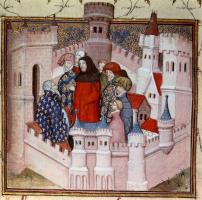
Illustration 11. King Richard II of England [aged 32], standing in black and red, meeting with Henry Percy 1st Earl of Northumberland [aged 57] at Conwy Castle [Map].
Annals of Kings Richard II and Henry IV. Meanwhile the King, moving himself here and there, fled at one time to Anglesey, at another to the castles of Conwy, Beaumaris, Flint, and Holt, where a great part of his treasure had been kept. But at last, when there was no hope of escape, he sent the Duke of Exeter, his brother, to the Earl of Northumberland and the Lord Archbishop of Canterbury, although the latter had been deprived of his bishopric by the same King, as was said above, asking to have a conference with them. They, being sent by the Duke, spoke with him [on 12th August 1399] at Conwy [Map] in North Wales. To them the King made known his intention, namely that he wished to resign and to be free from the burden of governing, provided only that he should not be killed, but that honourable maintenance should be provided for him, and that security of life should be granted, with faith pledged, both to him and to the eight persons who were with him. Among these, they say, were the Dukes of Exeter, Aumale, and Surrey, the Earls of Salisbury and Gloucester, Thomas Merke, Bishop of Carlisle, John Maudelyn, clerk, and others.
Rex interea, huc illucque se conferens, quandoque fugit Angliseiam, quandoque ad Castrum de Conewey, de Beumarreys, de Flynt, [et] de Holt, in quo magna pars fuerat thesauri sui. Sed tandem, cum nulla spes esset subterfugiendi, misit Ducem Exoniæ, fratrem suum, ad Comitem Northumbriæ et Dominum Archiepiscopum Cantuariæ, (sed tamen privatum per eundem, ut præmittitur, Episcopatu,) petens habere colloquium cum eisdem. Qui, a Duce missi, collocuti sunt cum eo apud Conewey, [in] Nortwallia Quibus Rex intimavit suum propositum, quod, videlicet, desideravit cedere, et sollicitudine gubernandi carere, ita duntaxat, ut non occideretur, sed victus sibi honorificus provideretur, vitæque securitas sibi et octo personis qui cum eo erant, fide interposita, donaretur; e quibus ferunt fuisse Duces Exoniæ, Albemarle, Southereyæ, et Comites Sarum [et] Gloucestriæ, Episcopum Karleolensem Thomam Meerk, Johannem Magdelene, clericum, etc.
Annals of Kings Richard II and Henry IV. When these things had been done, the Bishop of Carlisle rose to excuse himself concerning anything objected against him by suspicion, which he intended to prove false. The king said to him that he ought not to be judged in that case, but should be called to account in an ecclesiastical court. Nevertheless, after making a protestation that he did not wish to derogate from the right or liberty of the Church, he asked more urgently that his excuse might be heard. He very fully declared his innocence concerning many crimes which had been imputed to him only on suspicion, and concerning the conspiracy in the death of the duke, and so on. Afterwards he complained that he had long been under arrest. To this it was immediately answered that he had not been under arrest, but had been committed to safe custody for his own protection, and to avoid the hatred of the common people which they had conceived against him. Now, however, he was free to go wherever he wished. But nevertheless, for the sake of propriety, he was advised to return to the Abbot of St Albans, in whose company he had already stayed for some time by the king’s command, and to remain there until the world, through the calming of the common people, should smile more favourably upon him. And he did so for some time.
Hiis itaque gestis, Episcopus Carleolensis surrexit, ut excusaret se de quibuslibet objectis contra eum per suspicionem, quam intendit probare fallacem. Cui Rex dixit, non debere eum in illa causa judicari, sed in Curia Ecclesiastica fore conveniendum. Ille tamen, facta protestatione quod noluit derogare juri Ecclesiæ, vel libertati, rogavit instantius, ut excusatio sua posset audiri; declaravitque peroptime suam innocentiam de multis criminibus quæ ex suspicione tantum’ fuerunt sibi imputata, et de conspiratione in mortem Ducis, etc. Expost conquestus est quod diu fuerat sub aresta. Cui mox responsum fuit, quod non sub aresta, sed fuisse salvæ custodiæ commendatum pro tutela sua, et ad declinandum odium vulgi, quod conceperant contra eum; jam vero licere sibi pergere libere quocunque vellet. Sed tamen consultum est sibi, propter honestatem, ut rediret ad Abbatem Sancti Albani, in cujus comitiva jam moram traxerat, jussu Regis, et ibi permaneret, donec mundus, ex conquietatione vulgi, felicior arrideret; et fecit sic per tempus aliquod.
Annals of Kings Richard II and Henry IV. On that same day [29th October] all the temporal lords assembled in Parliament, among them also the Bishop of Carlisle. When they had sat down, the record concerning those who had appealed the Duke of Gloucester and others in the Parliament held in the twenty-first year of the late King Richard was about to be read. The Duke of Aumale, having heard the record, immediately rose and acknowledged that he had indeed been an appellant, but had never consented to the death of the Duke of Gloucester. Against him, however, Lord FitzWalter, as on other occasions, offered to prove by duel that he had been the cause of the killing. Then the Duke of Surrey, the Duke of Exeter, the Marquess of Dorset, and the Earls of Gloucester and Salisbury acknowledged the same about themselves, namely that they admitted they had been appellants, but had not consented to the duke’s death. Against the Earl of Salisbury, Thomas, Lord Morley, rose and objected that he had been the cause of the duke’s death, and asserted that he wished to prove it by duel. "For you," he said, "false and double-dealing man, betrayed the duke’s counsels to the king. When he most trusted in your loyalty, you deceitfully procured him to be indicted." And saying these things, he threw down his pledge against him. The earl himself, no less promptly, threw down his pledge against Lord Morley, asserting that he was ready to clear his innocence in this matter by duel. But because this case could not be decided on the present day, the next Monday [3rd November] after the feast of All Saints was appointed for the examination of the aforesaid case by the constable and marshal.
Ipso die convenerunt in Parliamentum omnes Domini temporales, inter quos et Episcopus Carleclensis. Et cum consedissent, lecturus fuit recordum de appellantibus Ducem Gloucestriæ, ete, in Parliamento tento vicesimo primo anno nuper Regis Ricardi. Dux de Almarle, audito recordo, surrexit illico, et fatebatur se quidem appellantem fuisse, sed nunquam in mortem Ducis Gloucestriæ consensisse. At contra, Dominus Fiz-Water, sicut alias, obtulit se duello probaturum quod ipse causa fuerat necis; cum Dux Southerey, Dux de Excestre, Marchio Dorcete, Comites Gloucestre atque Sarum, idem de ipsis fatebantur, ut se concederent appellantes, sed non consensisse in mortem Ducis. Contra Comitem Sarum surrexit Thomas, Dominus de Murlee, et objecit quod ipse causa fuerat mortis Ducis; et asseruit se velle duello probare. "Nempe tu," inquit, "falsus et ambidexter, prodidisti consilix Ducis Regi. Qui cum maxime in tua fide confideret, tu eum dolose procurasti indictari." Et hæc dicens, projecit vadium suum contra eum. Comes et ipse, nihil segnior, projecit vadium contra Dominum de Morlee, asserens se paratum ad purgandum duello suam innocentiam in hac parte. Sed quia die præsenti non poterat hæc causa discindi, ideo datus est dies Lunæ proximus post festum Omnium Sanctorum examinationi causæ prædictæ, per Constabularium et Marescallum.
In 1400 Bishop Thomas Merke was imprisoned in the Tower of London [Map] and deprived of his Bishopric.
Annals of Kings Richard II and Henry IV. Afterwards, in London, the clerics Maudelyn and William Ferby were condemned. They ended their lives by being drawn, hanged, and beheaded. Bernard Brocas [aged 46] and John Schevele, knights, and several others whose names we do not have, suffered a similar fate of death. The Bishop of Carlisle, accused of having given consent and counsel to the traitors, when he did not know how to answer, was condemned to death. Nevertheless, by the king’s mercy, he was kept alive in the Tower. The Abbot of Westminster, and Roger Walden, who had formerly ascended the throne of Canterbury, in what manner God knows, were, after questioning and answer, set free.
Expost Londoniis damnati sunt clerici, Magdelene et Willelmus Ferby, qui tractione et suspensione, atque capitis detruncatione, vitam finierunt. Bernardus Brocas et Johannes Schevele, milites, et plures alii, quorum nomina non tenemus, habuerunt similem mortis sortem. Episcopus Carleolensis, impetitus de consensu et consilio perlato proditoribus, dum respondere nescit, ad mortem damnatus est; sed tamen, Regis misericordia, in Turri vivus servabatur. Abbas Westmonasterii, et Rogerus Walden, qui dudum ascenderat thronum Cantuariensem, qualiter Deus novit, post interrogationem et responsionem, liberi dimittuntur.
Annals of Kings Richard II and Henry IV. In this year, the pope, out of regard for certain nobles, transferred the Bishop of Carlisle, Master Thomas Merke, to the bishopric of [….]1, from which he would receive neither fruits nor revenues. Therefore, a little later, he granted him the favour of one benefice, or of several, up to the value of five hundred marks, which the same Thomas was to accept in the diocese. Master William Strickland succeeded him in the bishopric of Carlisle.
Hoc anno, Papa, quorundam magnatum intuitu, transtulit Episcopum Carleolensem, Magistrum Thomam Merk, ad Episcopatum [....], unde nec fructus perciperet, nec proventus; et idcirco, paulo post fécit ei gratiam de uno beneficio, vel de pluribus, ad taxam quingentarum marcarum, quæ idem Thomas duceret, acceptanda in Dicecesi. Successit ei, in Episcopatum Karleolensem, Magister Willelmus Styrkelond.
Note 1. The name is absent in the Latin text. Bishop Thomas Merrke appears to have been appointed to the See of Salmasa aka Samastone, the location of which is uncertain. Le Quien identified it as Salmasa / Salmastrum, east of Nineveh, while the form Samastenus may instead point to Samosata, an ancient city located on the banks of the Euphrates River in modern-day southeastern Turkey. It was effectively a titular or non-functioning see for Merke.
In 1409 Bishop Thomas Merke died.
The Deposition of King Richard II. "Yes, (tell me them,) I desire to know who they are." "Know, Sire, that the first is your brother; the second who hath behaved amiss is the Duke of Surrey, who is, indeed, put in prison in the castle of Chester, for some offence committed against Duke Henry. Another is the Earl of Salisbury, together with the Bishop of Carlisle; the fifth, as I have heard my lord say, is Maudelain.r These are they who agreed and counselled you to put your uncle most wrongfully to death; and if they deny it, they await the judgment of your parliament, wherein you shall be highly crowned a sovereign king. There also shall Duke Henry be chief judge. Those who have been guilty of crime or treason shall be punished without partiality. Such is the determination of my lord. Certes, dear Sire, he would do nothing that is foolish or unreasonable. I would moreover speak to you of another thing; that you will speedily appoint the day; for there is nothing in the world that he more desireth; I know it well; and he wisheth for nothing but his land, and that which appertaineth to him; neither would have any thing that is yours,s for you are his immediate, rightful king; and he regretteth in his conscience the great mischief and wrong that he hath done unto you, through the evil persuasion of the enemy, who never slumbereth nor sleepeth, but is ever watchful to tempt mankind. It is he who hath whispered to him all that he hath done. Wherefore, for the sake of him who suffered unparalleled death for us upon the cross, may it please you, be gentle unto my lord, who is sorrowful and afflicted, and for once lay aside your wrath; and he will most humbly come on his knees before you, and sue for mercy. This done, together shall ye go to London, like devout and peaceful men; or, if you choose to go a different road you shall take it; and then shall the parliament be proclaimed throughout the land. Be sure of all this: I will swear to it upon the body of our Lord, consecrated by the priest's hand, that Duke Henry shall most faithfully observe all that I have said, and every thing as I have told you; for he solemnly pledged it to me upon the sacrament when last we parted. Now consider, Sire, how you will act, for I have tarried long."
Note r. Richard Maudelain, a priest of the chapel royal, who resembled the king so much in size, feature, and speech, that he was employed by the insurgents at Christmas to personate him in the army.
Un chapellain, [A chaplain,]
Qui resembloit si de certain [Who resembled so certainly]
Au bon roy Richart de visage, [The good King Richard in face,]
De corps, de fait, et de langage, [In body, in deed, and in speech,]
Qu'il n'est homme qui le vist [That there was no man who saw him]
Qui ne ccrtifiast et dist [Who did not affirm and say]
Que ce fust le roy ancien. [That it was the former king.]
This man appears to have been one of the most obsequious and daring of Richard's creatures; and served him in several confidential and difficult undertakings.1 Thus he was sent to bring over money from Ireland; and to attend the corpse of the Duke of Gloucester from Calais to London.2 The king gave him some property in Fleet-street, and the suburbs of London, which had belonged to Henry Bowet, clerk,3 a particular friend of the Duke of Lancaster, who had upon his account been attainted of treason, 22 Rich. II.4 So that for many reasons Henry had an especial dislike to Maudelain. He was a witness to Richard's will,5 and went with him upon the Irish expedition. On their return to Milford he was among those of his council who had advised him to withdraw from his army into France, see p. 77. I have already said p. 92, that he probably absconded; for, as he is a remarkable personage, it would have been mentioned had he been in the suite at Conway. When the rebels were dispersed at Cirencester he was taken in attempting to escape with Ferriby, and conducted to London for execution. He asked the mayor if he should be quartered. " No," said the mayor, "but your head will be cut off." Then Maudelain thanked God that he should die in the service of his sovereign lord, the noble king Richard.6 Walsingham oddly styles him, I. Mawdlyn Mawde.7
Note s. Henry's appearance in arms was but too symptomatic of a treasonable design against Richard not to excite strong suspicions in those who were unacquainted with his real intentions, and might not wish that the matter should be pushed to extremities. By the statute of Northampton, promulgated in the time of Edward III.1a and glossed upon and confirmed by many subsequent enactments in Richard's reign it was actual treason.2a No man could "ride armed in harness with launcegays, nor go armed by night nor by day, nor bear sallet, nor skull of iron, nor raise people and ride against the king, upon pain of treason." So that to meet all imputations arising from his display of warlike preparation, his vengeance was at first professed only against the favourites of the court, who had abused the confidence of their sovereign, and had been the instigators of tyrannical measures. Besides this, to quiet the scruples of many of his well-wishers, who might look to reform rather than revolution; and to persuade others, probably the Archbishop of York in particular, of the purity of his intentions, and that he had no ulterior view than that of private justice, and an arrangement for the general good of the realm, he made oath upon the sacrament at Doncaster,3a immediately upon his landing, and afterwards at Chester,4a that he came to claim no more than his inheritance, which the ill-advised Richard had, contrary to promise, seized into his hands. "For this," says Baker5a shrewdly, " was a reason had no objection; the other he reserved till his power should not need to regard objections." And here, in professing to the king that he wished to touch none of his rights, he gave the Percys a lesson which they afterwards retorted upon him. In the beginning of their opposition to him, before the battle of Shrewsbury, "scripserunt provincialibus ubilibet constitutis, propositum quod assumpserant, non esse contra suam ligantiam, et fidelitatem quam regi fecerant nee; ab aliunde exercitum congregasse, nisi pro salvatione personarum suarum, et reipublicae meliori gubernatione, &c. Plures igitur, visis his literis, collaudabant tantorum virorum solertiam, et extollebant fidem quam erga rempublicam praetendebant."6a
Note 1. APPENDIX, No. I
Note 2. Rymer, Fœdera, VIII. pp. 20, 21, 31.
Note 3. Calend. Rot. pat. p. 236. a. 3. p. 22 Ric. No. 24.
Note 4. Cotton, p. 381.
Note 5. Rymer, ut supra, p. 77.
Note 6. Accounts and Extracts, II. p. 235.
Note 7. Hist. Angl. p. 363.
Note 1a. Stat. 2 Edw. III. c.3
Note 2a. Stat. 2 Ric. II. c. 6. 7 Ric. II. c. 13. 20 Ric.II. c. 1. 21 Ric. II. e. 3
Note 3a. Ther sware the duke upon the sacrament
To claim no more but hii mother's heritage. Hardyng, by Ellis, p. 350.
Note 4a. Maydestone, Hist, de Martyr. Ric. Scrope, Anglia Sacra, pars secunda, p. 369.
Note 5a. Chronicle, p. 154.
Note 6a. Walsing. Hist. Angl. p. 367. "They wrote to the provincials established wherever they were, stating that the purpose they had undertaken was not against their loyalty and the faith they had pledged to the king; nor had they gathered an army from elsewhere, except for the preservation of their own persons and for the better governance of the commonwealth, etc. Therefore, many, upon seeing these letters, praised the prudence of such great men and extolled the faith they professed toward the commonwealth."
Annals of Kings Richard II and Henry IV. Having therefore appointed a governor of the land, the King ordered ships to be prepared, so that he might come with the greatest speed into Wales and forestall the Duke of Lancaster’s arrival in the country. But by the will of God it happened that a change of plan came upon the King at the very time when everything had been made ready for sailing, so that he ordered the horses and the other necessities, which had already been placed on the vessels, to be taken out and brought to another port. And so it came about that seven days were completed before he had once again placed the horses and the remaining equipment on the ships, as though God were arranging that the Duke of Lancaster should become so strong and well prepared that the King could do him no harm. At length, therefore, the King boarded the ships with the Dukes of Exeter, Aumale, and Surrey, whom he had created, and many other nobles whom he had taken with him, as well as the Bishops of London, Lincoln, and Carlisle1, and several other bishops and prelates, one of whom was the Abbot of Westminster, and landed at the port of [Milford Haven]2. There, hearing of the numerous crowd gathered with the Duke of Lancaster, he at first intended to fight against him. But because he was fearful and timid, he changed his plan, holding it for certain that the people, having conspired against him, would sooner choose to die than yield, because of the hatred they had conceived against him. Having entrusted the task of giving notice to the household to Lord Thomas Percy, the Steward, he fled with a few men to the Castle of [Conwy] [Map]. Lord Thomas Percy, having gathered the household in the hall at [Carmarthen?] informed them of the King’s flight, and told them that the King had commended himself to them and thanked them for their long and good service, and that he would reward them, all and each, according to their merits, when fortune smiled more favourably upon him, God granting it. And therefore he advised them all to save themselves, to yield to the present time, and to make provision for themselves as best they could, knew how, and recognised as expedient. Then, breaking the staff of his office, he wept most bitterly, wishing that he had never involved himself in such responsibility.
Constituto ergo terræ gubernatore, Rex jussit parari naves, ut cum summa celeritate venire posset in Walliam, et Ducis Lancastriæ adventum in patriam prævenire, Sed Dei voluntate contigit, ut incideret Regi diversum propositum, eo certe tempore, quando fuerunt omnia parata ad navigandum; ita ut juberet equos et cætera necessaria, quæ jam in ratibus erant constituta, extrahi, et ad alium portum trahi. Sicque factum est, ut complerentur dies septem, priusquam iterum equos et instrumenta reliqua in navibus collocasset; quasi Deo disponente, ut Dux Lancastriæ tam fortis efficeretur, et instructus, ut Rex minime sibi nocere posset. Itaque Rex, tandem ascensis navibus, cum Ducibus Exoniæ, Albemarle, et Southereyæ, quos creaverat, aliisque multis proceribus, quos secum traxerat, Episcopis quoque Londoniensi, Lincolniensi, Karleolensi, aliisque nonnullis Pontificibus et prælatis, quorum unus extitit Abbas Westmonasteriensis, apud portum de [....] applicuit; ubi audiens de numerosa turba collecta cum Duce Lancastriæ, contra eum primo quidem pugnasse proposuit; sed quia meticulosus erat, et timidus, mutavit propositum, pro certo tenens quod plebs, contra eum conjurata, citius mallet mori quam cedere, propter odium quod conceperant contra eum. Commissa quoque commonitione familiæ facienda Domino Thomaæ Percy, Senescallo, fugit cum paucis ad Castrum de [....] Dominus Thomas Percy, adunata familia in aula apud [....], notificavit eis fugçam Regis, et ut Rex se illis commendaverat, et regratiabatur eis de diuturno bonoque ser, Vitio, remuneraturus onmes et singulos, cum fortuna prosperior arrisisset, pro meritis, Deo dante. Et ideo monuit omnes ut se salvarent, et tempori huic cederent, et pro semetipsis disponerent, ut possent et scirent melius, ac noscerent opportunum; fractaque virga sui officii, flevit amarissime, optans quod nunquam se tali sollicitudini miscuisset.
Note 1. Thomas Merke, died 1409. He had been appointed Bishop of Carlisle in 1397. He was named as one of the executors of King Richard's II will in April 1399, and had travelled with Richard to Ireland later than year. He was imprisoned in 1400 and deprived of his Bishopric.
Note 2. Treason and Death of King Richard II: "Thus King Richard passed the sea in a little time; for the weather was fair and bright, and the wind good, which brought him within two days to Milford. He did not stop there, considering the distress, complaints, and lamentations of the poor people, and the mortal alarm of all. Then he resolved, that, without saying a word, he would set out at midnight from his host, attended by a few persons; for he would on no account be discovered. In that place he clad himself in another garb, like a poor priest of the Minors, for the fear that he had of being known of his foes. Alas he thought that the earl was still keeping the field with his warriors, wherefore he rode hard towards him in sad and pensive mood. It is now right that you should know what friends he took with him into the country. I saw and observed the Duke of Exeter, and with him the good Duke of Surrey, who was loyal and true to his death, together with the brave Earl of Gloucester. Three bishops were also with them; two of whom, as you shall hear, were not [did not behave] like men of worth. But I will first tell you their names. One was the Bishop of Saint David's, and the other was [my] lord of Carlisle; he was the best of them; for he never would desert the good king, nor did he ever change his mind about it for any thing that was said to him. The third was the Bishop of Lincoln, who cared nothing [not a rotten pear] for all their doings, for he was the duke's own brother, and thought he could easily make his peace with him at any time. Of laymen there were two knights, right worthy in arms, valiant and bold. The first was named Stephen Scroope; the other Terriby, who was well made and active; they had also Jenico, who bore the character of a good soldier, for according to common report he undertook very great feats."
Accounts and Extracts. The bishop of Carlisle suffered only about a year's imprisonment, and the loss of his bishopric. He died rector of Todenham, in the county of Gloucester.