

Lord Privy Seal is in Offices of State.
In 1316 Bishop Thomas Charleton was appointed Lord Privy Seal.
In 1327 Bishop Richard de Bury [aged 39] was appointed Lord Privy Seal.
In 1347 Archbishop Simon Islip was appointed Lord Privy Seal.
In June 1363 Bishop William of Wykeham [aged 43] was appointed Lord Privy Seal.
In June 1377 Bishop John Fordham was appointed Lord Privy Seal which position he held until December 1381.
In 1382 Bishop Walter Skirlaw was appointed Lord Privy Seal.
On 14th November 1397 Bishop Richard Clifford was appointed Lord Privy Seal; he resigned on 04 Nov 1401.
In 1421 Archbishop John Stafford was appointed Lord Privy Seal.
In 1444 Bishop Adam Moleyns was appointed Lord Privy Seal.
In 1467 Archbishop Thomas Rotherham [aged 43] was appointed Lord Privy Seal.
Abbot John Whethamstede’s Chronicle of the Abbey of St Albans
Abbot John Whethamstede's Register aka Chronicle of his second term at the Abbey of St Albans, 1451-1461, is a remarkable text that describes his first-hand experience of the beginning of the Wars of the Roses including the First and Second Battles of St Albans, 1455 and 1461, respectively, their cause, and their consequences, not least on the Abbey itself. His text also includes Loveday, Blore Heath, Northampton, the Act of Accord, Wakefield, and Towton, and ends with the Coronation of King Edward IV. In addition to the events of the Wars of the Roses, Abbot John, or his scribes who wrote the Chronicle, include details in the life of the Abbey such as charters, letters, land exchanges, visits by legates, and disputes, which provide a rich insight into the day-to-day life of the Abbey, and the challenges faced by its Abbot.
Available at Amazon in eBook and Paperback format.
In 1487 Bishop Richard Foxe [aged 39] was appointed Lord Privy Seal.
In 1510 Henry Marney 1st Baron Marney [aged 63] was appointed 269th Knight of the Garter, Chancellor of the Duchy of Lancaster, Lord Privy Seal, Vice-Chamberlain of the Household, Warden of the Stannaries and Captain of the Yeoman of the Guard by King Henry VIII of England and Ireland [aged 18].
In 1516 Bishop Thomas Ruthall [aged 44] was appointed Lord Privy Seal.
In 1530 Thomas Boleyn 1st Earl Wiltshire and Ormonde [aged 53] was appointed Lord Privy Seal.

Letters. Around 1536. Letter CXI. Cotton. MS. TITUS, B. I. FOL. 388. Original.
The present letter, being addressed to Cromwell [aged 51] as lord privy seal, must have been written between 1536 and 1540. The writer [aged 39] was the daughter of John lord Husee and the wife of Walter [aged 33] the last lord Hungerford. He was afterwards attainted and beheaded at the same time with Cromwell; "which certainly," says the chronicler Hall, "at the time of his death seemed to be very unquiet in his mind, and rather in a frenzy than otherwise [See Hall's Chronicle]. Perhaps his ill treatment of his wives filled up his cup of remorse".
Most piteously complaining and meekly beseeching your good and gracious lordship tenderly to consider the humble complaint and true intent of me, your most poorest and unfeigned beadswoman, Elizabeth Hungerford, now abiding as I have been long in captivity and as a prisoner within my lord's castle of Hungerford [Map], where no creature is suffered nor dare come unto me at any time, what need soever I have or shall happen unto me, for my lord's displeasure, but all only such as is by him appointed at this time, which have not only heretofore sought all the means they might to rid me in secret out of my life, but yet daily doth, as it is not unknown to all this country, if it shall please your good lordship to inquire of any gentleman or yeoman dwelling about my lord. I will except none.
And whereas my said lord Hungerford of late, unknown to me, obtained a commission of your lordship to the intent he would have been from me divorced for mine incontinency, as he damnably hath reported to my great slander and utter confusion in world, objecting such a crime of me unto your lordship and other as I never offended in, I take God to record; and now perceiving with himself that he could not, nor yet can prove, any manner of cause on my behalf to him given to be divorced, but that I may sooner object such matters against him, with many other detestable and urgent causes, than he can against me, if I would express them, as he well knoweth. And farther, that it pleased your good lordship of your goodness and charity to advertise him at the sending forth of your commission that I should have things necessary in every behalf, as it beseemed for his own honour, and that he should depart somewhat with me yearly towards my sustentation and living; which things chiefly, as I suppose, is the very cause only at this time of his stay in this matter: for surely it may please your good lordship to understand that it will grieve him not a little to depart with one groat at any time, although I am not of myself owner of one penny, nor have any earthly friend more than your lordship in this world able to help me, or house to resort unto, or that any man will or dare speak or do for me towards your lordship, or any other, for fear of my lord's displeasure: by reason whereof now of his own presumption he hath discharged your lordship's commissioners assigned, without any examination or amendment had or used of his demeanour towards me. And so am I, your most woefullest and poorest beadswoman, left in worse case than ever I was, as a prisoner alone, and continually locked in one of my lord's towers of his castle in Hungerford, as I have been these three or four years past, without comfort of any creature, and under the custody of my lord's chaplain, sir John a Lee [Note. Sir John a Leigh was made knight of the Bath in 1523, and died August 27th, 1543.Har/. MS, 897,fol. 16.], which hath once or twice heretofore poisoned me, as he will not deny upon examination. And after that he heard say that your lordship's pleasure was that my lord Hungerford should give me yearly a pension for my honest sustentation, he then said and promised my lord that he would soon rid me for that matter, and so ease my lord of that money paying, if he might have the keeping of me again, as now he hath; and I am sure he intendeth to keep promise with my said lord, if your good lordship see not remedy in this behalf shortly, for I have none other meat nor drink but such as cometh from the said priest, and brought me by my lord's fool continually, mine old servitor, as all men in these parts knoweth. Which meat and drink, considering the priest's promise made unto my lord, and his acts heretofore done unto me, as my lord well knoweth, I have oft feared, and yet do every day more than otlier, to taste either of the same meat or drink; wherefore many and sundry (times) I have been and yet am fain to drink water, or else I should die for lack of sustenance, and had, long ere this time, had not poor women of the country, of their charity, knowing my lord's demeanour always to his wives, brought me to my great window in the night such meat and drink as they had, and gave me for the love of God, for money have I none wherewith to pay them, nor yet have had of my lord these four years four groats.
And thus, my singular good lord, I am like to perish I fear me very soon, unless your good lordship, moved with pity and compassion, will command my said lord Hungerford, now being in London as I believe, to bring me before your lordship; and also the said priest, sir John h Lee; by whom your lordship, upon his examination, shall perceive many strange things of my lord's demeanour: and to the intent that I may, upon causes reasonable, be divorced from my said lord, or else require him to suffer me to come out of prison. And then will I come up on foot with some poor body unto your lordship, for the security of ray life, if it may please you to condescend thereunto, as I shall most humbly beseech your good lordship, for surely I will not longer continue this wretched life with him; I had rather destroy myself, or beg my living from door to door. And therefore, on the reverence of Jesus Christ, let not his fair, crafty, and subtle tongue longer defraud your good lordship in this matter. But require his lordship to send for me, and safely to be brought before your lordship, without farther delay; or else to command some other man at your lordship's pleasure to fetch me from him. And in so doing I shall be most bounden to pray, as I do evermore, to God for the preservation of your honourable estate long to endure.
By your most bounden beadswoman,.
Elizabeth Hungerford.
On 2nd July 1536 Thomas Cromwell 1st Earl Essex [aged 51] was appointed Lord Privy Seal.

In 1540 William Fitzwilliam 1st Earl of Southampton [aged 50] was appointed Lord Privy Seal.
On 29th April 1605 Henry Howard 1st Earl of Northampton [aged 65] was appointed Lord Privy Seal.


On 1st January 1616 Edward Somerset 4th Earl of Worcester [aged 66] was appointed Lord Privy Seal. See Diary of Anne Clifford.
On 22nd January 1644 Henry Bourchier 5th Earl Bath [aged 57] was appointed Lord Privy Seal.
John Evelyn's Diary. 17th February 1685. This morning his Ma* [aged 51] restor'd the staffe and key to Lord Arlington [aged 67], Chamberlaine; to Mr. Savell [aged 43], Vice-chamberlaine; to Lords Newport [aged 64] and Malnard [aged 62], Treasurer and Comptroler of the Household; Lord Godolphin [aged 39] made Chamberlaine to ye Queene [aged 26]; Lord Peterborow [aged 63] Groome of ye Stole in place of the Earle of Bath [aged 56]; the Treasurer's staff to the Earle of Rochester [aged 42]; and his brother the Earle of Clarendon Lord Privie Seale in place of the Marquis of Halifax [aged 51], who was made President of the Council; the Secretarys of State remaining as before.
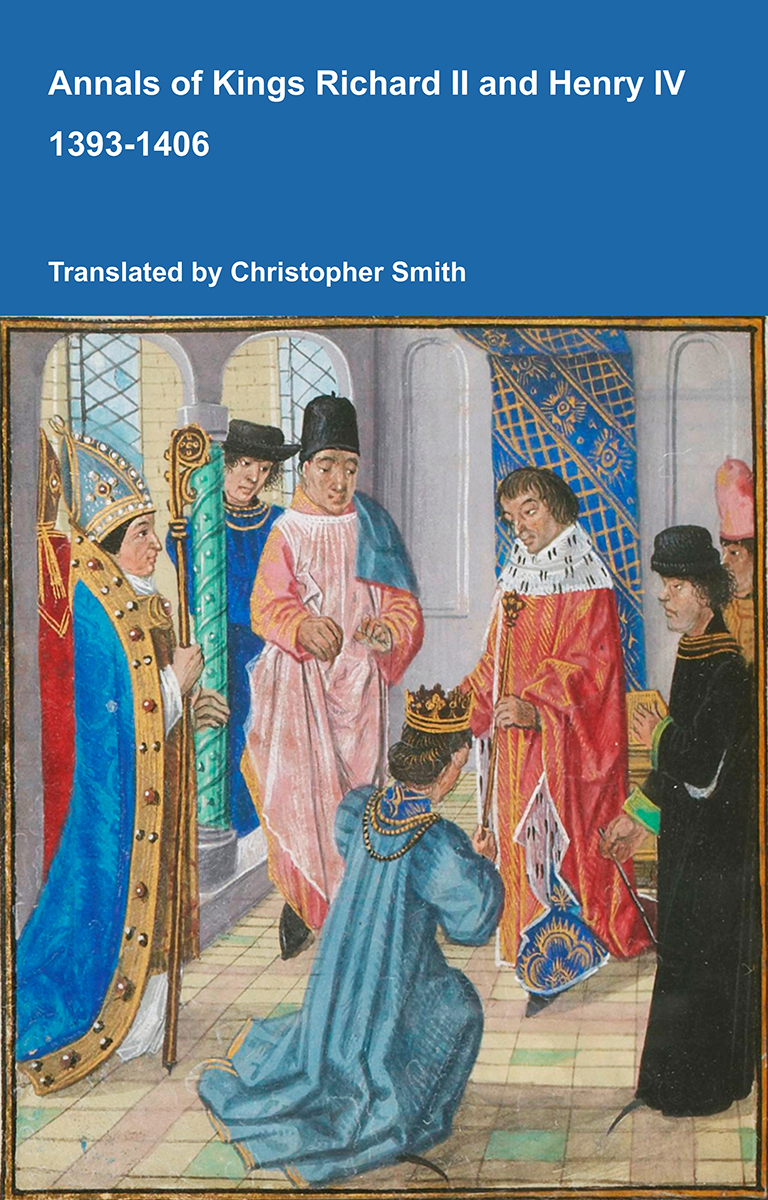
Annals of Kings Richard II and Henry IV 1393-1406
The Annals of Kings Richard II and Henry IV offers a vivid contemporary account of one of the most turbulent periods in late medieval England. Covering the reigns of Richard II and Henry IV, the chronicle records royal ceremonies, political conflict, rebellion, war, taxation, religious controversy, executions, popular unrest and remarkable portents. Its pages include a detailed description of Richard II’s coronation, the fall and deposition of the king, Henry IV’s seizure of the throne, the Percy rebellion, the execution of Archbishop Richard Scrope, the campaigns of Owain Glyndŵr, and England’s relations with Scotland, France, Portugal and Scandinavia. Alongside affairs of state, the annalist preserves reports of miracles, eclipses, prophecies, supernatural events and the experiences of ordinary townspeople, clergy, soldiers and travellers. Written from a monastic perspective, the work combines political observation with moral judgement, presenting victories and disasters as evidence of divine favour or punishment. At once a historical record and a reflection of medieval belief, the Annals provides an invaluable window into the challenges, ceremonies and conflicts of England at the turn of the fifteenth century.
Available at Amazon in eBook and Paperback format.
John Evelyn's Diary. 2nd June 1687. I went to London, it having pleased his Majesty to grant me a Privy Seal for £6,000, for discharge of the debt I had been so many years persecuted for, it being indeed for money drawn over by my father-in-law, Sir R. Browne, during his residence in the Court of France, and so with a much greater sum due to Sir Richard from his Majesty; and now this part of the arrear being paid, there remains yet due to me, as executor of Sir Richard, above £6,500 more; but this determining an expensive Chancery suit has been so great a mercy and providence to me (through the kindness and friendship to me of Lord Godolphin [aged 41], one of the Lords Commissioners of the Treasury, that I do acknowledge it with all imaginable thanks to my gracious God.
John Evelyn's Diary. 23rd June 1687. The Privy Seal for £6,000 was passed to me, so that this tedious affair was dispatched. Hitherto, a very windy and tempestuous summer. The French sermons to the refugees were continued at Greenwich Church.
John Evelyn's Diary. 21st February 1689. Innumerable were the crowds, who solicited for, and expected offices; most of the old ones were turned out. Two or three white staves were disposed of some days before, as Lord Steward, to the Earl of Devonshire [aged 49]; Treasurer of the household, to Lord Newport; Lord Chamberlain to the King, to my Lord of Dorset [aged 46]; but there were as yet none in offices of the civil government save the Marquis of Halifax [aged 55] as Privy Seal. A council of thirty was chosen, Lord Derby [aged 34] president, but neither Chancellor nor Judges were yet declared, the new Great Seal not yet finished.


John Evelyn's Diary. 2nd February 1690. The Parliament was dissolved by proclamation, and another called to meet the 20th of March. This was a second surprise to the former members; and now the Court party, or, as they call themselves, Church of England, are making their interests in the country. The Marquis of Halifax [aged 56] lays down his office of Privy Seal, and pretends to retire.
John Evelyn's Diary. 19th February 1690. I dined with the Marquis of Carmarthen [aged 57] (late Lord Danby), where was Lieutenant-General Douglas [aged 45], a very considerate and sober commander, going for Ireland. He related to us the exceeding neglect of the English soldiers, suffering severely for want of clothes and necessaries this winter, exceedingly magnifying their courage and bravery during all their hardships. There dined also Lord Lucas, Lieutenant of the Tower [aged 40], and the Bishop of St. Asaph [aged 62]. The Privy Seal was again put in commission, Mr. Cheny (who married my kinswoman, Mrs. Pierrepoint), Sir Thomas Knatchbull [aged 50], and Sir P. W. Pultney. The imprudence of both sexes was now become so great and universal, persons of all ranks keeping their courtesans publicly, that the King had lately directed a letter to the Bishops to order their clergy to preach against that sin, swearing, etc., and to put the ecclesiastical laws in execution without any indulgence.
John Evelyn's Diary. 11th June 1696. Dined at Lord Pembroke's [aged 40], Lord Privy Seal, a very worthy gentleman. He showed me divers rare pictures of very many of the old and best masters, especially one of M. Angelo of a man gathering fruit to give to a woman, and a large book of the best drawings of the old masters. Sir John Fenwick [aged 51], one of the conspirators, was taken. Great subscriptions in Scotland to their East India Company. Want of current money to carry on the smallest concerns, even for daily provisions in the markets. Guineas lowered to twenty-two shillings, and great sums daily transported to Holland, where it yields more, with other treasure sent to pay the armies, and nothing considerable coined of the new and now only current stamp, cause such a scarcity that tumults are every day feared, nobody paying or receiving money; so imprudent was the late Parliament to condemn the old though clipped and corrupted, till they had provided supplies. To this add the fraud of the bankers and goldsmiths, who having gotten immense riches by extortion, keep up their treasure in expectation of enhancing its icon. Duncombe, not long since a mean goldsmith, having made a purchase of the late Duke of Buckingham's estate at nearly £90,000, and reputed to have nearly as much in cash. Banks and lotteries every day set up.


In 1699 Thomas Herbert 8th Earl Pembroke 5th Earl Montgomery [aged 43] was appointed Lord Privy Seal.
John Evelyn's Diary. 24th April 1700. This week there was a great change of State officers. The Duke of Shrewsbury [aged 39] resigned his Lord Chamberlainship to the Earl of Jersey [aged 44], the Duke's indisposition requiring his retreat. Mr. Vernon [aged 54], Secretary of State, was put out. The Seal was taken from the Lord Chancellor Somers [aged 49], though he had been acquitted by a great majority of votes for what was charged against him in the House of Commons. This being in term time, put some stop to business, many eminent lawyers refusing to accept the office, considering the uncertainty of things in this fluctuating conjuncture. It is certain that this Chancellor was a most excellent lawyer, very learned in all polite literature, a superior pen, master of a handsome style, and of easy conversation; but he is said to make too much haste to be rich, as his predecessor, and most in place in this age did, to a more prodigious excess than was ever known. But the Commons had now so mortified the Court party, and property and liberty were so much invaded in all the neighbouring kingdoms, that their jealousy made them cautious, and every day strengthened the law which protected the people from tyranny.


In 1726 Thomas Trevor 1st Baron Trevor Bromham [aged 67] was appointed Lord Privy Seal.
On 14th May 1735 Francis Godolphin 2nd Earl Godolphin [aged 56] was appointed Lord Privy Seal.


In 1755 Charles Spencer 3rd Duke of Marlborough [aged 48] was appointed Lord Privy Seal.
Henrici Quinti, Angliæ Regis, Gesta, is a first-hand account of the Agincourt Campaign, and subsequent events to his death in 1422. The author of the first part was a Chaplain in King Henry's retinue who was present from King Henry's departure at Southampton in 1415, at the siege of Harfleur, the battle of Agincourt, and the celebrations on King Henry's return to London. The second part, by another writer, relates the events that took place including the negotiations at Troye, Henry's marriage and his death in 1422.
Available at Amazon in eBook and Paperback format.
In 1757 Richard Grenville-Temple 2nd Earl Temple [aged 45] was appointed Lord Privy Seal which office he held until 1761.