

Bishop of Hereford is in Bishop, Hereford Cathedral [Map].
In 676 Bishop Putta was appointed Bishop of Hereford. There is some debate among historians as to whether there were two Putta's and whether the Putta that was Bishop of Hereford was a different person to the Putta that was Bishop of Rochester.
Between 1013 and 1016 Bishop Athelstan was consecrated Bishop of Hereford.
In March 1056 Bishop Leofgar of Hereford was consecrated Bishop of Hereford.
Chronicon ex Chronicis by Florence and John of Worcester. 24th June 1070. The feast of St. John the Baptist being near, earl Asbiorn sailed to Denmark with the fleet which had wintered in the Humber; but his brother Sweyn [aged 51] outlawed him, because he had accepted money from king William [aged 42], to the great regret of the Danes. Edric, surnamed the Forester, a man of the most resolute courage, of whom we have spoken before, was reconciled with king William. After this, the king summoned from Normandy Lanfranc [aged 65], abbot of Caen, a Lombard by birth, a man of unbounded learning, master of the liberal arts, and of both sacred and secular literature, and of the greatest prudence in counsel and the administration of worldly affairs; and on the day of the Assumption of St. Mary, appointed him archbishop of Canterbury, causing him to be consecrated at Canterbury on the feast of St. John the Baptist, being Sunday. He was consecrated by Giso, bishop of Wells, and Walter, bishop of Hereford, who were both ordained at Rome by pope Nicholas, when Aldred, archbishop of York, received the pallium,—for he evaded being ordained by Stigand, who then held the archbishopric of Canterbury, knowing him not to have received the pallium canonically. Bishop Heriman, who had already transferred the seat of his bishopric from Sherbourne to Salisbury, also assisted at his consecration, with some others. Afterwards, Lanfranc consecrated Thomas, archbishop of York. The suit of the reverend Wulfstan [aged 62], bishop of Worcester, was again prosecuted, there being now a bishop who could advocate the cause of the church of York; and the affair was, by the aid of God's grace, decided at a council held at a place called Pedred, before the king, archbishop Lanfranc, and the bishops, abbots, earls, and lords of all England. All the groundless assertions by which Thomas and his abettors strove to humble the church of Worcester, and reduce her to subjection and servitude to the church of York, were, by God's just judgement, entirely refuted and negatived by written documents, so that Wulfstan not only recovered the possessions he claimed, but, by God's goodness, and the king's assent, regained for his see all the immunities and privileges freely granted to it by its first founders, the holy king Ethered, Oshere, sub-king of the Hwiccas, and the other kings of Mercia, Cenred, Ethelbald, Offa, Kenulf, Edward the Elder, Athelstan, Edmund, Edred, and Edgar.
On 29th December 1079 Robert the Lotharingian was consecrated Bishop of Hereford by Archbishop Lanfranc [aged 74] at Canterbury Cathedral [Map].
Around December 1102 Bishop Reynelm was nominated to be Bishop of Hereford. King Henry [aged 34] invested Reynelm with the temporalities of the see. This led to a dispute with Archbishop Anselm [aged 69] who refused to consecrate Reynelm. Reynelm refused to be consecrated by Gerard, Archbishop of York so the King exiled Reynelm.
Chronicon ex Chronicis by Florence and John of Worcester. 7th January 1121. Meanwhile, two clerks were chosen to fill sees which had been vacant for some time; namely, Richard, who was keeper of the king's seal under the chancellor, and Robert, who had filled the office of steward of the meat and drink in the king's household with great industry. The first of these was preferred to the see of Hereford, the latter to the see of Chester [Note. Bishop of Coventry?]. Herbert, also, a monk of Westminster, was made abbot of that monastery.
Richard, chosen bishop of Hereford on Friday the seventh of the ides [the 7th] of January, was consecrated at Lambeth on Sunday the seventeenth of the calends of February [17th January] by Ralph, archbishop of Canterbury, with the assistance of Richard, bishop of London, and the bishops, Robert of Lincoln, Arnulph of Rochester, Urban of Glamorgan [aged 45], and Bernard of St. David's.
Chronicon ex Chronicis by Florence and John of Worcester. 12th June 1121. After a few days, one named Everard, attached to the king's chapel, was elected bishop of Norwich, and consecrated at Canterbury [Map] by archbishop Ralph on the second of the ides [the 12th] of June; Arnulph, bishop of Rochester, Richard, bishop of Hereford, and Robert, bishop of Coventry, having met for the purpose.
In 1130 Bishop Robert de Bethune was appointed Bishop of Hereford.
On 5th September 1148 Bishop Gilbert Foliot was consecrated Bishop of Hereford at Saint-Omer by Archbishop Theobald.

Anne Boleyn. Her Life as told by Lancelot de Carle's 1536 Letter.
In 1536, two weeks after the execution of Anne Boleyn, her brother George and four others, Lancelot du Carle, wrote an extraordinary letter that described Anne's life, and her trial and execution, to which he was a witness. This book presents a new translation of that letter, with additional material from other contemporary sources such as Letters, Hall's and Wriothesley's Chronicles, the pamphlets of Wynkyn the Worde, the Memorial of George Constantyne, the Portuguese Letter and the Baga de Secrets, all of which are provided in Appendices.
Available at Amazon in eBook and Paperback format.
On 22nd December 1163 Bishop Robert Melun [aged 63] was consecrated Bishop of Hereford by Archbishop Thomas Becket [aged 44] at Canterbury Cathedral [Map].
In 1186 Bishop William de Vere was appointed Bishop of Hereford.
In 1200 Bishop Giles de Braose 7th Baron Braose 5th Baron Bramber was appointed Bishop of Hereford.
Between 21st August 1234 and 30th August 1234 Bishop Ralph de Maidstone was elected Bishop of Hereford.
On 12th November 1234 Bishop Ralph de Maidstone was consecrated Bishop of Hereford by Archbishop Edmund Rich [aged 59] at Canterbury Cathedral [Map].
On 14th June 1275 Bishop Thomas Cantilupe [aged 57] was appointed Bishop of Hereford.
On 8th September 1275 Bishop Thomas Cantilupe [aged 57] was consecrated Bishop of Hereford.
On 1st October 1282 Bishop Richard de Swinfield was elected Bishop of Hereford.
On 7th March 1283 Bishop Richard de Swinfield was consecrated Bishop of Hereford.
On 22nd May 1317 Bishop Adam Orleton was consecrated Bishop of hereford.
In 1327 Bishop Thomas Charleton was appointed Bishop of Hereford.
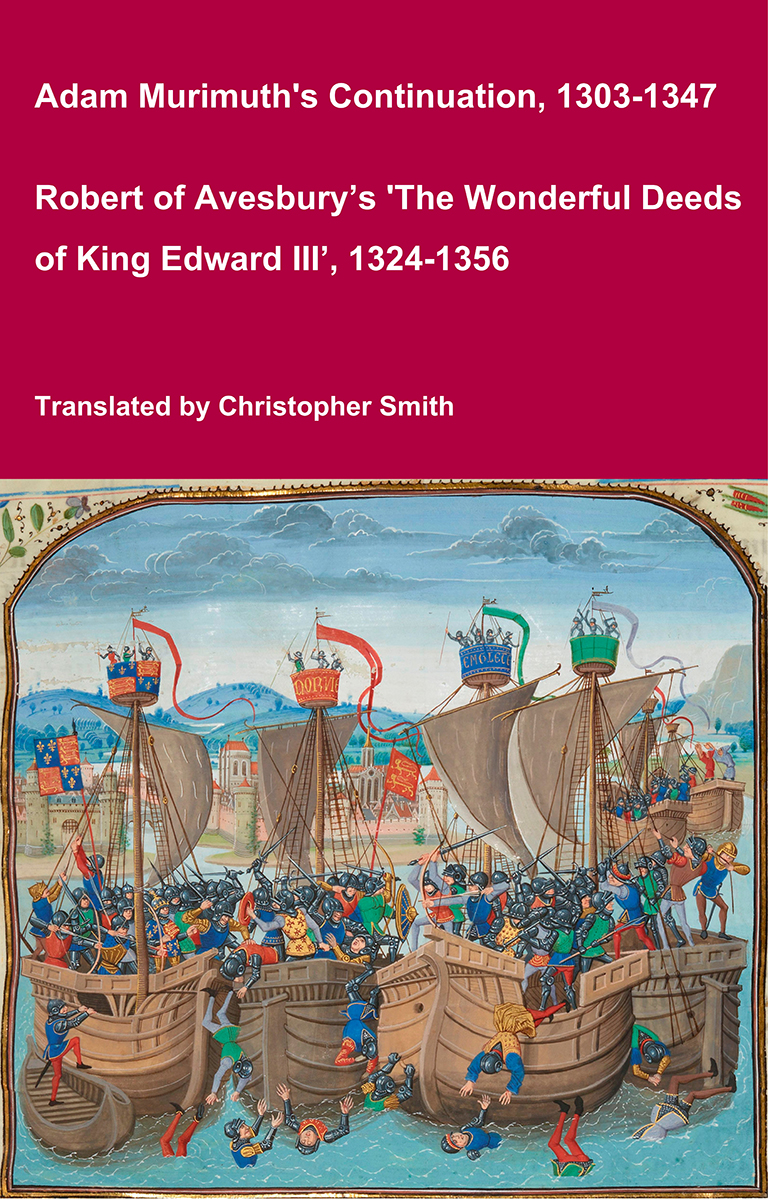
Adam Murimuth's Continuation and Robert of Avesbury’s 'The Wonderful Deeds of King Edward III'
This volume brings together two of the most important contemporary chronicles for the reign of Edward III and the opening phases of the Hundred Years’ War. Written in Latin by English clerical observers, these texts provide a vivid and authoritative window into the political, diplomatic, and military history of fourteenth-century England and its continental ambitions. Adam Murimuth Continuatio's Chronicarum continues an earlier chronicle into the mid-fourteenth century, offering concise but valuable notices on royal policy, foreign relations, and ecclesiastical affairs. Its annalistic structure makes it especially useful for establishing chronology and tracing the development of events year by year. Complementing it, Robert of Avesbury’s De gestis mirabilibus regis Edwardi tertii is a rich documentary chronicle preserving letters, treaties, and official records alongside narrative passages. It is an indispensable source for understanding Edward III’s claim to the French crown, the conduct of war, and the mechanisms of medieval diplomacy. Together, these works offer scholars, students, and enthusiasts a reliable and unembellished account of a transformative period in English and European history. Essential for anyone interested in medieval chronicles, the Hundred Years’ War, or the reign of Edward III.
Available at Amazon in eBook and Paperback format.
On 17th March 1360 Archbishop William Courtenay [aged 18] was consecrated Bishop of Hereford.
On 12th March 1375 Bishop John Gilbert was translated to Bishop of Hereford.
On 20th June 1389 Bishop Thomas Trevenant was consecrated Bishop of Hereford.
In 1448 Bishop Richard Beauchamp [aged 27] was appointed Bishop of Hereford.
On 22nd June 1492 Bishop Edmund Tuchet [aged 49] was appointed Bishop of Hereford.
In 1504 Bishop Richard Mayew [aged 64] was appointed Bishop of Hereford.
On 20th August 1535 Bishop Edward Fox [aged 39] was elected Bishop of Hereford.
On 26th May 1553 Bishop John Harley was consecrated Bishop of Hereford.
On 1st March 1554 Bishop Robert Parfew aka Warton was translated to Bishop of Hereford.
On 19th March 1554 Bishop John Harley was deprived of his see of Bishop of Hereford for being a Protestant, and because he was married.
On 1st April 1554 the Lord Chancellor Bishop Edmund "Bloody" Bonner of London [aged 54], assisted by Bishop Stephen Gardiner [aged 71], Bishop Nicholas Ridley [aged 54] and Bishop Cuthbert Tunstall [aged 80], consecrated seven bishops at Southwark Cathedral [Map]:
Bishop George Cotes was consecrated Bishop of Chester.
Bishop Gilbert Bourne was consecrated Bishop of Bath and Wells.
Bishop James Brooks [aged 41] was consecrated Bishop of Gloucester.
Bishop Maurice Griffiths [aged 47] was consecrated Bishop of Rochester.
Bishop Henry Morgan was consecrated Bishop of St David's.
Bishop John White [aged 44] was consecrated Bishop of Lincoln.
Bishop Robert Parfew aka Warton was consecrated Bishop of Hereford.
Henry Machyn's Diary. 1st April 1554. [The first day of April my lord chancellor [aged 54] did consecrate six new bishops at St. Mary Overy's [Map], before the high altar; and a goodly mass was said. And when all] was done thay yede unto my lord ch[ancellor's,] for ther was as grett a dener as youe ha[ve seen.] Thes be the bysshopes names that wher consecrated, [doctor] Whyt [aged 44], warden of Wynchastur, the bysshope of Ly[ncoln]; doctur Borne, bysshope of Bathe; doctur Morgan, bishop of sant Davys; doctur Brokes [aged 41], bysshope of Gloss [ter]; doctur Cottes, bysshope of Westtchastur; bysshope of sant Asse changyd to be bysshope of Arfford; master [Griffith] [aged 47] parsun of sant Magnus bysshope of Rochastur.
In 1559 Bishop John Scory [aged 49] was elected Bishop of Hereford.
In 1634 Bishop Matthew Wren [aged 48] was appointed Bishop of Hereford.
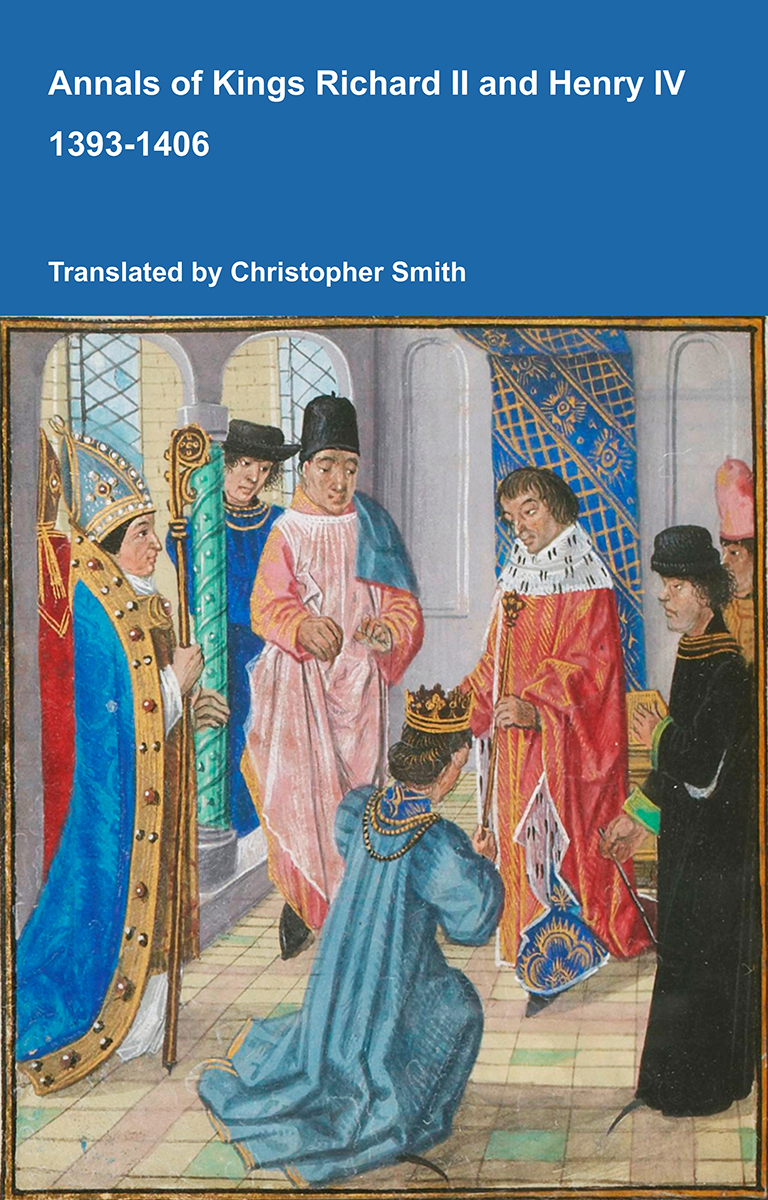
Annals of Kings Richard II and Henry IV 1393-1406
The Annals of Kings Richard II and Henry IV offers a vivid contemporary account of one of the most turbulent periods in late medieval England. Covering the reigns of Richard II and Henry IV, the chronicle records royal ceremonies, political conflict, rebellion, war, taxation, religious controversy, executions, popular unrest and remarkable portents. Its pages include a detailed description of Richard II’s coronation, the fall and deposition of the king, Henry IV’s seizure of the throne, the Percy rebellion, the execution of Archbishop Richard Scrope, the campaigns of Owain Glyndŵr, and England’s relations with Scotland, France, Portugal and Scandinavia. Alongside affairs of state, the annalist preserves reports of miracles, eclipses, prophecies, supernatural events and the experiences of ordinary townspeople, clergy, soldiers and travellers. Written from a monastic perspective, the work combines political observation with moral judgement, presenting victories and disasters as evidence of divine favour or punishment. At once a historical record and a reflection of medieval belief, the Annals provides an invaluable window into the challenges, ceremonies and conflicts of England at the turn of the fifteenth century.
Available at Amazon in eBook and Paperback format.
In July 1636 Bishop George Coke [aged 65] was translated to Bishop of Hereford.
In 1661 Bishop Herbert Croft [aged 58] was appointed Bishop of Hereford.
On 6th January 1661 Bishop Nicholas Monck [aged 51] was consecrated Bishop of Hereford.

John Evelyn's Diary. 20th February 1676. Dr. Gunning [aged 62], Bishop of Ely, preached before the King [aged 45] from St. John xx. 21, 22, 23, chiefly against an anonymous book, called "Naked Truth", a famous and popular treatise against the corruption in the Clergy, but not sound as to its quotations, supposed to have been the Bishop of Hereford and was answered by Dr. Turner, it endeavoring to prove an equality of order of Bishop and Presbyter.
In 1713 Bishop Philip Bisse [aged 46] was appointed Bishop of Hereford.
In 1723 Bishop Henry Egerton [aged 33] was appointed Bishop of Hereford.
In 1787 Bishop John Harley [aged 58] was appointed Bishop of Hereford.
In 1808 Bishop John Luxmoore [aged 42] was translated to Bishop of Hereford.
On 20th May 1832 Bishop Edward Grey [aged 49] was consecrated as Bishop of Hereford.
In 1868 Bishop James Atlay [aged 50] was appointed Bishop of Hereford.

In January 1895 Bishop John Percival [aged 60] was elected Bishop of Hereford by Archibald Philip Primrose 5th Earl Rosebery 1st Earl Midlothian [aged 47].
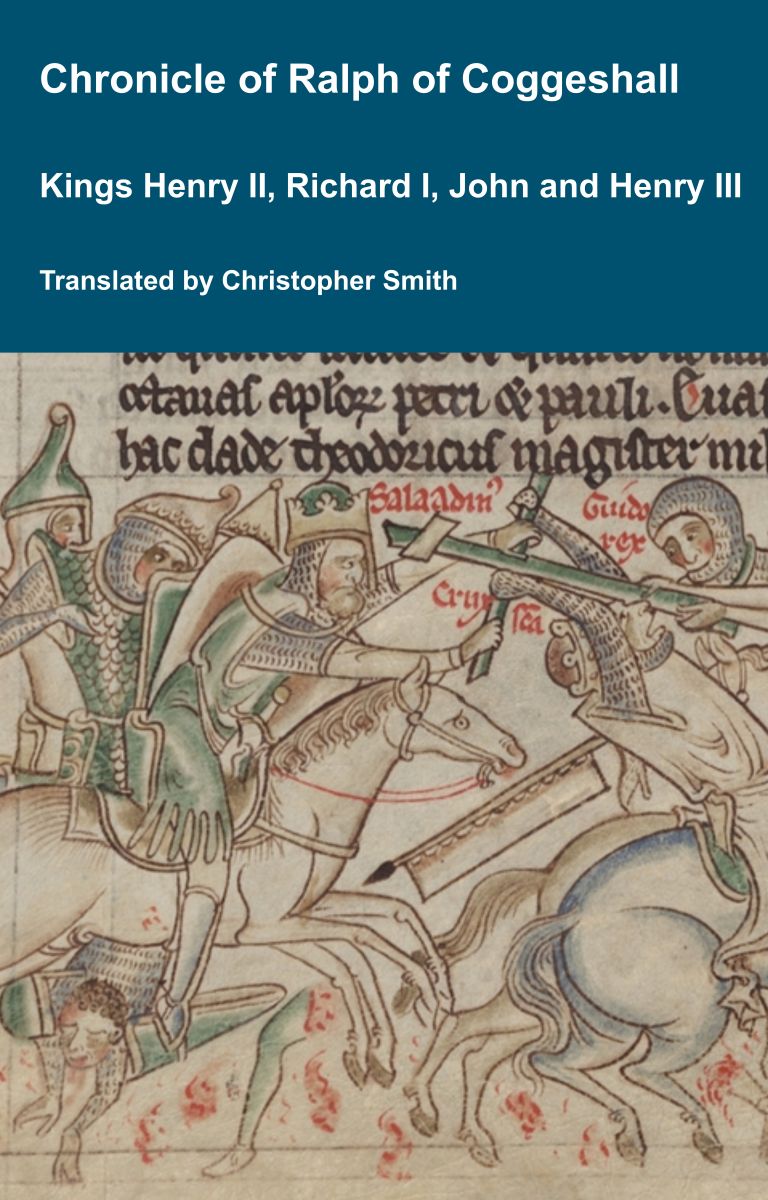
Chronicle of Abbot Ralph of Coggeshall
The Chronicle of Abbot Ralph of Coggeshall (Chronicon Anglicanum) is an indispensable medieval history that brings to life centuries of English and European affairs through the eyes of a learned Cistercian monk. Ralph of Coggeshall, abbot of the Abbey of Coggeshall in Essex in the early 13th century, continued and expanded his community’s chronicle, documenting events from the Norman Conquest of 1066 into the tumultuous reign of King Henry III. Blending eyewitness testimony, careful compilation, and the monastic commitment to record-keeping, this chronicle offers a rare narrative of political intrigue, royal power struggles, and social upheaval in England and beyond. Ralph’s work captures the reigns of pivotal figures such as Richard I and King John, providing invaluable insights into their characters, decisions, and the forces that shaped medieval rule. More than a simple annal, Chronicon Anglicanum conveys the texture of medieval life and governance, making it a rich source for scholars and readers fascinated by English history, monastic authorship, and the shaping of the medieval world.
Available at Amazon in eBook and Paperback format.
Bishop James Beauclerk was appointed Bishop of Hereford.
Bishop Peter Acquablanca was elected Bishop of Hereford.