

Paternal Family Tree: Despencer
Bishop Henry Despencer educated at Oxford University.
Before 24th March 1335 [his father] Edward Despencer [aged 25] and [his mother] Anne Ferrers [aged 36] were married. They were second cousins. He a great grandson of King Edward I of England.
Around 1341 Bishop Henry Despencer was born to Edward Despencer [aged 31] and Anne Ferrers [aged 42]. He a great x 2 grandson of King Edward I of England. Coefficient of inbreeding 1.78%.
On 15th December 1357 [his brother] Edward Despencer 1st Baron Despencer, Baron Burghesh [aged 22] was created 1st Baron Despencer.
On 3rd April 1370 Bishop Henry Despencer [aged 29] was appointed Bishop of Norwich.
Before 1373 [his brother] Edward Despencer 1st Baron Despencer, Baron Burghesh [aged 37] and [his sister-in-law] Elizabeth Burghesh 3rd Baron Burghesh [aged 30] were married. She by marriage Baroness Despencer. He by marriage Baron Burghesh. They were half fourth cousin once removed. He a great x 2 grandson of King Edward I of England. She a great x 5 granddaughter of King John of England.
On 11th November 1375 [his brother] Edward Despencer 1st Baron Despencer, Baron Burghesh [aged 40] died at Llanblethian. He was buried at Tewkesbury Abbey [Map]. His son [his nephew] Thomas [aged 2] succeeded 2nd Baron Despencer.
On 25th June 1381 Bishop Henry Despencer [aged 40] brought the Peasant's Revolt to an end at North Walsham, Norfolk at the Battle of North Walsham.
Walsingham Chronica Majora. The bishop Bishop Henry Despencer [aged 40], with the knights, then hurried swiftly towards Norfolk, namely to North Walsham, the place where the commons had decided to await the royal answer and the return of their companions. As he passed through the country, the bishop’s number was continually increased, because many of the knightly order, and many gentlemen from the country who had been hiding for fear of the commons, seeing that the bishop had put on a soldier’s equipment, had taken up a metal helmet and a hard coat of mail which arrows could not pierce, and had also seized a material, double-edged sword, joined themselves to his side.
The bishop, therefore, when he [Bishop Henry Despencer] had come to the aforesaid place [on 25th June 1381], accompanied by a suitable force, found the peasants, in the manner of warriors, to have surrounded the place where they had gathered with ditches. Over the ditch they had fixed boards, windows, and doors, together with stakes, for their defence. Behind them he saw their baggage and carts placed, as though they were thinking not at all of flight. Without delay, the warlike bishop, about to fight in open battle, moved by the audacity of the scoundrels, ordered his trumpeters and heralds to sound. Then he himself, taking a lance in his right hand, urged on his horse with sharp spurs, and was carried against them with such courage and such boldness that, at a very swift charge, he reached the ditch before his men, faster than his own arrows. Nor was there any need for bow-bearing archers, since the matter was now being fought hand to hand at close quarters. The warlike prelate, therefore, like a boar gnashing its teeth, sparing neither himself nor his enemies, directed his attack wherever he saw the danger to be greatest. Piercing one man through, throwing down another, wounding another, he did not cease to inflict severe harm, until the whole crowd which had followed him, having reached the ditch, was ready to fight. Therefore the bishop’s men fought fiercely, and the commons no less so, until, as usually happens, the weaker conscience terrified the unjust side and withdrew their spirit from boldness and from the will to die. Nothing is more wretched than to wage wars with a seared conscience, for fear and confusion are always accustomed to be brought upon it, and victory never to come from it. Therefore the fearful common people fled; and because no other way remained except beyond their carts and baggage, which, as we have said, they had placed behind them, they strove to make their way through the woods. But the prelate, everywhere carrying out the office of a watchful commander, crushed these attempts. He hindered those who were thinking of flight by cutting them down, and cut them down by hindering them, until, after the chief stirrers of the crowd had been captured, together with their king, John Litster, and as many of the commons as he wished had been killed, and as many as he wished had been preserved alive, he gained complete victory.
Episcopus cum militibus properat festinanter versus Northfolchiam, ad North Walsham videlicet, locum in quo communes expectasse decreverant responsum regium et reditum sociorum. In pertranseundo ergo patriam, semper numerus episcopalis augebatur, quia de ordine militari et plures e patria generosi, qui delitescebant timore communium, videntes Episcopum militem induisse, et galeam assumpsisse metallicam, et loricam duram, quam non possent penetrare sagittæ, necnon gladium materialem ancipitem arripuisse, ejus lateri se junxerunt.
Episcopus itaque, cum pervenisset ad locum præfatum, stipatus turba decenti, reperit rusticos, more bellatorum, fossata cireumeinxisse locum in quem convenerant, et super fossam tabulas, fenestras, et ostia, cum palis, in defensionem sui fixisse. A tergo autem conspicit eorum cariagium et carectas locatas, tanquam de fuga minime cogitarent. Nec mora, Episcopus Martius, aperto Marte pugnaturus, commotus super audacia nebulonum, jubet tubicinibus et clarigatoribus suis canere; et ipse, arrepta dextra manu lancea, urget cornipedem acutis calcaribus, et tanta animositate, tanta audacia, efferatur in cos, ut cursu velocissimo fossam præoccuparet, citatior sagittis suis; nec erat opus arcitenentibus sagittariis, cum res jam manu ad manum comminus ageretur. Antistes ergo belliger, velut aper frendens dentibus, sibi nec hostibus suis parcens, ubi!majus conspicit esse periculum, dirigit tentum suum, et, hunc perforando, illum dejiciendo, alium vulnerando, non cessat lædere vehementer, donec omnis turba quæ eum secuta fuerat, nacta fossa, ad confligendum parata foret: idcirco pugnatum est acriter ab episcopalibus, nec secus a communibus, donec, ut assolet, infirmior ‘conscientia partem terreret injustam, et animum ab audacia et voluntate subtraheret moriendi. Nihil est infelicius quam bella gerere cauteriata conscientia, qua timor et confusio semper solent ingeri, nunquam victoria provenire. Fugiunt idcirco meticulosi plebani, et quia nulla alia restabat via ultra carectas suas et cariagia, quæ retulimus eos à tergo suo locasse, per saltus iter facere elaborant. Sed Præsul, imperatoris circumspecti ubique gerens officium, hos conatus elidit, et fugere meditantes cædendo impedit, impediendo cædit; donec captis majoribus turbæ concitatoribus, et ipso eorum rege, Johanne Littestere, [et quot volebat occisis e communibus], et quot volebat ad vitam reservatis, plena victoria potiretur.
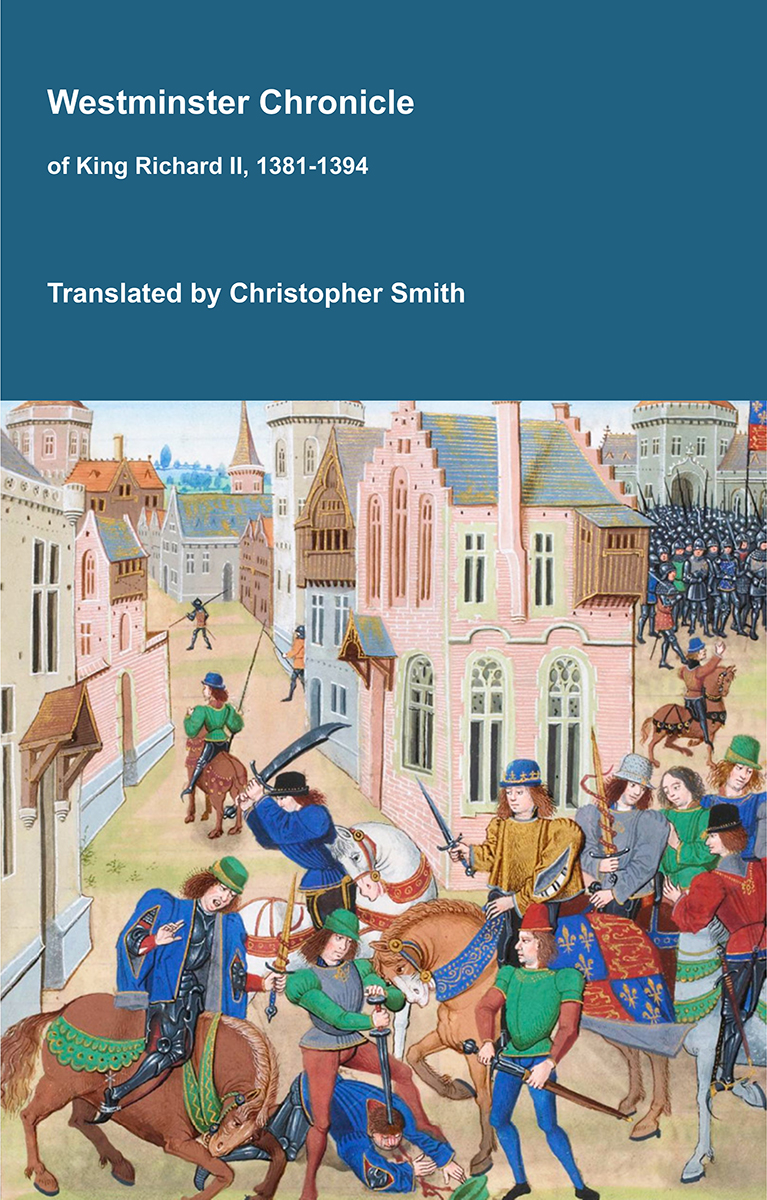 Westminster Chronicle. Meanwhile the king of England, fearing that danger threatened the town of Calais, both because of the scarcity of provisions and because of the lack of fighting men, gathered provisions from every side and sent them, with a multitude of armed men, to Calais for the protection of the town. For two days and three nights before the feast of Saint Thomas the Apostle [21st December 1382] there was an unceasing flood of rain. Because of this, throughout various parts of England, the flow of waters increased so greatly that immense damage to crops and other things followed. On the day of the aforesaid apostle, the bishop of Norwich [aged 41]1 took the cross, and likewise raised it, in the church of Saint Paul, on the steps before the door of the choir, with the bishop of London performing the solemnities. On that day the weather was clear and cloudless, offering some happy omen. And because this solemnity was unfamiliar and unknown to the English, the bishop searched in every cathedral church for the form of so great an act, but, finding it nowhere, discovered the fullest form of this observance only in the church of Westminster.
Interim rex Angliæ metuens villæ de Caleys imminere periculum tum propter paucitatem victualium tum propter defectum bellatorum, undique victualia collecta cum multitudine armatorum Calesiam transmisit villam in tutelam. Per duos dies et tres noctes ante festum sancti Thomæ apostoli indesinens erat inundatio pluviarum unde per diversas partes Angliæ in tantum augebatur aquarum discursus ut exinde sequeretur frugum et aliarum rerum immensum detrimentum. In die prædicti apostoli episcopus Northwycensis sumpsit crucem pariter et erexit in ecclesia sancti Pauli super gradus ante ostium chori, peragente solemnia episcopo Londonensi. Ipso die clara fuit et sine nube temperies, aliquod felix auspicium offerens, et quia invisa fuit et incognita Anglis ista solemnitas ubique in omni ecclesia cathedrali scrutatus est episcopus formam tanti facti ; sed nullibi reperiens solum in ecclesia Westmonasterii plenissimam hujus observationis invenit formam.
Note 1. Henry le Despenser, around 1341-1406, known as the 'Fighting Bishop' for his part in suppressing the Peasants' Revolt. He was appointed Bishop of Norwich in 1370. In 1382 Pope Urban VI had proclaimed a crusade led by Henry Despenser against the antipope Robert of Geneva who took the name Clement VII, who King Charles VI of France supported.
Westminster Chronicle. Around the end of parliament, the chancellor of England addressed the bishop of Norwich [aged 42] in this way, before the king and the magnates of the realm: "Lord bishop, you have your sword carried before you everywhere, as though you were a temporal1 lord. Put away your sword, because the king is offended by this, and the other temporal lords complain of it with grave murmuring. You should also conduct yourself henceforth as it befits a bishop to conduct himself. Moreover, lord bishop, at the request of the commons, as you desired, the king appointed you governor of his wars, to last for one full year, so that you might manfully fight his enemies wherever they should happen to meet you. For this you received a great sum of money from the king, and finally you promised to observe the aforesaid matters without delay. But now, with almost half the year having passed, you leave your promise unfulfilled, and, with the treasure of the land consumed without an expedition, you have brought the state of the wars almost to nothing." The bishop, however, somewhat stunned by these words, gave no excusable answer to the charges. But, like a man surrounded on all sides by his enemies and unable to avoid loss, he lost what he could lose, namely his temporalities. These were very quickly taken from him and immediately sequestered into the king’s hand. The king, however, consoled the bishop and urged him not to be at all afraid, protesting that he would be sufficiently favourable to him, whatever had at that time been judged there. These things were done, as was said, on the Friday immediately before the end of parliament, the dominical letter being D.
Circa finem vero parliamenti sic allocutus est cancellarius Angliæ episcopo Northwycensi coram rege et regni magnatibus. "Domine episcope vos habetis gladium vestrum delatum coram vobis ubilibet sicut dominus temporalis. Deporatis gladium vestrum quia ob hoc offenditur rex et ceteri domini temporales inde gravi murmure conqueruntur. Habeatis etiam vos de cetero secundum quod episcopo deceat se habere. Præterea, domine episcope, ad petitionem comitatum prout desiderastis rex præfecit vos gubernatorem guerrarum suarum per unum annum integre duraturum, ad debellandum viriliter hostes suos ubicunque contingerent vobis occurrere, magna summa pecuniæ perinde a rege accepta, finaliterque promisistis præmissa indilate servare, at nunc medietate anni fere transacta promissum relinquitis incompletum thesauroque terræ sine expeditione absumpto, status guerrarum quasi in nibilum adduxistis." Episcopus vero ad hæc quodammodo stupefactus excusabile responsum ad objecta minime protulit, sed sieut homo undique suis inimicis vallatus, dispendium evitare non valens, ea quæ potuit amittere scilicet temporalia sua ab eo quantocius erant ablata et in manu regis protinus sequestrata. Rex vero consolatus ‘est episcopum et hortatus est eum ne ullatenus expavescat protestans quod satis favorabilis sibi existeret quiequid ibidem protunc extitit judicatum. Acta sunt hæc ut dicebatur, feria via proxime ante finem parliamenti, litera dominicalis D.
Note 1. Temporal Lords i.e. Dukes, Earls and Barons, as opposed to Spiritual Lords i.e. Archbishops and Bishops.
The History of William Marshal was commissioned by his son shortly after William’s death in 1219 to celebrate the Marshal’s remarkable life; it is an authentic, contemporary voice. The manuscript was discovered in 1861 by French historian Paul Meyer. Meyer published the manuscript in its original Anglo-French in 1891 in two books. This book is a line by line translation of the first of Meyer’s books; lines 1-10152. Book 1 of the History begins in 1139 and ends in 1194. It describes the events of the Anarchy, the role of William’s father John, John’s marriages, William’s childhood, his role as a hostage at the siege of Newbury, his injury and imprisonment in Poitou where he met Eleanor of Aquitaine and his life as a knight errant. It continues with the accusation against him of an improper relationship with Margaret, wife of Henry the Young King, his exile, and return, the death of Henry the Young King, the rebellion of Richard, the future King Richard I, war with France, the death of King Henry II, and the capture of King Richard, and the rebellion of John, the future King John. It ends with the release of King Richard and the death of John Marshal.
Available at Amazon in eBook and Paperback format.
Westminster Chronicle. Also, on the twentieth day of October, the king held his parliament at Westminster, in which many matters were raised and proposed on either side by the commons for the salvation of the realm, some of which will be described below. On the fourth day of the parliament, the bishop of Norwich [aged 44] had restitution of his temporalities, which temporalities he had lost at the will of the lords in a certain parliament immediately after he came back from Flanders, as has been related above. At that time the Scots secretly entered England and devastated the town of Hexham, together with the whole adjoining district, with their customary plundering and burnings. And indeed, the losses now inflicted upon us by them exceed those which our army had lately imposed upon them in Scotland. For although our northern men once flourished in great valour, now, with the wind changed, they have become idle and witless, and scorn to guard their country by watches or sentries against the ambushes of enemies. Therefore, through their negligence and sloth, it has happened that they have lost their country and their goods by misfortune. And certainly, perhaps, they would have lost much greater things in the meantime had it not been for the courage and nobility of Sir Henry Percy [aged 21], who, after the lord king had withdrawn with his army from Scotland, fought with the Scots five times and always carried off victory over them.
Item xx die Octobris tenuit rex suum parliamentum apud Westmonasterium in quo multa per communitatem pro salvatione regni fuerunt mota et hinc inde proposita, quorum aliqua inferius describentur. Quarto die parliamenti episcopus Northwycensis habuit restitutionem suorum temporalium, quæ quidem temporalia statim postquam venit de Flandria in quodam parliamento ad nutum dominorum amisit, quomodo est supra relatum. Quo in tempore Scoti latenter Angliam intraverunt et villam de Exham cum tota provincia adjacenti rapinis et incendiis solitis devastabant. Et profecto ista dispendia nobis jam per illos inflicta excedunt ea quæ dudum noster exercitus illis in Scotia irrogabat. Quamvis enim nostri boreales olim multa strenuitate vigebant nunc vero mutato velo desides et vecordes effecti eorum patriam vigiliis sive excublis ab inimicorum insidiis custodiæ contemnunt. Unde causante illorum negligentia et desidia accidit illis patriam perdere ac bona eorum fortuna. Et pro certo multo majora medio tempore forsitan amisissent nisi magnanimitas et nobilitas domini Henrici de Percy fuisset qui cum Scotis post recessum domini regis cum exercitu suo de Scotia quinquies dimicavit et de eis semper victoriam reportavit.
Chronicle of Adam of Usk [~1352-1430]. 1388. In this king's reign, on account of the papal schism, the bishop of Norwich [aged 47]1 crossed over into Flanders with a crusade, and there he destroyed in warfare some nine thousand men of that land who sided with the French heretics; but he was forced to withdraw thence and to return to his own country by the power of the king of Franee and his army, many of the English then dying of the flux.
Note 1. Henry Spencer or Despencer, the warlike bishop of Norwich, had fought in his youth for pope Adrian against Bernabo Visconti of Milan, and received for his reward the see of Norwich in 1370. But "vulpis pilum mutat, non animum," and the bishop did not lose his taste for fighting. He was distinguished at the time of Wat Tyler's rebellion for the vigour with which he repressed the uprising in his diocese: defeating, shriving, and executing the rebels with great zeal. His crusade in Flanders got him into trouble, for he had to pay the penalty of failure by the loss of his temporalities, which were, however, afterwards restored.—Godwin, De Presul. Angl.
On 30th April 1399 William Sawtry aka Salter was taken to Henry le Despenser [aged 58], Bishop of Norwich, ordered he be examined. The examination lasted for two days, held at the Bishop's palace, South Elmham Hall. He charged with heresy and held in an episcopal prison.
On 26th May 1399 William Sawtry aka Salter appeared before Bishop Henry le Despenser [aged 58] in St John's Hospital, King's Lynn, the next day, and swore on the Gospels that he would never again preach Lollardy. He also promised to never hear confession without a license from le Despenser. His abjuration was repeated in the Bishop's Chapel, South Elmham several days later.
In 1406 Bishop Henry Despencer [aged 65] died.
Archaeologia Volume 22 Section XVI. The Bishopp of Norwiche ys shamefully used at his owne towne of Lynne.m
A lytle [small tyme] after Æster the Bishopp of Norwiche comynge to Lynne, hys owne towne, not content with the accustomed honour that the bishopps, his predecessors had, sought to have a new honour; therefor, seyng the mayor of the towne, when he publikely walked through the streetes to have the sergeant go before hym, carryinge the mace in hys handes where soever he went, & supposynge hymselffe, for that he was lord of the towne, to be above the mayor, he requested of the cheif men of the towne, that that honoure myght be done unto hym whiche was doone unto a mayor. In very deede before the bishop the verger ys accustomed only to cary a rodd, typped with blacke horne at bothe endes. The maisters [aldermen] of the towne answear very courtly, that they were well pleased he shold have that honour, yf he colde by a good meanes, & without the offence of the commons of the towne, obteyne such a custome of the kynge or the kynge's councell, and brynge in the saime, otherwyse they sayed, that they feared the common people, that was unconstant and prompt to sedition, for the vulgar sort of that towne wolde stone them yf they sholde suffer suche a custome to be broughte in; therfore they desyre hym, upon there knees, that he wolde desyst from such a petition, that he wolde save hys owne honoure & the aldermen, whoe, without doubt, were in thys case in great daunger yf he persysted in hys purpose. The bishopp, but a young man & unbrydled,n supposinge thys humilytye of the towne's men to come only for feare of hym, usynge the councell of Roboum, answeared that he wolde in no wyse doo that whiche they requested, yea he wolde doo that whiche he had purposed, in the spyte of them all, whom he called ribauldes. He also dyd chyde the aldermen of the towne for there faynte hartes, for that they sayed they feared the common people of the towne, whome he esteemed as nothynge. All hearynge the bishopp's obstinacye, very humbly they say unto hym: for that, reverend father, (say they) you affyrme that you will altogeather doo that thynge even as you have sayed, we beseache you to have us excused, that we honourably conduct you without the towne & doo oure due reverence unto you; for truly we feare not only oure skyns, but also our lyves, for yf the comonaltye perceave us to cleave unto you att this present in this act, all the deeds sholde be imputed unto us, & so perchaunce we sholde, without cause, suffer punyshment. But the bishoppe, nothynge estemynge them or there reasons, commanded one of his servaunts to taike the mace & to cary yt before hym, whiche was doone, and when he had gone a lytle forwardes, the commons of the towne perceavynge (as they affyrmed) that agaynst the libertyes of the towne he had erected the mace, & caryed the sayme before hym in the sayme towne, psently they began to shutt the gates, to bende there bowes, & shoote att hym with arrowes, divers with other instruments persecuted hym; wherefore yt came to passe that he was stricken from hys horse, & hys horse hurte, & dyvers of hys men (for that yt was nere nyghte) were grevously wounded of the arrowe fliynge in darkenes, they certein of his men leavynge hym there fledd away.
Note m. This story is quoted in Blomefield's Norfolk (vol. ii. p. 368, fol.) from Fox, who has apparently (as in the instance referred to in a former note) translated it in his own words from the St. Alban's History. He has by mistake (as Blomefield has observed) substituted Lennam for Lynn. The town of Lanham, or Lavenham, in Suffolk, never belonged to the bishop, and has no corporation. Lenna, as Blomefield remarks, is the old Latin word for Lynn. It is rightly translated in the MS. copied in the text, and it is correctly given in Archbishop Sudbury's interdict issued on the occasion, and printed in Wilkins's Concilia, vol. iii. p. 118.
Note n. This "young and unbridled" bishop was Henry Spencer, called the warlike Bishop of Norwich, whom Archbishop Parker describes to have been militiae quam theologiae peritior i.e. "skill in warfare rather than in theology.". He had been a soldier in his youth, and a commander in the army of the Pope, who preferred him to the see of Norwich. In 1383, when youth could no longer be his apology (for he had then been thirteen years a bishop), he raised a large army in defence of the Papal authority, and led it into Flanders. On his return he was fined and disgraced, but was subsequently pardoned. In his Life by Capgrave, printed in Wharton's Anglia Sacra, vol. ii. p. 359, his conduct is defended, and his character extolled for a strict regard to justice, and for liberality towards the poor.
Kings Wessex: Great x 10 Grand Son of King Edmund "Ironside" I of England
Kings Gwynedd: Great x 11 Grand Son of Maredudd ab Owain King Deheubarth King Powys King Gwynedd
Kings Seisyllwg: Great x 13 Grand Son of Hywel "Dda aka Good" King Seisyllwg King Deheubarth
Kings Powys: Great x 11 Grand Son of Maredudd ab Owain King Deheubarth King Powys King Gwynedd
Kings England: Great x 2 Grand Son of King Edward I of England
Kings Scotland: Great x 7 Grand Son of King David I of Scotland
Kings France: Great x 11 Grand Son of Hugh I King of the Franks
Kings Duke Aquitaine: Great x 14 Grand Son of Ranulf I Duke Aquitaine
Kings Spain: Great x 6 Grand Son of Alfonso VII King Castile VII King Leon
Great x 4 Grandfather: Thomas Despencer 
Great x 3 Grandfather: Hugh Despencer
Great x 4 Grandmother: Recuara Harcourt 
Great x 2 Grandfather: Hugh Despencer
Great x 1 Grandfather: Hugh "Elder" Despencer 1st Earl Winchester 4 x Great Grandson of King Henry I "Beauclerc" England
Great x 4 Grandfather: Alan Basset 
Great x 3 Grandfather: Philip Basset 2 x Great Grandson of King Henry I "Beauclerc" England
Great x 4 Grandmother: Aline Fitzrobert  Great Granddaughter of King Henry I "Beauclerc" England
Great x 2 Grandmother: Aline Basset 3 x Great Granddaughter of King Henry I "Beauclerc" England
Great x 4 Grandfather: Matthew Reginar 9 x Great Grandson of King Edward "Elder" of the Anglo Saxons
Great x 3 Grandmother: Hawise Reginar 10 x Great Granddaughter of King Edward "Elder" of the Anglo Saxons
Grandfather: Hugh "Younger" Despencer 1st Baron Despencer 5 x Great Grandson of King Henry I "Beauclerc" England
Great x 4 Grandfather: Walter Beauchamp  7 x Great Grandson of Maredudd ab Owain King Deheubarth King Powys King Gwynedd
Great x 3 Grandfather: William Beauchamp 8 x Great Grandson of Maredudd ab Owain King Deheubarth King Powys King Gwynedd
Great x 4 Grandmother: Joan Mortimer 
Great x 2 Grandfather: William Beauchamp 9th Earl Warwick 7 x Great Grandson of Hugh I King of the Franks
Great x 4 Grandfather: William Maudit
Great x 3 Grandmother: Isabel Maudit 6 x Great Granddaughter of Hugh I King of the Franks
Great x 4 Grandmother: Alice Beaumont  5 x Great Granddaughter of Hugh I King of the Franks
Great x 1 Grandmother: Isabella Beauchamp 8 x Great Granddaughter of Hugh I King of the Franks
Great x 4 Grandfather: Geoffrey Fitzpeter 1st Earl Essex
Great x 3 Grandfather: John Fitzgeoffrey
Great x 4 Grandmother: Aveline Clare Countess Essex
Great x 2 Grandmother: Maud Fitzjohn Countess Warwick 8 x Great Granddaughter of Hugh I King of the Franks
Great x 4 Grandfather: Hugh Bigod 3rd Earl Norfolk  6 x Great Grandson of Hugh I King of the Franks
Great x 3 Grandmother: Isabel Bigod 7 x Great Granddaughter of Hugh I King of the Franks
Great x 4 Grandmother: Maud Marshal Countess Norfolk and Surrey  6 x Great Granddaughter of Hugh I King of the Franks
Father: Edward Despencer Great Grandson of King Edward I of England
Great x 4 Grandfather: Richard Clare 3rd Earl Hertford
Great x 3 Grandfather: Gilbert Clare 5th Earl Gloucester 4th Earl Hertford 2 x Great Grandson of King Henry I "Beauclerc" England
Great x 4 Grandmother: Amice Fitzrobert Countess Hertford Great Granddaughter of King Henry I "Beauclerc" England
Great x 2 Grandfather: Richard de Clare 6th Earl Gloucester 5th Earl Hertford 3 x Great Grandson of King Henry I "Beauclerc" England
Great x 4 Grandfather: William Marshal 1st Earl Pembroke
Great x 3 Grandmother: Isabel Marshal Countess Cornwall, Gloucester and Hertford 6 x Great Granddaughter of Hugh I King of the Franks
Great x 4 Grandmother: Isabel Clare Countess Pembroke 5 x Great Granddaughter of Hugh I King of the Franks
Great x 1 Grandfather: Gilbert "Red Earl" Clare 7th Earl Gloucester 6th Earl Hertford 4 x Great Grandson of King Henry I "Beauclerc" England
Great x 4 Grandfather: Roger Lacy 6th Baron Pontefract 7th Baron Halton  9 x Great Grandson of King Edward "Elder" of the Anglo Saxons
Great x 3 Grandfather: John Lacy Earl Lincoln 10 x Great Grandson of King Edward "Elder" of the Anglo Saxons
Great x 4 Grandmother: Maud Clere Baroness Lacy Baroness Warkworth 
Great x 2 Grandmother: Maud Lacy Countess Gloucester and Hertford 4 x Great Granddaughter of King Henry I "Beauclerc" England
Great x 4 Grandfather: Robert Quincy Earl Lincoln 6 x Great Grandson of Hugh I King of the Franks
Great x 3 Grandmother: Margaret Quincy 3rd Countess Lincoln and Pembroke 3 x Great Granddaughter of King Henry I "Beauclerc" England
Great x 4 Grandmother: Hawise Gernon 2nd Countess Lincoln 2 x Great Granddaughter of King Henry I "Beauclerc" England
Grandmother: Eleanor Clare Baroness Zouche Mortimer Granddaughter of King Edward I of England
Great x 4 Grandfather: King John of England  son of King Henry "Curtmantle" II of England
Great x 3 Grandfather: King Henry III of England son of King John of England
Great x 4 Grandmother: Isabella of Angoulême Queen Consort England 5 x Great Granddaughter of Hugh I King of the Franks
Great x 2 Grandfather: King Edward I of England son of King Henry III of England
Great x 4 Grandfather: Raymond IV Count Provence  Grandson of Alfonso II King Aragon
Great x 3 Grandmother: Eleanor of Provence Queen Consort England Great Granddaughter of Alfonso II King Aragon
Great x 4 Grandmother: Beatrice Savoy Countess Provence 13 x Great Granddaughter of Charles "Charlemagne aka Great" King of the Franks King Lombardy Holy Roman Emperor
Great x 1 Grandmother: Joan of Acre Countess Gloucester and Hertford daughter of King Edward I of England
Great x 4 Grandfather: Alfonso IX King Leon  Grandson of Alfonso VII King Castile VII King Leon
Great x 3 Grandfather: Ferdinand III King Castile III King Leon Great Grandson of Alfonso VII King Castile VII King Leon
Great x 4 Grandmother: Berengaria Ivrea I Queen Castile Granddaughter of King Henry "Curtmantle" II of England
Great x 2 Grandmother: Eleanor of Castile Queen Consort England 2 x Great Granddaughter of Alfonso VII King Castile VII King Leon
Great x 4 Grandfather: Simon Dammartin 10 x Great Grandson of Charles "Charlemagne aka Great" King of the Franks King Lombardy Holy Roman Emperor
Great x 3 Grandmother: Joan Dammartin Queen Consort Castile and Leon 2 x Great Granddaughter of Alfonso VII King Castile VII King Leon
Great x 4 Grandmother: Marie Montgomery Countess Ponthieu Great Granddaughter of Alfonso VII King Castile VII King Leon
Bishop Henry Despencer 2 x Great Grandson of King Edward I of England
Great x 4 Grandfather: William Ferrers 3rd Earl of Derby  6 x Great Grandson of Hugh I King of the Franks
Great x 3 Grandfather: William Ferrers 4th Earl of Derby 6 x Great Grandson of Maredudd ab Owain King Deheubarth King Powys King Gwynedd
Great x 4 Grandmother: Sybil de Braose Countess Derby  5 x Great Granddaughter of Maredudd ab Owain King Deheubarth King Powys King Gwynedd
Great x 2 Grandfather: William Ferrers 5th Earl of Derby 3 x Great Grandson of King Henry I "Beauclerc" England
Great x 4 Grandfather: Hugh de Kevelioc Gernon 5th Earl Chester Great Grandson of King Henry I "Beauclerc" England
Great x 3 Grandmother: Agnes Gernon Countess Derby 2 x Great Granddaughter of King Henry I "Beauclerc" England
Great x 4 Grandmother: Bertrade Montfort Countess Chester
Great x 1 Grandfather: William Ferrers 4 x Great Grandson of King Henry I "Beauclerc" England
Great x 4 Grandfather: Saer Quincy 1st Earl Winchester 9 x Great Grandson of King Edward "Elder" of the Anglo Saxons
Great x 3 Grandfather: Roger de Quincy 2nd Earl Winchester 6 x Great Grandson of Hugh I King of the Franks
Great x 4 Grandmother: Margaret Beaumont Countess Winchester 5 x Great Granddaughter of Hugh I King of the Franks
Great x 2 Grandmother: Margaret Quincy Countess Derby 3 x Great Granddaughter of King David I of Scotland
Great x 4 Grandfather: Alan Lord of Galloway
Great x 3 Grandmother: Helen Galloway Countess Winchester 2 x Great Granddaughter of King David I of Scotland
Great x 4 Grandmother: Margaret Dunkeld  Great Granddaughter of King David I of Scotland
Grandfather: William Ferrers 1st Baron Ferrers of Groby 5 x Great Grandson of King Henry I "Beauclerc" England
Great x 4 Grandfather: Thomas Despencer
Great x 3 Grandfather: Hugh Despencer
Great x 4 Grandmother: Recuara Harcourt
Great x 2 Grandfather: Hugh Despencer
Great x 1 Grandmother: Anne Despencer 4 x Great Granddaughter of King Henry I "Beauclerc" England
Great x 4 Grandfather: Alan Basset
Great x 3 Grandfather: Philip Basset 2 x Great Grandson of King Henry I "Beauclerc" England
Great x 4 Grandmother: Aline Fitzrobert Great Granddaughter of King Henry I "Beauclerc" England
Great x 2 Grandmother: Aline Basset 3 x Great Granddaughter of King Henry I "Beauclerc" England
Great x 4 Grandfather: Matthew Reginar 9 x Great Grandson of King Edward "Elder" of the Anglo Saxons
Great x 3 Grandmother: Hawise Reginar 10 x Great Granddaughter of King Edward "Elder" of the Anglo Saxons
Mother: Anne Ferrers 6 x Great Granddaughter of King Henry I "Beauclerc" England
Great x 4 Grandfather: Stephen Segrave 
Great x 3 Grandfather: Gilbert Segrave
Great x 4 Grandmother: Rohese Despencer
Great x 2 Grandfather: Nicholas Segrave 1st Baron Segrave
Great x 1 Grandfather: John Segrave 2nd Baron Segrave
Great x 3 Grandfather: Geoffrey de Lucy of Newington in Kent 
Great x 2 Grandmother: Maud de Lucy
Great x 4 Grandfather: William Cantilupe 
Great x 3 Grandmother: Nichole Cantilupe
Grandmother: Ellen or Margaret Segrave Baroness Ferrers Groby
Great x 1 Grandmother: Christiana Plessey Baroness Segrave