

Paternal Family Tree: Mortimer
Around 1350 Thomas Mortimer was born illegitimately to Roger Mortimer 2nd Earl March [aged 21].
Before 1352 [his father] Roger Mortimer 2nd Earl March [aged 23] and Philippa Montagu Countess March [aged 19] were married. She by marriage Countess March. She the daughter of William Montagu 1st Earl Salisbury and Catherine Grandison Countess of Salisbury. He the son of [his grandfather] Edmund Mortimer and [his grandmother] Elizabeth Badlesmere Countess Northampton [aged 38].
In 1354 [his father] Roger Mortimer 2nd Earl March [aged 25] was restored 2nd Earl March
On 26th February 1360 [his father] Roger Mortimer 2nd Earl March [aged 31] died. He was buried at Wigmore Abbey [Map]. His son [his half-brother] Edmund [aged 8] succeeded 3rd Earl March, 5th Baron Mortimer of Wigmore.
On 24th August 1369 [his half-brother] Edmund Mortimer 3rd Earl March, Earl of Ulster [aged 17] and [his sister-in-law] Philippa Plantagenet Countess March 2nd Countess Ulster [aged 14] were married at Reading Abbey, Berkshire [Map]. She by marriage Countess March. He by marriage Earl of Ulster. She the daughter of Lionel of Antwerp 1st Duke of Clarence and Elizabeth Burgh Duchess of Clarence. He the son of [his father] Roger Mortimer 2nd Earl March and Philippa Montagu Countess March [aged 37]. They were fourth cousins. She a granddaughter of King Edward III of England.
On 27th December 1381 [his half-brother] Edmund Mortimer 3rd Earl March, Earl of Ulster [aged 29] died. He was buried at Wigmore Abbey [Map]. His son [his nephew] Roger [aged 7] succeeded 4th Earl March, 3rd Earl of Ulster, 6th Baron Mortimer of Wigmore.
After 29th January 1386 Thomas Mortimer [aged 36] and Agnes Poynings Baroness Bardolf were married. He the illegitmate son of Roger Mortimer 2nd Earl March.

On 19th December 1387 an army of the Lords Appellant led by the future King Henry IV of England [aged 20] prevented the forces of King Richard II of England [aged 20] commanded by Robert de Vere 1st Duke Ireland [aged 25] from crossing the bridge [Map] over the River Thames at Radcot in Oxfordshire. When Thomas of Woodstock 1st Duke of Gloucester [aged 32] arrived with further Lord Appellant's men the King's men were encircled. The King's men attempted to force the crossing of the bridge at which time the only casualties occurred including Thomas Molyneux [aged 49] who was killed by Thomas Mortimer [aged 37]. Around 800 men drowned in the marshes whilst trying to escape. Robert de Vere 1st Duke Ireland narrowly escaped to France.
Walsingham Chronica Majora. 19th December 1387. At that time, there was a certain Thomas Molyneux [aged 49], who prepared himself for battle, as not all the lords had yet gathered at that place, but only one—Henry, the Earl of Derby, son of the Duke of Lancaster. After fighting for some time, Henry, exhausted and despairing, entered the nearby river. Among the many present, Thomas de Mortimer [aged 37], a knight, urged him either to come ashore or be pierced with arrows in the river without a doubt. "If I come ashore," said Thomas, "will you spare my life?" "I make no such promise," replied the knight, "but either come ashore or you will soon perish." To this, Thomas responded, "If that is the case, allow me to come ashore and fight you or any one of you, so that I may die as a man." As he began to ascend, the knight grabbed him by the helmet and pulled it off his head. Immediately, drawing a dagger, the knight pierced Thomas' brain, killing him.
Erat ibi tune dictus Thomas Mulinewes, qui se praparavit ad pugnam, quia nondum Domini cuncti convenerant ad illum locum, sed unus tantum, filius Ducis Lancastriæ, Henricus, Comes Derbeyæ; qui, cum aliquandin pugnasset, fessus et desperans flumen, quod prope erat, ingressus est. Inter multos vero, Thomas de Mortuo Mari, miles, hortabatur ut ascenderet, vel sine dubio eum in flumine sagittis perforaret. "Si," inquit Thomas, "ascendam, visne servare vitam meam?" "Non hoc promitto," ait miles, "sed vel ascendas vel occumbes mox." Cui ille,—"Si sic," inquit, "necesse est, sinas ut ascendam et tecum, vel quocunque vestrum, pugnem, ut moriar sicut homo." In ascendendo autem cepit eum miles per cassidem, et de capite suo traxit, et mox, extracto cultello daggardo, ejus cerebrum perforavit.
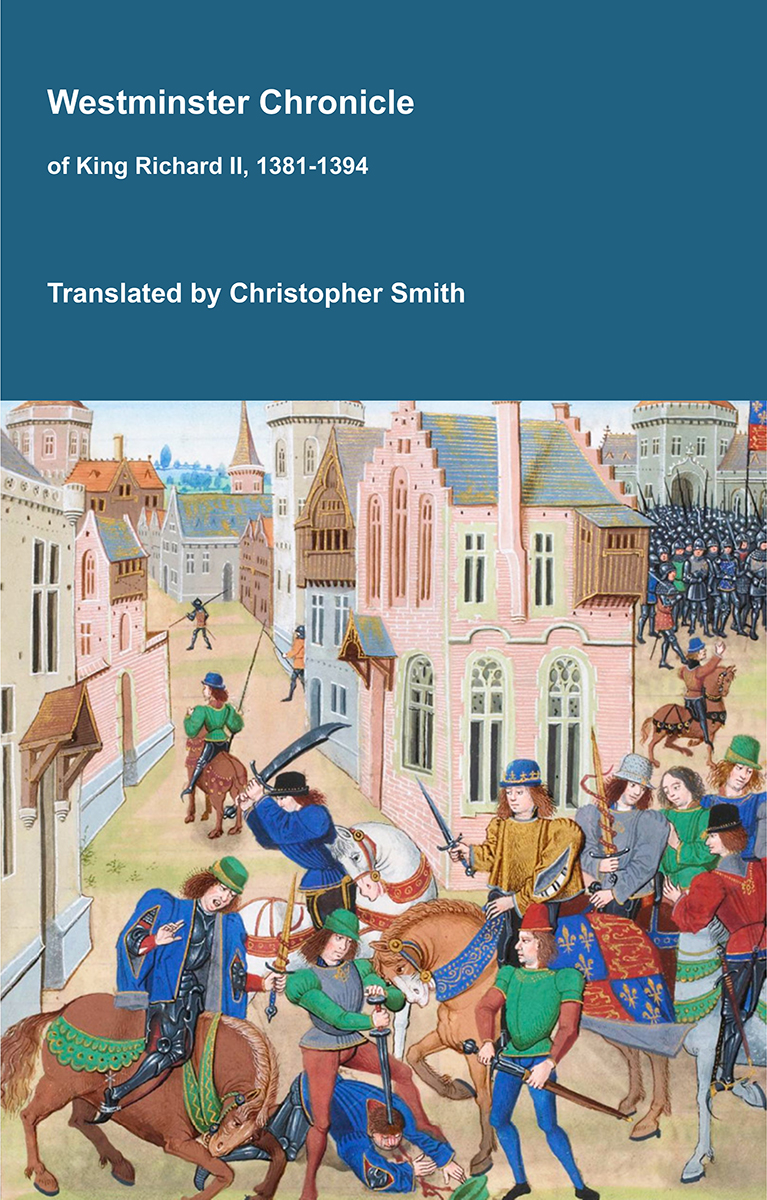 Westminster Chronicle. Therefore, on the twentieth day of December, the aforesaid duke [aged 25], making his journey with his Cheshiremen and Welshmen, numbering five thousand, towards Witney, was first met in a broad field by the earl of Arundel with his men. Seeing them, the aforesaid duke encouraged his men to battle, drew them up for the fight in distinct battle-lines, and raised the banners of the king and of Saint George. When the earl of Arundel and the other lords who were then present learned this, they sent to them, saying that they held with the king as his liege men, and that they did not wish to fight against them in any way unless they meant wholly to stand with the traitors of the king and kingdom, who had been lawfully appealed on certain charges of treason. But they answered and said that they had by no means come for the sake of fighting, but that, by the king’s command, for the protection of the person of the duke of Ireland, "know that we have ridden together with him. But we do not wish to give aid to the traitors of the king or kingdom, nor to provide them with help in anything." Therefore they immediately showed signs of peace, lowering their bows and their other arms. The lords then ordered them to return to their homes, and not to proceed any further with the aforesaid duke in any way, if they wished to save their lives. Sir Thomas Mortimer [aged 37]1, however, notwithstanding the negotiation, rushed upon a certain man called Molyneux [deceased], the chief counsellor of the aforesaid duke, and immediately killed him.
Then the other lords came to the said place with their companies of armed men, those who had been farther away from that place than the rest, arranging themselves as though they were about to enter into mortal combat. The duke, therefore, astonished at this sight, and perceiving that his men had been defeated, took flight and came to the bridge called Radcot Bridge, which he found broken. Therefore, on horseback, he entered the River Thames, and having swum across the channel, vanished from their sight. In that deep water some of his men were drowned, and very many there, near the river-bed, were also trampled down in the marshes by those pursuing the aforesaid duke. The rest, having lost their arms and their horses, returned sorrowfully to their own homes. All the baggage and equipment of the aforesaid duke was brought to the lords. The duke of Ireland, having thus escaped from the hands of the lords, went to the king in the clothing of a groom or servant. After having such conversation with him as he could, he quickly went to the castle of Queenborough. There, having at once secured a ship, he withdrew to the lands beyond the sea.
Igitur xx die Decembris dux prædictus iter faciens eum suis Cestrensibus et Walensibus numero quinque millia versus Wytteneyam ubi in lato campo primo cum suis comes Arundelliæ occurrebat quos videns dux prædietus animavit suos ad bellum distinetis aciebus ad pugnam erexitque vexilla regis et sancti Georgii. Quod comperiens comes Arundelliæ et cæteri domini qui tunc aderant miserunt ad illos dicentes se tenere cum rege sicuti suos ligios homines, nec velle contra illos ullatenus dimicare nisi voluerint omnino stare cum regis et regni proditoribus qui sunt super certis proditionibus legitime appellati. At illi respondentes dixerunt se nullatenus causa pugnæ venisse sed jussu regis gratia tuitionis personæ ducis Hiberniæ noverint nos seeum pariter cequitasse, proditoribus vero regis seu regni opem impendere nolle nec in aliquc juvamen præstare. Unde protinus ostenderunt signa pacis erectis areubus et eorum cæteris armamentis. Quos tunc jusserunt domini ad eorum larves redire nec cum duce prædicto debere ulterius procedere ullo modo si voluerint eorum vitam salvare. Dominus vero Thomas de Mortuo Mari non obstante tractatu irruit in quendam vocatam Molineres præcipuum consiliarium ducis prædicti et ipsum protinus interfecit.
Tunc vero venerunt ad dictum locum cæteri domini cum eorum cuneis armatorum qui ab eo loco cæteris remotiores fuerunt disponendo se tanquam inirent certamen mortale. Dux itaque ad hujusmodi spectaculum stupefactus perpendensque suos fore devictos fugam arripuit venitque ad pontem vocatum Rodecotebrygg, quem fractum invenit ; igitur eques flumen Thamysiæ intravit transnatatoque alveo ab oculis eorum evanuit. In illo enim gurgite quidam de suis erant submersi et quamplures ibi prope alveum in paludibus ab insequentibus ducem prædictum fuerant etiam conculcati. Cæteris vero armis amissis atque eorum equis dolentes ad propria redierunt. Supellectilia itaque omnia præfati ducis ad dominos sunt adducta. Dux itaque Hibernicus taliter a manibus dominorum evasus in habitu garcionis ad regem accessit, habitoque colloquio tali quali cum eo celeriter adiit castrum de Queneborgh. Ubi confestim navigio perquisito in partes transmarinas secessit.
Note 1. Thomas Mortimer, around 1350-1399, killed Thomas Molyneux, around 13380-1387. Walsingham, St Albans Chronicle: The Chronica Maiora: "At that time, there was a certain Thomas Molyneux, who prepared himself for battle, as not all the lords had yet gathered at that place, but only one, Henry, the Earl of Derby, son of the Duke of Lancaster. After fighting for some time, Henry, exhausted and despairing, entered the nearby river. Among the many present, Thomas de Mortimer, a knight, urged him either to come ashore or be pierced with arrows in the river without a doubt. 'If I come ashore,' said Thomas, 'will you spare my life?' 'I make no such promise,' replied the knight, 'but either come ashore or you will soon perish.' To this, Thomas responded, 'If that is the case, allow me to come ashore and fight you or any one of you, so that I may die as a man.' As he began to ascend, the knight grabbed him by the helmet and pulled it off his head. Immediately, drawing a dagger, the knight pierced Thomas."
Chronicle of Geoffrey le Baker of Swinbroke
Baker was a secular clerk from Swinbroke, now Swinbrook, an Oxfordshire village two miles east of Burford. His Chronicle describes the events of the period 1303-1356: Gaveston, Bannockburn, Boroughbridge, the murder of King Edward II, the Scottish Wars, Sluys, Crécy, the Black Death, Winchelsea and Poitiers. To quote Herbert Bruce 'it possesses a vigorous and characteristic style, and its value for particular events between 1303 and 1356 has been recognised by its editor and by subsequent writers'. The book provides remarkable detail about the events it describes. Baker's text has been augmented with hundreds of notes, including extracts from other contemporary chronicles, such as the Annales Londonienses, Annales Paulini, Murimuth, Lanercost, Avesbury, Guisborough and Froissart to enrich the reader's understanding. The translation takes as its source the 'Chronicon Galfridi le Baker de Swynebroke' published in 1889, edited by Edward Maunde Thompson.
Available at Amazon in eBook and Paperback format.
In 1397 Thomas Mortimer [aged 47] was charged with treason for having killed Thomas Molyneux at the Battle of Radcot Bridge. Ordered to surrender himself with three months he decided to flee to Scotland.
In 1399 Thomas Mortimer [aged 49] died.
Kings Wessex: Great x 11 Grand Son of King Edmund "Ironside" I of England
Kings Gwynedd: Great x 7 Grand Son of Owain "Great" King Gwynedd
Kings Seisyllwg: Great x 13 Grand Son of Hywel "Dda aka Good" King Seisyllwg King Deheubarth
Kings Powys: Great x 8 Grand Son of Maredudd ap Bleddyn King Powys
Kings England: Great x 6 Grand Son of King Henry "Curtmantle" II of England
Kings Scotland: Great x 9 Grand Son of King Malcolm III of Scotland
Kings France: Great x 12 Grand Son of Hugh I King of the Franks
Kings Duke Aquitaine: Great x 16 Grand Son of Ranulf I Duke Aquitaine
Kings Spain: Great x 8 Grand Son of Alfonso VII King Castile VII King Leon
Great x 4 Grandfather: Ralph Mortimer 
Great x 3 Grandfather: Roger Mortimer 1st Baron Mortimer of Wigmore Great Grandson of King John of England
Great x 4 Grandmother: Gwladus verch Llewelyn "Dark Eyed" Aberffraw Granddaughter of King John of England
Great x 2 Grandfather: Edmund Mortimer 2nd Baron Mortimer of Wigmore 2 x Great Grandson of King John of England
Great x 4 Grandfather: William de Braose 9th Baron Abergavenny 7th Baron Bramber  7 x Great Grandson of Maredudd ab Owain King Deheubarth King Powys King Gwynedd
Great x 3 Grandmother: Maud de Braose 7 x Great Granddaughter of Hugh I King of the Franks
Great x 4 Grandmother: Eva Marshal  6 x Great Granddaughter of Hugh I King of the Franks
Great x 1 Grandfather: Roger Mortimer 1st Earl March 3 x Great Grandson of King John of England
Great x 4 Grandfather: Enguerrand Ingleram Fiennes  9 x Great Grandson of King Edward "Elder" of the Anglo Saxons
Great x 3 Grandfather: William Fiennes 10 x Great Grandson of King Edward "Elder" of the Anglo Saxons
Great x 4 Grandmother: Isabel Provence 
Great x 2 Grandmother: Margaret Fiennes 4 x Great Granddaughter of King Henry "Curtmantle" II of England
Great x 4 Grandfather: John Beaumont  2 x Great Grandson of King Henry "Curtmantle" II of England
Great x 3 Grandmother: Blanche Beaumont 3 x Great Granddaughter of King Henry "Curtmantle" II of England
Great x 4 Grandmother: Jeanne Chateaudun
Grandfather: Edmund Mortimer 4 x Great Grandson of King John of England
Great x 4 Grandfather: Simon de Joinville
Great x 3 Grandfather: Geoffrey Geneville 1st Baron Geneville 8 x Great Grandson of Hugh I King of the Franks
Great x 4 Grandmother: Bearice of Auxonne  7 x Great Granddaughter of Hugh I King of the Franks
Great x 2 Grandfather: Piers Geneville 9 x Great Grandson of Hugh I King of the Franks
Great x 4 Grandfather: Gilbert Lacy  7 x Great Grandson of Maredudd ab Owain King Deheubarth King Powys King Gwynedd
Great x 3 Grandmother: Maud Lacy Baroness Geneville 8 x Great Granddaughter of Maredudd ab Owain King Deheubarth King Powys King Gwynedd
Great x 4 Grandmother: Isabel Bigod  7 x Great Granddaughter of Hugh I King of the Franks
Great x 1 Grandmother: Joan Geneville Baroness Mortimer 2nd Baroness Geneville 6 x Great Granddaughter of King David I of Scotland
Great x 4 Grandfather: Hugh XI of Lusignan VI Count of La Marche II Count Angoulême  6 x Great Grandson of Hugh I King of the Franks
Great x 3 Grandfather: Hugh XII of Lusignan VII Count of La Marche III Count Angoulême 4 x Great Grandson of King David I of Scotland
Great x 4 Grandmother: Yolande Capet Countess Lusignan, La Marche and Angoulême  3 x Great Granddaughter of King David I of Scotland
Great x 2 Grandmother: Jeanne Lusignan 5 x Great Granddaughter of King David I of Scotland
Great x 4 Grandfather: Raoul Fougères
Great x 3 Grandmother: Jeanne Fougères Countess Lusignan Countess La Marche and Angoulême
Father: Roger Mortimer 2nd Earl March 5 x Great Grandson of King Henry "Curtmantle" II of England
Great x 2 Grandfather: Gunselin Badlesmere 
Great x 1 Grandfather: Bartholomew Badlesmere 1st Baron Badlesmere
Great x 2 Grandmother: Joan Fitzbernard
Grandmother: Elizabeth Badlesmere Countess Northampton 4 x Great Granddaughter of King Henry "Curtmantle" II of England
Great x 4 Grandfather: Gilbert Clare 5th Earl Gloucester 4th Earl Hertford  2 x Great Grandson of King Henry I "Beauclerc" England
Great x 3 Grandfather: Richard de Clare 6th Earl Gloucester 5th Earl Hertford 3 x Great Grandson of King Henry I "Beauclerc" England
Great x 4 Grandmother: Isabel Marshal Countess Cornwall, Gloucester and Hertford 6 x Great Granddaughter of Hugh I King of the Franks
Great x 2 Grandfather: Thomas de Clare 4 x Great Grandson of King Henry I "Beauclerc" England
Great x 4 Grandfather: John Lacy Earl Lincoln  10 x Great Grandson of King Edward "Elder" of the Anglo Saxons
Great x 3 Grandmother: Maud Lacy Countess Gloucester and Hertford 4 x Great Granddaughter of King Henry I "Beauclerc" England
Great x 4 Grandmother: Margaret Quincy 3rd Countess Lincoln and Pembroke 3 x Great Granddaughter of King Henry I "Beauclerc" England
Great x 1 Grandmother: Margaret Clare Baroness Badlesmere 3 x Great Granddaughter of King Henry "Curtmantle" II of England
Great x 4 Grandfather: Maurice Fitzgerald 2nd Lord Offaly  5 x Great Grandson of Maredudd ab Owain King Deheubarth King Powys King Gwynedd
Great x 3 Grandfather: Maurice Fitzgerald 4th Lord Offaly 6 x Great Grandson of Maredudd ab Owain King Deheubarth King Powys King Gwynedd
Great x 4 Grandmother: Juliana Granville Baroness Offaly 
Great x 2 Grandmother: Juliana Fitzgerald 2 x Great Granddaughter of King Henry "Curtmantle" II of England
Great x 4 Grandfather: Stephen Longespée  Grandson of King Henry "Curtmantle" II of England
Great x 3 Grandmother: Emmeline Longespée Baroness Offaly Great Granddaughter of King Henry "Curtmantle" II of England
Great x 4 Grandmother: Emmeline Riddlesford
Thomas Mortimer 6 x Great Grandson of King Henry "Curtmantle" II of England